Topkapi Palace (Topkapı Sarayı) was the main residence and seat of government of the Ottoman sultans for some four centuries, and today it is one of the world's great palace museums. It stands on Sarayburnu, the green headland of Istanbul where the Golden Horn, the Bosphorus and the Sea of Marmara meet. Spread across a vast complex of courtyards, pavilions and gardens, it offers a rare glimpse into the daily life, ceremony and splendour of an imperial court, and it ranks among the essential sights of the city.
Topkapı Palace: Location, accommodation options and contact
The place's location on the map and nearby accommodation and hotel options are shown by Stay22. Cookies are used. Your consent is remembered on every page; you can turn it off at any time in the cookie settings.
Topkapı Palace history: from Mehmed the Conqueror to the first museum of the republican era
After the conquest of Constantinople in 1453, Mehmed II first held court in the Old Palace at Beyazıt and then built a New Palace on Sarayburnu. Official sources give 1460–1478 for the building campaign, although some historians place the first works in 1459 and the inner core in the mid-1460s; an inscription on the Imperial Gate records 1478. The complex was long called Saray-ı Cedîd-i Âmire, the New Imperial Palace, and took the name Topkapı, "Cannon Gate", from a seaside palace that burned down. Suleiman the Magnificent enlarged it, Mimar Sinan rebuilt the kitchens after the fire of 1574, and the court moved to Dolmabahçe in the nineteenth century. Topkapı became a museum on 3 April 1924. The palace was raised on the site of the ancient Byzantine acropolis, and even after the move to Dolmabahçe it kept the treasury, the library and much of its ceremonial role until it became a museum.
Topkapı Palace architecture and layout: four courtyards, three gates and a cult of privacy
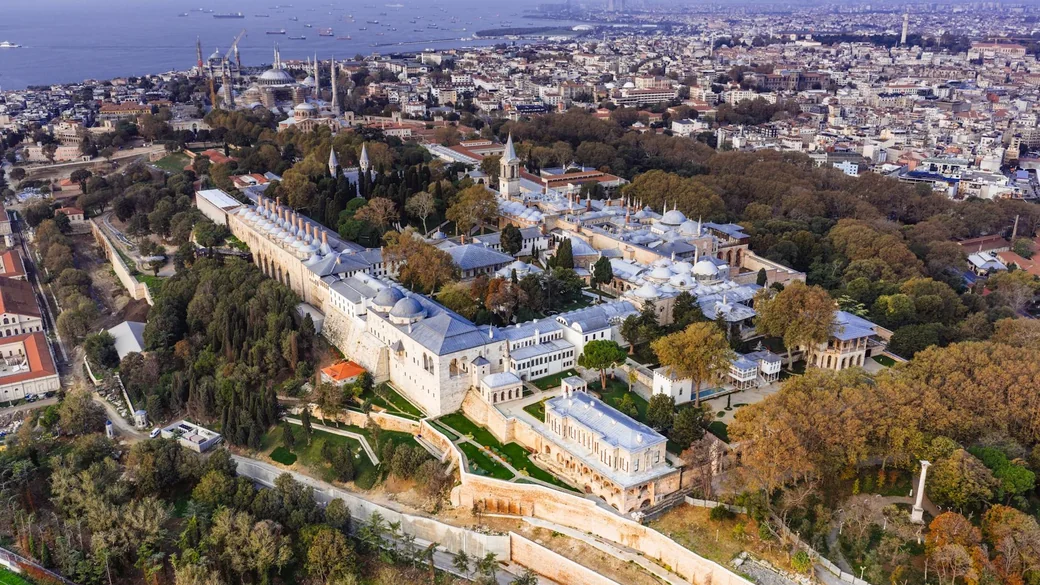
The palace is organised around four functions: the outer service zone (Birun), the Imperial Council (Divan), the palace school of the Inner Court (Enderun) and the private Harem. Four courtyards link them, separated by three great gates: the Imperial Gate, the Gate of Salutation and the Gate of Felicity. Most buildings are low, with lead-covered domes and thick walls, many of them up to three metres. Privacy and silence were codified by Mehmed II in 1477 and 1481, which is why grilled windows and hidden passages appear everywhere. Alaüddin (Acem Ali), Davud Ağa, Mimar Sinan and Sarkis Balyan all left their marks, from classical Ottoman to Baroque, Rococo and Empire styles. The layout is thought to have been influenced by Edirne Palace: the service buildings are of stone, mostly single-storey with tall domes, while the residential quarters combine stone and timber. Unlike European palaces built around one grand façade, this complex unfolds as a sequence of gates and courtyards, each more private than the one before; today its grounds cover about 350,000 square metres, not counting Gülhane Park.
Plan your visit to Topkapı Palace: opening hours, closed day, tickets and time needed
Topkapı Palace is closed on Tuesdays. According to the official site, the ticket office stops selling in the late afternoon while the museum stays open until the evening; seasonal changes are possible, so check before you travel. The palace also closes on the first day of the Ramadan Feast and on 1 January. Reserve four hours; three and a half to four and a half is typical with the Harem. According to the official calendar, the palace stays open on national holidays such as 23 April, 1 May, 19 May, 15 July, 30 August and 29 October.
First and Second Courtyards: Imperial Gate, Divan Hall, Tower of Justice and the palace kitchens
Step through the Imperial Gate into the First Courtyard, where the Byzantine church of Hagia Irene and the old Imperial Mint stand. The Gate of Salutation opens onto the Divan Courtyard, the administrative core. Here the Imperial Council met under the dome of the Kubbealtı, and the Tower of Justice rises behind it. The kitchens, rebuilt by Sinan after 1574, are ten domed buildings that once fed about 4,000 people with a staff of more than 800; today they hold a Chinese porcelain collection of around 10,700 pieces, one of the finest in the world. Do not miss the armoury, with about 400 weapons, and the Şerbethane (the sherbet pantry). A gilded latticed window above the council chamber, reached from the Tower of Justice, let the sultan follow the deliberations without being seen. The Ottomans used Hagia Irene as a storehouse and imperial armoury.
The Imperial Treasury at Topkapı: Spoonmaker's Diamond, Topkapı Dagger and golden thrones
The Treasury occupies the Conqueror's Pavilion, one of the oldest buildings in the palace, dating from around 1460. Its four rooms show jewelled thrones, emerald-studded aigrettes, armour and gifts from foreign rulers. The Topkapı Dagger, with three large emeralds on its hilt, was ordered in 1747 by Mahmud I as a present for Nader Shah of Persia, but the shah was killed before it left the empire; the 1964 film Topkapi turned it into a world-famous heist target. You will also see two solid-gold candlesticks of 48 kilograms each, set with 6,666 diamonds, and the Spoonmaker's Diamond (Kaşıkçı Elması), about 86 carats and ringed by 49 diamonds. Photography is not permitted inside, and corridors are narrow, so visit early.
Sacred Relics Chamber at Topkapı: the Prophet's Mantle and the tradition of Quran recitation
The Sacred Relics are housed in the Privy Chamber, today called the Hırka-i Saadet Dairesi. Selim I brought them to Istanbul after conquering Egypt in 1517. The collection includes the Prophet Muhammad's mantle, his banner, a fragment of a tooth, hairs of his beard, a letter, a sword, a bow and his footprint; objects attributed to earlier prophets and the first caliphs are also displayed. The mantle itself rests in a golden shrine and cannot be seen. Hafiz reciters read the Quran in rotation inside the chamber, a custom said to date back to Selim I, although accounts say it was interrupted in the twentieth century and later resumed. Photography is strictly forbidden; dress modestly and stay quiet.
The Harem at Topkapı Palace: private apartments, the Golden Road and newly opened rooms
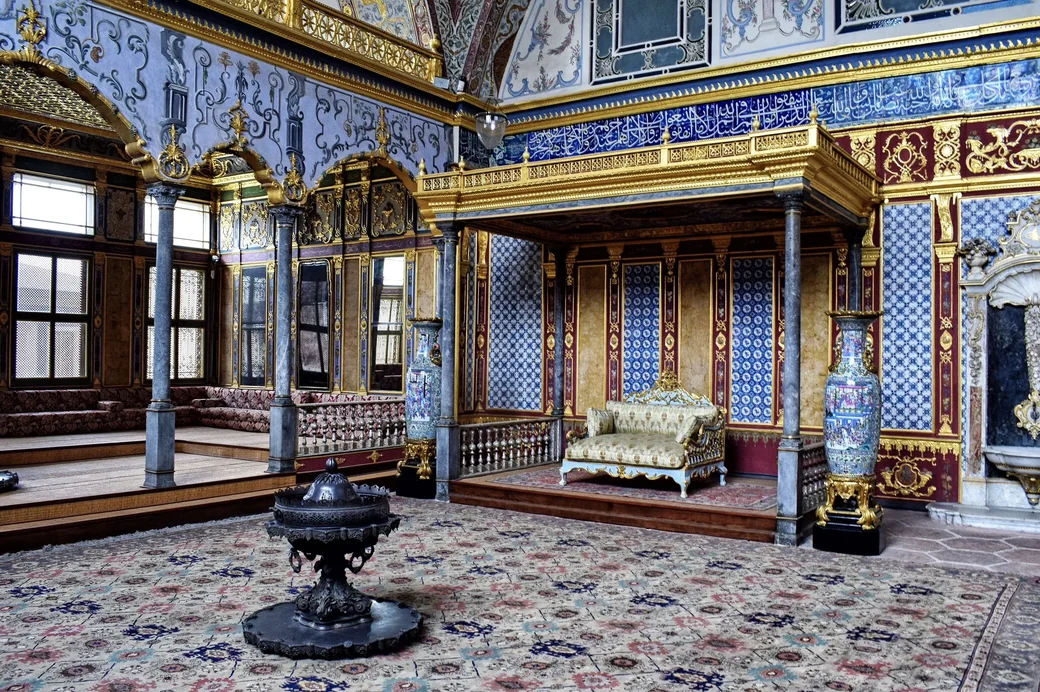
Harem means "forbidden". Behind these walls lived the sultan's mother, the Valide Sultan, his consorts, concubines, children and the eunuchs who guarded them; the complex is said to have more than 400 rooms, though only a few are open. Follow the Courtyard of the Eunuchs, the Golden Road, the Queen Mother's apartments and the Imperial Hall with its great dome. Murad III's Privy Chamber, attributed to Sinan, is the oldest room that kept its decoration of İznik tiles.Restoration has opened new areas in stages: the Concubines' Courtyard with its bath, the Kuşhane kitchen, the Karaağalar Ward, a tile gallery in the Mabeyn passage and the Courtyard of the Consorts and Concubines, which adds about 20 minutes to the visit. Look for the door hidden behind a mirror in the Imperial Hall, which gave the sultan a safe passage; the gilded grille in the sultan's bath, said to guard the bather against assassination attempts; and the wall fountain in Murad III's chamber, meant to mask conversations from eavesdroppers.
Third and Fourth Courtyards: Gate of Felicity, Audience Chamber, Library and Bosphorus terraces
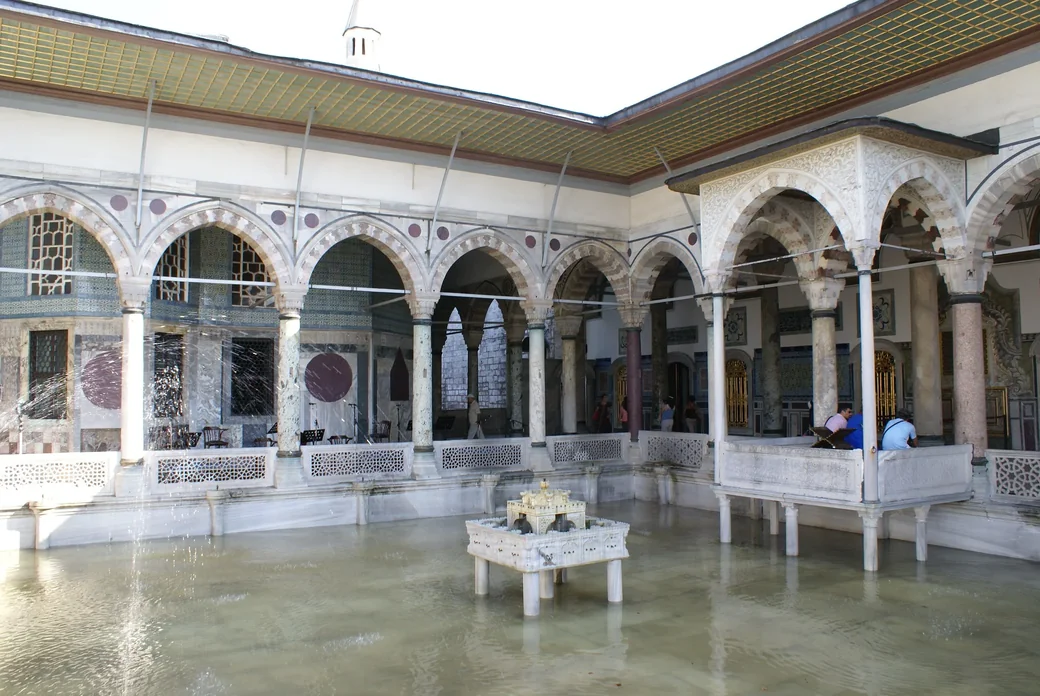
Beyond the Gate of Felicity, no one entered without the sultan's permission. The Audience Chamber, ringed by 22 columns, led to the Library of Ahmed III, built in 1719 in the shape of a Greek cross and decorated with İznik tiles. In the Imperial Wardrobe, about 2,500 garments and caftans trace Ottoman taste in silk. The Fourth Courtyard is the sultan's private garden: the Revan Kiosk (1635–36) and the Baghdad Kiosk (1638–39) celebrate victories in the East, the Iftar Pavilion sits above the Golden Horn, and the Mecidiye Kiosk, designed by Sarkis Balyan in 1840, was the last great addition. The terraces open onto the Bosphorus, the Golden Horn and the Marmara. Alongside these collections, the museum holds Ottoman miniatures and manuscripts and an archive of some 300,000 documents.
Legends and rumours of Topkapı Palace: the Spoonmaker's Diamond, the Executioner's Fountain and ghosts
Many tales clinging to Topkapı are tradition rather than record, so here they are marked as such. According to legend, the Spoonmaker's Diamond was found on a rubbish heap and sold by a peddler for three spoons, which supposedly explains its name. Rumour has it that it once belonged to Napoleon's mother, although historians treat that as fanciful; the more plausible trail runs through a French officer named Pigot and Tepedelenli Ali Pasha. The Executioner's Fountain is said to be where the headsman washed his hands and sword, though historians doubt this, and folk belief claims its water is cursed. Rumour also whispers of weeping concubines and babies' voices in the Harem corridors, which sceptics attribute to creaking timber. It is also said that the halberdiers let their long locks fall over their faces while carrying firewood into the Harem.
Kösem Sultan and Harem intrigue at Topkapı: the only Valide Sultan ever killed
Kösem Sultan, regent for her sons and then her grandson, was the most powerful woman in the Harem. On 2 September 1651 she was killed in a struggle with her daughter-in-law Turhan Sultan, and she remains the only Valide Sultan in Ottoman history to be murdered. Later accounts say that she hid in a cupboard or hidden rooms, was dragged to the Kuşhane gate, which is today the Harem exit, and was strangled with a curtain cord; the details differ between sources. An unverified rumour adds that servants lit candles on the anniversary of the night. The same era saw princes confined in the Kafes, "the cage", a system meant to prevent succession wars after the earlier practice of killing brothers.
Firsts and surprising facts about Topkapı Palace: pharmacy, sign language and 3-metre walls
Topkapı was the first museum of the republican era, opened on 3 April 1924. The first court pharmacy was created under Mehmed II, and the Tower of the Head Physician, the oldest building of the Fourth Courtyard, once held medicines. Because silence was the rule in the inner courts, deaf servants served close to the sultan, and sign language is said to have become almost a second official language at court; Ali Ufkî Bey, who lived in the palace for years, described how long-serving deaf servants mastered it. Walls up to three metres thick are part of the palace's solid, fortress-like character. As part of the Historic Areas of Istanbul, inscribed by UNESCO in 1985, the palace is also one of the most visited monuments in the city.
How to get to Topkapı Palace: T1 tram, Marmaray, ferries and parking advice
Take the T1 tram to Sultanahmet, the stop closest to the Imperial Gate, or to Gülhane, one stop towards Kabataş; each is a short walk to the entrance. From the Asian side, use Marmaray to Sirkeci and either ride the T1 one stop or walk 10 to 15 minutes through Gülhane Park. From Taksim, take the F1 funicular to Kabataş, then the T1. From Cevizlibağ, where the Metrobüs stops, change to the T1 as well. Ferries to Eminönü leave you about 20 minutes on foot from the gate. Driving is discouraged because Sultanahmet is mostly closed to traffic; if you must come by car, use a car park in Eminönü or Sirkeci.
To avoid crowds, arrive at opening on a Wednesday or Thursday, go first to the Third Courtyard for the Treasury and Sacred Relics, then visit the Harem, and leave the kitchens and gardens for later. Weekends and holidays are far busier. For photographs, the Fourth Courtyard terraces beside the Baghdad Kiosk and the Sofa Mosque give Bosphorus, Golden Horn and Marmara views. Access is partial: the main courtyards, armoury, wardrobe, Treasury, Relics and Harem can be visited by wheelchair, but some buildings have steps, so ask staff. Audio guides are offered in several languages; licensed guides wait at the gate. For a break, the Konyalı restaurant in the Fourth Courtyard, known for its Bosphorus views, is a familiar stop, although services can change, so check on site.
Do's and don'ts at Topkapı Palace: etiquette, dress code and rules to know
Do buy tickets online, keep your combined ticket for the day, and arrive early for the Harem. Do dress modestly and speak quietly in the Sacred Relics chamber. Do not take photographs in the Relics chamber, the Treasury or other exhibition halls where signs forbid it, and do not use flash. Do not smoke on the grounds, and do not bring weapons: they are banned for everyone. Large bags may be restricted at the gate, and some sources mention restrictions on strollers inside. Wear comfortable shoes for the cobblestones and carry water. Respect the guards and signs; many rooms are small, so give others space, and do not touch the exhibits or lean on historic walls.
Nearby attractions: combine Topkapı Palace with Hagia Sophia, the Blue Mosque and Gülhane Park
Topkapı sits inside Istanbul's historic peninsula, so many highlights lie within walking distance. The Istanbul Archaeology Museums and Gülhane Park, the old imperial rose garden, are right beside the palace. Hagia Sophia, the Sultan Ahmed (Blue) Mosque, the Hippodrome and the Basilica Cistern are roughly five to fifteen minutes away on foot. The Fountain of Ahmed III stands in the square outside the Imperial Gate, and the Spice Bazaar and Grand Bazaar are a tram ride or a longer walk away. Plan the palace for the morning and the other sights for the afternoon.
Topkapı Palace: Visitor Tips
Arrive at opening on a weekday and head straight for the Third Courtyard, where the Sacred Relics and the Imperial Treasury draw the longest queues later in the day. Wear comfortable shoes: the courtyards are large and paved with cobblestones. Photography is allowed outdoors but not inside the Sacred Relics chamber or most exhibition halls. Buy tickets on the official website to skip the box-office line, remember that the palace is closed on Tuesdays, and keep your combined ticket for the whole day because it covers the Harem and Hagia Irene as well.
Topkapı Palace: Best Time to Visit
Weekday mornings at opening (never Tuesday, when it is closed); spring and early autumn for mild weather; late-afternoon light on the terraces.
Topkapı Palace: Admission Fees
Combined – Palace, Harem and Hagia Irene
One ticket for the palace museum, the Harem (the private quarters of the sultan's family) and Hagia Irene (the Byzantine church in the first courtyard); valid for one day. The palace section is included in this combined ticket.
TRY 2,750
Harem only
Separate ticket for the Harem (the private quarters of the sultan's family) inside the palace grounds.
TRY 1,050
Hagia Irene only
Separate ticket for Hagia Irene, the Byzantine church in the palace's first courtyard.
TRY 1,050
Foreign students aged 12–25 (ISIC card)
Reduced rate for foreign students; a physical International Student Identity Card (ISIC) must be shown.
TRY 500
Children up to 6 (free)
Free entry for children aged 6 and under; proof of age may be requested.
Free
Quick Info
4h
easy
Topkapı Palace: Getting There
The easiest way to reach Topkapı Palace is the T1 tram (Kabataş–Bağcılar). Get off at Sultanahmet, the stop closest to the Imperial Gate, or at Gülhane, one stop towards Kabataş; both are a short walk away. If you come from the Asian side, take Marmaray to Sirkeci, then either ride the T1 one stop or walk 10 to 15 minutes through Gülhane Park. From Taksim, take the F1 funicular down to Kabataş and change to the T1 tram. Ferries from Üsküdar or Kadıköy land at Eminönü, from where the tram or a 20-minute walk brings you to the gate. Driving is not recommended because the Sultanahmet area is mostly closed to traffic.
Nearby stops & parking
Closest stops: Sultanahmet and Gülhane (T1 tram) and Sirkeci (Marmaray and T1). There is no practical parking beside the palace; if you must drive, use a car park in the Eminönü or Sirkeci area and continue on foot or by tram. Taxis can drop you at the Sultanahmet side of the Imperial Gate, but traffic around the old city is heavy, so rail is faster.
Topkapı Palace: Dress Code & Etiquette
Topkapı is a museum, so there is no strict dress code, but the Sacred Relics chamber is a place of devotion: dress modestly with covered shoulders and knees, keep your voice low and do not take photographs. Smoking is not allowed on the grounds, and weapons are forbidden at the entrance for everyone, including security personnel. Large bags may be restricted at the gate, so travel light.