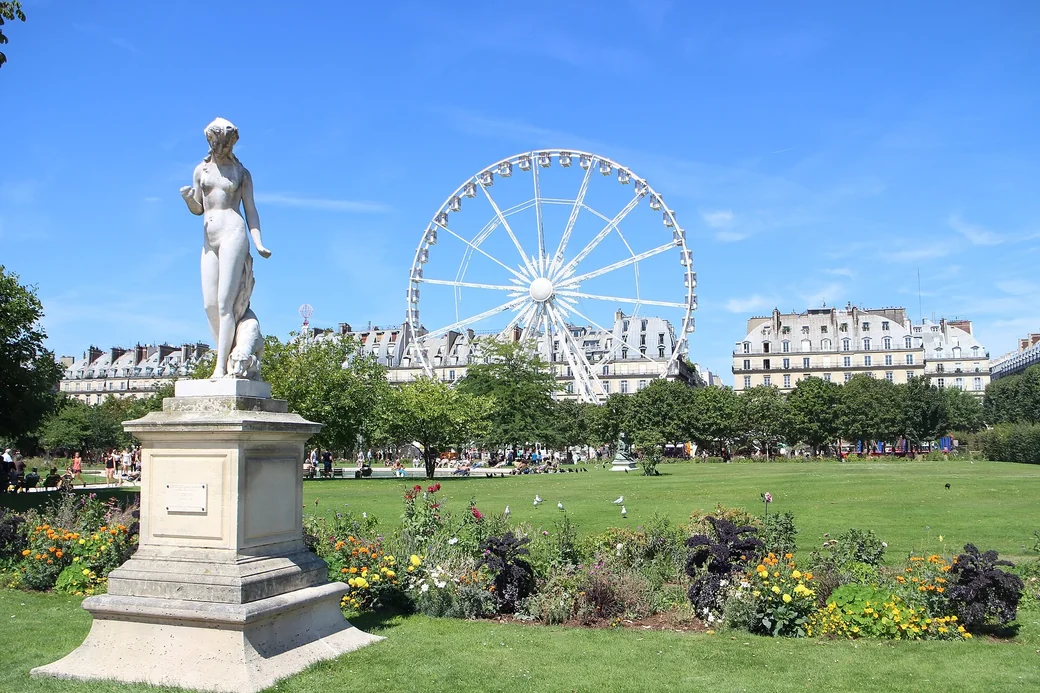
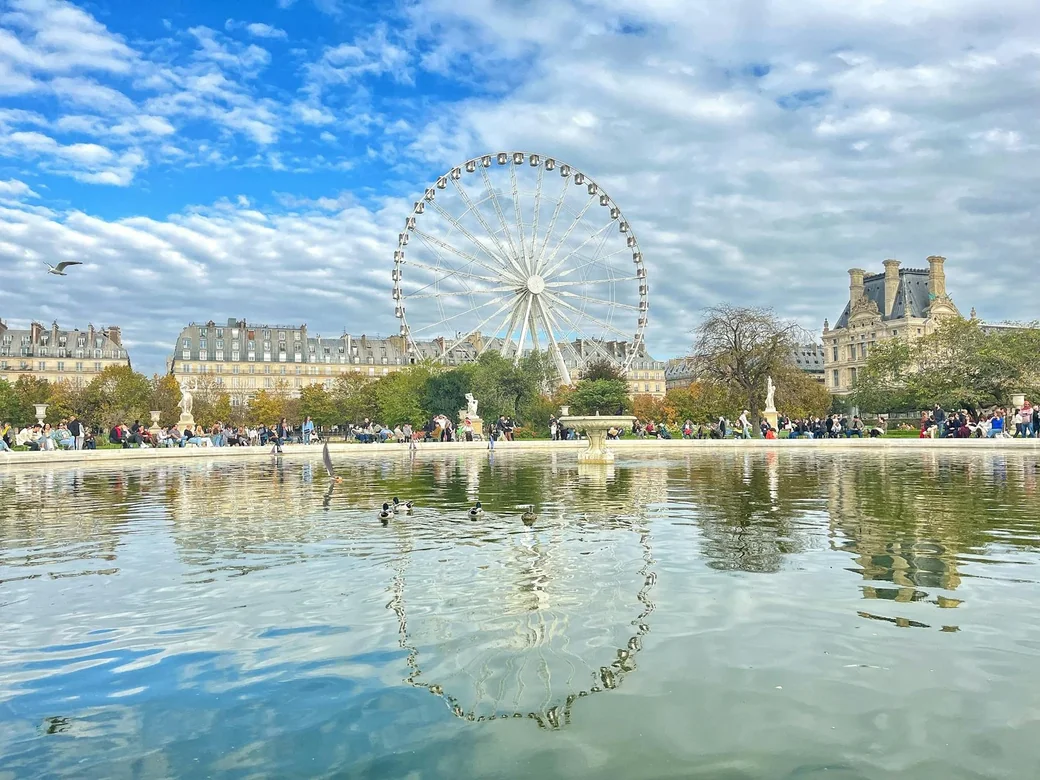
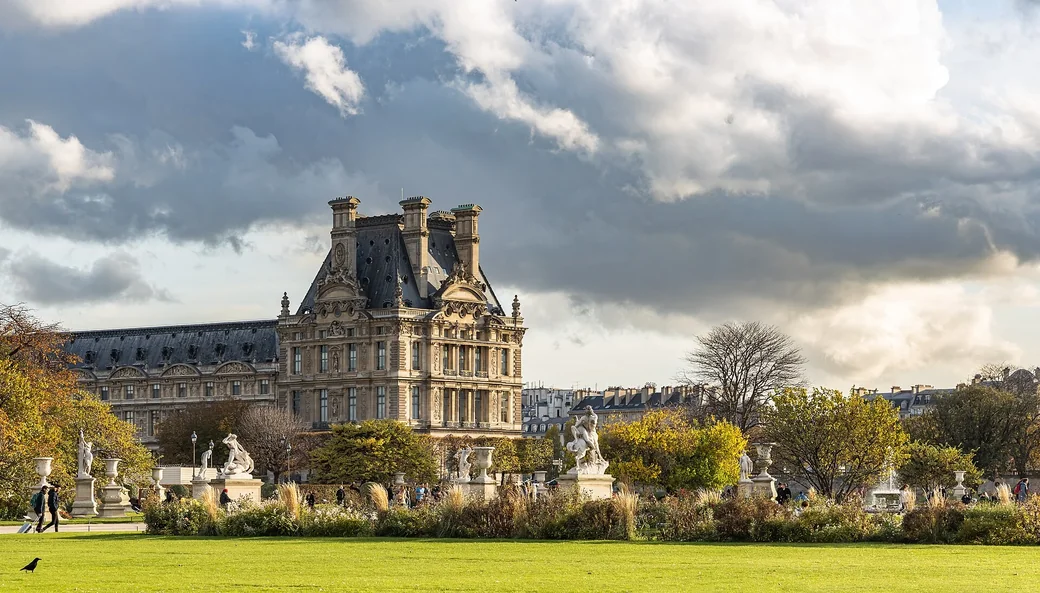
The Tuileries Garden (Jardin des Tuileries) is a large formal garden in the heart of Paris, laid out beside the Louvre on the Right Bank of the Seine. Created for a royal palace and now a free public park, it is loved for its classical French design and its calm atmosphere in the middle of the city. With its broad walks, lawns and shady corners, it is one of the most popular places in Paris to stroll or simply sit and watch everyday Parisian life go by.
Tuileries Garden: Location, accommodation options and contact
Place de la Concorde / Rue de Rivoli, 75001 Paris, France
The place's location on the map and nearby accommodation and hotel options are shown by Stay22. Cookies are used. Your consent is remembered on every page; you can turn it off at any time in the cookie settings.
The Tuileries Garden began life as a private royal retreat rather than a public space. In 1564, Catherine de' Medici, the widowed queen and regent of France, commissioned it as the garden of her ambitious new residence, the Tuileries Palace, built just west of the old Louvre fortress on land named for the tile kilns, or tuileries, that had once stood there. For roughly a century the garden belonged to the French court, closed to ordinary Parisians and shaped to suit the tastes of successive monarchs who lived beside it. At the time, this land lay just outside the walls of medieval Paris.
The Tuileries Palace itself no longer stands. It was gutted by fire during the violent final days of the Paris Commune in 1871 and its ruined shell was demolished a few years later, leaving only a gap in the Louvre's long courtyard where it once stood. The garden, remarkably, survived that destruction intact and has remained one of the defining green spaces of central Paris ever since, carrying the palace's name and memory long after the building itself disappeared.
André Le Nôtre's Classical Vision
The garden most visitors walk through today owes its form to a single major redesign. In 1664, André Le Nôtre, the royal gardener who would soon go on to create the gardens of Versailles, was commissioned to rework the Tuileries in the formal French classical style he was perfecting at the time. Le Nôtre replaced the garden's earlier, looser layout with strict geometric order: a dominant central axis, symmetrical parterres (ornamental flowerbeds) of clipped hedging, long gravel allées (formal garden avenues) radiating outward, and carefully engineered sightlines that draw the eye toward distant landmarks.
That sense of calculated grandeur, balance and perspective is exactly what later made Le Nôtre famous across Europe and shaped the look of countless gardens that followed his example. Walking the Tuileries today, along its ruler-straight central promenade and past its mirror-image flowerbeds, visitors are experiencing essentially the same disciplined vision Le Nôtre imposed more than three and a half centuries ago, one of the clearest surviving examples of French classical garden design anywhere in Paris.
One of France's First Public Gardens
Just three years after Le Nôtre's redesign began, in 1667, the Tuileries took a step that few royal gardens of its era attempted: it opened its gates to the general public. At a time when most royal grounds remained strictly private, reserved for the court and its guests, allowing ordinary Parisians to walk the same avenues as the monarchy was a notably early and significant gesture of openness.
That decision helped set the Tuileries on a very different path from other former royal gardens across Europe, many of which remained closed for generations longer. It has functioned as a genuinely public park for well over three hundred years now, through revolutions, empires and republics, making it one of the oldest continuously public gardens in France and a living link between the country's monarchical past and its present civic life.
25 Hectares Between the Louvre and Concorde
The Tuileries Garden covers approximately 25.5 hectares in the heart of the 1st arrondissement (city district), making it one of the largest green spaces in central Paris. It stretches along the Right Bank of the Seine in a long, elegant band, bounded by the Louvre and its museum wings to the east and by the wide, open expanse of Place de la Concorde to the west, with the busy shops and arcades of the Rue de Rivoli running along its northern edge.
Because of this position, the garden functions as a natural, green corridor connecting two of the city's most important landmarks, and many visitors end up walking through it simply as a pleasant route between the Louvre and the Champs-Élysées rather than as a planned destination in its own right. Its scale means a brisk crossing takes only ten or fifteen minutes, while a slower, more thorough visit exploring the side paths and terraces can easily fill an hour or two. Walking its full length is a small history lesson in itself, following a line that has anchored the heart of Paris for more than four and a half centuries.
The Grand Bassins and the Grande Allée
Two large ornamental ponds anchor the garden's classical layout. The round Grand Bassin Rond sits closer to the Louvre end, while the octagonal Grand Bassin Octogonal lies near Place de la Concorde, and both are ringed with the garden's characteristic green metal chairs, ideal for sitting beside the water. On the octagonal pond, children push small, brightly coloured sailboats across the water with wooden sticks, a tradition that remains one of the most charming everyday sights in the garden.
Running between the major features is the Grande Allée, the broad, tree-lined central promenade that forms the spine of the entire garden and provides its most dramatic long view, stretching in an almost unbroken line from the Louvre's Arc de Triomphe du Carrousel all the way to the obelisk on Place de la Concorde and on toward the Arc de Triomphe in the distance.
The Arc de Triomphe du Carrousel
At the eastern end of the garden, right where it meets the Louvre's courtyard, stands the Arc de Triomphe du Carrousel, a compact triumphal arch built in the early nineteenth century to celebrate Napoleon's military victories. Though far smaller than its more famous namesake at the top of the Champs-Élysées, it was designed with the same triumphal-arch tradition in mind and originally supported a set of bronze horses taken from Venice, which were returned to Venice in 1815 and replaced in 1828 by a new bronze chariot group by the sculptor François Joseph Bosio, topped by an allegorical figure of Peace. It was commissioned by Napoleon himself, who also intended it as a ceremonial gateway framing the courtyard between the palace wings.
The arch marks a natural threshold between the museum grounds of the Louvre and the open expanse of the Tuileries Garden, and standing beneath it offers one of the best framed views back toward the glass pyramid and the Louvre's palace wings on one side, and forward down the length of the Grande Allée on the other.
An Open-Air Sculpture Gallery
Scattered along the Tuileries' paths, terraces and lawns is a substantial outdoor sculpture collection that turns an ordinary walk through the garden into something closer to a stroll through an open-air museum. Works by Auguste Rodin and Aristide Maillol stand among the trees alongside pieces by other sculptors from the nineteenth and twentieth centuries, often positioned so that visitors come across them unexpectedly while walking a side path or rounding a clipped hedge.
Many of the older statues visible in the garden today are, in fact, careful copies rather than the original works. To protect fragile marble and bronze pieces from decades of weather, wind-blown grit and pollution, the most delicate originals have been moved indoors to the Louvre's own collections for long-term conservation, with faithful replicas left outside so the overall composition and character of the garden's sculpture displays remain intact for visitors to enjoy.
Musée de l'Orangerie and the Jeu de Paume
Two notable museums sit within the Tuileries' grounds, giving visitors an easy way to combine outdoor scenery with gallery time. At the western end, right beside Place de la Concorde, the Musée de l'Orangerie occupies a former greenhouse and houses Claude Monet's monumental Water Lilies paintings in two purpose-built oval rooms, alongside the notable Walter-Guillaume collection of early twentieth-century art.
At the garden's northwest corner, near the Rue de Rivoli, the Jeu de Paume gallery is dedicated to modern and contemporary photography and image-based art, hosted in a building put up in the early 1860s under Napoleon III as a court for jeu de paume (the “palm game,” an early form of tennis), the game that gave the gallery its name. Both institutions sit close enough to the garden's paths that a visitor can easily move from greenery to gallery and back again within the same afternoon.
Best Time to Visit and How to Avoid the Crowds
Like most of central Paris's major sights, the Tuileries Garden is at its most peaceful in the early morning, particularly on weekdays, when the gravel paths are quiet, the light is soft and low, and the ponds are often glassy and still before the day's foot traffic picks up. Arriving shortly after opening is an easy way to enjoy the formal parterres (ornamental flowerbeds) and long allées (formal garden avenues) almost to yourself.
Weekends and the middle of sunny summer afternoons naturally draw the largest crowds, as do the days around major exhibitions at the Louvre or the Orangerie, since many visitors pass through the garden on their way between the two. Spring and autumn tend to offer the most comfortable balance of mild weather and moderate visitor numbers, while a late-afternoon visit in the golden hour before sunset rewards patient walkers with particularly warm, flattering light across the ponds and statues.
Where to Capture the Best Views
The Tuileries rewards photographers with its rigorous symmetry. Standing at the centre of the Grande Allée and looking straight down its length produces one of the most classic Paris compositions, with clipped trees marching off in perfect rows toward a distant landmark. The two ponds offer another favourite angle, especially in still morning light, when the surrounding statues, trees and sky reflect cleanly across the water.
Toward the western end, the view from the terraces near Place de la Concorde looks back across the garden's central axis and out toward the obelisk on the square, with the Champs-Élysées and the Arc de Triomphe lined up beyond it along the same historic axis. Wide, empty gravel paths in the early morning also make for atmospheric, nearly deserted shots that are much harder to capture later in the day.
Metro Stations at Both Ends of the Garden
Getting to the Tuileries Garden by metro is simple, since two stations sit almost at its opposite ends. Metro Tuileries, served by Line 1, opens directly onto the garden's eastern half close to the Louvre, making it a natural stop for anyone combining a museum visit with a walk through the grounds. At the far western end, Metro Concorde is served by three lines, 1, 8 and 12, putting the garden within easy reach from most parts of the city without needing to change lines more than once.
Because the garden runs in a long strip between these two stations, visitors can enter at one end and simply walk through to exit at the other, making it an efficient and scenic shortcut as much as a destination, particularly convenient for anyone travelling between the Louvre and the Champs-Élysées or the Madeleine district.
Attractions Just Steps Away
Few places in Paris pack as many major landmarks within such easy walking distance. The Louvre and its glass pyramid sit right at the garden's eastern edge, while the Musée de l'Orangerie and its Monet water lily rooms occupy the western corner nearest Place de la Concorde, itself one of the largest and most historic public squares in the city, home to the Luxor obelisk and framed views down the Champs-Élysées.
Along the garden's northern boundary, the arcaded shops and cafés of the Rue de Rivoli offer everything from souvenir stalls to well-known department stores, making it an easy place to pause for refreshments before or after a walk through the grounds. Because so many of these sights sit within a few minutes of one another, the Tuileries works naturally as the connecting piece of a longer half-day itinerary through this part of central Paris.
Level Paths for All Visitors
The Tuileries Garden is generally well suited to visitors using wheelchairs or those who simply prefer flatter, easier walking. Most of the main pathways are flat gravel or paved surfaces, and level, no-step access is available from all of the garden's principal entrances along the Rue de Rivoli, the Seine side, and the two end squares, so reaching the central allées (formal garden avenues) and both ponds does not require navigating stairs or steep slopes.
That said, some of the looser gravel sections, particularly around the ponds and side paths, can become softer and slower going for wheelchair users after heavy rain, so allowing a little extra time on wet days is worth planning for. Accessible restroom facilities are available on site, and service animals are welcome throughout the grounds.
Family Fun and Garden Etiquette
The Tuileries has long been a favourite spot for Parisian families. Children can enjoy a brightly coloured carousel shaded by trees, a set of trampolines near the Terrasse des Feuillants and a playground, while parents rest on the garden's famous green metal chairs and watch the toy sailboats glide across the Grand Bassin Octogonal. On weekdays, office workers from the surrounding district also come to eat lunch on the green chairs in the shade of the horse chestnut and lime trees, giving the garden its relaxed, everyday Parisian character.
A few simple courtesies help keep the garden pleasant for everyone. Cycling is not permitted on many of the pedestrian paths, some of the central lawns are roped off and meant to be admired rather than walked or picnicked on, and visitors are asked to take their litter with them to the bins provided. Following these light rules keeps the formal parterres (ornamental flowerbeds) and quiet corners in good condition for the millions of visitors who pass through every year.
Tuileries Garden: Visitor Tips
You can walk in from any of the main gates along the Rue de Rivoli, the Seine side or the two end squares, and cross the whole garden from the Louvre to Place de la Concorde in a single scenic stroll. Pull up one of the famous green metal chairs by a pond for a classic Parisian pause.
Tuileries Garden: Best Time to Visit
Early weekday mornings bring the softest light and calmest paths, especially by the ponds. Spring and autumn suit a long stroll, while summer evenings cast a golden glow over the main avenue.
Tuileries Garden: Admission Fees
Free admission
Free to enter and open to everyone; no ticket is needed.
Free
Quick Info
1h 30m
easy
Tuileries Garden: Getting There
The Tuileries Garden sits directly in central Paris and is easiest to reach on foot or by metro. It has no vehicle access or parking of its own, since it is a pedestrian garden, but taxis and rideshare drop-offs are simple along the Rue de Rivoli or around Place de la Concorde.
Nearby stops & parking
Metro Tuileries (Line 1) opens right onto the garden's eastern half near the Louvre, while Metro Concorde (Lines 1, 8 and 12) sits at the western end by Place de la Concorde. Both stations make it easy to enter from either end of the garden.
Tuileries Garden: Dress Code & Etiquette
There is no dress code at all, since the Tuileries is an open-air public garden rather than an indoor venue. Comfortable walking shoes are the main consideration, given the gravel paths, along with a hat or sunscreen in summer and a warm layer in winter, since much of a visit takes place outdoors.