Skip to contentSkip to navigation
Guide&Travel
Favorites (0)
Sign InSign up
Guide&Travel

In-depth city guides — compare destinations, plan your budget, and discover what's nearby. In 12 languages.

support@guideandtravel.com
Bulgaria

Explore

  • Cities
  • Places
  • Events & Key Dates

General Information

  • About Flights
  • About Car Rental
  • About Travel Insurance
  • About SIM Cards
  • About Visas

Tools

  • City Comparison
  • Packing List

Support

  • Help Center
  • Contact Us
  • FAQ

Company

  • About Us
  • Blog
  • Sponsorship

Subscribe to our Newsletter

Get travel tips, exclusive deals, and inspiration delivered to your inbox.

© 2026 GuideAndTravel. All rights reserved.

Privacy PolicyTerms of ServiceCookie PolicyImage Credits
Food & Drink — London
CitiesLondonFood & Drink

Food & Drink in London

Local cuisine, must-try dishes, signature restaurants, and the food culture you should know.

London has less a single local cuisine than a layered one. Working-class dishes from the old docks, the Jewish heritage of the East End, curry-house (a restaurant serving South Asian-style dishes shaped in London) traditions with South Asian roots, Caribbean kitchens in Brixton and Notting Hill and a newer wave of West African and global fine dining (elaborate, high-end restaurant cooking) all share the same streets. One walk can take you from a marble-topped pie shop to a market stall, a neighbourhood pub (a neighbourhood public house serving drinks and meals) and a tasting-menu room.

This page follows that story: dishes and drinks born in the city, protected regional products, historic addresses, markets and street food, café, tea and bakery habits, and the dietary questions visitors ask most. Local and foreign food words are explained in brackets, so you can read a menu without a dictionary.

A few things hold almost everywhere: kitchens close earlier than most visitors expect, neighbourhoods away from the big sights usually give better value, and opening hours, booking rules and menus change often, so check a venue’s own information before you set out.

Typical food & drink prices in London

Last updated: November 19, 2026.Prices are reviewed and refreshed at least once a month.

Average meal cost (per person)

Breakfast
£14
Lunch
£22
Dinner
£42

Common items

Breakfast

  • Full English Breakfast (eggs, bacon, sausage, beans)£13.50
  • Bacon Butty (bacon sandwich)£6.50
  • Salt Beef Bagel (cured beef, mustard, pickle)£8
  • Smoked Salmon and Scrambled Eggs (on toast)£12.50
  • Crumpets with Butter (toasted griddle cakes)£5.50

Lunch

  • Fish and Chips (battered fish with chips)£17.50
  • Pie and Mash (meat pie, mash, parsley sauce)£9.50
  • Ploughman's Lunch (cheese, bread, pickle)£13.50
  • Bangers and Mash (sausages, mash, onion gravy)£14.50
  • Chicken Tikka Masala (creamy spiced curry)£15

Dinner

  • Sunday Roast (roast beef, Yorkshire pudding, gravy)£22
  • Steak and Ale Pie (beef and beer pie)£17.50
  • Fish Pie (fish in sauce under mash)£19
  • Shepherd's Pie (minced lamb under mash)£16.50
  • Lamb Balti (spiced lamb curry)£16
  • Beef Wellington (beef fillet in pastry)£34

Snacks

  • Scotch Egg (egg wrapped in sausage meat)£4.50
  • Sausage Roll (sausage meat in pastry)£3.50
  • Cornish Pasty (pastry pie with beef and veg)£5.50
  • Jellied Eels (chilled eel in jelly)£5.50
  • Cheese Toastie (grilled cheese sandwich)£8
  • Meal Deal (sandwich, snack and drink)£4.50

Desserts

  • Sticky Toffee Pudding (date sponge with toffee sauce)£8.50
  • Cream Tea (scones, clotted cream, jam, tea)£12.50
  • Apple Crumble with Custard (baked apples, oat topping)£8
  • Eton Mess (strawberries, meringue, cream)£9

Other

  • Cup of Tea (black tea with milk)(drink)£3.20
  • Flat White (espresso with silky milk)(drink)£3.90
  • Pint of Lager (draught beer, large glass)(drink)£6.50
  • Pint of Cask Ale (traditional hand-pulled beer)(drink)£6.20
  • Glass of Wine (house red or white)(drink)£8.50
  • Gin and Tonic (classic London dry gin drink)(drink)£10

Approximate prices, updated periodically. Actual costs may vary.

Highlights

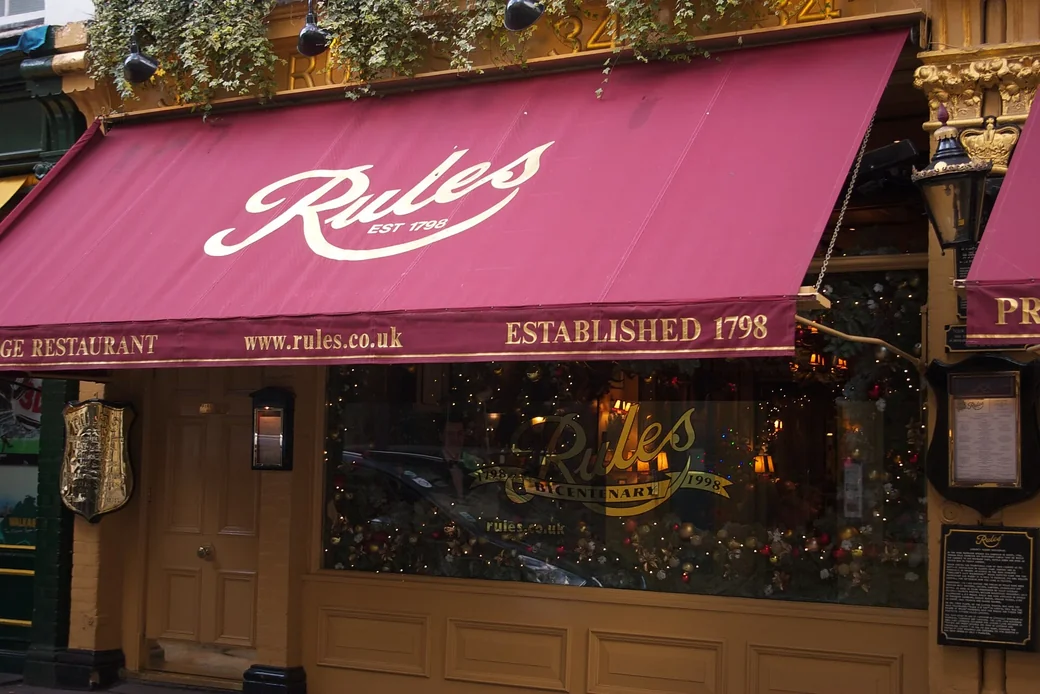
Rules, opened in 1798 on Maiden Lane in Covent Garden, is London's oldest restaurant, known for classic British game, oysters, pies and puddings.

Traditional British

Rules

4.6€€€
Directions

Rules opened on Maiden Lane in Covent Garden in 1798 as an oyster bar run by Thomas Rule, and describes itself as the oldest restaurant in London — a claim the seafood house Wiltons disputes. Only a handful of families have owned it across its two centuries.\n\nThe dining room has barely changed: red velvet banquettes (upholstered bench seating), dark panelling and walls crowded with paintings, drawings and cartoons. The menu stays firmly British, with game at its centre during the autumn and winter season, alongside steak and kidney pudding (a steamed suet pastry filled with beef and kidney) and classic puddings. Reserve ahead, especially for a weekend table. The nearest stations are Covent Garden (Piccadilly line) and Charing Cross (Bakerloo and Northern lines).

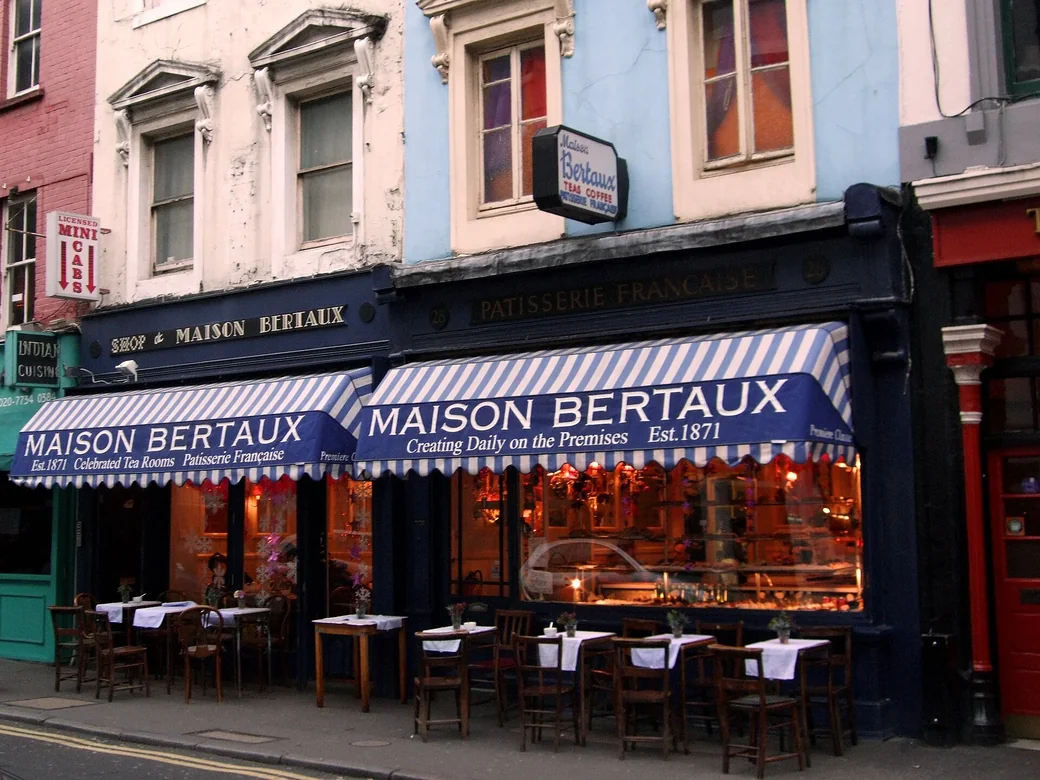
Maison Bertaux, founded in 1871 at 28 Greek Street in Soho, is London's oldest French patisserie (pastry shop), known for its cakes, eclairs and scones.

Bakery & Patisserie

Maison Bertaux

4.5€€
Directions

Maison Bertaux has been baking on Greek Street in Soho since 1871, which makes it the oldest patisserie in London. It was founded by a Frenchman who arrived from Paris in the aftermath of the Commune (the short-lived revolutionary government of Paris in 1871), and it has been managed since 1988 by the sisters Michele and Tania Wade.\n\nThe shop is tiny, the upstairs tea room tinier, and nothing matches: mismatched chairs, hand-written signs, an occasional art show on the walls. The counter carries mille-feuille (layered puff pastry), fruit tarts, éclairs, almond croissants and scones. Pay on the way out, and expect to be told which cakes came out best that morning. It is within walking distance of Tottenham Court Road (Central, Northern and Elizabeth lines) and Leicester Square (Piccadilly and Northern lines).

Bouchon Racine

Bistro & Brasserie

Bouchon Racine

4.8€€€
Directions

Bouchon Racine sits up a narrow staircase above the Three Compasses pub on Cowcross Street in Clerkenwell. Henry Harris opened it in 2022 and in June 2026 it was voted the best restaurant in the United Kingdom at the National Restaurant Awards, beating far grander and far more expensive rooms.\n\nThere is no theatre here: a handwritten menu, closely packed tables, and French bistro cooking done properly — chicken liver parfait, rabbit in mustard sauce, veal chop with Roquefort butter, crème caramel. The value is the point as much as the cooking, which is why reservations disappear weeks ahead.

Core by Clare Smyth

Modern British

Core by Clare Smyth

4.8€€€€
Directions

Core sits on a quiet stretch of Kensington Park Road in Notting Hill and holds three Michelin stars. Chef Clare Smyth built her reputation running a three-star kitchen in Chelsea before opening her own room here, and the cooking is unmistakably hers: British ingredients treated with absolute precision and very little decoration.\n\nThe signature dishes have become modern classics — a potato dressed with roe, a slow-cooked carrot served as a main course, a dessert built around apple. The dining room is warm rather than formal, and tables are released months ahead. Core opened in August 2017 at 92 Kensington Park Road. The nearest station is Notting Hill Gate (District, Circle and Central lines).

Plates

Fine Dining

Plates

4.8€€€
Directions

Plates opened on Old Street in 2024, run by the siblings Kirk and Keeley Haworth, and the following February it became the first entirely plant-based restaurant in the United Kingdom to win a Michelin star. The dining room is small and plainly finished, with an open kitchen along one side.\n\nKirk Haworth's cooking is classically trained and applies that discipline to vegetables: a barbecued maitake mushroom with black bean mole (a dark, spiced sauce of Mexican origin), house-laminated sourdough, a raw cacao gateau to finish. Most guests are not vegan, which is rather the point. Tables are released in batches and go quickly. Plates is at 320 Old Street, in a small building set around a courtyard. The nearest station is Old Street (Northern line).

The Ledbury

Modern British

The Ledbury

4.8€€€€
Directions

The Ledbury stands on a residential corner of Ledbury Road in Notting Hill and is one of only six restaurants in London holding three Michelin stars. Australian chef Brett Graham has run the kitchen since the restaurant opened in 2005, and his cooking is closely associated with game (wild-hunted meat such as venison and grouse) and with produce he sources himself.\n\nThe room is understated — pale walls, generous spacing, no theatre — which leaves the plates to do the talking. Menus change constantly with the season, service is unhurried, and reservations open well in advance and disappear quickly. Chef Brett Graham is also one of the people behind The Harwood Arms in Fulham. The nearest station is Westbourne Park (Circle and Hammersmith & City lines).

E Pellicci

Breakfast & Brunch

E Pellicci

4.8€
Directions

E Pellicci has stood on Bethnal Green Road since 1900 and has been run by the same Italian family throughout, having been founded by Priamo Pellicci after he moved to London from Tuscany. The frontage of chrome-lined glass panels and the marquetry interior are protected as a listed building (a legally protected historic building).\n\nThe menu is half East End café, half Italian home cooking: a full English breakfast (the traditional cooked British breakfast) served all day, bubble and squeak (pan-fried potato and cabbage), pasta with pesto, grilled chops and homemade puddings. What people remember longest is the welcome, which is loud, familiar and extended to everyone who walks in.

Ikoyi

West African

Ikoyi

4.7€€€€
Directions

Ikoyi was founded by Jeremy Chan and Iré Hassan-Odukale and moved in 2023 into a bare, concrete-and-timber room at 180 Strand. It holds two Michelin stars and in 2026 was named the world's best restaurant in its category by the American magazine Food & Wine.\n\nThe cooking takes West African spicing as its starting point and runs it through British produce and East Asian technique, which produces flavour combinations most guests have never met before. The signature smoked jollof rice (a spiced West African rice dish) with crab has become one of London's most talked-about dishes. Tasting menu only; book early. The restaurant sits on the corner of the Strand and Surrey Street, its interior was designed by the Danish architect David Thulstrup, and its name comes from the Lagos neighbourhood where co-founder Iré Hassan-Odukale was born. The nearest station is Temple (District and Circle lines).

Showing 8 of 30

What to Know Before You Go

Why London Food Culture Is Unlike Any Other City

London’s table is built from migration and trade, not one regional tradition. Dockworkers left pie and mash and fried fish; East End Jewish bakers and smokers gave the city the beigel (a dense ring of bread, boiled then baked) and cured salmon; the curry house (a restaurant serving a London-shaped repertoire of South Asian dishes) became a local institution; Caribbean communities brought jerk cooking (spice-rubbed grilled meat) to Brixton and Notting Hill; and West African, spice-led cooking has climbed into fine dining over the last twenty years. Every district tastes different, so the best way to eat in London is to move between neighbourhoods.

London Food History: Docks, Grand Hotels and Royal Warrants

Pie and mash grew up in the early nineteenth century, when large docks opened in East London and workers needed cheap, filling meals. Another thread runs through the court: the Royal Warrant (an official mark showing a firm supplies the royal household) helped Fortnum & Mason, founded in 1707, and Twinings build the image of luxury provisions, and Twinings shows a copy of its 1837 warrant in its Strand museum. Late-nineteenth-century hotels such as the Savoy and the Ritz brought continental haute cuisine (elaborate, high-end cooking) to the upper-class table. The Tudor kitchens at Hampton Court Palace tell the older story, and the landmark cookbooks are Hannah Glasse’s The Art of Cookery (1747), Eliza Acton’s Modern Cookery (1845) and Mrs Beeton’s Book of Household Management (1861), with Elizabeth David’s Mediterranean books reshaping home cooking later.

Traditional London Dishes: Pie and Mash, Eels, Fish and Chips

Pie and mash is a small minced-beef pie with mashed potato and liquor (a thin green parsley sauce, not a drink), eaten with fork and spoon in tiled, marble-topped shops. Jellied eels (eel pieces set in their own jelly and served cold) recall a Thames full of eels and are still sold beside the pies. Fish and chips is white fish in crisp batter with thick chips, mushy peas (mashed marrowfat peas), tartar sauce and malt vinegar. The salt beef beigel packs tender brined beef, mustard and pickled cucumber into a chewy beigel, a legacy of East End Jewish bakeries. The Sunday roast is roast meat with Yorkshire pudding (a puffed, baked batter cup), roast potatoes and gravy, horseradish with beef and mint sauce with lamb. Curry-house classics such as tikka masala (chicken in a creamy spiced tomato sauce), balti (a curry cooked and served in a small steel bowl) and vindaloo (a hot, tangy curry) were shaped in London, now joined by regional and fine-dining South Asian kitchens. Jellied eels also exist in a hot, stewed version.

London Drinks and Pairings: Gin, Porter, Pimm’s and Builder’s Tea

London dry gin is a style, not a place name: botanicals go in during distillation and nothing sweet is added afterwards, giving a clean, juniper-led taste. Porter (a dark, roasty beer, ancestor of modern stout) is, according to legend, named after the market porters and dock workers who drank it. Pimm’s Cup is a gin-based fruit-cup liqueur created in 1823 by James Pimm at his City oyster bar, served long with lemonade, cucumber, strawberries and mint. Builder’s tea is strong black tea with plenty of milk. Classic pairings: fish and chips with malt vinegar and lager, oysters with stout or dry white wine, curry with lager or mango lassi (a yoghurt drink), cheese with port, a scone with clotted cream (thick, spoonable cream) and jam, and Pimm’s with lemonade on a summer afternoon. Pimm’s is also the traditional drink of the Wimbledon tennis tournament and of summer outdoor events.

Protected Regional Foods: London Cure Smoked Salmon and More

London’s own protected food is London Cure smoked salmon, the first London product with PGI status (Protected Geographical Indication, a legal mark tying a food to its place). It must be made in the boroughs of Tower Hamlets, Hackney or Newham, cured and smoked entirely by hand with salt and oak smoke; the smoke seals in the taste rather than flavouring it, and the salmon used is itself protected. This style began in the East End’s Jewish community around 1900. London shops also sell protected foods from elsewhere: Stilton and West Country Cheddar (PDO, protected designation of origin), Cornish pasty and Melton Mowbray pork pie (PGI), Jersey Royal potatoes and Plymouth gin. London dry gin, by contrast, is a production style, not a protected name.

London Breakfast Culture, Meal Times and Late-Night Eating

Weekday breakfast is quick, but weekends belong to the full English (a fry-up of eggs, bacon, sausage, beans, mushrooms, tomato and toast, sometimes with black pudding, a blood sausage), served in cafés and caffs (simple neighbourhood cafés). The bacon bap (bacon in a soft roll) with ketchup or brown sauce (a tangy, spiced dark sauce) is the everyday classic; porridge and kippers (smoked herring) are rarer. Weekend brunch often needs a booking. Communities add their own mornings: beigels in the East End, ful (stewed fava beans) and hummus (chickpea paste) on Edgware Road, spread-style breakfasts on Green Lanes, paratha (flaky flatbread) and chai (spiced milk tea) in Southall. Roughly: breakfast in the early morning, lunch around midday, dinner in the early evening with last orders earlier than many visitors expect, afternoon tea (a mid-afternoon tea with sandwiches, scones and cakes) in the middle of the afternoon, Sunday roast from midday into the afternoon, and pre-theatre set menus in the early evening. Late at night Brick Lane’s beigel shops, Soho, Chinatown and kebab or fried-chicken shops stay open, but Sunday nights close early.

Types of London Restaurants: Pubs, Caffs, Chippies and Children’s Menus

The pub (a public house where you order and pay at the bar) is the neighbourhood’s social centre, and a gastropub adds restaurant-quality cooking. A caff is a modest café for breakfast and tea, a chippy a fish-and-chip shop, a pie and mash shop a tiled one-dish institution, a chophouse a grill in the old City style, and a carvery serves roast meat carved at a counter. Tea rooms specialise in afternoon tea, food halls gather stalls under one roof, supper clubs are small bookable meals in temporary spaces, and members’ clubs are private dining rooms. Children’s menus, high chairs and colouring sheets are standard in chains and family pubs, and pubs usually welcome children with adults until early evening; some formal restaurants limit young guests at night, and Rules does not admit under-tens in the evening, so ask when you book.

London Food Firsts, Records and Fun Facts

London’s first coffeehouse opened in 1652 in St Michael’s Alley off Cornhill, and by 1663 there were more than eighty; the Jamaica Wine House marks the spot. Twinings has traded on the Strand since 1706 and is said to hold the world’s oldest continuously used company logo. Joseph Malin of Bow is credited with the first recorded fish-and-chip shop around 1860, though Mossley in northern England (1863) disputes it; Rock & Sole Plaice (1871) is London’s oldest still trading. Rules (1798) calls itself London’s oldest restaurant, while Wiltons began as an oyster stall in 1742. The Eagle in Farringdon, opened in 1991, is widely seen as the first gastropub, a word a critic coined after eating there. Pimm’s dates from 1823, Sainsbury’s began in Drury Lane in 1869, Waitrose in Acton in 1904, and Borough Market claims trading since 1014 and has stood on its site since 1756. Two stories are legend only: according to legend a coffeehouse box marked TIP (to insure promptness) gave us the word tip, and the sandwich is said to be named after an earl who kept playing cards while he ate.

Historic Restaurants, Food Shops, Food Museums and Cooking Classes

Rules in Covent Garden serves game, pies and puddings in an unchanged setting; Wiltons in St James’s is the oyster and seafood house; Sweetings in the City serves lunch only. M. Manze on Tower Bridge Road, with roots in the 1890s, is the oldest eel and pie shop still trading, and Veeraswamy, opened in 1926 by Edward Palmer, is regarded as the country’s oldest surviving Indian restaurant. Fortnum & Mason on Piccadilly offers tea, hampers and preserves, with a clock where figures of its founders bow each hour; E. Pellicci and the Regency Café are cherished caffs. The small Twinings Museum tells three centuries of tea history, the Museum of Brands shows food packaging and advertising, the London Museum holds food history, and distillery and brewery tours are the liveliest drink museums. Cooking schools and short classes exist for visitors who want to learn.

London Street Food, Markets and Where Locals Really Eat

Borough Market is the city’s great food hall, with Maltby Street and Ropewalk as smaller weekend alternatives. Brick Lane offers beigels and curries, Brixton Village and Pop Brixton gather Caribbean, African and global stalls, Camden Market is the biggest and most touristic, Mercato Metropolitano and Seven Dials Market are covered food halls, and Leather Lane and Whitecross Street feed office workers at weekday lunch; Netil Market and Broadway Market in Hackney are Saturday favourites. Locals eat on high streets (the main shopping streets of a district) in Peckham, Walthamstow, Hackney, Deptford, Camberwell, Tooting, Crouch End and Stoke Newington: try curry in Tooting, Southall or Wembley, book a Sunday roast at a neighbourhood pub, and visit markets on weekday mornings. For groceries, Tesco, Sainsbury’s, Asda, Morrisons and the Co-op are the main chains, Lidl and Aldi the discounters, Waitrose and M&S Food the upper end; the meal deal (a sandwich, snack and drink bundle) is the standard office lunch. Fortnum & Mason, Harrods Food Hall and Selfridges Foodhall serve luxury shoppers, international grocers in Chinatown, Edgware Road, Southall and Brixton stock the world’s ingredients, and Smithfield (meat), Billingsgate (fish) and New Spitalfields (produce) have long been the wholesale backbone. The Southbank Centre Food Market runs at weekends beside the river, and Whole Foods and Planet Organic cover organic shopping.

Vegan, Vegetarian, Halal and Gluten-Free Eating in London

London is a world leader in plant-based dining: it has repeatedly topped HappyCow’s vegan-city index, with well over a hundred fully vegan restaurants. Almost every pub and chain offers a vegan dish, and menus mark V (vegetarian) and VG (vegan). Halal food is just as easy: Edgware Road, Whitechapel, Green Street, Southall, Wembley, Tooting and Harrow are dense with halal restaurants and butchers. Look for an HMC or HFA certificate (halal certification bodies), remember that some chains are halal only at certain branches, and that some halal restaurants serve alcohol; even the Michelin guide can be filtered for halal and vegan options. For gluten-free diners, menus must declare fourteen major allergens, so asking is routine; Coeliac UK accredits venues, supermarkets carry wide free-from ranges, and a few fully gluten-free bakeries exist, mainly in east and north London. Beware shared fryers at fish-and-chip shops, pub pies and beer; some chippies fry gluten-free food separately on set days. Each January the Veganuary campaign (a month of trying vegan food) also fills menus with extra plant-based dishes. Ilford and Walthamstow also have many halal restaurants and butchers.

London Coffee and Tea Culture: From Flat Whites to Afternoon Tea

Modern specialty coffee in London traces back to Monmouth Coffee, opened in Covent Garden in 1978. Around 2005 Soho cafés run by newcomers from the southern hemisphere introduced the flat white (a small, silky milk coffee with thin foam), now the signature order, and this third wave (craft-focused specialty coffee) spread through Shoreditch, Clerkenwell, Fitzrovia and Peckham; Monmouth, Square Mile, Workshop, Prufrock, Kaffeine and Climpson & Sons are well-known names, and plant milks are standard. Tea comes in two registers: builder’s tea, the everyday strong brew, and afternoon tea, a tiered stand of sandwiches, scones and pastries that, according to legend, began with a duchess wanting something between lunch and dinner; grand hotels take reservations and sometimes ask for smart dress, and a cream tea (tea with scones, clotted cream and jam) is the lighter version. Communities add masala chai (spiced milk tea) in Southall, mint tea on Edgware Road, tulip-glass tea on Green Lanes and bubble tea in Chinatown. Origin, Allpress and Ozone are other well-known roasters.

London Bakeries, Desserts, Bread, Ice Cream and Festival Foods

The city’s bakeries come from three streams: continental patisseries around Soho, Jewish baking (beigels, rugelach, which are rolled pastries, and cheesecake) and the recent artisan sourdough wave in Hackney and Dalston; Borough Market sells filled doughnuts, Stockwell and Golborne Road are known for pastel de nata (custard tarts), and baklava (layered nut-and-syrup pastry) shops cluster on Edgware Road and Green Lanes. Local sweets include the Chelsea bun (a spiral of raisins, cinnamon and glaze) and the Maids of Honour tart (a small curd tart from the Richmond and Kew area, said by legend to date from the Tudor court). Bread runs from the bloomer (a long scored white loaf) and cottage loaf (a round loaf topped with a smaller round) to crumpets (spongy griddle cakes), English muffins (flat, round yeast breads cooked on a griddle), sourdough, beigels, naan and roti (South Asian flatbreads) and rye. In the nineteenth century Clerkenwell’s Little Italy (the Clerkenwell quarter settled by migrant families) ran the ice trade and street sales, Carlo Gatti’s penny licks (a penny’s worth of ice cream in a small glass) made ice cream affordable, and the cry hokey pokey (a street seller’s call) is believed to come from their patter; today there are Mr Whippy vans (soft-serve), the 99 (a cone with a chocolate flake), gelato and kulfi (dense South Asian ice cream). Festival foods follow the calendar: roast turkey, pigs in blankets (sausages wrapped in bacon), mince pies (small pies filled with spiced dried fruit) and Christmas pudding (a dense, steamed dried-fruit pudding) at midwinter, pancakes on Shrove Tuesday (the Tuesday before Lent, traditionally pancake day), hot cross buns (spiced fruit buns marked with a cross) at Easter, toffee apples (apples coated in hard caramel) and parkin (ginger oat cake) on Bonfire Night (an autumn night of bonfires and fireworks), iftar (sunset meal) tables at Ramadan and Eid in Whitechapel, Green Street and Edgware Road, mithai (South Asian sweets) at Diwali in Southall and Wembley, Chinatown specials at Lunar New Year, jerk chicken (chicken marinated in spices and grilled) and rum punch (a fruity rum cocktail) at Notting Hill Carnival and sufganiyot (jam doughnuts) at Hanukkah in Golders Green. The Real Bread Campaign (an initiative defending artisan bread against industrial loaves) champions the craft side of this scene.

Michelin-Starred Restaurants and World’s 50 Best Names in London

London holds well over eighty Michelin-starred restaurants. The three-star names include Restaurant Gordon Ramsay in Chelsea, Core by Clare Smyth and The Ledbury in Notting Hill, Hélène Darroze at The Connaught, Alain Ducasse at The Dorchester and Sketch’s Lecture Room & Library, with Ikoyi, The Clove Club, Gymkhana and A. Wong among the two-star kitchens. Ikoyi and Kol have both reached the World’s 50 Best list: Ikoyi cooks spice-led food drawing on West African, East Asian and local produce, while Kol makes Mexican dishes almost entirely from local ingredients, with sea buckthorn standing in for lime and a langoustine taco as its signature. The Bib Gourmand (Michelin’s mark for good-value cooking) is the better filter for affordable quality, and a set lunch is the usual way to try a top kitchen more cheaply. Chefs who shaped the city’s style include Fergus Henderson of St John (nose-to-tail cooking, using the whole animal), Marco Pierre White, Gordon Ramsay, Yotam Ottolenghi, Jeremy Chan, Santiago Lastra and Asma Khan. Rankings change every year, so check the current lists.

London Dining Etiquette, Prices, Tipping and Tourist-Trap Signs

In a pub you order and pay at the bar, and tipping bar staff is not the custom; offering them a drink is the traditional thank-you. Queueing is taken seriously everywhere. Licensed venues must give free tap water on request, and London tap water is safe. Where an optional service charge is added, no extra tip is expected, and tips must be shared fairly with staff. Prices come in tiers: supermarket lunches, market stalls, chippies and caffs at the low end; pubs, curry houses and neighbourhood bistros in the middle, where the same dish costs more near the big sights than on a local high street; tasting menus, hotel afternoon teas and starred rooms at the top, where a set lunch narrows the gap. Pub portions are generous. Tourist-trap signs, especially several together: touts at the door, laminated photo menus in many languages, one menu offering every cuisine, a prime spot opposite a landmark that is empty at peak hours, vague claims such as best in London, and no local customers in the evening. Good signs are a short seasonal menu, a daily chalkboard, a booking system and a spot one street back from the main road. Order jellied eels out of curiosity rather than as a dare, and remember that last orders come earlier than many visitors expect. A curry house and a regional South Asian restaurant are different experiences, so choose by what you want to eat.

Tours & Experiences in London

Skip-the-line tickets, small-group walks, and curated experiences.

All Tours in London

More about London

  • Sports & Recreation
  • Arts & Culture
  • Fashion & Design
  • Entertainment & Activities