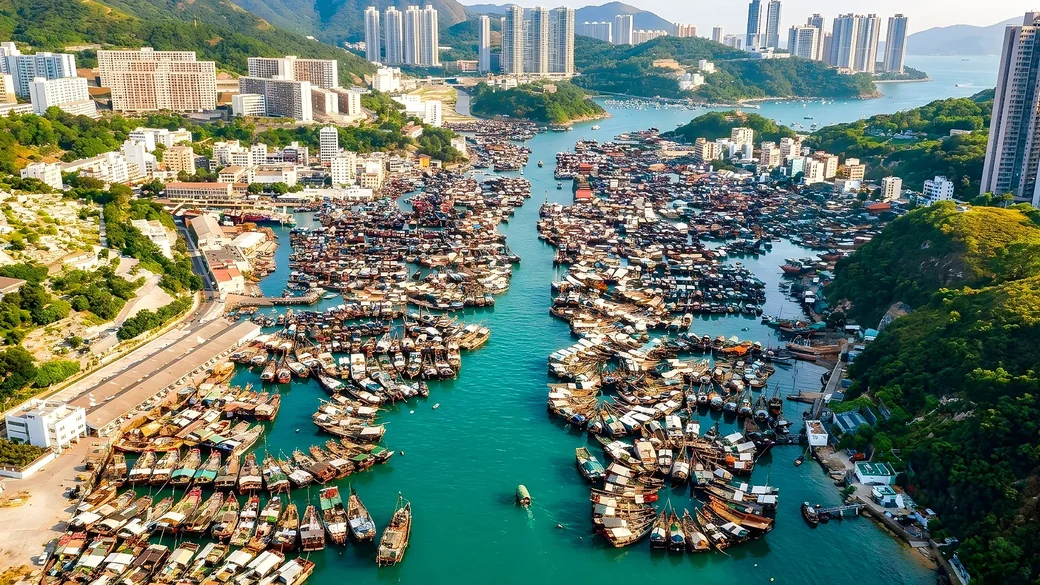
Aberdeen Floating Village is the name travellers give to the boat-dwelling community of Aberdeen Harbour, a sheltered anchorage on the south side of Hong Kong Island between the town of Aberdeen and the island of Ap Lei Chau. It is less a single attraction than a living waterfront where Hong Kong's fishing heritage still meets the modern city. Visitors come to stroll along the water, head out among the boats and discover a maritime culture closely tied to the very origin of Hong Kong's name.
Aberdeen Floating Village: Location, accommodation options and contact
Aberdeen Promenade, Aberdeen Praya Road, Aberdeen, Southern District, Hong Kong Island, Hong Kong
The place's location on the map and nearby accommodation and hotel options are shown by Stay22. Cookies are used. Your consent is remembered on every page; you can turn it off at any time in the cookie settings.
The classic twenty- to thirty-minute loop leaves from the promenade, threads between moored junks and trawlers, passes under the Ap Lei Chau Bridge and comes back. Settle the route and the duration before you board. Licensed operators run fixed departures through the day; independent boat owners work more informally, so confirm what you are getting first. Larger sightseeing boats leave from Aberdeen Fisherman's Wharf Pier 6 on the reclaimed side of the waterfront, and some of those tours end with a bowl of Lau Kee boat noodles, a dish that came off the harbour's own floating kitchens.
The Local Sampan Crossing to Ap Lei Chau
Between Ap Lei Chau Main Street and Aberdeen runs an ordinary ferry service worked by sampans. It is not a sightseeing tour: residents use it to get to work and to the market, the crossing takes only a few minutes, and the fare is a fraction of a tourist ride. For many visitors it is the most memorable boat trip of the day.
Best Photo Spots Around Aberdeen Harbour
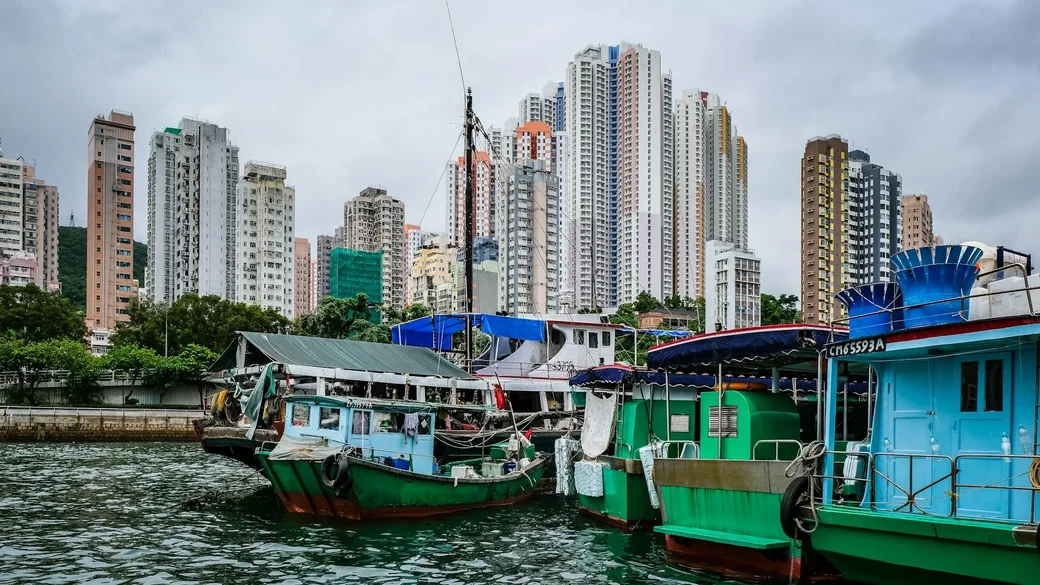
The walkway on the Ap Lei Chau Bridge gives the widest frame, lining up moored boats, the shelter and the towers in one shot. Kwun Hoi Path at the eastern end of the promenade puts you level with the water. From a sampan you get the low angle and the hulls up close. The last hour before sunset is the strongest light.
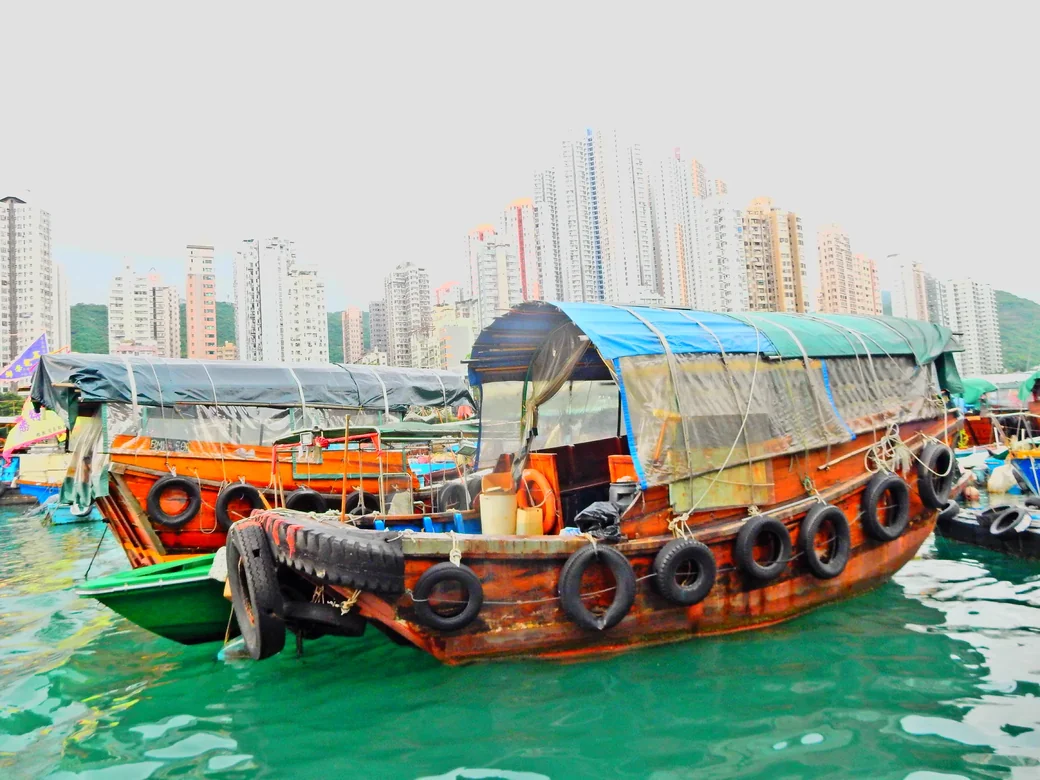
The harbour has no gate, no ticket office and no single street; the whole typhoon shelter is the sight. Fishing junks moored three deep sit beside steel trawlers with laundry strung across the deck, weathered wooden houseboats, yachts from the marina and small motorised sampans threading between them, while the towers rise directly behind. Nowhere else in Hong Kong do the two faces of the city sit so close together. The tree-lined Aberdeen Promenade along Aberdeen Praya Road, where benches, pavilions and fishermen sculptures face the moored fleet, gives easy vantage points all along the shore.
Aberdeen Wholesale Fish Market at First Light
Built in 1950 at the western end of the promenade, this is the oldest and largest wholesale fish market in Hong Kong and still handles a large share of the city's live seafood. The night's catch is sorted and sold before dawn, and the market canteen opens in the small hours. Stay out of the loading lanes and let the work happen around you.
How This Harbour Gave Hong Kong Its Name
In Cantonese Aberdeen is Heung Kong Tsai, Little Hong Kong, and fragrant aquilaria wood grown inland was once shipped out through these waters. According to local accounts, foreign sailors who came ashore here in the early nineteenth century took the village name for the name of the whole island; by the time the mistake was noticed, it had already stuck. A village called Heung Kong Tsuen appears on Ming-era maps. During the Japanese administration in the Second World War the Chinese name of Aberdeen was rendered as Moto Hong Kong, meaning the origin of Hong Kong.
The incense trade gave the anchorage its reputation as a fragrant harbour, and an older name for the bay, Shek Pai Wan, still survives in nearby street and estate names.
Tin Hau Temple and the Legend of the Sea Goddess
Founded by Aberdeen fishermen in 1851 at the north end of Aberdeen Main Road, the temple once stood on the shoreline and now sits a few hundred metres inland after reclamation. It is a modest grey-brick Qing-era hall with several chambers. According to tradition, Tin Hau (the sea goddess) learned from a Taoist priest at the age of thirteen and went on to rescue those in danger of drowning at sea.
The Old Temples of Ap Lei Chau
Across the water on Hung Shing (protector deity of sea and weather) Street stands the Hung Shing Temple of 1773, the oldest temple in the Aberdeen and Ap Lei Chau area and a declared monument. A few minutes away on Main Street, the Shui Yuet or Kwun Yum (Guanyin, goddess of mercy) Temple dates from the end of the nineteenth century and is a graded historic building. Both are small, active and easy to combine with the market.
Tin Hau and Yu Lan: Festivals Still Held on the Water
The land and boat residents of Aberdeen hold a Tin Hau (the sea goddess) Festival on the twenty-third day of the third lunar month, with celebrations and a parade, and a Yu Lan (festival honouring the dead and wandering spirits) Festival on the fourteenth day of the seventh, during which a paper boat is used to gather incense and offerings from each household. Both appear in Hong Kong's intangible cultural heritage inventory. Fishing families here also once performed a Jiao salvation ritual (a Taoist rite performed for peace and deliverance) on the water itself, bringing their vessels together to form a ceremonial field and praying for settled weather and good catches; Tin Hau and Chu Tai Sin, a deity revered by the fishing families, were the ones they turned to.
Saltwater Songs: The Sung Memory of the Harbour
The fishing community here kept its own sung repertoire. Saltwater songs carried stories and knowledge from one generation to the next, while lament songs were sung mainly by women at weddings and funerals. With the fleet reduced and the families ashore, only a handful of singers remain, and a documentary filmed over four years has recorded some of the last of them. A local operator now runs an educational tour inside the typhoon shelter that includes an intangible-heritage workshop where visitors learn to sing fishermen's songs, along with a houseboat visit and a stop at a dragon boat base.
Dragon Boat Racing in Aberdeen Harbour
Aberdeen keeps one of the most traditional race days in Hong Kong, with more than a century of history behind it. Long boats carrying full crews of around fifty paddlers drive through the shelter to the beat of the drums, usually from early morning. The promenade fills quickly, and some spectators watch from sampans on the water rather than from the shore.
What Happened to the Jumbo Floating Restaurant
Opened in 1976 and shaped like an imperial palace, the Jumbo was moored here for more than four decades and drew visitors from around the world. It closed in 2020 and capsized in the South China Sea in 2022 while being towed away. Its smaller and older companion, Tai Pak, built in 1952, is still moored in the harbour but is not serving guests. Aberdeen Harbour itself appears in Bruce Lee's Enter the Dragon of 1973, where the fighters board a junk here. The Jumbo, however, cannot be in that film or in the 1974 Bond picture often mentioned alongside it, since the vessel only opened in 1976.
Coming Ashore: How the Floating Village Emptied
Estimates from the 1960s put as many as 150,000 people living aboard here, and thousands of sampans were still in use in the mid-1980s. From the 1960s public housing drew most families ashore; Yue Kwong Chuen on the hillside above the harbour was one of the estates built for them. The move is now studied through archive work and oral history interviews with those who made it. It is also recorded that children from the typhoon shelters were taught on floating schools run by religious organisations, although that part of the story is less well documented than the move into public housing.
For generations families here were born, married and said their farewells on the water, and as late as the mid-1980s the floating population still numbered in the tens of thousands. Today the harbour keeps a handful of lived-on boats, a fishing fleet that still works, and a typhoon shelter that fills with more than a thousand vessels when storms approach or the annual fishing moratorium brings the fleet home.
Photography Etiquette: These Boats Are Homes
Some of the vessels in the shelter are still lived on, and working crews are going about their day on the rest. Photograph the harbour, the hulls and the skyline as much as you like, but do not point a lens into a cabin or at someone's face without asking, and do not step onto a boat you have not been invited aboard. A nod and a smile usually settle it.
Accessibility: The Promenade Is Easy, the Boats Are Not
The promenade is flat, wide and step-free, with benches, shaded pavilions and accessible restrooms, and both nearby MTR stations have lifts. Boarding a small sampan is a different matter: the step down is awkward and the boat moves underfoot. Larger sightseeing boats are steadier, but anyone using a wheelchair should confirm access with the operator before booking.
What to Combine Nearby: Ap Lei Chau, Temples and Seafood
Ap Lei Chau, shaped like a duck tongue and among the most densely populated islands anywhere, sits a short crossing away with its waterfront promenade, Wind Tower Park, two old temples and a cooked food centre known for seafood. Ocean Park is a few minutes inland, and Aberdeen Country Park offers reservoir walks above the harbour. Half a day covers the water, a full day covers both sides. The island is joined to Aberdeen by two road bridges, the first opened in 1980 and a second alongside it in 1994, with the Aberdeen Channel Bridge added in 2016 to carry the railway; Ap Lei Chau is also known for its boat builders and has been listed by Guinness World Records as the world's most densely populated island. Beyond it, Horizon Plaza fills a converted industrial block with outlet shopping, Mount Johnston rises over the southern shore, buses carry on to Repulse Bay and Stanley, and Béthanie at Pok Fu Lam lies a short ride the other way.
Aberdeen Floating Village: Visitor Tips
Agree the route and the length of your sampan ride before you step aboard — operators work the promenade informally and expectations differ. The best light falls in the last hour before sunset, when the towers glow and the moored fleet turns to silhouette; the strongest vantage point is the walkway on the Ap Lei Chau Bridge, which lines up the boats, the shelter and the skyline in one frame. For atmosphere rather than photographs, come before breakfast, when the wholesale fish market is in full swing and the promenade belongs to joggers and tai chi groups. Remember that some of these boats are homes: photograph the harbour freely, but not into people's cabins or faces without asking. Wear shoes with grip, bring sun protection in summer, and allow time to cross to Ap Lei Chau, which is where the quieter half of the experience waits.
Aberdeen Floating Village: Best Time to Visit
October to December for dry, clear air; early morning for the fish market, golden hour for the harbour; Dragon Boat Festival morning for the races
Quick Info
3h
easy
Aberdeen Floating Village: Getting There
The harbour sits on the MTR South Island Line, but no station carries the Aberdeen name. Get off at Lei Tung for the Ap Lei Chau side and the sampan crossing, or at Wong Chuk Hang for the town and the promenade; both are roughly a ten- to fifteen-minute walk and both run direct to Admiralty, where you can change for the rest of the network. By bus, route 70 leaves from the Exchange Square terminus beside Hong Kong station and drops you close to Aberdeen Promenade. From the southern beaches, routes 73 and 973 come through Repulse Bay and call at Aberdeen Main Street, while route 107 from Kowloon arrives at the Aberdeen Bus Terminus. Routes 40 and 40M connect Pok Fu Lam with Aberdeen Praya Road. By taxi the ride from Central takes roughly fifteen to twenty minutes through the Aberdeen Tunnel. On foot the whole waterfront is flat and walkable, and a marked cycle route follows the Aberdeen Channel.
Nearby stops & parking
Closest MTR stations are Lei Tung (exit A1, for Ap Lei Chau Main Street and the sampan crossing) and Wong Chuk Hang, both lift-equipped. Buses use the Aberdeen Bus Terminus and the stops along Aberdeen Praya Road and Aberdeen Main Road. Taxis wait at the terminus and at the promenade's eastern end. Paid underground parking is available at the shopping complexes in Aberdeen town, and park-and-ride facilities at Wong Chuk Hang and Ocean Park stations let drivers leave the car and finish the trip by rail.
Aberdeen Floating Village: Dress Code & Etiquette
The harbour and promenade have no dress rules; wear what suits the weather, with shoes that grip for boarding a sampan and a hat and sun protection from spring through autumn. The temples around the harbour are a different matter. At the Tin Hau (the sea goddess) temple in Aberdeen and the Hung Shing (protector deity of sea and weather) and Kwun Yum (Guanyin, goddess of mercy) temples on Ap Lei Chau, keep shoulders and knees covered, speak quietly, step around worshippers rather than through them, and never photograph someone mid-prayer or point a lens at an altar being used. Hats come off indoors. If incense is offered to you, accepting is welcome but never expected.