Ayutthaya Historical Park is an open-air archaeological site in central Thailand that preserves the ruins of the kingdom's former royal capital, in the heart of the present-day town of Ayutthaya. Here, the remains of grand temples and royal buildings still dominate the townscape, giving a vivid sense of a once-powerful city. For first-time visitors, it is one of the most evocative places in the country to picture the splendour of old Siam and to see the roots of Thai history and culture.
Ayutthaya Historical Park: Location, accommodation options and contact
Pratu Chai Sub-district, Phra Nakhon Si Ayutthaya District, Phra Nakhon Si Ayutthaya 13000, Thailand
The place's location on the map and nearby accommodation and hotel options are shown by Stay22. Cookies are used. Your consent is remembered on every page; you can turn it off at any time in the cookie settings.
Inside Thailand's UNESCO-Listed Ayutthaya Historical Park
The park spreads across a river island where the Chao Phraya, Pa Sak and Lopburi rivers meet. UNESCO inscribed it in 1991 as the "Historic City of Ayutthaya," recognizing more than four centuries of political, artistic and religious history compressed into roughly 289 hectares of ruins. Inside the park boundary sit around 95 individually catalogued sites — most are ruined temple foundations and towers, while a few working monasteries still host resident monks today. Wander far enough and you'll find traces of many additional temple locations recorded on old maps, many reduced to little more than a brick outline in the grass. The park welcomes a great many visitors every year, yet because the ruins are spread across a wide, leafy island rather than packed into one plaza, it rarely feels as crowded as its visitor numbers suggest. Give yourself time to simply walk between sites — the gaps of open lawn, canals and old city walls are as much a part of the story as the temples themselves.
Ayutthaya's Founding and Four Centuries as Siam's Capital
In 1350, a ruler remembered as Prince U Thong founded a new capital on this river island and took the throne name Ramathibodi I, reportedly moving his court here after an epidemic emptied his former capital. Ayutthaya went on to serve as the capital of Siam for 417 years, absorbing the earlier kingdom of Sukhothai and becoming one of the wealthiest trading cities in Asia. By the early 1700s, foreign visitors were calling it the "Venice of the East" for its network of canals, and its population is estimated to have topped a million people — genuinely one of the largest cities on Earth at the time. Ships from China, Japan, Persia, the Netherlands, Portugal and France anchored along its rivers, and foreign merchant communities kept their own quarters just outside the city walls. Kings such as Narai the Great, who reigned from 1656 to 1688, presided over a particularly cosmopolitan era of diplomacy that sent embassies as far as the court of Louis XIV in France. Foreign envoys who reached the Siamese royal court in turn left dazzled by its splendour.
The Fall of Ayutthaya: What Happened in 1767
Ayutthaya's four centuries as a capital ended in catastrophe. After roughly fourteen months of siege, the Burmese army broke through the city's defenses on 7 April 1767 and burned it to the ground, melting down gilded Buddha images for their gold and marching tens of thousands of residents off as captives. The kingdom that had once rivaled any city in Asia never rebuilt on the same site; a new Siamese capital rose instead at Thonburi under the military leader Taksin, and in 1782 King Rama I moved it across the river to Bangkok. For two centuries the ruins sat largely abandoned to the jungle. Thailand's Fine Arts Department began serious conservation work only in 1969, the site was formally declared a historical park in 1976, and in 1991 UNESCO recognized it as a World Heritage Site. Walking among the headless Buddha statues and fire-scarred brick towers today, it helps to remember that the damage is not simple decay — most of it is a direct, deliberate record of that one catastrophic year.
Wat Mahathat and the Buddha Head in the Tree Roots
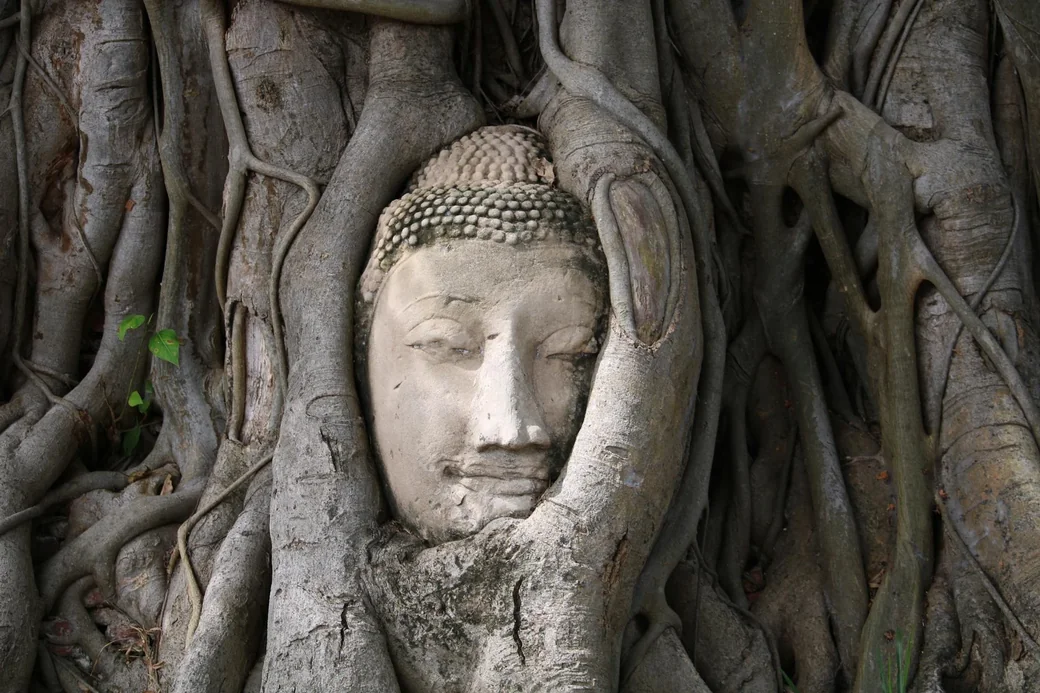
Wat Mahathat is probably the single most photographed spot in Ayutthaya, and for good reason. Somewhere along its brick pathways, the sandstone head of a Buddha statue has become completely entwined in the roots of an old banyan (or bodhi) tree, so that stone and living wood now appear fused together. Nobody fully knows how it happened — the accepted theory is that the head fell during the 1767 sacking of the city and the tree simply grew around it over the following decades. Built in the 14th century, Wat Mahathat once served as the spiritual center of the kingdom and a residence for the Supreme Patriarch of the Thai monkhood, so beyond the famous tree it's also worth slowing down for the rows of headless Buddha images and the ruined central prang (a tall Khmer-style tower). Because of its fame, this particular corner draws queues by mid-morning; arriving close to opening time gives you a much better chance at an unobstructed photo, and one rule is strictly enforced here: when photographing the head, crouch or kneel so that your own head stays lower than the Buddha's.
Wat Phra Si Sanphet, the Royal Temple of Three Chedis
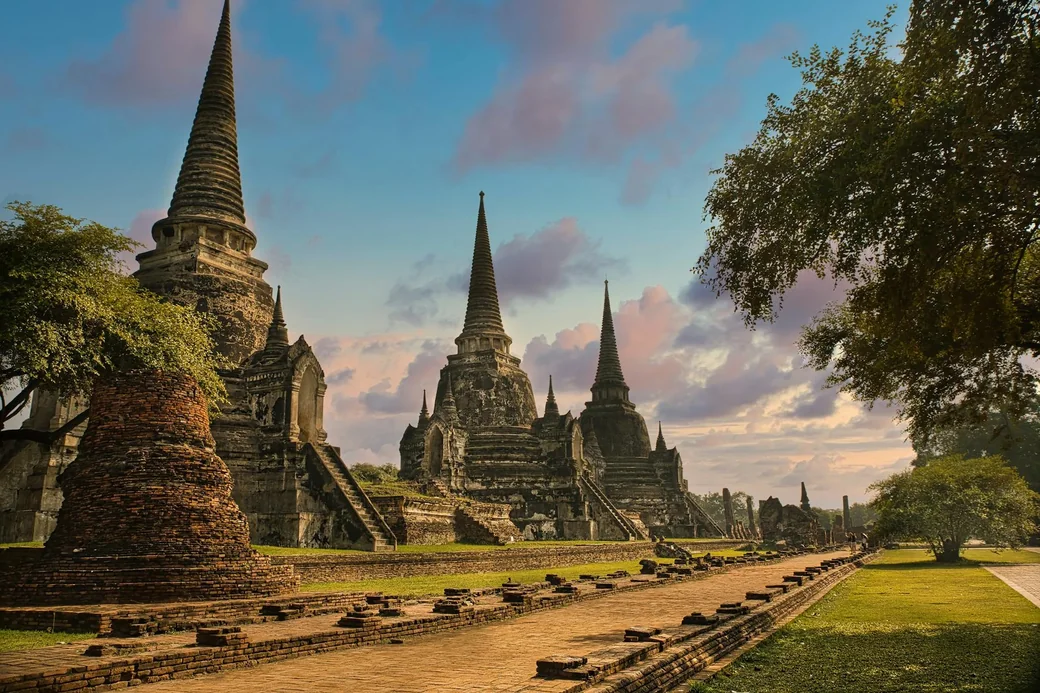
Unlike most temples in the park, Wat Phra Si Sanphet never housed resident monks — it stood inside the grounds of the royal palace and functioned purely as the private ceremonial temple of the Ayutthaya kings, which is why locals still sometimes call it "the King's Temple." Built in the 15th century, its most recognizable feature is a row of three large bell-shaped chedis standing on a raised platform, each one built to enshrine the cremated remains of an Ayutthaya-era king. The temple once held a standing Buddha image roughly 16 metres tall and covered in hundreds of kilograms of gold; when Burmese forces destroyed the temple in 1767, that statue was melted down on the spot and its gold carried away. What survives today — the three chedis and the surrounding gallery walls — still gives a strong sense of how the royal palace complex must have looked, and the site pairs naturally with a walk through the neighbouring palace grounds.
Wat Chaiwatthanaram: Khmer-Style Architecture at Sunset
Set apart from the main island on the west bank of the Chao Phraya River, Wat Chaiwatthanaram was commissioned in 1630 by King Prasat Thong, reportedly to honour his mother, and it deliberately borrows the architectural language of Cambodia's Angkor temples. A tall central prang (a tall Khmer-style tower) representing Mount Meru — the axis of the universe in Buddhist and Hindu cosmology — is ringed by smaller satellite chedis (bell-shaped stupas), with covered galleries and rows of seated Buddha figures connecting them. Because it sits directly on the riverbank, this is widely considered the best sunset spot in Ayutthaya: the warm evening light hits the weathered red brick and throws long reflections across the water, and the crowds here tend to be noticeably thinner than at Wat Mahathat. It's a few kilometres from the historical core, so it works best as a stop by tuk-tuk, bicycle, or as part of a river-boat itinerary rather than an on-foot detour.
Wat Yai Chai Mongkhon: The Victory Chedi
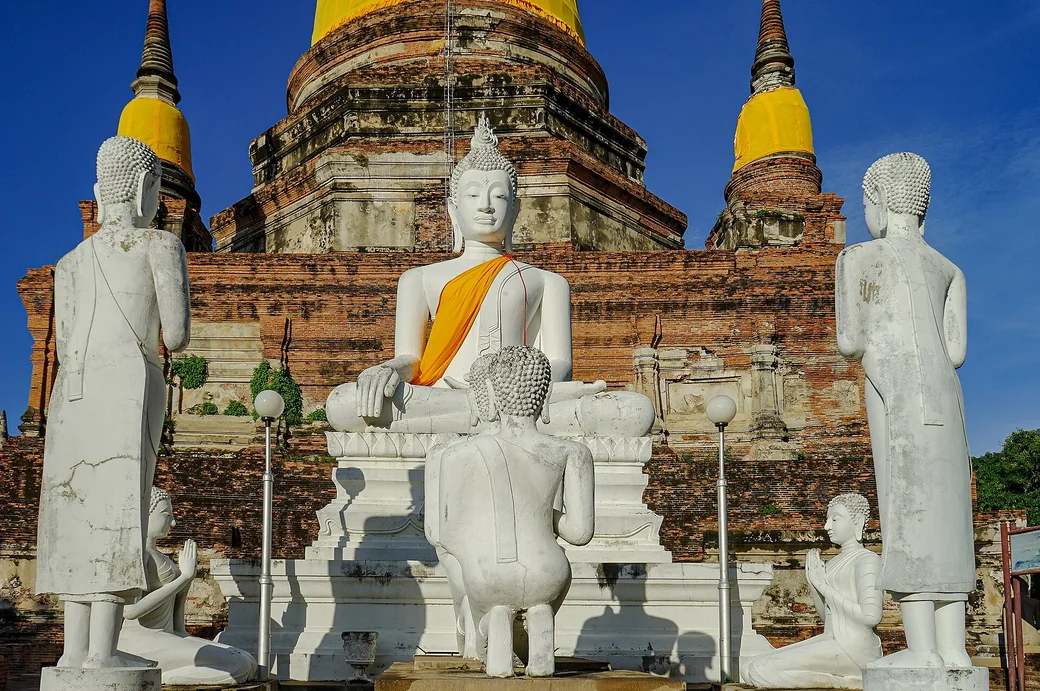
Founded as a monastery back in 1357, Wat Yai Chai Mongkhon later became the site of Ayutthaya's most triumphant monument: a roughly 62-metre bell-shaped chedi built by King Naresuan the Great to commemorate his celebrated victory over the Burmese crown prince at the end of the 16th century. The temple's name translates loosely as "the great monastery of auspicious victory." A steep staircase lets visitors climb partway up the chedi for a wide view over the surrounding countryside, while at ground level a long line of seated Buddha statues, wrapped in saffron-coloured cloth, runs along the base of the monument. Unlike many of the park's ruins, this is a living, active temple with resident monks, so modest dress — covered shoulders and knees — is expected here more strictly than at the pure archaeological sites. A large reclining Buddha statue nearby is another popular stop within the same grounds.
Wat Ratchaburana and the Giant Reclining Buddha of Wat Lokayasutharam
Directly across the road from Wat Mahathat, Wat Ratchaburana was founded in 1424 by King Borom Rachathirat II on the cremation ground of his two elder brothers, who had died fighting each other for the throne. Its design draws on Hindu cosmology: a soaring central prang (a tall Khmer-style tower) represents Mount Meru, flanked by four smaller satellite towers and eight surrounding chedis (bell-shaped stupas) symbolising the continents and oceans of traditional cosmology. A narrow staircase leads down into a crypt beneath the main tower, where faded but still-visible murals and a scattering of ancient artefacts survive from before the temple was looted. A short walk away, Wat Lokayasutharam offers something completely different: an enormous open-air reclining Buddha, one of the largest in Ayutthaya, lying peacefully in the grass. Together the two sites make a natural short loop and a good change of pace after the more architecturally dense temples nearby.
Temple Tickets in Ayutthaya and the Combination Pass
There is no single ticket or turnstile for "the historical park" as a whole: it's an open island where the roads and footpaths between the ruins are open to everyone, and tickets are sold at the gate of each individual temple you choose to enter. Not every site works the same way — the major ruins run by the Fine Arts Department have their own ticket booths, active monasteries such as Wat Yai Chai Mongkhon run separate ones, and some open-air sites, including the reclining Buddha at Wat Lokayasutharam, have no ticket booth at all. If you plan to see several of the headline ruins, look at the combination pass, which covers a selection of the most important sites — Wat Mahathat, Wat Ratchaburana, Wat Phra Si Sanphet, Wat Phra Ram, Wat Chaiwatthanaram and Wat Maheyong — and is sold at the ticket window of any of them. Booths generally accept cash only, so carry small notes: ATMs are easy to find in town, but not at the temple gates.
How Long to Budget for Your Visit
Ticket booths generally stop selling entry about half an hour before the stated closing time, so aim to arrive at your last site with a little room to spare. A focused visit to the handful of headline temples — Wat Mahathat, Wat Phra Si Sanphet and Wat Chaiwatthanaram among them — can comfortably be done in half a day, which is why Ayutthaya works so well as a single-day trip from Bangkok. If you'd rather take things slowly, cover the sites further from the main island, and add in the National Museum, budget a full day, and specialists on the destination generally recommend closer to three days for travellers who want to see practically everything the wider area has to offer, ruins and all.
Getting to Ayutthaya from Bangkok: Train, Van or Car
Ayutthaya sits roughly 75 to 80 kilometres north of Bangkok, and there's no single "best" way to get there — it depends on your schedule and how much comfort you want. The train is the classic choice, but Bangkok has two departure stations for it: express and rapid services leave from Krung Thep Aphiwat Central Terminal, reach Ayutthaya in about an hour and have bookable seats, while the slow ordinary trains with fan-cooled third-class carriages still depart from the historic Hua Lamphong station, take around two hours and sell tickets only on the day. Minivans and buses leave frequently from Bangkok's Mo Chit (Northern) Bus Terminal — the minivan stands at Victory Monument mentioned in older guides closed years ago — and drop passengers near the town centre rather than at the station across the river. For door-to-door convenience, private transfers and taxis are available, and a slower but scenic alternative is a river-boat day trip along the Chao Phraya, often combined with a stop at Bang Pa-In Palace on the way.
Getting Around the Park: Bicycles, Tuk-Tuks and Scooters
Once you've arrived, the ruins are spread out enough that walking everywhere isn't realistic in the heat, so most visitors rent a bicycle for the day at stalls near the train station or in town — it's the cheapest way to move between temples at your own pace and stop wherever catches your eye. Motorbike and scooter rentals are also widely available for a bit more freedom and speed, if you're comfortable riding one. Tuk-tuks are everywhere and can be hired by the hour or for a half or full day, with the driver waiting outside each temple while you look around — a good option if the heat, distance or your own schedule make pedalling less appealing. Whichever you choose, keep in mind that some of the finest sites, including Wat Chaiwatthanaram, sit a few kilometres outside the main cluster of ruins, so it's worth planning your route in a rough loop rather than backtracking across the island more than necessary.
Best Time to Visit and Where to Get the Best Photos
Thailand's cooler season, from November through March, is by far the most comfortable time to explore Ayutthaya, with drier air and far less rain, although afternoon temperatures still often climb above 30°C. Within a single day, early morning — ideally right at opening — and the hour before sunset offer the softest light and the smallest crowds, particularly at the famous Buddha-head tree at Wat Mahathat, where a mid-morning queue can build quickly. For sunset specifically, Wat Chaiwatthanaram's riverside position makes it the standout choice, with the fading light glowing against the weathered brick and reflecting in the water. Whatever the season, take sun protection seriously — a hat, sunscreen and a refillable water bottle make a real difference across a few hours of walking with very little shade, and the midday sun even in the cooler months can still be intense by early afternoon.
What to Wear and How to Behave at the Temples
Because most of Ayutthaya's sites are technically ruins rather than active places of worship, dress rules here are somewhat more relaxed than at Bangkok's grand temples — but a few of them, including Wat Yai Chai Mongkhon and Wat Phanan Choeng, remain functioning monasteries with resident monks, and modest dress covering the shoulders and knees is expected there. It's worth carrying a light scarf or wrap in your bag just in case. Regardless of which site you're at, treat every Buddha image with the respect due a sacred object: don't climb on statues, sit on ruins for a photo, or pose in a way that places your body higher than a Buddha's head, all of which are considered seriously disrespectful in Thai culture and have led to fines or worse for tourists in the past. Shoes should come off before entering any active temple building, and a quiet, unhurried manner goes a long way here.
Beyond the Ruins: Bang Pa-In Palace and Other Nearby Sights
If you have more than a few hours to spend in the area, several attractions outside the historical park itself round out a visit nicely. Bang Pa-In Royal Palace, about 18 kilometres away, is a working royal summer retreat set around an ornamental lake, with pavilions and buildings mixing Thai, Chinese and European styles — it's included in almost every full-day tour from Bangkok. Closer to town, the Chao Sam Phraya National Museum houses gold artefacts recovered from the temple ruins, while the Ayutthaya Historical Study Centre offers a more curated introduction to daily life during the kingdom's height. For something more relaxed in the evening, the Ayothaya Floating Market and the Ayutthaya Night Market both serve local specialities like boat noodles and the spun-sugar dessert roti sai mai alongside handicrafts and live performances, and a slow night boat cruise around the historic island is a memorable way to end the day away from the daytime heat.
Ayutthaya Historical Park: Visitor Tips
Arrive at opening time to beat both the heat and the crowds at Wat Mahathat's famous Buddha-head tree, then work your way toward Wat Chaiwatthanaram for sunset. Renting a bicycle is the easiest way to cover the site at your own pace; a tuk-tuk driver hired by the half-day is a good alternative if you'd rather not pedal in the heat. Carry cash in small notes for the temple ticket booths, plus a hat, sunscreen and water, since shade is limited between temples. If you only have half a day, prioritise Wat Mahathat, Wat Phra Si Sanphet and Wat Chaiwatthanaram; with a full day, add Wat Yai Chai Mongkhon and the Chao Sam Phraya National Museum.
Ayutthaya Historical Park: Best Time to Visit
November to March mornings or the hour before sunset — cooler air, softer light and thinner crowds than the midday heat.
Ayutthaya Historical Park: Admission Fees
Foreign visitors – one site (per temple or monument)
Charged per temple or monument; the main sites such as Wat Mahathat, Wat Phra Si Sanphet and Wat Chaiwatthanaram each have their own ticket.
A flat-rate ticket that covers several of the park's main sites in one purchase; ask at the counter which sites it includes.
THB 300
Thai nationals – one site
Reduced rate for one site for Thai citizens, on showing a Thai ID card.
THB 10
Thai nationals – flat-rate ticket
Reduced flat-rate ticket for Thai citizens, on showing a Thai ID card.
THB 40
Quick Info
4h
moderate
Ayutthaya Historical Park: Getting There
Ayutthaya lies about 75–80 km north of Bangkok. The fastest trains are the express and rapid services from Krung Thep Aphiwat Central Terminal (formerly Bang Sue Grand Station), which reach Ayutthaya in about an hour and can be booked in advance; the slow ordinary trains with fan-cooled third-class seats still leave from the historic Hua Lamphong station and take around two hours. Minivans and buses depart frequently from Mo Chit (Northern) Bus Terminal, take about an hour and a half depending on traffic and drop passengers close to the town centre on the island. Private transfers and taxis offer door-to-door convenience, useful for families or early departures. A slower, scenic alternative is a river cruise along the Chao Phraya River, often combined with a stop at Bang Pa-In Palace. Once in Ayutthaya, the historical park's temples are spread across the town, so arrange onward transport — bicycle, tuk-tuk or scooter rental — on arrival rather than trying to cover the site entirely on foot.
Nearby stops & parking
Ayutthaya Railway Station sits on the eastern bank of the river, a short ferry or bridge crossing from the historical park's main temple cluster — bicycle and tuk-tuk stands operate right outside the station for onward travel. Minivans from Bangkok generally terminate near the town centre, within easy tuk-tuk distance of the main sites. Car parking is available near most major temples, including Wat Mahathat and Wat Phra Si Sanphet, though it can fill up on weekends and holidays. ATMs are easy to find throughout the town on the island, but temple ticket booths generally accept cash only, so withdraw small notes before setting off.
Ayutthaya Historical Park: Dress Code & Etiquette
Most of Ayutthaya's ruins are no longer active places of worship, so dress rules are more relaxed here than at Bangkok's working temples. A handful of sites, however — including Wat Yai Chai Mongkhon and Wat Phanan Choeng — remain functioning monasteries with resident monks, where shoulders and knees should be covered and shoes removed before entering any temple building; packing a light scarf or wrap is a simple way to stay covered without overdressing for the heat. At every site, ruined or active, treat Buddha images with clear respect: don't climb on statues or ruins for photos, and never pose with your body positioned higher than a Buddha's head, since both are considered seriously disrespectful in Thai culture.