Bangkok National Museum is Thailand's flagship museum of history, art and archaeology, located in Rattanakosin (the historic royal quarter of Bangkok), the oldest part of the capital. Rather than a single modern building, it is a cluster of traditional Thai halls and gardens that once formed a royal residence. For first-time visitors to Thailand, it is the place to see the country's long cultural story told through original objects, from its earliest settlements to the splendour of its royal court.
Bangkok National Museum: Location, accommodation options and contact
4 Na Phra That Road, Phra Borom Maha Ratchawang, Phra Nakhon, Bangkok 10200, Thailand
The place's location on the map and nearby accommodation and hotel options are shown by Stay22. Cookies are used. Your consent is remembered on every page; you can turn it off at any time in the cookie settings.
Bangkok National Museum History: Thailand's First Public Museum
King Chulalongkorn (Rama V) opened Siam's first public museum on 19 September 1874 in the Concordia Pavilion inside the Grand Palace, to show the collection of his father, King Mongkut, together with other objects of general interest. The Fine Arts Department still celebrates that day as the birth of the country's national museum. In 1887 the collection moved to the Front Palace and became the Wang Na Museum; it was renamed the Bangkok Museum in 1926 and came under the Fine Arts Department in 1934. Today it is the main branch of Thailand's network of national museums and one of the largest museums in Southeast Asia, with galleries that trace Thai history back to the Neolithic. A long renovation programme has given many halls new interiors, better lighting and multimedia displays, so even returning visitors find plenty that feels fresh.
Wang Na, the Front Palace: The Vice King's Residence Behind the Museum
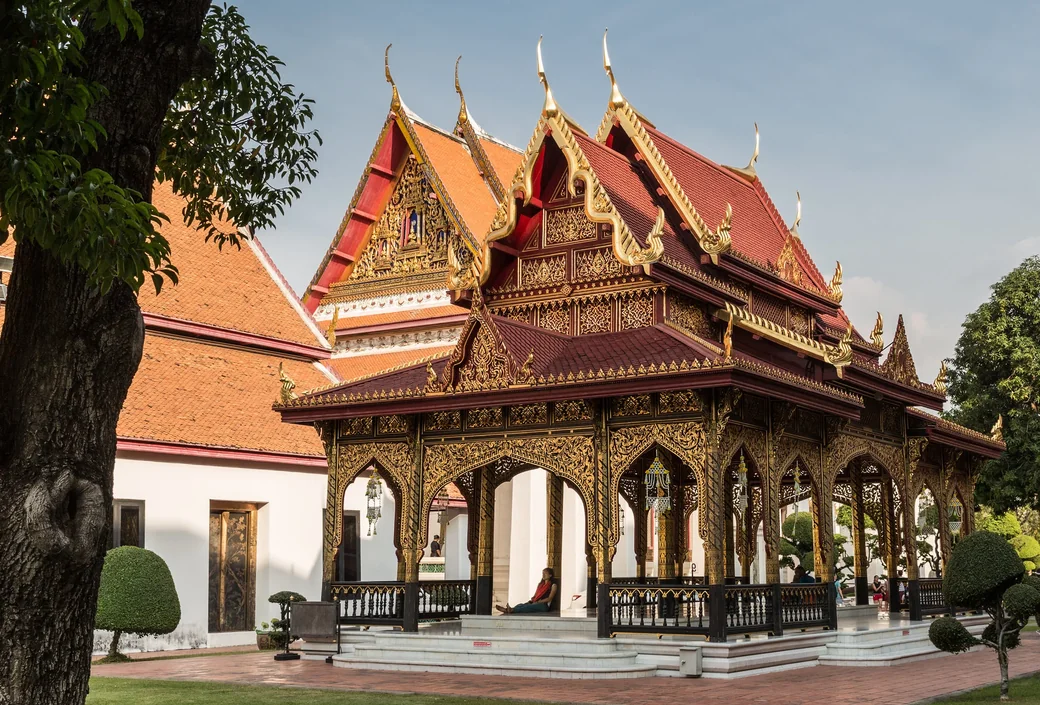
The museum occupies the Wang Na, or Front Palace, begun in 1782 for the vice king (uparaja), a royal deputy who ranked just below the monarch and was often his chosen successor. Its first resident, Maha Sura Singhanat, the prince successor to King Rama I, laid out the palace, and several of his buildings still stand, including the audience hall that now opens the visit. When King Chulalongkorn abolished the post of vice king, the palace was turned over to the museum, which is why walking the grounds feels more like exploring a royal residence than a modern gallery: courtyards, pavilions, lotus ponds and ornate halls, many with beautifully decorated Chinese-style doors. The complex sits between Thammasat University and the National Theatre, facing the ceremonial ground of Sanam Luang, where royal cremations have traditionally been held.
Buddhaisawan Chapel and the Sacred Phra Phuttha Sihing Buddha
Built in the late 18th century by the first vice king, the Buddhaisawan Chapel (Phutthaisawan Hall) is the spiritual and artistic heart of the museum. It enshrines Phra Phuttha Sihing, a seated bronze Buddha finished in gold that is revered as the second most important Buddha image in Thailand after the Emerald Buddha. Maha Sura Singhanat brought it to Bangkok from Chiang Mai after a campaign in the north. The interior walls are covered with early Rattanakosin (Bangkok's early royal era) court-style murals showing scenes from the life of the Buddha, arranged in panels between the doors and windows, and art historians rank them among the finest works of their era. Curiously, other cities, including Chiang Mai and Nakhon Si Thammarat, keep images of the same name, and locals in each consider theirs the original. The chapel is still used for worship, so enter barefoot and quietly.
Thai History Gallery and the King Ram Khamhaeng Inscription
The first building after the entrance is Siwamokhaphiman Hall, once the palace's audience hall. Its front section houses the Thai History Gallery, which runs from prehistory to the Bangkok era and even explores the question of where the Thai people came from. The star exhibit is the King Ram Khamhaeng Inscription, a Sukhothai-period stone that describes early Thai script, government, religion and society; it was added to UNESCO's Memory of the World Register in 2003 in recognition of its importance. The rear of the hall is home to the Prehistory Gallery, which covers the cultures that lived in present-day Thailand long before its first kingdoms, with tools, pottery and religious artefacts. Start here if you want a clear timeline before exploring the art and palace collections, because everything else in the museum becomes easier to place. The Thai History Gallery is the first of the museum's three permanent collections; the archaeology and art history galleries and the decorative arts and ethnology collection make up the other two.
Art History Gallery: Dvaravati, Srivijaya, Khmer and Asian Buddhist Art
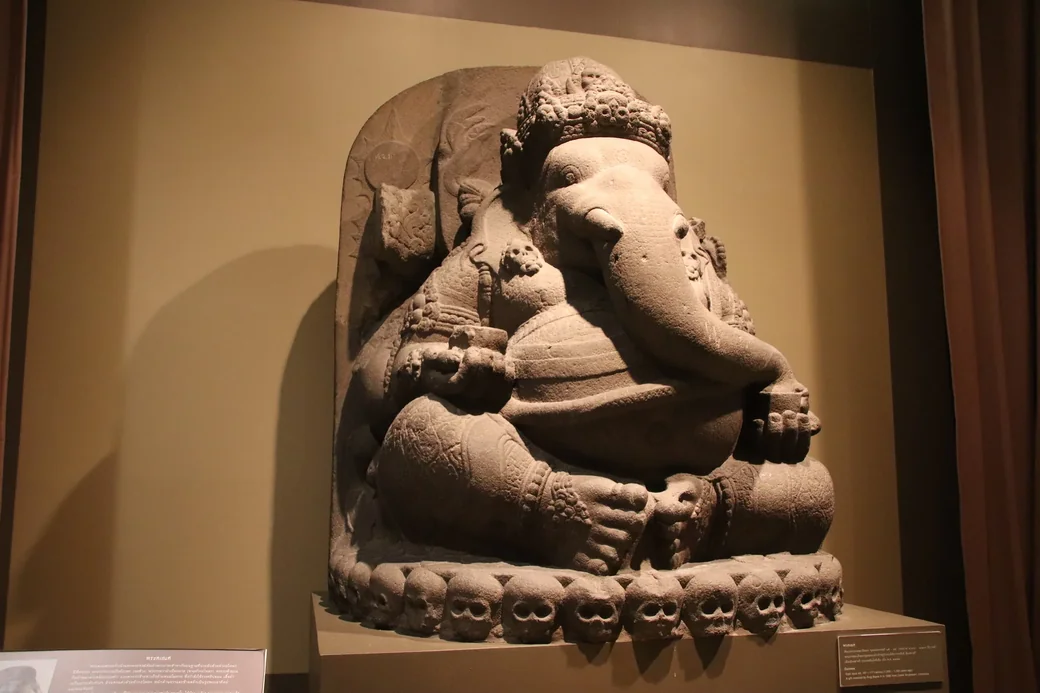
The North Wing follows Thai art from the Dvaravati, Srivijaya and Lopburi periods to the early Bangkok era, and the museum also displays Buddhist art from across Asia: Gandhara, Tang China, Champa, Java and the Khmer world. Look out for the 8th-century bronze torso of the Avalokiteshvara of Chaiya from Surat Thani, a Srivijaya masterpiece showing Central Javanese influence, and the four-armed Ganesha from Candi Singhasari in East Java. A Cham lintel from Binh Dinh in Vietnam arrived in 1938 in exchange for a Thai Buddha image, and between 1939 and 1948 the museum swapped works with the Guimet Museum in Paris. Scholars have debated the dating of a group of large Hindu bronzes, including two standing figures of Shiva measuring 308 and 150 centimetres, since the 19th century. The graceful Sukhothai Buddha images are a favourite with many visitors.
Decorative Arts and Ethnology: Royal Treasures, Khon Masks and Weapons
The former central palace buildings hold the decorative arts and ethnology collection, which focuses on court and regional material culture. Expect gold and precious stones, mother-of-pearl inlay, royal emblems and insignia, costumes and textiles, ceramics, carved ivory, historic royal conveyances, weapons and musical instruments. Highlights include the Throne of the White Umbrella once used by Prince Pinklao, elaborate masks from Khon, Thailand's classical masked dance-drama, a war-elephant display with antique weapons, and collections of Thai swords, polearms and cannons. The rooms are spread across several historic buildings, so walking through them is also a way of seeing how the palace was organised. Children are usually fascinated by the masks and the royal vehicles, which makes this section a good choice if you are visiting as a family.
Royal Funeral Chariots Hall and the Great Victory Chariot of Rama I
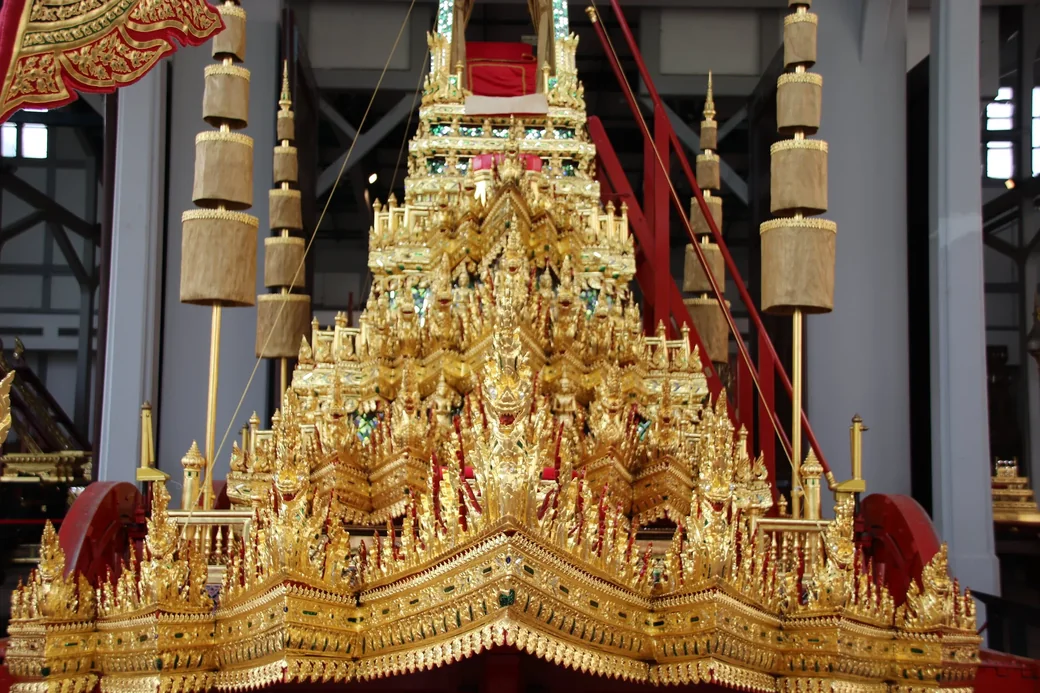
One of the museum's most spectacular buildings houses the giant gilded vehicles used in royal cremation processions. The centrepiece is the Great Victory Royal Chariot (Phra Maha Phichai Ratcharot), commissioned by King Rama I in 1795, displayed with royal palanquins such as the Royal Golden Litter and the Royal Chariot with Three Poles, as well as funeral urns and pyres. These are not static relics: they are still pulled through the streets during state funerals, and before each use they are restored with traditional lacquer, gilding and glass work. At times the Fine Arts Department closes the hall so the vehicles can be prepared for royal funeral ceremonies. Check its status before your visit if the chariots are a priority.
The Red House: An Early Bangkok Teak Residence
Tucked away in the grounds, the Red House is a traditional Thai teak house that was originally one of the private quarters of Princess Sri Sudarak, the elder sister of King Rama I. It was later moved from the old palace in Thonburi, on the other side of the river, to the Grand Palace for Queen Sri Suriyendra, consort of King Rama II, and finally found its home in the museum grounds. Today it is furnished in early Rattanakosin (Bangkok's early royal era) style to show the domestic life of the royal court, and it includes objects that once belonged to Queen Sri Suriyendra. After the grand palace halls and packed galleries, the Red House offers an intimate glimpse of how members of the royal family actually lived in the first decades of Bangkok. Its dark timber walls and carved details also make it one of the most photogenic corners of the complex.
Golden Boy and Kneeling Lady: Khmer Bronzes Returned from New York
In May 2024 the museum unveiled two bronzes that the Metropolitan Museum of Art in New York had returned to Thailand after holding them for about three decades. The Golden Boy, a figure roughly 900 years old, is sometimes identified as Shiva or as a Khmer king such as Jayavarman VI; the Kneeling Lady was presented alongside it. Both are thought to come from the lower northeast of Thailand, probably Buriram province, and belong to the Khmer art tradition that flourished there in the 11th and 12th centuries. The Golden Boy was reportedly dug up by a villager decades ago and exported illegally, and the pieces entered the Met's collection in the late 1980s. Their return, after long provenance research, was a rare success in Thailand's efforts to recover looted heritage, and more requests for other artefacts are being pursued. Further returns have followed: in January 2026 four Prakhon Chai bronzes from the 8th–9th centuries, three bodhisattvas and a Buddha image, were handed back by the Asian Art Museum of San Francisco in a ceremony at the museum.
Guided Tours by the National Museum Volunteers
The best way to make sense of this huge collection is to join a tour by the National Museum Volunteers, a group of guides who have completed a detailed training course. Tours start in the morning on Wednesdays and Thursdays, with the meeting point at the museum ticket office, and they cover pre-Thai and Thai art, Thai history and culture, Buddhism and the Buddhaisawan Chapel. They are offered in English, French, German and Japanese, but the language line-up differs between the two days, so check the group's website before you go; tours in some other languages can be arranged for groups. A tour usually lasts about two hours or a little longer and focuses on the key pieces in each area. Visitors regularly say the commentary goes far deeper than the wall labels, making it one of the best-value experiences in Bangkok.
Opening Days, Visit Length and the Best Time to Go
The museum is open Wednesday to Sunday and closed on Mondays and Tuesdays; it may also close on some royal or national holidays, and on certain holidays it opens specially, so confirm before visiting on a public holiday. Arrive right at opening: the grounds are quieter, the light is softer for photos, and you avoid the strongest midday heat while walking between buildings. Allow at least two to three hours for the main halls, or about 90 minutes if you only want the highlights; history and art lovers can easily spend half a day or more. If you want a guided tour, plan your visit for a Wednesday or Thursday morning. Bangkok is hot and humid all year, so carry water and, in the rainy season, an umbrella for the walks between pavilions.
Dress Code and Etiquette at Bangkok National Museum
Dress modestly, with shoulders and knees covered, especially if you plan to enter the Buddhaisawan Chapel, which is still an active place of worship and home to one of the country's most revered Buddha images. You must take off your shoes before entering the chapel and some other buildings, so easy slip-on shoes will save time. For security reasons, large bags have to be checked before you enter the galleries. Keep your voice low, never touch the exhibits, and follow the instructions of museum staff. Water is useful in the heat, but drink it outside the galleries. Showing respect in the chapel matters: Thai visitors come here to pay homage, and royal ceremonies connected with the museum's collections still take place in the complex.
Photography Rules and the Best Photo Spots
Photography without flash is allowed in most galleries and throughout the outdoor areas, but flash and tripods are not permitted. Some rooms, particularly those with royal regalia, delicate textiles or murals, and some temporary exhibitions, may restrict photography completely, so watch for signs and follow staff instructions. Inside the Buddhaisawan Chapel, read the posted rules before raising your camera. The most popular shots include the chapel's murals, the teak Red House, and the palace facades with their decorated Chinese-style doors, courtyards and lotus ponds. Early morning brings the gentlest light and the fewest people in frame, while the shaded colonnades between buildings are ideal for a cooler break between photos.
How to Get to Bangkok National Museum by Boat, Metro or on Foot
The museum stands on Na Phra That Road on the western side of Sanam Luang, a short walk north of the Grand Palace. The most enjoyable route is the Chao Phraya Express Boat to Tha Chang pier (N9): turn left onto Maha That Road, walk through the amulet market to its end, turn right and continue to Sanam Luang, then turn left with the Grand Palace behind you, and the museum is on your left. From Phra Arthit pier (N13) the walk takes around 10–12 minutes. On the metro, get off at MRT Sanam Chai and walk about 15–20 minutes, or take a short taxi or tuk-tuk ride. Several city bus lines pass nearby, though traffic around the Grand Palace can be slow at peak times. From Khao San Road, it is a flat, easy walk across Sanam Luang.
On-Site Facilities and Nearby Sights
On site there is a restaurant-café for a break, and brochures and maps help you find your way between the many buildings. The Grand Palace and Wat Phra Kaew are a short walk away but form a separate site with their own ticket, and Wat Pho lies just beyond them. The National Gallery on Chao Fa Road is within walking distance, and Thammasat University and the National Theatre are right next door. Many travellers combine the museum with the Grand Palace in the morning and Wat Pho in the afternoon for a complete cultural day in old Bangkok, ideally after visiting the museum first, since it explains much of what you will see in the temples.
Bangkok National Museum: Visitor Tips
Arrive at opening and allow two to three hours for the main halls. Join a volunteer-led tour on a Wednesday or Thursday morning to get the most out of the collection. Cover shoulders and knees and wear shoes you can slip off easily for the Buddhaisawan Chapel. Flash and tripods are not allowed. Check whether the Royal Funeral Chariots Hall is open before you go.
Bangkok National Museum: Best Time to Visit
Wednesday to Sunday right at opening for cooler air, soft light and fewer crowds; Wednesday or Thursday morning if you want a volunteer-guided tour.
Bangkok National Museum: Admission Fees
Foreign visitors (adult)
Standard rate for visitors from abroad, covering the permanent exhibition buildings with Thai art, history and royal funeral chariots. The museum is closed on Mondays and Tuesdays.
THB 240
Thai nationals (with ID card)
Reduced rate for Thai citizens on showing a Thai ID card.
THB 30
Quick Info
2h 30m
easy
Bangkok National Museum: Getting There
The easiest and most scenic way to arrive is by the Chao Phraya Express Boat. Get off at Tha Chang pier (N9), turn left onto Maha That Road and walk through the amulet market to its end, turn right and continue to Sanam Luang, then turn left with the Grand Palace behind you: the museum is on your left. From Phra Arthit pier (N13) the walk takes about 10–12 minutes via Phra Athit Road and Sanam Luang. By metro, take the MRT Blue Line to Sanam Chai and walk about 15–20 minutes, or hop into a taxi or tuk-tuk for the last stretch. From Khao San Road it is a flat, easy walk across Sanam Luang.
Nearby stops & parking
Closest piers: Tha Chang (N9) and Phra Arthit (N13) on the Chao Phraya Express Boat. Closest metro station: MRT Sanam Chai (Blue Line), roughly 15–20 minutes on foot. Several city bus lines pass nearby, though traffic around the Grand Palace can be slow at peak times. Taxis and tuk-tuks can drop you on Na Phra That Road, on the western side of Sanam Luang.
Bangkok National Museum: Dress Code & Etiquette
Dress modestly, with shoulders and knees covered, particularly if you plan to enter the Buddhaisawan Chapel, which is still an active place of worship. Shoes must be removed before entering the chapel and some other buildings. Large bags must be checked before entering the galleries. Speak quietly, do not touch the exhibits, and follow staff instructions in sacred spaces.