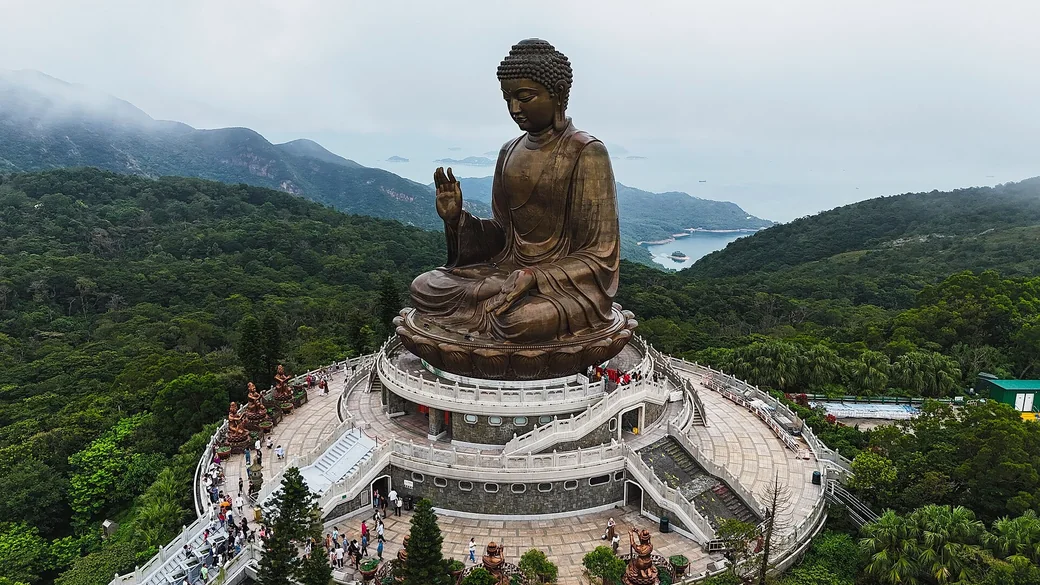
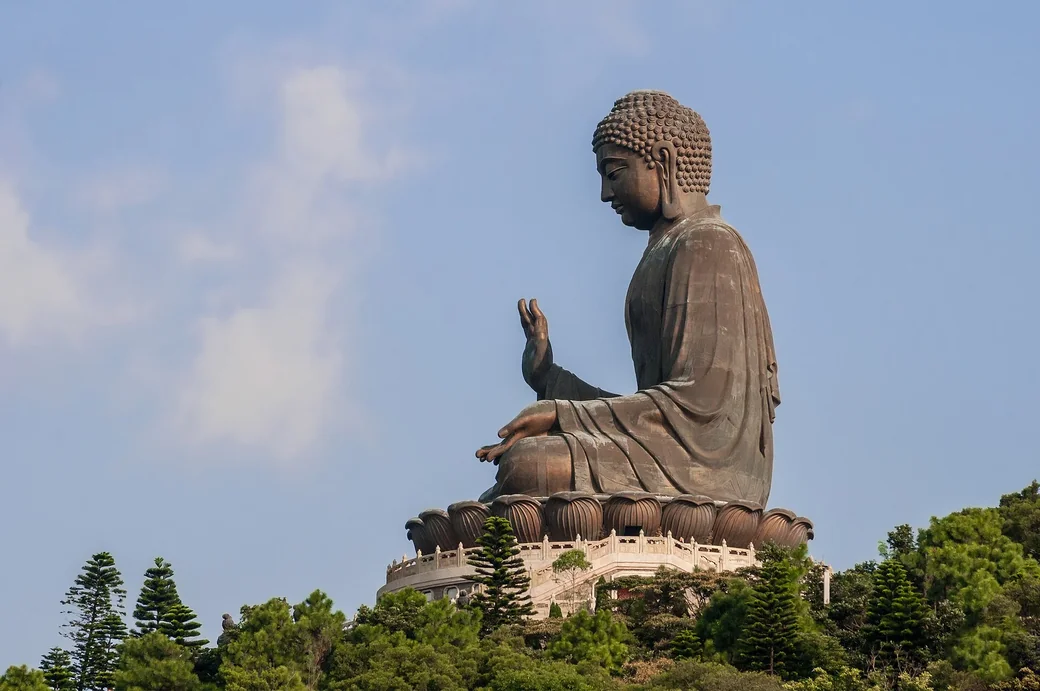
The Big Buddha, formally the Tian Tan Buddha, is a giant bronze statue of a seated Buddha on the Ngong Ping plateau, high in the mountains of Lantau Island in Hong Kong. Raised on a hilltop above Po Lin Monastery, it looks out over green ridges that fall away towards the South China Sea. Together, the statue and the monastery form one of Hong Kong's most important Buddhist sites and one of its best-known landmarks, visited by pilgrims and sightseers alike.
Big Buddha (Tian Tan Buddha, 天壇大佛): Location, accommodation options and contact
Ngong Ping Road, Ngong Ping, Lantau Island, New Territories, Hong Kong
The place's location on the map and nearby accommodation and hotel options are shown by Stay22. Cookies are used. Your consent is remembered on every page; you can turn it off at any time in the cookie settings.
The granite staircase from the forecourt to the statue's platform has 268 steps, and most visitors take ten to twenty minutes over it. The treads are wide and evenly cut, there are handrails on both sides, and several landings let you stop without blocking anyone. In humid weather the climb feels considerably harder than the number suggests, so carry water and set a pace you can hold. At the top you can walk a full circuit of the platform at the statue's feet, with Po Lin Monastery directly below and the ridges of Lantau opening in every direction. Footwear matters more than fitness: the stone becomes slick after rain. The hill itself is called Muk Yue Fung, Wooden Fish Peak, named after the hollow wooden drum struck during Buddhist chanting; its summit stands at roughly 482 metres.
How the Big Buddha Was Built: 202 Bronze Panels and Aerospace Engineering
The figure is a shell of 202 cast bronze panels — 160 for the body, 36 for the lotus throne, 6 for the cloud motifs — bolted onto an internal steel frame. Reinforced concrete was the original plan, but it could not hold the fine modelling of the face and robes, so tin bronze was chosen instead. A sculptor from the Guangzhou Academy of Fine Arts spent almost two years producing the one-fifth scale plaster master. Casting, machining and assembly were carried out by an aerospace engineering works in Nanjing using methods developed for satellite and rocket components, and the narrow mountain roads of Lantau made simply delivering the five-tonne face a problem in its own right. The ground was granted at a nominal price in 1974, a dedicated building committee was formed in 1981, and the whole undertaking spanned twelve years. The plaster master was modelled by the sculptor Hou Jinhui. The face alone weighs five tonnes, and roughly two kilograms of gold went into its casting. The last bronze panel was fitted in October 1989 at a topping-out ceremony, and the finished statue was consecrated on 29 December 1993. The finished statue stands 26.4 metres high with its lotus throne and about 34 metres including the podium, weighs more than 250 tonnes and ranks among the largest outdoor seated bronze Buddhas in the world.
Inside the Base: The Three Halls Beneath the Buddha
Three floors are stacked inside the podium and linked by a spiral staircase. The lowest, the Hall of Benevolent Merit, holds a Ksitigarbha Bodhisattva carved from nanmu wood (a prized Chinese hardwood) more than five centuries old, together with four wall paintings by a Sri Lankan monk showing the Buddha's birth, awakening, first teaching and passing. Above it the Hall of the Dharma Realm displays Buddhist paintings, ceramics and calligraphy. The top floor, the Hall of Remembrance, enshrines relics presented to Po Lin Monastery by a temple in Sri Lanka, with the names of donors carved into the walls. A six-tonne bronze bell two metres across hangs in the stairwell, inscribed inside and out with scripture. Across its three floors the podium covers some 2,239 square metres. The relics were presented in 1992 by Mahiyangana Temple in Sri Lanka, brought back by a delegation from the monastery. At major ceremonies the bell is sounded automatically 108 times, one stroke for each of the 108 afflictions it is meant to dispel.
Reading the Statue: Mudras, the Northward Gaze and the Lotus Throne
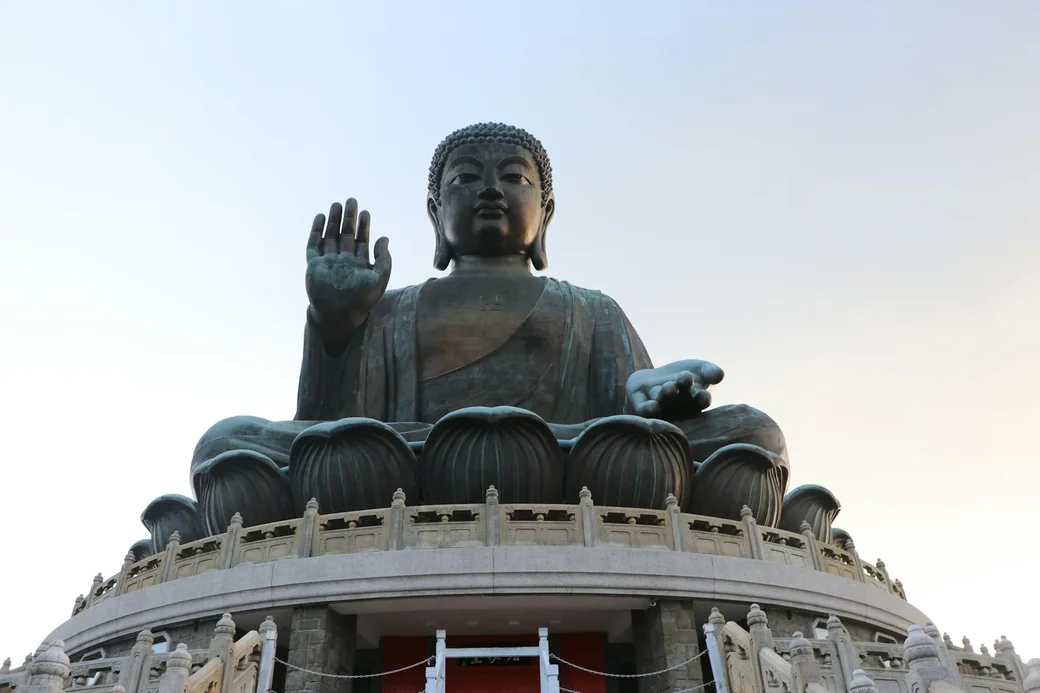
Almost nothing here is decorative. The raised right hand forms the abhaya mudra, a gesture of reassurance and the removal of suffering; the left lies open on the lap in the varada mudra, the granting of wishes. The three-tiered podium echoes the circular terraces of the Altar of Heaven in Beijing, which is where the name Tian Tan comes from. The posture is that of Shakyamuni at the moment of awakening beneath the bodhi tree. On the chest is a swastika, in Buddhism an ancient emblem of good fortune and continuity. Six smaller bronze figures, the Offering of the Six Devas, present flowers, incense, a lamp, ointment, fruit and music. The face is modelled on the Vairocana Buddha of the Longmen Grottoes, while the robes and hair ornament follow a Shakyamuni figure in Cave 360 at Dunhuang, giving the statue the full, rounded style of Sui and Tang sculpture. Great Buddha images traditionally face south; this one, unusually, looks north.
Legends and Stories Told About the Big Buddha
Several stories circulate around the statue, and all of them are best taken as folklore rather than fact. According to local hearsay, no typhoon has struck Hong Kong head-on since the Buddha was raised — a popular saying rather than a record of the weather. The monastery's own account says that the relics kept in the upper hall are the size of grains of rice and that, according to tradition, their colour shifts and may look different to different people. It is also said that the statue is counted among the great Buddhas of the five directions, standing for the south, and that its northward gaze is a blessing sent out across the mainland; both are interpretations passed down by devotees rather than official doctrine.
Po Lin Monastery: A Working Temple Since 1906
The monastery facing the Buddha was founded in 1906 by three monks from Jiangsu, who called their first shelter the Big Thatched Hut; it took the name Po Lin, Precious Lotus, in 1924. Its main axis runs from the Mountain Gate through the Hall of Skanda Bodhisattva and the Main Shrine Hall, where three bronze Buddhas represent past, present and future lives, to the Grand Hall of Ten Thousand Buddhas. Bell and drum towers, a meditation hall and a sutra library holding a set of the Qianlong Tripitaka (the Buddhist canon printed under the Qianlong emperor) stand to either side. The vegetarian kitchen has fed pilgrims for generations, and the monks' hand-made wooden bracelets are sold nowhere else. The three founders were the monks Da Yue, Dun Xiu and Yue Ming, and in 1918 nuns ordained here established the nearby Chi Chuk Lam nunnery. The monastery's year still turns on its observances: a seven-day meditation retreat in the first lunar month, and the Ullambana rites in which families remember their ancestors.
The Bodhi Path and the Twelve Divine Generals
The walk from the cable car to the Buddha is a designed route rather than a shortcut. Leaving Ngong Ping Village you pass under a white ceremonial gate in northern Qing style and onto the Bodhi Path, lined on both sides with stone figures of the Twelve Divine Generals who guard the Medicine Buddha. Each weighs around a tonne and stands about 1.8 metres tall, each keeps watch over a two-hour period of the day, and each wears a crown carrying the emblem of one Chinese zodiac animal — so you can look for your own. Forty carved stone lotus lamps run alongside, and an open-air altar hosts ceremonies. Before the path even begins, Ngong Ping Village holds a handful of indoor attractions worth knowing about: Walking with Buddha, the Monkey's Tale Theatre drawn from the Jataka stories (tales of the Buddha's previous lives), the Cable Car Discovery Centre, a motion-simulator cinema and a virtual-reality show, plus a two-storey tea house where Hong Kong teas are served.
Cable Car or Bus? Choosing How to Reach Ngong Ping
The cable car is the experience; the bus is the insurance. Ngong Ping 360 runs 5.7 kilometres in about 25 minutes across the bay and over the ridges, with standard, glass-floored and fully glazed cabins, and it is the longest bi-cable system in Asia. It also stops for lightning, strong wind and scheduled maintenance, which is why New Lantao Bus 23 from Tung Chung is worth knowing: slower, winding and entirely unaffected by weather that grounds the cabins. Only water may be drunk on board, and children under twelve must travel with someone aged fifteen or over. Many visitors ride up and take the bus down, or the reverse. Technically the line runs between two terminals with two intermediate angle stations and eight towers, and a standard cabin carries up to seventeen people. Walkers have another option: the Ngong Ping 360 Rescue Trail climbs alongside the cable route from Tung Chung, and the operator sells a dedicated hiking pass for those who want to combine the walk with a ride.
Best Time to Visit and How to Avoid the Crowds
October to December is the sweet spot: dry air, clear light and comfortable temperatures. Within the day, the first hour after opening is by far the quietest, and the monastery grounds open earlier than the statue, so an early arrival is never wasted. Coach groups tend to build through the late morning and thin out again after mid-afternoon, which makes the last couple of hours a good second choice. Weekdays beat weekends by a wide margin. Public holidays and Lunar New Year fill the plateau completely. The Buddha's Birthday brings a bathing ceremony at the monastery that is open to all and genuinely worth seeing, but expect crowds.
Mountain Weather on the Ngong Ping Plateau
Ngong Ping sits high enough that it runs several degrees cooler than the harbour, and the wind on the Buddha's platform can be sharp even on a warm day, so pack a light layer whatever the forecast in town. Cloud is the real variable: the plateau can sit inside it for hours, and on those days the statue appears and disappears from twenty metres away, which is atmospheric but not what most people have travelled for. Summer is humid and falls within the typhoon season. Rain makes the granite steps slippery and will suspend the cable car if it comes with lightning or strong gusts.
Where to Take the Best Photographs
The strongest angle is from the lower third of the staircase, looking up: the steps compress and the statue fills the frame at its most imposing. From the platform you can circle the figure completely, with the monastery roofs below and ridgelines behind. The last two minutes of the cable car approach give the only view that shows the Buddha, the monastery and the plateau together. Down in the monastery, the smoke of the incense forecourt frames the silhouette on the hill beautifully. The white ceremonial gate works as a foreground, and morning light warms the bronze far more kindly than the flat glare of midday. Hong Kong has framed the figure officially too: it has appeared on definitive postage stamps, and the opening scene of the 2003 Hong Kong crime film Infernal Affairs III was shot at the statue. Down in the village, eight cable car cabins painted in the colours of different national flags are set out as a photo stop, and they work well with children in the frame.
Temple Etiquette at the Big Buddha and Po Lin Monastery
This is an active monastery with resident monks, not an open-air museum. Keep your voice low inside the halls, remove hats, and never step on the raised wooden thresholds in the doorways. Do not point at the Buddha images, and avoid sitting with the soles of your feet directed towards a statue. Ask before photographing monks or anyone at prayer, and respect the photography signs posted hall by hall. If you want to offer incense, buy it from the stalls by the forecourt rather than bringing your own. Give way to worshippers at the altars, and leave the cushions and kneelers free for those using them.
Accessibility: Reaching the Platform Without the Steps
The 268 steps are not the only way up. A narrow service road and ramp reach the lower level of the podium, and staff at the site will arrange access on request, so wheelchair users can get to the statue itself rather than viewing it from the forecourt. Both cable car terminals have ramps, lifts, accessible toilets and staff who assist with boarding, and wheelchairs can be taken into the cabins. From the upper terminal the route to the forecourt runs about 650 metres on a gentle gradient. Note that the Lantau buses are generally not wheelchair accessible, and only Lantau taxis, not urban ones, serve the plateau.
Making a Full Day of It on Lantau Island
The Buddha rewards an hour or two; Lantau rewards a day. Bus 21 reaches the stilt-house fishing village of Tai O in about fifteen minutes, which pairs naturally with a late afternoon. Walkers have Lantau Peak at 934 metres, Hong Kong's second-highest summit and a famous sunrise spot, roughly one to two hours up from the monastery and mostly stairs, so a head torch is essential for a pre-dawn start. Gentler options include the circuit around Nei Lak Shan and the Ngong Ping Trail. A youth hostel on the plateau lets you be on the summit before first light, and Tung Chung has shops and the MTR for the way home. Tai O also runs small boat trips in search of the pink dolphins that live in these waters. Back at the foot of the hill, Tung Chung has the Citygate Outlets mall for the end of the day and, a short walk from the station, the small Tung Chung Fort with its old cannons; Hong Kong Disneyland sits a few stops along the same MTR line.
Wild Cattle and the Forgotten Tea Plantation of Ngong Ping
Two things surprise most first-time visitors. The first is the cattle: descendants of farm animals released when cultivation ended, they graze freely around the village and bus terminus. Give them space, never feed them, and never walk between a cow and her calf. The second is hidden on the slope above the monastery, where Hong Kong's only tea plantation was laid out in the 1950s and supplied a locally sold green tea for several decades. The land returned to government hands in the 1990s, but tens of thousands of tea bushes still grow wild among the derelict buildings. The tea house down in the village is a separate, modern business.
Big Buddha (Tian Tan Buddha, 天壇大佛): Visitor Tips
Arrive early. The plateau is calmest in the first hour after opening, and the monastery grounds open before the statue does, so there is always something to see while you wait. Carry water for the 268 steps and wear shoes with grip, because the granite turns slippery after rain. Bring a light layer even in summer: Ngong Ping sits high enough to be noticeably cooler than the harbour. Check the cable car's status on the morning of your visit, since lightning, high wind and scheduled maintenance can all suspend it; the Lantau buses keep running when it does not. Give the free-roaming cattle around the village plenty of room, keep your voice down inside the monastery halls, and allow at least half a day if you want to pair the Buddha with Tai O or a walk on the ridge trails.
Big Buddha (Tian Tan Buddha, 天壇大佛): Best Time to Visit
October to December for dry, clear air. Arrive at opening time on a weekday, or come after mid-afternoon, to miss the heaviest crowds.
Quick Info
3h
moderate
Big Buddha (Tian Tan Buddha, 天壇大佛): Getting There
The classic approach is the Ngong Ping 360 cable car. Take the MTR Tung Chung Line to its terminus at Tung Chung, leave by Exit B, and the lower terminal is a two-minute walk away. The ride covers 5.7 kilometres in about 25 minutes, crossing Tung Chung Bay and climbing over the ridges of North Lantau, and ends beside Ngong Ping Village; from there it is a level ten-minute walk through the piazza to the foot of the steps.
The cheapest route is New Lantao Bus 23, which leaves from the Tat Tung Road bus terminus in Tung Chung and takes roughly 45 to 50 minutes on a narrow, twisting mountain road — worth knowing if anyone in your group is prone to motion sickness. From the south of the island, take the ferry from Central Pier 6 to Mui Wo and pick up bus 2, about 35 to 40 minutes. From Tai O, bus 21 reaches Ngong Ping in about 15 minutes. Coming straight from the airport, bus S1 runs to Tung Chung in around 15 minutes. Lantau taxis also serve the plateau; ordinary urban taxis do not.
Nearby stops & parking
Ngong Ping Bus Terminus is the end of the line for every New Lantao Bus route serving the plateau and sits only a few minutes' walk from the Buddha's forecourt. The Ngong Ping Cable Car Terminal is at the entrance to Ngong Ping Village, with a Lantau taxi rank alongside it. Drivers can leave vehicles at the Ngong Ping Piazza car park, from which a flat path of about 200 metres leads to the foot of the steps, or at the car park by the monastery's ceremonial gate. Many visitors prefer to park in Tung Chung and ride up, and left-luggage facilities are available at both the Tung Chung terminal and the information centre in Ngong Ping Village, which is useful if you are travelling with suitcases between the airport and the city.
Big Buddha (Tian Tan Buddha, 天壇大佛): Dress Code & Etiquette
There is no posted dress code at the Big Buddha or at Po Lin Monastery, but this is a working religious community rather than a museum, and visitors are expected to dress with that in mind. Covered shoulders and knees are the comfortable middle ground; beachwear, very short shorts and clothing with provocative slogans will draw disapproving looks. Comfortable closed shoes matter for the staircase. Inside the halls, keep your voice low, take your hat off, do not step on the raised thresholds and do not point at the images. Ask before photographing monks or anyone at prayer, and follow the photography signs posted in each hall.
Guide / Language
en
zh
Big Buddha (Tian Tan Buddha, 天壇大佛): Amenities & Facilities