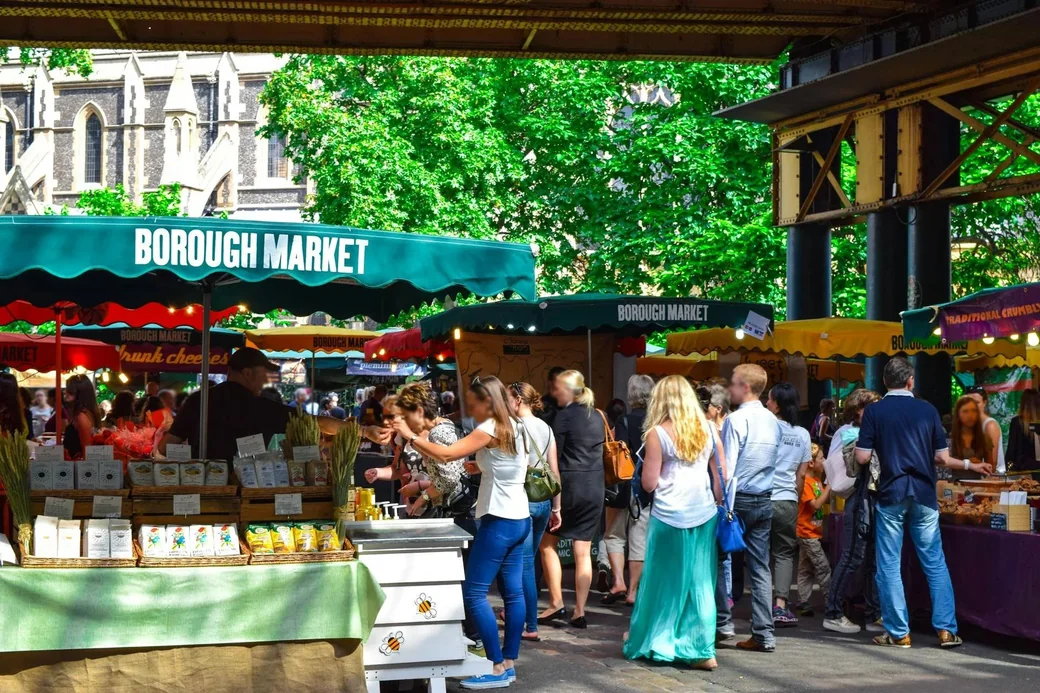
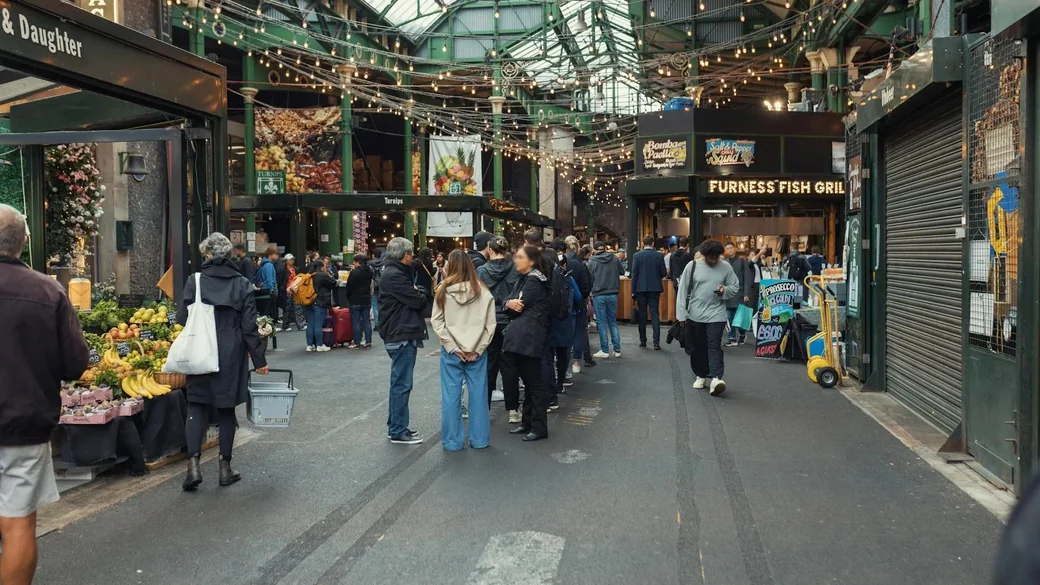
Borough Market is one of London's best-loved food markets, set beneath the railway arches at the southern end of London Bridge in Southwark, on the south bank of the Thames. Part working market and part street-food destination, it brings farmers, bakers, cheesemakers, fishmongers, butchers, spice merchants and street cooks together under iron roofs and along cobbled lanes, while the surrounding streets add restaurants, bars and small shops. It is a place to taste, shop for fine produce and enjoy one of the city's liveliest atmospheres.
Borough Market: Location, accommodation options and contact
8 Southwark Street, London SE1 1TL
The place's location on the map and nearby accommodation and hotel options are shown by Stay22. Cookies are used. Your consent is remembered on every page; you can turn it off at any time in the cookie settings.
Borough Market History: A Thousand Years Beside London Bridge
Southwark lies at the southern end of what was long London's only river crossing, so traders gathered here for centuries. The market dates its beginnings to 1014 at the latest. In the 1270s the City of London barred its citizens from buying food in Southwark; in 1550 it took over the market and raised trading from two days a week to four. Congestion led Parliament to close the old market in 1754, and in 1756 local parishioners opened a new one just off the high street, where it still stands. Excavations in 1961 reportedly uncovered traces from the first century AD. In 1930 Charlie Chaplin's offer to sponsor the traders' annual sports day even turned it into national news. The railway arrived in the nineteenth century and made Borough a major fruit-and-vegetable wholesale hub; in the late 1990s the market reinvented itself as the retail food market visitors know today.
The 1014 Legend: Prince Olaf, London Bridge and a Nursery Rhyme
According to Heimskringla, a thirteenth-century saga collection, the Viking-age prince Olaf Haraldsson, an ally of King Æthelred, tied ropes to London Bridge in 1014 and pulled it down with his ships, splitting the forces holding the City from those in Southwark. The same text calls Southwark a great market town, which is why the market points to 1014. Legend adds that his poet's victory verse, 'London Bridge is broken down', inspired the nursery rhyme. Historians call that link only a hypothesis: the rhyme was already famous when the saga was first translated for modern readers, and no other account confirms the attack.
Borough Market Architecture: Victorian Ironwork, Art Deco Gate and Floral Hall Portico
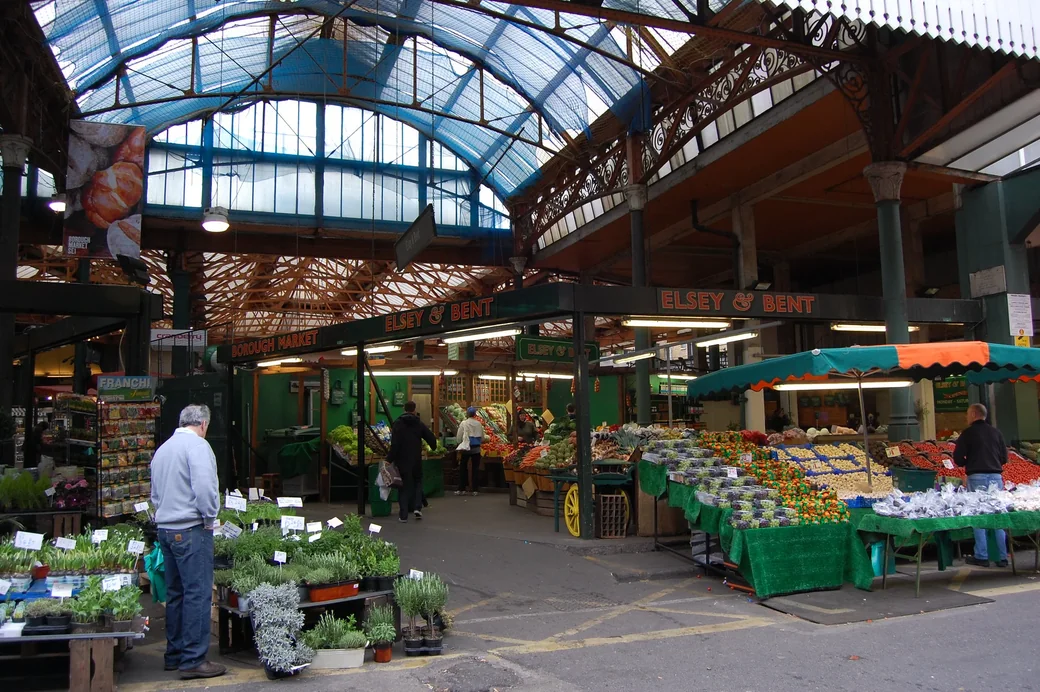
The present halls were designed in 1851 by Henry Rose, with additions in 1863–64 by Edward Habershon. Rose had earlier redesigned the nave of St Saviour's (today's Southwark Cathedral), and Habershon specialised in Gothic-style churches and chapels, which helps explain the Gothic flavour of the wrought iron. Look for the Art Deco entrance on Southwark Street, added in 1932, and the iron-and-glass portico with its fan-shaped window and decorative pineapples on Stoney Street. That portico was built in 1858–59 for the Floral Hall at Covent Garden and re-erected here in the early 2000s; it has been Grade II listed (nationally protected) since 2008. Gustave Doré and Blanchard Jerrold illustrated the iron market in 1872.
Borough Market Map: Three Crown Square, Green Market, Market Kitchen and Market Hall
The market is a tangle of halls and lanes, so it helps to know its parts. Three Crown Square is the largest trading area, with bigger producers and merchants selling fruit, vegetables, cheese, meat and fish. The Green Market is for small specialist producers. Borough Market Kitchen, in Jubilee Place, is the covered street-food hall with long shared tables. The Market Hall facing Borough High Street, a greenhouse-style hall, hosts demonstrations and children's activities. Entrances open from Southwark Street, Stoney Street, Cathedral Street and Borough High Street; the Borough Market Store just inside the main entrance can answer questions.
What to Eat at Borough Market: Street Food Stalls and Hot Dishes
Come hungry and graze. Kappacasein is famous for raclette (melted cheese scraped over potatoes and pickles) and a four-cheese grilled sandwich; Richard Haward's serves oysters from a family of oyster farmers; Nana Fanny's is known for salt beef bagels; Gujarati Rasoi and Horn OK Please offer vegetarian street food; The Black Pig is praised for its pork sandwiches. Borough Market Kitchen gathers a wide choice of street-food traders under one roof, and Padella, a short walk away, serves fresh handmade pasta. Stalls rotate, so treat names as starting points, and share dishes to taste more.
Cheese, Bread, Coffee and Fresh Produce: What to Buy at Borough Market
Borough rewards shoppers who take something home. Neal's Yard Dairy, around the corner on Park Street, is a temple of farmhouse cheese; Bread Ahead is known for sourdough, focaccia and filled doughnuts and runs a baking school; Monmouth Coffee roasts single-origin beans, and its queue on Stoney Street is part of the experience. Spice Mountain sells spices and flavoured salts, The Ginger Pig sells rare-breed meat from its own farms, Chegworth Valley presses apple juices from Kent orchards, and Brindisa stocks cured meats and olive oil. Seasonal treats include wild garlic in spring, strawberries in June and truffles in winter. Many traders offer small tastings, so ask politely. A simple rule works well here: eat first, shop second, and take something home; cheese, bread, spices and jars of honey all travel well.
Best Time to Visit Borough Market: How to Avoid the Crowds
Weekday mornings just after opening and Tuesday to Thursday afternoons, once the lunch rush fades, are the calmest times. On Saturdays the market opens earlier, and arriving early gives you space before the crowd thickens through the morning; Saturday afternoon is the busiest moment of the week. Sundays close earlier, and Monday is a rest day. Not every trader is present every day, but there is plenty of choice all week. Allow between one and a half and three hours. Spring and autumn are the most comfortable seasons, covered halls shelter you from rain, and the weeks before the year-end holidays are festive but very busy.
Borough Market Visitor Tips: Payments, Toilets, Seating and Guided Tastings
Most traders take cards, but a few small stalls prefer cash, and there are banks on Borough High Street and Southwark Street. Public toilets are in Three Crown Square, Borough Market Kitchen and the Market Hall. Seating is limited, so plan to eat in the Southwark Cathedral gardens or by the river. The whole market is smoke-free, bikes and scooters must be pushed, and dogs must be on a lead or carried. For a guided visit, the market lists two official tours: a tasting tour with food writer Celia Brooks on selected Friday mornings and a private behind-the-scenes tour with Totally Tailored. Both run in English and need advance booking. Items left behind are kept by the market's security team for a limited time.
Borough Market Accessibility: Step-Free Routes, Cobbles and Accessible Toilets
The public areas lie on a single ground-floor level, so there are no stairs or lifts to worry about, although a few restaurant buildings have several floors. The estate is historic: some surfaces are cobbled, and passages vary from about 1.5 to 4 metres wide, so some corners are easier than others. Fully fitted accessible toilets with emergency pull cords are found in four places during trading hours, and no RADAR key (the national key for accessible toilets) is needed. The Borough Market Store just inside the main entrance is step-free and a good place to ask for help. A weekday morning makes manoeuvring far easier than a crowded Saturday afternoon.
Hidden Details and Photo Spots at Borough Market
Look up and around. A reproduction of the market's eighteenth-century bell, cast in 2013 by the famous Whitechapel foundry, hangs near the Middle Road entrance; the original rule was to ring it at nine each morning before stalls could open. Inside the iron halls a huge wooden board from 1910 lists the rents for flowers, fruit and vegetables. Faded ghost signs (old painted advertisements) include 'Take Courage' on Park Street and Lee Brothers on Bedale Street. The Wheatsheaf pub on Stoney Street lost its upper floor when the railway viaduct was built. On Park Street, a terrace by Henry Rose from 1831 recalls Thomas Cure's sixteenth-century almshouse bequest, and Cromwell Buildings on Redcross Way date from 1864.
Borough Market Film Locations: Harry Potter, Bridget Jones and More
Borough's Victorian streets are a favourite with film crews. In Harry Potter and the Prisoner of Azkaban the Knight Bus pulls up on Stoney Street beneath the railway bridge, where the Leaky Cauldron entrance stood; in the first film that entrance was filmed at Leadenhall Market instead. Bridget Jones's Diary used Bedale Street for Bridget's flat, with the Globe Tavern next door and a neighbouring wine bar dressed as a restaurant for the famous fight scene. A sandwich shop on Bedale Street became a taxi office in The Edge of Reason, and Stoney Street appears in Bridget Jones's Baby. Lock, Stock and Two Smoking Barrels was shot on Park Street, and Clink Street stood in for The Elephant Man. The same Park Street houses are also said to appear in Howards End.
Borough Market Legends: Ghost Stories, a Ship's Cannon and Local Folklore
Folklore clings to these lanes. According to local ghost stories, the Market Porter pub on Stoney Street, long known for opening early for market workers, is haunted: staff tell of tills and glass-washers switching on by themselves and of an upstairs room where visitors rarely linger. Inns across Southwark have their own spirits, from a shadowy lady said to drift through the old bedrooms of the George Inn to a mischievous poltergeist nicknamed Charlie at the Anchor Tap. The iron bollard at the corner of Stoney Street and Southwark Street is a genuine nineteenth-century ship's cannon; rumour says it was captured at Trafalgar, but no evidence supports that. Enjoy these tales as folklore, not fact.
Cross Bones Graveyard Near Borough Market: Southwark's Memorial to the Outcast Dead
A short walk from the market, on Redcross Way, Cross Bones is an old burial ground that was never consecrated and holds more than 15,000 poor Londoners. Its gates are hung with ribbons and tokens in memory of 'the outcast dead', and a volunteer-run garden of remembrance welcomes visitors on most days. Tradition says it also received the 'Winchester Geese', women licensed by the Bishop of Winchester who lived and worked in medieval Southwark, although nobody can prove it. In 1996 the poet John Constable said that the spirit of a medieval 'Goose' led him there in a vision and dictated a poem; it grew into The Southwark Mysteries, staged at Shakespeare's Globe and Southwark Cathedral in 2000. Treat the place as one of quiet remembrance.
Borough Market Is a Charity: Community, Sustainability and Food Policy
Borough Market is owned by an independent charitable trust and run by a board of volunteer trustees, an unusual set-up for a market of its size. An Act of Parliament of 1756 fixed it on this land 'for ever' as an asset of the local community, and it receives no public funding: stall fees and rents pay for the market. Traders are chosen under a Food Policy built on nine principles, including quality, sustainability, animal welfare and accessibility. The market is an accredited Living Wage employer, sends no waste to landfill, provides drinking-water fountains instead of selling bottled water, passes surplus food to local charities through volunteers, and runs school programmes such as Young Marketeers and the Market Explorers activities for children.
Things to Do Near Borough Market: Southwark Cathedral, The Shard and the Thames Path
Southwark Cathedral stands beside the market. Look for Hodge, the resident cat named after Samuel Johnson's own cat, and for the carved corbel (supporting stone) remembering his predecessor, Doorkins Magnificat. Shakespeare's brother Edmund is buried here, and John Harvard, founder of Harvard University, was baptised in the church. A plaque in Talbot Yard marks the site of the Tabard Inn, where Chaucer's pilgrims set out, and the George Inn on Borough High Street is the last galleried coaching inn in London. Southwark lay outside the City's rules for centuries, which helps explain why markets, inns and theatres flourished here. Walk on to the Golden Hinde, the Clink Prison Museum, Shakespeare's Globe, Tate Modern, the Shard and Tower Bridge. Charles Dickens mentions the George Inn in Little Dorrit, and Maltby Street Market, about a mile away, offers another food-market atmosphere. London Bridge station, served by the Jubilee and Northern lines as well as National Rail trains, stands right beside the market, which makes it an easy starting point for a walk along the Thames Path.
Borough Market: Visitor Tips
Arrive hungry and early. Weekday mornings just after opening are the calmest, and the Saturday crowd builds quickly later in the morning.
Do share portions so you can taste more stalls, bring a tote bag, and ask traders about ingredients if you have allergies or dietary needs. Keep bags zipped and phones out of back pockets in the busiest lanes; as in any crowd, pickpockets can be a risk.
Don't ride bikes or scooters through the market, don't smoke, and don't leave dogs unattended; dogs must be on a lead or carried. Seating is scarce, so take your food to the gardens of Southwark Cathedral or to the riverside.
Photo spots: the Art Deco gate on Southwark Street with the Shard behind it, the Floral Hall portico on Stoney Street, light slanting through the railway arches, and the faded painted ghost signs. Ask before photographing people or stalls up close; professional shoots need the market's permission in advance. Visitors also mention a cash machine tucked inside a red telephone box.
Borough Market: Best Time to Visit
Tuesday–Thursday afternoons or right at opening; Saturday morning for the full buzz. Spring and autumn are pleasant, and the covered halls suit any weather.
Borough Market: Admission Fees
Free admission
Walking through the market halls and the surrounding stalls is free of charge; food and drink are paid for at each stall.
Free
Quick Info
2h
easy
Borough Market: Getting There
By Tube and train: the market is right next to London Bridge station, served by the Jubilee and Northern lines and by National Rail services. From the station walk down London Bridge Street, turn left onto Borough High Street and then right onto Southwark Street; if you can see Southwark Cathedral, you are in the right place. By bus: routes 17, 21, 35, 47, 133, 343 and 381 stop within about five minutes' walk. On foot: it is an easy riverside stroll along the Thames Path from Tate Modern (about ten minutes) or from Tower Bridge (about fifteen minutes). By bike: racks stand inside the market and cycle-hire docks are close by. By car: the market has no car park and lies inside the Congestion Charge zone (London's central road-user charge area), so public transport is far easier. Taxis can pick up and drop off at points around the market.
Nearby stops & parking
Closest station: London Bridge for the Tube and National Rail. Bus stops for the routes above lie within a five-minute walk. Cycle-hire docks are nearby, and bike racks stand in the Green Market and on Stoney Street. There is no parking at the market itself; the nearest public car parks include Snowsfields, and the whole area is inside the Congestion Charge zone. Cab pick-up and drop-off points surround the market. For a calmer arrival, get off at London Bridge and walk the last few minutes past the cathedral gardens.
Borough Market: Dress Code & Etiquette
There is no dress code at the market, so come casual. Wear comfortable, closed shoes because the lanes are partly cobbled, and layer your clothing since the halls are covered but the passages are open to the weather. A small backpack or tote is easier than a large bag in the crowds. Good manners: queue patiently, ask before photographing traders, step aside while you eat and respect the smoke-free rule. If you step into Southwark Cathedral next door, dress modestly and keep your voice low, especially during services.