The British Museum, in the Bloomsbury district of central London, is one of the world's great museums of human history, art and culture. Its galleries bring together objects from every continent and every era, allowing visitors to follow the story of humanity from prehistory to the present day within a single, monumental building. Famous treasures from ancient Egypt, Greece and Mesopotamia sit alongside remarkable collections from Asia, Africa, the Americas and Europe, making it one of the most important museums anywhere and an essential stop on any visit to London.
British Museum: Location, accommodation options and contact
Great Russell Street, Bloomsbury, London WC1B 3DG, United Kingdom
The place's location on the map and nearby accommodation and hotel options are shown by Stay22. Cookies are used. Your consent is remembered on every page; you can turn it off at any time in the cookie settings.
Best Time to Visit the British Museum and How to Avoid the Crowds
The galleries are quietest in the first hour after opening and again in the last hour before closing. Midday is the busiest period, along with weekends, school holidays, bank holidays and the Christmas–New Year season. November and early December are usually calmer. On Fridays the museum stays open late, which makes the evening a relaxed time to see the highlights. Rooms 1, 2, 15 and 21 on the ground floor, the Islamic world galleries (Rooms 42–43) and the Japan galleries (Rooms 92–94) tend to stay peaceful all day. Galleries begin to close shortly before closing time, while the Great Court stays open a little longer. Some Friday late openings include extra activities, which can make the museum busier and noisier.
How to Enter the British Museum: Timed Slots, Two Entrances and Security Queues
General entry works with timed slots reserved on the museum's website. Booking ahead brings priority entry at busy times; walk-up visits are possible, but the wait can be longer. Arrive at your slot time rather than earlier. There are two entrances, the main one on Great Russell Street and a second on Montague Place, and everyone passes a security check and bag search. A single booking covers up to nine people, while groups of ten or more need a group booking. Special exhibitions are ticketed separately and can sell out, so reserve them early. Entry to the permanent collection is free.
British Museum Highlights Route: What to See in Two to Three Hours
Most visitors need two to three hours for the headline objects, although a full day would not exhaust the collection. A classic route begins on the ground floor with the Rosetta Stone (Room 4), continues to the Parthenon Sculptures (Room 18) and the Assyrian lion-hunt reliefs (Room 10), then climbs to the Lewis Chessmen (Room 40), the Sutton Hoo helmet (Room 41) and the Egyptian mummies (Rooms 62–63). Pick up the museum map, try an object trail, and choose five or six rooms rather than racing through everything. Beyond the headline route, Room 1 (Enlightenment) is the museum's first wing, built to house King George III's library, and still uses Smirke's original display-case designs. Room 2 explores collecting the world, Room 24 (the Wellcome Trust Gallery) looks at living and dying, Room 68 is the money gallery, and Rooms 90 and 90a show prints and drawings in changing displays. Rooms 30 and 35 host special exhibitions. Behind these highlights lies a collection of roughly eight million objects spanning some two million years, spread across more than 50 galleries on several floors.
Rosetta Stone, Mummies and the Egyptian Galleries of the British Museum
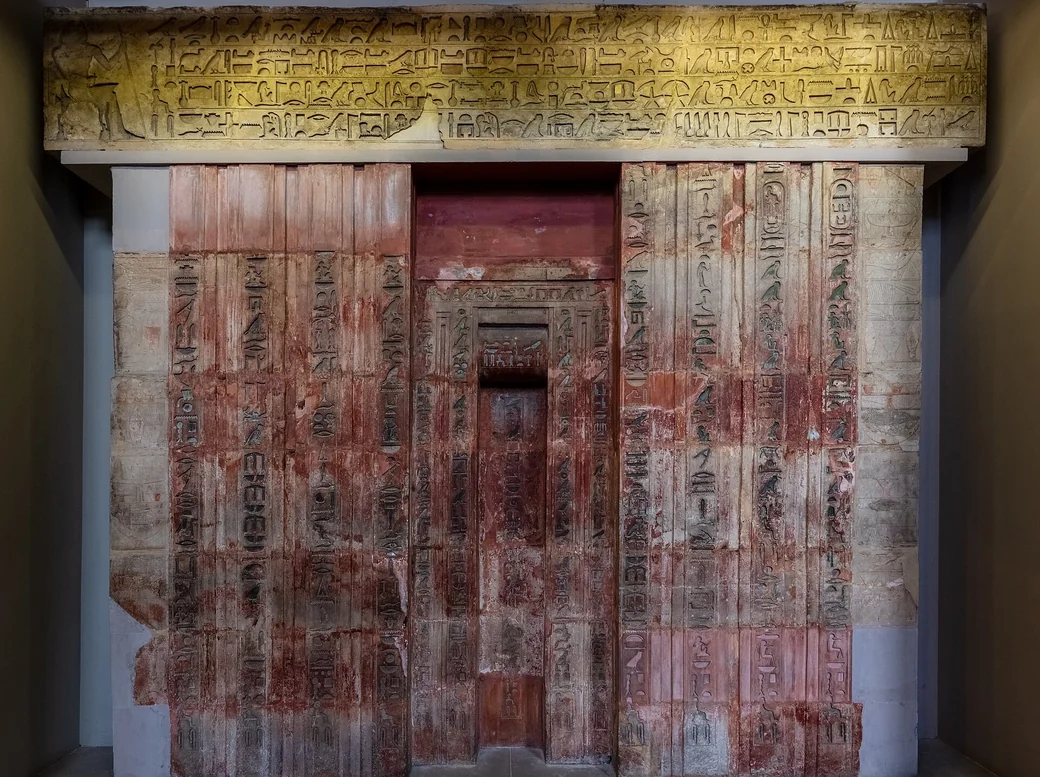
Room 4 holds the Rosetta Stone, a slab of dark granodiorite (a hard grey-pink stone) carved in 196 BC with one decree in three scripts, hieroglyphic, Demotic and Greek, which helped scholars read ancient Egyptian writing. Look at its sides: faint painted inscriptions mention its 1801 acquisition in Egypt and its presentation by King George III. Upstairs, Rooms 62–63 show mummies and coffins, Room 61 displays the painted tomb-chapel of Nebamun, and Rooms 64–66 cover early Egypt, Nubia and Coptic Egypt. Room 4 also offers touch tours. The stone was found in 1799 during building work at Fort Julien near the port of Rosetta (Rashid) and has been on show at the museum since 1802, apart from a short break in 1917–1919. The colossal quartzite head of Amenhotep III stands in the Great Court.
Parthenon Sculptures, Assyrian Reliefs and Ancient Near East Galleries
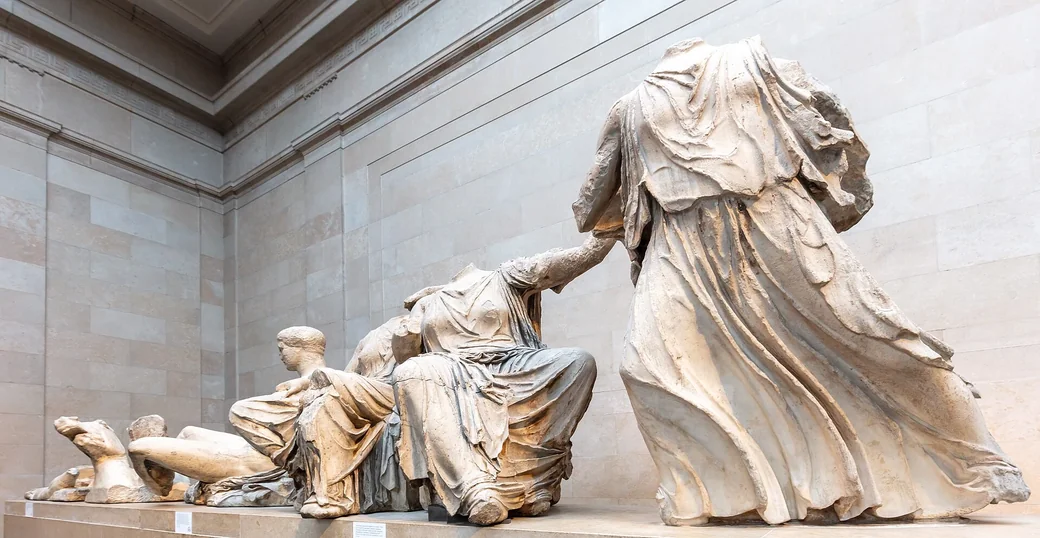
Room 18 presents the Parthenon Sculptures, marble figures that once decorated the temple of Athena on the Acropolis in Athens. Nearby you will find the Nereid Monument (Room 17), the Mausoleum of Halikarnassos (Room 21) and the Bassai frieze (Room 16). The monumental Assyrian reliefs fill Rooms 6–10, including the lion hunts of Room 10, and upstairs the Mesopotamia galleries and the Oxus Treasure of ancient Iran (Room 52) continue the journey. The Parthenon rooms are among the busiest, so go early or late. The Assyrian rooms include the Balawat Gates, reliefs from Nimrud and Nineveh, the Siege of Lachish and finds from Khorsabad. Room 22 explores Alexander's world, Rooms 53–56 cover South Arabia, Anatolia and Urartu, and Mesopotamia, and Rooms 69–73 turn to Greek and Roman life, the Roman Empire, the Etruscans, Cyprus and the Greeks in Italy.
Sutton Hoo Helmet, Lewis Chessmen and Medieval Treasures in Rooms 40 and 41
Room 41 displays the treasures of Sutton Hoo, an early medieval ship burial found in Suffolk in 1939, including its famous helmet. Next door, Room 40 holds the Royal Gold Cup and the Lewis Chessmen, 12th-century walrus-ivory chess pieces discovered on the Isle of Lewis in the Hebrides; a smaller group is kept in Edinburgh. Rooms 49 and 50 follow Roman Britain and Iron Age Europe, with fine Celtic metalwork. Together these rooms form a compact walk through early European history. Room 40 is devoted to medieval Europe, Room 41 to Sutton Hoo and Europe from AD 300 to 1100, and Room 51 to Europe and the Middle East.
Japan, Korea, China, Africa and the Americas: Beyond Europe at the British Museum
The upper floors hold the Asian galleries: China and South Asia (Room 33), Chinese jade (Room 33b), the Percival David collection of Chinese ceramics (Room 95), Korea (Room 67), with a full-size reconstruction of a scholar's study (a sarangbang), and Japan (Rooms 92–94), where a tea-house replica hosts tea ceremonies from time to time. Rooms 42–43 present the Islamic world. Downstairs, Room 25 covers Africa, Room 26 North America and Room 27 Mexico, where a turquoise double-headed serpent stands out. Room 33a holds the Amaravati sculptures. The museum also holds about 80 works from North Korea, gathered during curatorial visits in 2001 and 2002.
Great Court, Reading Room and Architecture: Seeing the Building Itself
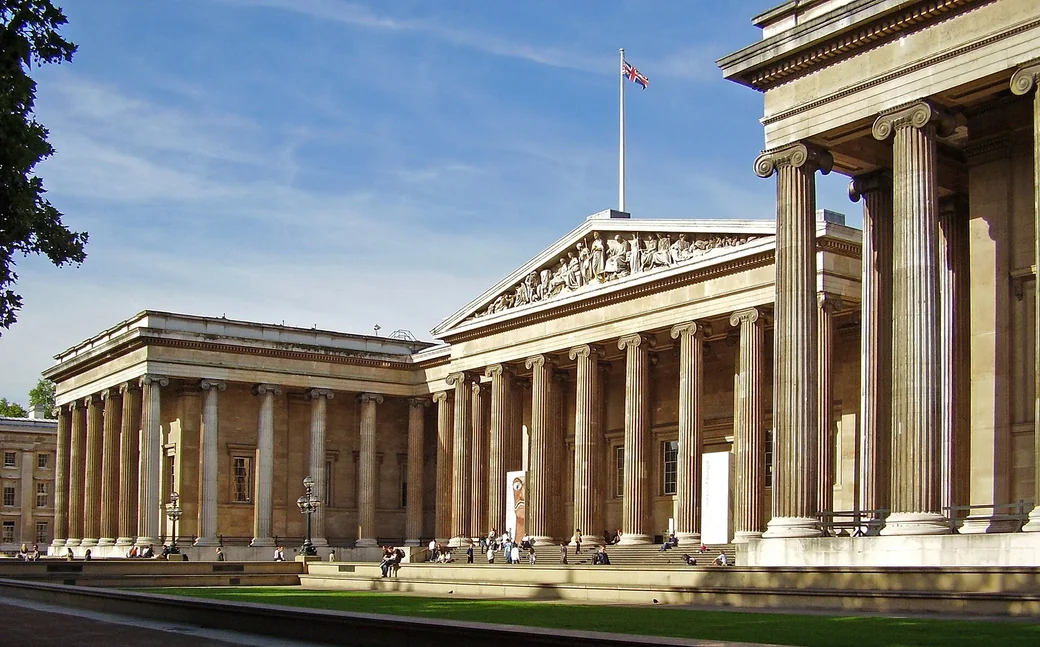
Look at the building as well as inside it. Sir Robert Smirke's Greek Revival front was completed in 1852, and the pediment above its columns shows eight stages of the "progress of civilisation", once painted white against a Wedgwood-blue background. The Great Court covers two acres under a glass roof of more than 3,000 panes, no two of the same shape. At its centre rises the Round Reading Room (1857), which is occasionally closed, so check the museum's website beforehand. Even the iron railings are painted a shade called "invisible green". Smirke's original plan treated the central courtyard as a garden, but from 1852 it filled with book stacks, and the library stayed until 1997. After a competition with more than 130 entries, Foster and Partners transformed the space; it opened on 6 December 2000 and added about 40 percent more public space. The Reading Room was designed by Sydney Smirke and built in 1854–57; its dome is 42.6 metres wide, its ceiling is papier-mâché, and Bram Stoker was among its readers. The library collections moved to St Pancras in 1997, and the museum's own library and archive can be visited by appointment. The Great Court also displays totem poles, the Lion of Knidos and a sandstone slab inscribed in Ogham (an early medieval Irish alphabet written as notched strokes along an edge). The site could have been different: Buckingham House, later Buckingham Palace, was considered before Montagu House was chosen. Until the late 19th century the galleries relied on daylight, and in 1879 the museum became one of London's first public buildings to try electric lighting. During the Second World War the treasures were evacuated, and heavy sculptures were stored in a Tube tunnel at Aldwych. Smirke's building began to rise in 1823, replacing Montagu House, the 17th-century mansion that first housed the museum, and its style, Greek Revival, is an architecture modelled on classical Greek temples. The sculptures in the pediment (the triangular gable above the columns) were designed by Sir Richard Westmacott. The Great Court is the largest covered public square in Europe, the Reading Room's dome echoes the Pantheon in Rome, and Karl Marx, Virginia Woolf, Oscar Wilde and Arthur Conan Doyle also read and wrote beneath it.
Audio App, Guided Tours, Hands-On Desks and Object Trails
The official Audio app offers gallery introductions and commentaries on about 250 objects in English, French, German, Italian, Spanish, Chinese, Japanese and Korean, plus a guide in British Sign Language; bring your own headphones. The museum also offers talks, tours, object trails and an audio-descriptive guide under "Tours and talks" on its website. Guided touch tours in Room 4 and Rooms 18–18b must be booked in advance. The Audio app also offers 65 gallery introductions and self-guided tours from ancient Egypt to medieval Europe; when you see the audio-guide symbol on a case, type its number into the app. A 153-part audio-descriptive guide is available on SoundCloud, more than 200 BSL videos exist, and Braille and raised-line materials can be collected from the Information Desk.
The British Museum with Children: Family Facilities and Activities
Object trails turn the visit into a treasure hunt, and sensory support backpacks can be borrowed from the Families Desk. The Families Desk and the Ford Centre for Young Visitors open at weekends and during local school holidays. Pushchairs are welcome, fold-up buggies can be left in the cloakroom, and an easy-access entrance route serves families with buggies and children under five. Mummies, Assyrian lions and the Rosetta Stone are reliable favourites, and the Pizzeria has a children's menu.
Accessibility at the British Museum: Step-Free Access, Wheelchairs and Sensory-Friendly Visits
Both entrances offer step-free access with lifts, and visitors with access needs can ask staff to skip the queue. Manual wheelchairs can be reserved by phone or email at least two working days ahead; the museum cannot provide staff to push them. Assistance animals are welcome. You will find audio-descriptive and BSL guides, induction loops, touch tours, ear defenders and a sensory map of quiet and noisy areas. A few smaller galleries have no lift or step-free access, and there is no Changing Places toilet on site. The sensory map shows which areas are busier and noisier, such as the main entrance, the Montague Place foyer, the area around the cloakroom and the Great Court, and which galleries are calmer, filled with daylight or kept dim; temperatures also vary from gallery to gallery. Induction loops are installed at the Ticket Desk and the Clore Centre, more than 200 BSL videos are available, and audiovisual content is captioned. Relaxed evening events are held, and the Hidden Disabilities Sunflower scheme is supported. Water bowls for assistance animals are kept at the Information Desk, and the nearest animal relief area is Russell Square. The nearest Changing Places toilet is at Great Ormond Street Hospital, about 15 minutes' walk from the Montague Place entrance. Wheelchairs cannot be taken off site, and because the Box Office is closed at weekends, reserve one on a weekday. The east lift in the Great Court does not reach levels −1 and −2.
Do's and Don'ts at the British Museum: Bags, Security and Photography
Travel light. Wheeled suitcases and large or heavy luggage are not allowed (the official site lists the size limits); storage is available at Euston, King's Cross and Charing Cross stations, and the cloakroom just inside the main entrance has limited capacity. Bags may be searched, so allow time at security. Hand-held photography is allowed for personal use in most galleries, but tripods, monopods and selfie sticks are not; signs mark restricted areas. Charging phones is not permitted, so start with a full battery. Never leave bags unattended. Folding bicycles may be brought inside, but adult scooters, skateboards and musical instruments may not enter the site. Wi-Fi is available throughout the museum.
Where to Eat and What to See Nearby: Cafés and Bloomsbury Attractions
Inside, the Court Cafés in the Great Court offer food and drinks, the first-floor Coffee Lounge overlooks the Reading Room, the Pizzeria offers vegetarian, vegan and gluten-free choices, and the Great Court Restaurant should be booked in advance. Food trucks stand outside. Beyond the gates, Russell Square gardens are a short walk away, while the British Library, Sir John Soane's Museum, the Charles Dickens Museum and Covent Garden are each roughly 10–20 minutes on foot. The nearest Underground stations are Tottenham Court Road (Central, Northern and Elizabeth lines), Holborn (Central and Piccadilly lines) and Russell Square (Piccadilly line), each a short walk from the museum.
Legends and Ghost Stories of the British Museum: The Unlucky Mummy and the Phantom Station
According to legend, the so-called "Unlucky Mummy" brings misfortune to anyone who disturbs it, and one popular tale claims it sailed on the Titanic in 1912. The stories say it brought bad luck to owners, photographers and journalists, and that hammering and crying were heard from its case; the journalist William T. Stead, who died in the sinking, is said to have retold the tale at dinner on board. In reality it is a painted wooden coffin lid, catalogued EA22542 and shown in Room 62; donated in 1889, it has left the museum only for loans, in 1990 and 2007. Another rumour says the ghost of an Egyptian princess named Amen-Ra haunts the museum's former Tube station and wails along the tunnels towards Holborn. The 1935 film Bulldog Jack, with its fictional secret passage from the Egyptian rooms to a disused station, fed the story, and some versions claim two women vanished from the Holborn platform on its opening night. The station itself opened in 1900 and closed in September 1933, when Holborn's new platforms opened less than 100 metres away; it later served as a military office, and its street building was demolished in 1989. These remain tales, not proven facts.
Surprising Facts About the British Museum: From Mike the Cat to Mozart
The museum opened in 1759 and once had its own Tube station (1900–1933). A cat named Mike guarded the main gate from 1909 to 1929, and his obituaries appeared in the Evening Standard and TIME. Mozart visited as a boy during his family's London stay in the 1760s and dedicated his first sacred composition, "God is our Refuge", to the museum. In 2005 the street artist Banksy slipped a fake cave-art stone into a gallery, labelled with a story about early man heading for out-of-town hunting grounds, and, by the artist's account, it stayed three days before anyone noticed (the museum spoke of one or two). The Roman Portland Vase, lent to the museum in 1810 and bought in 1945, was famously shattered in 1845, pieced back together and restored again in 1988–89. About 15 films have been shot here: Hitchcock's Blackmail used mirrors to make actors appear on a vast set, and for Night at the Museum the crew had three nights, 200 people, a 40-tonne crane and balloon lights too big for the front door. A 4,000-year-old clay tablet may be the world's oldest customer complaint: the buyer protests that the copper ingots delivered were not of the promised quality and vows to inspect them himself in his own yard. The museum's most popular exhibition ever, Treasures of Tutankhamun, opened in 1972 and drew about 1.6 million visitors to see 50 objects, including the gold death mask. Sir Hans Sloane, a physician and President of the Royal Society, left more than 70,000 objects as well as books, manuscripts and coins to the nation; the natural history collections later moved to South Kensington in the 1880s, and the library became the separate British Library in 1973. The museum holds around 50,000 drawings and over two million prints, among them Dürer's Rhinoceros. A restricted cabinet called the Secretum, opened in 1865 with about 200 erotic objects viewable by permit, has long since been dispersed through the collection. A snail glued to card in a collection donated in 1846 revived four years later and lived until 1852, a record for suspended animation. The Lampedusa Cross, made from the wood of refugee boats, joined the collection in 2015, and the first museum shop was a postcard stall set up in 1912, the year applicants also sat demanding exams on topics such as engraving and ancient coinage. The museum also lends thousands of objects around the world. The museum itself was founded by an Act of Parliament in 1753 as the world's first national public museum, built around Sloane's collections together with the Cotton, Harley and Royal libraries.
British Museum: Visitor Tips
Reserve an entry time slot online, arrive at opening time or later in the afternoon, and pick five or six galleries instead of trying to see everything. Travel light, because wheeled suitcases are not allowed, and plan a break in the Great Court. Do not miss the Rosetta Stone (Room 4), the Parthenon Sculptures (Room 18), the mummies (Rooms 62–63), the Sutton Hoo helmet (Room 41) and the Lewis Chessmen (Room 40). The official Audio app and the Friday late opening are good ways to see more without the crowds.
British Museum: Best Time to Visit
Quietest: weekday mornings just after opening, the last hour before closing and Friday evenings; November and early December are calm too. Weekends, school holidays and midday are livelier.
British Museum: Admission Fees
Free admission
Entry to the permanent collection is free, with a timed slot recommended for a smooth arrival; special exhibitions are ticketed separately.
Free
Quick Info
3h
easy
British Museum: Getting There
The British Museum is in Bloomsbury, in central London, and the easiest way to reach it is on foot from one of four Tube stations: Tottenham Court Road (about 5 minutes; Central, Northern and Elizabeth lines), Holborn (about 7 minutes; Central and Piccadilly lines), Russell Square (about 7 minutes; Piccadilly line) and Goodge Street (about 8 minutes; Northern line). From Heathrow Airport the Elizabeth line runs directly to Tottenham Court Road, while the Piccadilly line serves Holborn and Russell Square. Buses stop on New Oxford Street (1, 8, 19, 25, 38, 55, 98, 242), on Tottenham Court Road and Gower Street (14, 24, 29, 73, 134, 390) and on Southampton Row (59, 68, X68, 91, 168, 188); check Transport for London's journey planner for diversions. The main railway stations nearest to the museum are Euston, King's Cross St Pancras and Charing Cross. Driving is not practical: there is no car park, and the museum lies inside central London's Congestion Charge zone. Black cabs can use the rank at the main gates on Great Russell Street.
Nearby stops & parking
Nearest stations: Tottenham Court Road, Holborn, Russell Square and Goodge Street, all within an 8-minute walk. Bus stops line New Oxford Street, Tottenham Court Road and Southampton Row. A taxi rank stands at the main gates on Great Russell Street, and a docking station of the city's cycle-hire scheme sits on the corner of Great Russell Street and Montague Street, two minutes from the main entrance. The museum has no parking of its own; Blue Badge bays (not run by the museum) are found on Montague Place, Montague Street and Coptic Street, and other parking nearby is limited, so public transport is the best choice. Luggage can be stored at Euston, King's Cross and Charing Cross stations.
British Museum: Dress Code & Etiquette
There is no formal dress code. Wear comfortable shoes, because the galleries are large, and bring a light extra layer, as temperatures change from room to room. Speak quietly in the galleries that display human remains, such as the mummy rooms, and give other visitors space at the most popular cases. Objects may not be touched except in supervised hands-on sessions. Bags may be searched at entry; wheeled suitcases, tripods, monopods and selfie sticks are not allowed inside.