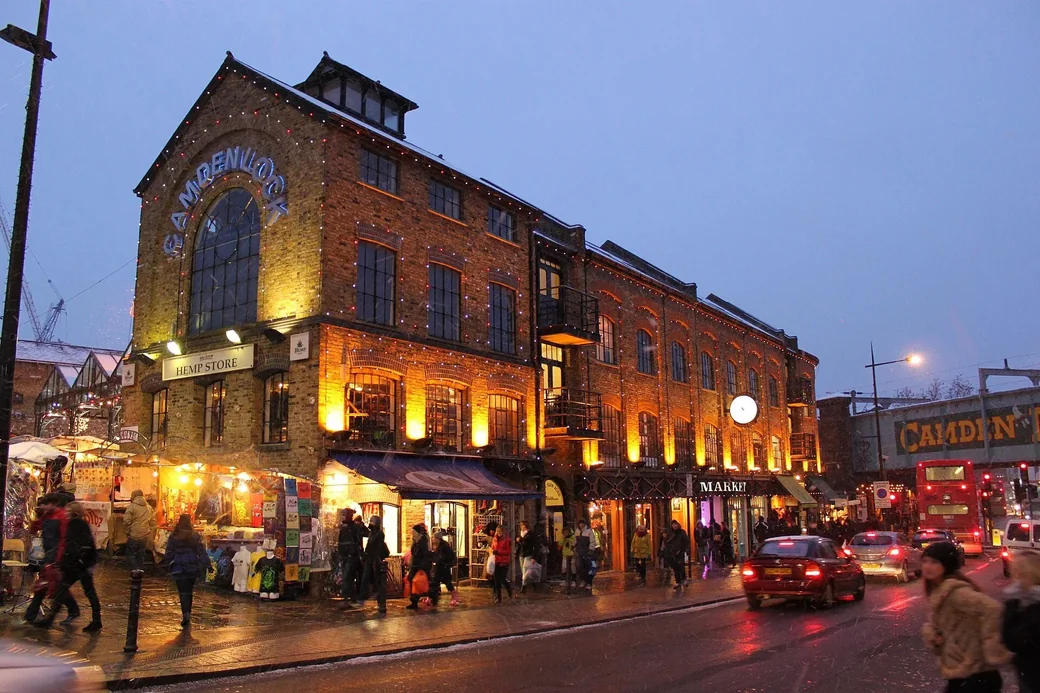
Camden Market is a lively market district in Camden Town, north London, spread along the banks of the Regent's Canal. Its maze of open yards, historic brick buildings and canal-side lanes is packed with independent stalls and shops, where everything from second-hand fashion and handmade crafts to music and street food from around the world awaits. With its creative, rebellious spirit and a mix of industrial heritage and youth culture, it is one of the capital's best-known and most colourful destinations.
Camden Market: Location, accommodation options and contact
Camden Lock Place, London NW1 8AF, United Kingdom
The place's location on the map and nearby accommodation and hotel options are shown by Stay22. Cookies are used. Your consent is remembered on every page; you can turn it off at any time in the cookie settings.
Camden Market explained: Camden Lock, Stables Market and Hawley Wharf
Camden Market is one market in three quarters, and knowing them makes the maze easy to read. Camden Lock is the original canal-side core, strong on crafts, handmade goods and a dense cluster of street-food yards. The Stables Market is the largest and most atmospheric part, built into Victorian brick stables, ramps, tunnels and railway arches, and known for vintage fashion, alternative style and furniture. Hawley Wharf, the newest quarter, sits beside the canal with covered food halls, shops, a cinema and indoor entertainment. The three are connected on foot, each has several entrances, and together they hold a vast number of places to shop, eat and drink. Start wherever the crowd is thinnest and let the lanes lead you. Entry to all three quarters is free.
The story of Camden Market: from a 1974 crafts fair to a London icon
Camden Market began on 30 March 1974, when sixteen traders set out stalls beside Camden Lock in a former builders' and timber yard behind the Dingwalls building. It was meant to be temporary and opened only on Sundays: the canal trade had faded, and a planned urban motorway made permanent rebuilding impossible. When that road scheme was abandoned in 1976, the market had already become a local favourite. Sunday opening, at a time when most shops stayed shut on that day, helped draw the crowds, and the market spread into the neighbouring stables, yards and arches. A three-storey brick-and-iron market hall followed in 1991. Even the district's name has a story: Camden Town is named after Charles Pratt, 1st Earl Camden, who began laying out its streets in 1791.
Camden Lock and the Regent's Canal: the lock that tried something new
The lock gates beside the market belong to the Regent's Canal, which opened as far as Camden in 1816 and was completed in 1820. Hampstead Road Lock, popularly called Camden Lock, is a twin lock whose two chambers are both preserved, and each passage lifts a boat about two and a half metres. Right here, the canal's engineers tried a bold idea: a pair of hydro-pneumatic lift locks designed by the inventor William Congreve to save water. They worked only briefly between 1816 and 1818, because key parts could not be made watertight, and conventional locks replaced them. The small castellated building beside the lock was built in 1815 to house the air compressors for that experiment. Look, too, for the cast-iron roving bridge, which let towing horses change banks without being unhitched.
Stables Market and the Horse Hospital: Victorian railway heritage underfoot
The Stables Market occupies what was once the horse yard of a great Victorian railway goods depot. From the 1850s into the early twentieth century, well over a hundred horses were stabled here, hauling wagons and shunting goods for the railway and for the carrier firm Pickfords, while tunnels and ramps kept them clear of the tracks. The Horse Hospital, where injured animals were treated, still stands with its horse ramps and original stalls, mangers and hay racks, and it is listed at Grade II*, a high level of protection. Many shops are set into the brick railway arches, and bronze horse sculptures greet you at the entrance. Because these are protected historic buildings, some floors are uneven and some passages are narrow, so take your time and look up at the brickwork.
The Camden Catacombs and hidden history: vaults, gin and curiosities beneath the market
Despite the dramatic name, the so-called Camden Catacombs were never a burial place. They are a network of brick vaults, passages and horse tunnels built for the railway: engine vaults designed under Robert Stephenson once housed the machinery that hauled trains up the slope from Euston by rope, and horse tunnels linked the yards with the canal. Later the wine-and-spirits firm Gilbey stored wine, beer and gin in the vaults, and the Interchange Warehouse beside the lock, where goods passed between canal barge and railway wagon, still stands. Much of the old complex has become shops and stalls, while the deeper tunnels are not open to visitors. According to hearsay, one hidden tunnel still holds wartime beds and boxes of papers, but nobody has proved it.
Before the market, Camden's biggest industry was gin, shipped around the world along the Regent's Canal. The wine-and-spirits firm Gilbey bottled and stored it here, and the Roundhouse itself served for a time as a gin warehouse. The Wine and Beer Vaults are the last part of the old catacomb complex not yet turned into shops, while Robert Stephenson's winding-engine house, a cathedral-like set of vaults from the 1830s, is protected at Grade II*. The canal that carried all this trade cost about twice its original estimate to build. Some smaller surprises: the lane now called Camden Lock Place was once Commercial Place; a playful sign beneath the Gloucester Avenue bridge told passers-by that pirates were about to raid them and to have their treasure ready, a joke said to have encouraged donations to the Pirate Castle; a well-known radio and TV presenter once sold sofas, TVs and crockery from a Stables stall before Christmas; and the young Charles Dickens later boarded in nearby College Place. According to legend, the woman behind the Mother Red Cap tale was a girl called Jinney, said to be a Kentish Town brick-maker's daughter, and the rival Mother Black Cap tavern across the road was reportedly named after another local legend of a woman with magical powers.
Camden legends: Mother Red Cap, a ghostly lady and the Dead Dog Tunnel
Camden has its share of folklore, and none of it is proven. According to legend, a fortune-teller known as Mother Damnable or Mother Red Cap lived in a cottage on the spot where the World's End pub now stands, near Camden Town station; her portrait hung on the tavern sign for generations, and the inn carried her name. A tavern is recorded in this part of Camden from the 1690s, and the present pub building dates from 1875. Legend also says that a woman in Victorian dress glides through the Stables tunnels, and according to an urban legend she still haunts the club next door to the pub. Another mystery is the name Dead Dog Tunnel, used locally for the canal entrance to the old Interchange basin: where the name came from is simply unknown. Enjoy these stories as local colour, not as history.
Camden's music heritage: Dingwalls, the Roundhouse, Electric Ballroom and KOKO
Camden's markets grew up beside one of London's richest live-music neighbourhoods. Dingwalls, the canal-side venue next to the market, opened in 1973 as a dance hall and takes its name from the timber merchant T. E. Dingwall, whose painted name still shows on the brickwork; it hosted punk and new-wave bands, Blondie among them in their early years in the country. Nearby, the Roundhouse, built in the 1840s as a railway engine shed, became a landmark arts and music venue from the 1960s onwards. The Electric Ballroom, a dancehall from the 1930s renamed in 1978, still stages gigs, KOKO began life in 1900 as a theatre, and the Jazz Cafe adds a soulful note. The market even runs its own online radio station, CDNX, playing indie, rock, soul and classic dance.
The Amy Winehouse statue at Stables Market
In the heart of the Stables Market stands a life-size bronze statue of Amy Winehouse, the singer who made Camden her home. Created by the sculptor Scott Eaton, it was unveiled on 14 September 2014, the day that would have been her thirty-first birthday, by her family and friends. It shows her in her trademark beehive with a hand on her hip and a rose, and the sculptor said he wanted to capture her attitude and strength together with a hint of vulnerability. A first plan to place it at the Roundhouse was changed so that fans could see it freely and even touch it. According to local hearsay, she once sold vintage clothes as a teenager from the railway arches nearby. The statue is a place of quiet remembrance, so be respectful, take your photo and make room for others.
Shopping at Camden Market: vintage, vinyl, alternative style and the stalls worth seeking out
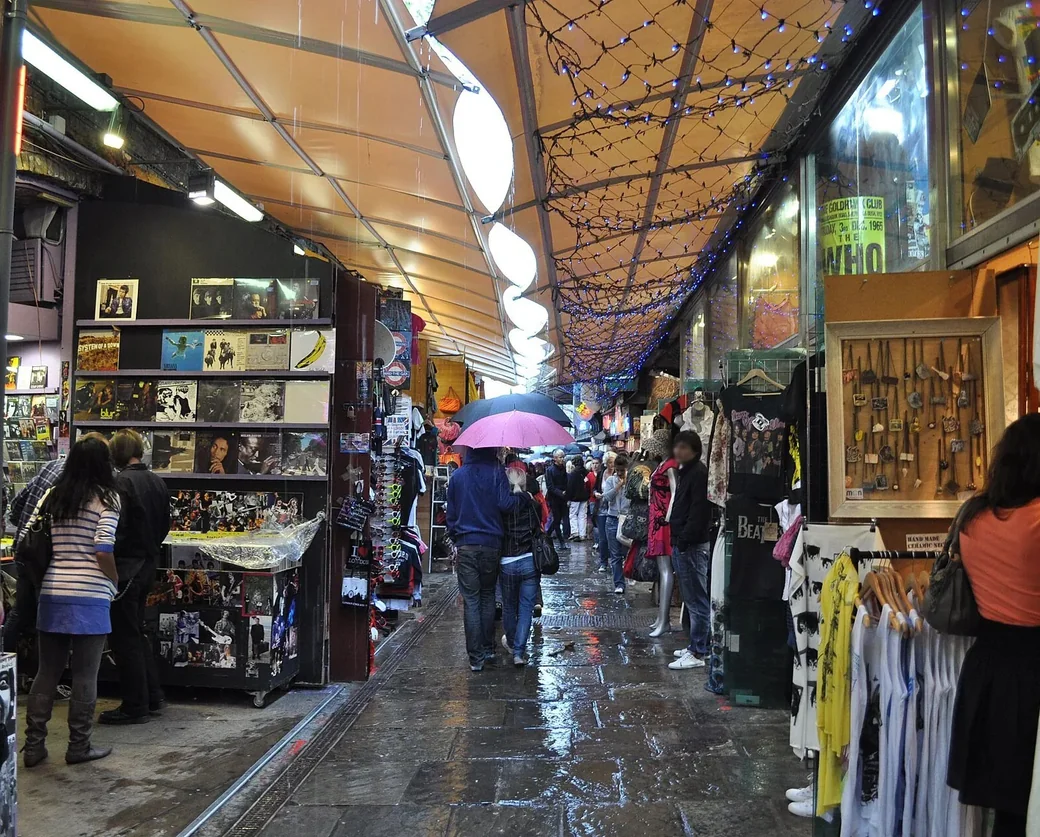
Shopping here is about the unexpected. Camden Lock leans towards crafts, handmade jewellery, gifts and music stalls, while the Stables Market is the place for vintage clothing, retro signs, furniture, antiques and alternative fashion, gothic, punk and neon rave styles included. Cyberdog, flanked by two giant metal figures at its entrance, looks more like a club than a shop and is among the market's most photographed doorways. Small independent stores sell hats, mechanical puzzles and collectables, and Hawley Wharf adds fashion, music and design shops in a modern setting. Chain stores are generally kept out of the Stables, so most shops are one-offs. Wander without a list, compare similar items before you buy, and leave time to flick through the vinyl.
Beyond the big names, a few traders are worth hunting for. In the Stables, Black Rose sells gothic accessories such as coffin-shaped handbags. Elsewhere in the market, Mad Hatters piles up hats, GoGo Gadget stocks mechanical puzzles and Camden Retro Signs sells vintage signage; the official market guide also lists Dr. Martens, the Bandai Namco Cross Store and the UMusic Shop among its retailers. For food, Basta Falafel is known for stuffed pittas and bowls that suit vegetarians and vegans, The Cheese Wheel finishes fresh pasta in a giant wheel of Grana Padano, and Hans & Gretel and Humble Crumble handle dessert. Traders come and go, so use the interactive map on the official website to see who is there today. Hawley Wharf's food halls stay open well into the evening, while its shops close earlier; each venue sets its own hours.
What to eat at Camden Market: street food from West Yard to Hawley Wharf
Camden is as much a food market as a shopping one, with a huge choice of food stalls and counters. West Yard, beside Camden Lock, has the densest cluster of street-food traders, with stalls such as Oli Baba's, known for halloumi fries with za'atar yoghurt and pomegranate molasses, and Yorkshire Burrito, which wraps a roast dinner in a Yorkshire pudding. Chin Chin Labs freezes ice cream with liquid nitrogen in front of you, while The Cheese Bar in the Stables turns melted cheese into theatre with its conveyor belt of dishes. Hawley Wharf's covered Waterside Halls offer more sit-down options and stay open into the evening. Vegetarian, vegan and halal choices are widespread. Queue at off-peak hours, share plates to taste more, and keep napkins handy.
Hawley Wharf: cinema, indoor funfair, brewery taproom and canalside leisure
Hawley Wharf, the market's newest quarter, was built on the site of the former canal-side market and opened in the early 2020s as a mix of shops, food halls, leisure venues and homes. The Curzon cinema is tucked into the railway arches and has five small screens, while Babylon Park, a three-storey space-themed indoor amusement venue, offers a mini rollercoaster, bumper cars and arcade games for families. Under the Hawley Wharf railway arches you will also find a canalside brewery taproom with a terrace, while a late-night darts bar and a small gin distillery where you can watch the spirit being made sit in West Yard, beside Camden Lock. Nearly all of this is under cover, which makes the quarter the best choice on a rainy day or in the evening. Check each venue's own website for booking and opening times before you go.
Regent's Canal boat trips and the towpath walk from Camden Lock
The canal is Camden's calmest side. Boats leave from the Camden Lock area for Little Venice, passing Regent's Park and the grounds of London Zoo and slipping through the short Maida Hill tunnel, about 250 metres long. The Jenny Wren, a traditional open-sided narrowboat, has run since 1968 and passes through Camden Lock itself on a round trip of roughly ninety minutes with live commentary; London Waterbus runs scheduled water-bus trips along the canal, and Jason's Trip, the oldest regular service, has offered one-way trips of about forty-five minutes since 1951 in the warmer months. Some services depend on season or booking, so check beforehand. You can also simply walk the towpath towards King's Cross or Little Venice. Near the Gloucester Avenue bridge, the Pirate Castle, a mock fortress built in 1977, now offers water sports to young people. On the towpath, keep to one side for cyclists. Along the way, lock gates, moored narrowboats (the long, slim boats typical of English canals) and colourful murals give the towpath its character.
When to visit Camden Market: best times, crowds and a smart route
Weekday mornings are the calmest time to see Camden Market, and arriving near opening time gives you the lanes almost to yourself. Weekend afternoons are the busiest, when the narrow Stables passages and the stretch between the Tube station and the lock bridge become packed. A smart route is to start at Chalk Farm, walk south past the Roundhouse into the Stables, continue to Camden Lock and Hawley Wharf, and finish at Camden Town, moving against the flow of visitors. Allow two to four hours, more if you add a canal cruise. The open-air yards are best in dry weather from spring to autumn; the arches and halls shelter you in the rain. Hawley Wharf's food halls and the North Yard restaurants keep serving in the evening. The market is open every day of the year except Christmas Day.
Accessibility, safety and etiquette at Camden Market: do's and don'ts
Hawley Wharf is step-free, with lifts to every floor and a Changing Places toilet, while much of the Lock and Stables quarters is step-free but cobbled and uneven because of the protected buildings; the interactive map on the official website shows lifts, ramps and accessible toilets, and security staff are on site around the clock. Do keep bags zipped and phones in front pockets in crowds, carry a card plus a little cash, wear sturdy shoes and ask before photographing traders. Don't expect a car park, don't block narrow lanes for photos, and don't lean over the lock edges on the towpath. Professional filming and photography on market land requires a licence arranged through the market's film office.
Around Camden Market: Roundhouse, Primrose Hill, High Street facades and photo spots
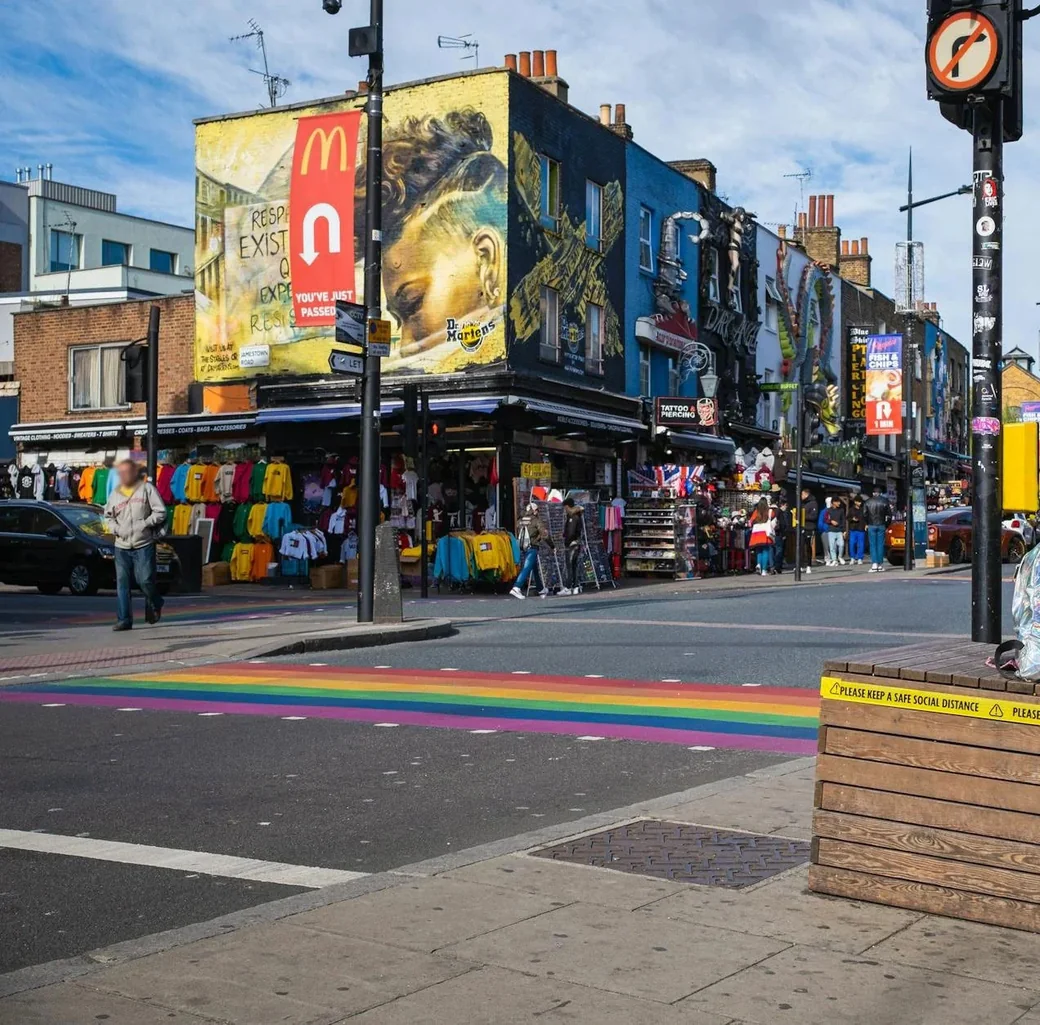
Several sights lie within a short walk. The Roundhouse stands on Chalk Farm Road, and Primrose Hill, about fifteen minutes to the north-west, rewards you with a skyline view of London. Regent's Park and London Zoo are a short walk along the canal. Back on Camden High Street, look up at the oversized three-dimensional shopfronts — giant boots, a dragon, an elephant — which turned the street into an open-air pop-art gallery. For photographs, try the colourfully painted railway bridge by the lock, first painted in 1989 by John Bulley and refreshed since, the Interchange Warehouse, the cobbled canal basin and the former TV studio building by the canal, whose roofline is topped with giant egg-cup sculptures. The young Charles Dickens lived on nearby Bayham Street.
Camden Market: Visitor Tips
- Visit on a weekday morning for quiet lanes; weekend afternoons are the busiest.
- Start at Chalk Farm and walk south, so you move against the crowd and finish at Camden Town.
- Wear comfortable shoes: the cobbles, ramps and old brick floors are uneven.
- Keep bags zipped and phones in front pockets in crowded passages.
- When it rains, shelter in the Stables arches or the covered halls at Hawley Wharf.
- Add a canal cruise or a towpath walk to escape the crowds for an hour.
Camden Market: Best Time to Visit
Weekday mornings are calmest; weekend afternoons are liveliest. Spring to early autumn suits the canal and open yards; in rain, head for the covered halls and arches.
Camden Market: Admission Fees
Free admission
Wandering through the Lock, Stables and Hawley Wharf quarters along Regent's Canal is free of charge; food, drink and shopping are paid for at each stall or shop.
Free
Quick Info
3h
easy
Camden Market: Getting There
By Tube, the closest stations are Camden Town and Chalk Farm (both on the Northern line), each roughly a five- to ten-minute walk from the market, while Camden Road (London Overground, Mildmay line) is about eight minutes away. Camden Town station is very busy at weekends and is sometimes made exit-only for a while to control numbers, so Chalk Farm, or a walk from Mornington Crescent, is a useful alternative. Buses 24, 27, 31, 168, 214, 274 and 393 serve the area. Step-free access differs from station to station; if you need step-free travel, check Transport for London's step-free guide and live information first, and note that Camden Road has lifts. The market has no car park of its own and parking in Camden Town is extremely limited, so public transport, a taxi, or a walk along the Regent's Canal towpath from King's Cross or Little Venice is the best way to arrive.
Nearby stops & parking
Nearest stops: Camden Town and Chalk Farm (Northern line), Camden Road (London Overground, Mildmay line), and bus stops along Camden High Street and Chalk Farm Road for routes 24, 27, 31, 168, 214, 274 and 393. Taxis and ride-hailing cars can set down on Camden High Street near Camden Lock Place, and on Chalk Farm Road near the Stables entrance and the Horse Hospital gate. There is no dedicated car park; limited on-street parking exists in the surrounding streets and fills quickly at weekends. The canal towpath connects the market on foot with King's Cross, Regent's Park and Little Venice.
Camden Market: Dress Code & Etiquette
Camden Market is not a religious site and there is no formal dress code: casual and colourful is the norm. Wear comfortable, closed shoes, because the cobbles and ramps are uneven, and bring a light layer, since the yards are open to the weather while the arches and halls are covered. Some bars, clubs and gig venues nearby set their own entry rules. Be courteous to traders, performers and the residents of the moored boats along the canal, ask before photographing people, and keep to one side of the towpath so that cyclists and walkers can pass.