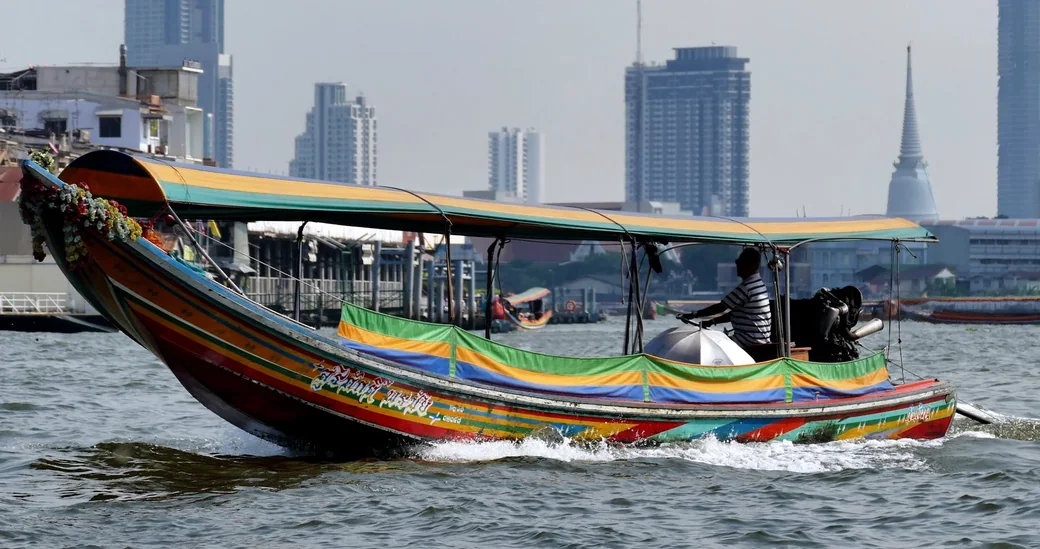
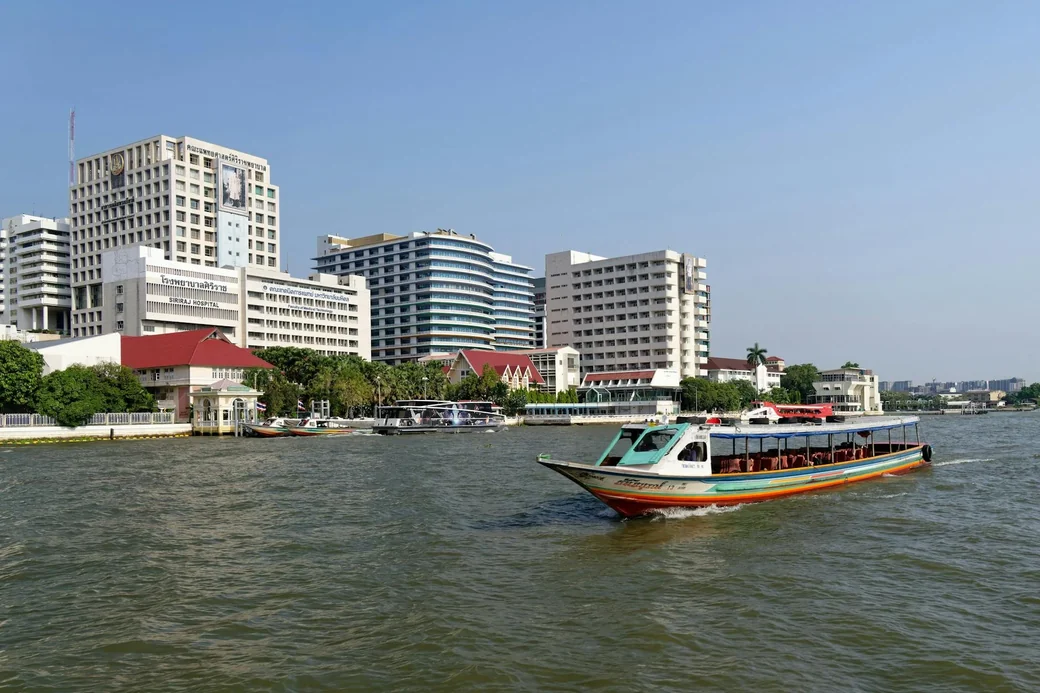
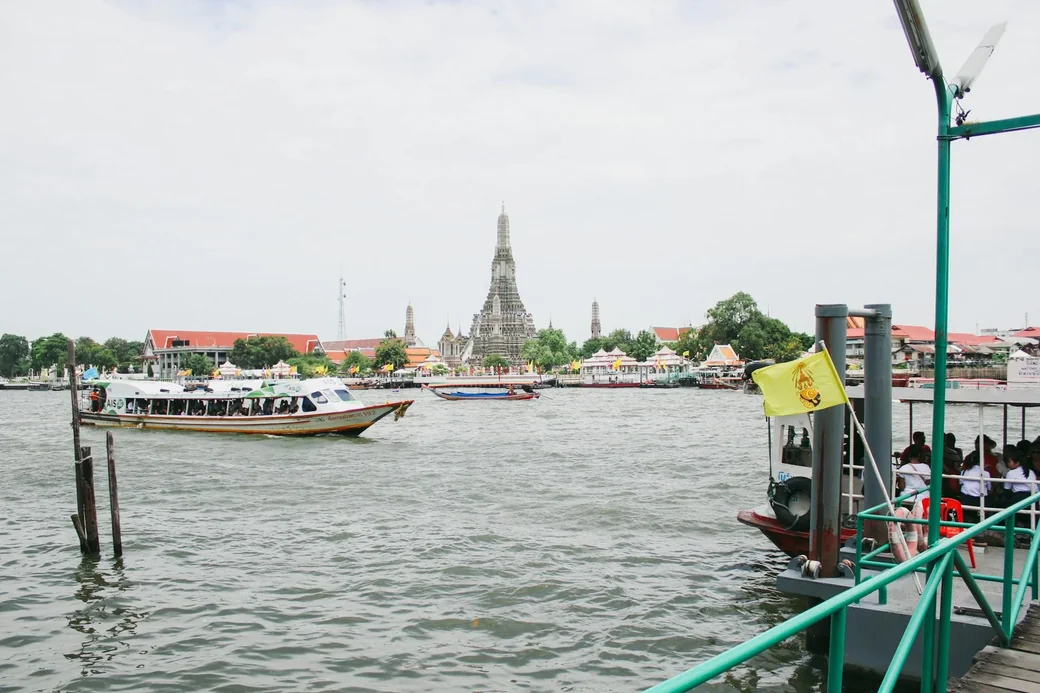
The Chao Phraya Tourist Boat is a hop-on-hop-off sightseeing boat on the Chao Phraya, the wide river that winds through the centre of Bangkok. Instead of a fixed cruise, it works like a floating sightseeing line, letting visitors move between many of the city's famous riverside temples, palaces and markets at their own pace. For first-time visitors it is a relaxed and memorable introduction to old Bangkok, seen from the water that shaped the city's history.
Chao Phraya Tourist Boat: Location, accommodation options and contact
The place's location on the map and nearby accommodation and hotel options are shown by Stay22. Cookies are used. Your consent is remembered on every page; you can turn it off at any time in the cookie settings.
Look for the blue flag: it marks this boat apart from the orange, yellow and red express lines that share the same river. Launched in 2003 specifically for sightseeing rather than commuting, it calls at the main piers between Sathorn and Phra Arthit. One ticket, bought at the pier, covers unlimited boarding for the rest of that day — simply flash it each time a boat pulls in. The river's own name is a mark of prestige: chao phraya was the highest rank of the old Thai nobility, roughly equivalent to a duke, which is why English-language sources often render it as the River of Kings.
Sathorn Pier: The Main Hub Next to BTS Saphan Taksin
Most rides begin at Sathorn, also called Central Pier, tucked directly beneath Taksin Bridge. It sits right below Saphan Taksin, the only BTS Skytrain station built with a purpose-made walkway down to the water. Ticket counters for several boat companies cluster here, along with the cross-river ferry and hotel shuttle boats, making it the busiest single point on the whole river. One of those hotels, the Mandarin Oriental a short way upriver, has welcomed literary guests since the nineteenth century — Joseph Conrad and Somerset Maugham among them — and still keeps an Authors' Wing in their honour.
The Main Stops Along the River Circuit
From south to north the core stops run Sathorn, ICONSIAM, Ratchawongse (Chinatown), Rajini (Pak Khlong Talat flower market), Wat Arun, Tha Chang (Grand Palace), Tha Maharaj, Prannok (Wang Lang/Siriraj) and Phra Arthit — with Asiatique added south of Sathorn in the late afternoon and evening. Printed route maps at each pier list every stop with its main nearby attraction. A classic sequence is to step off at Tha Chang for the Grand Palace, walk on to Wat Pho, then ride across to Wat Arun's own pier on the opposite bank; every stop lies a short walk from its sight.
One Ticket, Unlimited Reboarding for the Day
Day passes are sold as unlimited hop-on-hop-off, meaning the boat itself can be treated as a moving sightseeing platform rather than a one-way transfer. A single-trip fare, bought separately, only covers one boarding with no reboarding rights. Either way, tickets are bought before or upon boarding, never in advance for a fixed date, since the pass activates the moment it is first used. The company keeps its own ticket counters at each of its stops, separate from those of the commuter lines.
How Long the Full Loop Takes, and When to Go
Non-stop end to end, the route takes under an hour; spread across a real day of stepping off at temples and markets, most visitors need at least half a day to see the highlights properly. Mid-morning brings the heaviest crowds at the Grand Palace piers, while the very first departures and the last couple of hours before closing tend to be noticeably quieter. Boats depart at regular intervals rather than continuously, so a short wait at the pier is part of the rhythm, and stringing the same riverside sights together by road would otherwise take a full day of taxis and traffic.
The Open Upper Deck Is Where the View Is
Both riverbanks are visible from the upper deck without glass or a roof in the way, which is what makes it the spot for photos of Wat Arun, the Grand Palace and the everyday river traffic of barges and long-tail boats. Seats face outward toward the water on both sides, so switching sides partway through the ride captures temples on whichever bank the boat is passing at that moment. Several double-decker boats run the route, and from the top deck the view also takes in the old shophouses of Chinatown and the glass façade of ICONSIAM.
Dress Code for the Temple Stops Along the Way
Wat Arun, Wat Pho and the Grand Palace all enforce a strict dress code since they remain active religious and royal sites: shoulders and knees covered, no see-through fabric, and — at the Grand Palace specifically — no leggings even under a skirt. Staff at each entrance check appearance before allowing entry, and rented or borrowed sarongs are usually available on the spot for a small fee or deposit.
Chinatown and the Flower Market Are Just One Stop Away
Getting off at Ratchawongse Pier drops passengers straight into the noise, food stalls and gold shops of Yaowarat, Bangkok's Chinatown, at its liveliest after dark. A short walk north along the riverside leads to Pak Khlong Talat, the 24-hour flower market where fresh garlands and blooms arrive from the provinces overnight — worth a look even for visitors with no intention of buying anything.
Connecting to the Royal Barges Museum and Wang Lang Market
Stepping off at Wang Lang, next to Siriraj Hospital, opens onto one of the liveliest local food markets along the river, popular with students and hospital staff rather than tour groups. The Royal Barges National Museum, home to the gilded ceremonial boats once rowed by the king, sits a further walk or short tuk-tuk ride inland along the canals — not directly on the pier, so it takes a little extra planning to reach.
The Evening Extension South to Asiatique
From late afternoon into the evening, the route stretches south past Sathorn to Asiatique The Riverfront, turning the boat into a convenient way to end a day of temple-hopping with riverside dinner, shopping stalls and the Ferris wheel. Asiatique also runs its own free shuttle boats from Sathorn, so travellers who arrive after the tourist boat's last southbound run still have an easy way to reach it.
Wheelchairs, Strollers and Limited Mobility
The boats themselves are marketed as wheelchair accessible, but the gap and slope between a floating pier and the boat deck shift with the tide and can be steep at some stops, so travelling with a companion who can help is strongly advisable. The same caution applies to strollers and heavy luggage — staff will usually assist, but a little extra time should be budgeted for boarding at busier piers.
Onboard Safety: Life Jackets, First Aid and Insurance
Every seat has access to a life jacket, and each boat carries a first-aid kit and CCTV cameras covering the deck. Passengers are covered by onboard insurance for the duration of the trip, part of the standard safety package the company advertises alongside its route information. None of this requires any action from passengers beyond noting where the life jackets are stored when boarding. The boats are run by Chao Phraya Tourist Boat Co., Ltd., a sister company of the Chao Phraya Express Boat commuter network that became a separate company in 2012.
Language and Onboard Announcements
There is no live tour guide on board; instead, a recorded public-address system announces each upcoming pier in English and Thai, giving enough notice to gather belongings before docking. Printed route maps at the ticket counters, usually available in English and Thai, list every stop and its main attraction, which is the closest thing to a guidebook the service provides.
Boarding Etiquette: Tickets, Flags and Manners
Buy from the marked ticket booth rather than anyone approaching on the pier itself, and double-check the destination board, since several companies with different colour flags dock at the same spot within minutes of each other. Once aboard, padded bench seats are shared with the next group of passengers, so keeping shoes, bags and feet off the upholstery is simply good manners rather than a posted rule. Bangkok residents tend to ride the plain orange- and yellow-flag express lines for their daily commute, since those cost less and stop more often, while the single blue flag spares visitors the task of matching colours to destinations.
Best Season for the River, and Loy Krathong Nights
November through February brings Bangkok's coolest, driest weather, making open-deck river travel far more comfortable than during the hot or rainy months that follow. Somewhere within that window, on the full-moon night of the twelfth month of the traditional Thai lunar calendar, the Loy Krathong (the festival of floating offerings) festival fills the Chao Phraya with floating lantern offerings; piers get noticeably busier and boats run fuller than usual, so it is worth allowing extra time to travel that particular evening. As on any open-air river vessel, the ride feels different with the weather and the state of the river, and the calm, dry months show it at its best.
Chao Phraya Tourist Boat: Visitor Tips
Buy tickets only at the official Chao Phraya Tourist Boat counters at each pier, not from unaffiliated sellers on the street. Confirm which direction a boat is heading before boarding — several companies and flag colours share the same piers. The open upper deck offers the best photographs but no shade, so bring sunscreen, a hat and water for a full day of hopping on and off. This boat does not stop at every pier the ordinary commuter lines use, so if a specific address falls between two tourist-boat stops, a short walk or a connecting cross-river ferry may be needed. Finally, build slack into the schedule: a regular boat service feels relaxed until a queue forms at a popular pier like Tha Chang or Sathorn around midday.
Chao Phraya Tourist Boat: Best Time to Visit
Early morning for calm water and soft light, or late afternoon into golden hour for Wat Arun; November to February brings the coolest, driest weather.
Chao Phraya Tourist Boat: Admission Fees
All-day pass (unlimited rides)
Unlimited rides on the tourist boat for the whole day, with stops at the main riverside piers and landmarks.
THB 150
Single trip
One ride between two piers on the tourist boat route.
THB 40
Quick Info
2h
easy
Chao Phraya Tourist Boat: Getting There
The simplest way to reach the boat is the BTS Skytrain's Silom Line to Saphan Taksin Station (S6), which sits directly above Sathorn (Central) Pier — the only BTS station in the city built with a purpose-made link down to the river. From the station, signed walkways lead straight to the ticket counters. Taxis and ride-hailing apps can drop passengers on Charoen Krung Road beside the pier, though traffic along the riverfront can be heavy at rush hour, which is exactly the congestion the boat is meant to avoid. Travellers already in the historic district can join the route further along, at piers such as Tha Chang, Rajini or Phra Arthit, all reachable on foot from the Grand Palace, Wat Pho and Khao San Road respectively.
Nearby stops & parking
Sathorn Pier sits beneath Taksin Bridge, directly below Saphan Taksin BTS station (Silom Line), which also connects onward to the MRT network via a short walk or taxi. The same pier hosts Chao Phraya Express Boat commuter lines, a cross-river ferry to Charoen Nakhon on the Thonburi side, and shuttle boats to riverside hotels such as the Mandarin Oriental and the Peninsula. There is no dedicated visitor car park at the pier; drivers are better off using paid parking at ICONSIAM or a nearby hotel and finishing the last stretch on foot or by taxi.
Chao Phraya Tourist Boat: Dress Code & Etiquette
There is no dress code for riding the boat itself, but several of its stops lead straight to active Buddhist temples, where the rules are strictly enforced. At Wat Arun, Wat Pho and especially the Grand Palace, shoulders and knees must be covered — sleeveless tops, shorts above the knee and leggings are all turned away at the Grand Palace's gate. A sarong or wrap can usually be borrowed or rented cheaply at temple entrances for anyone caught without appropriate clothing. It is worth packing a light scarf or long trousers in a day bag before setting out, rather than relying on finding one on arrival.