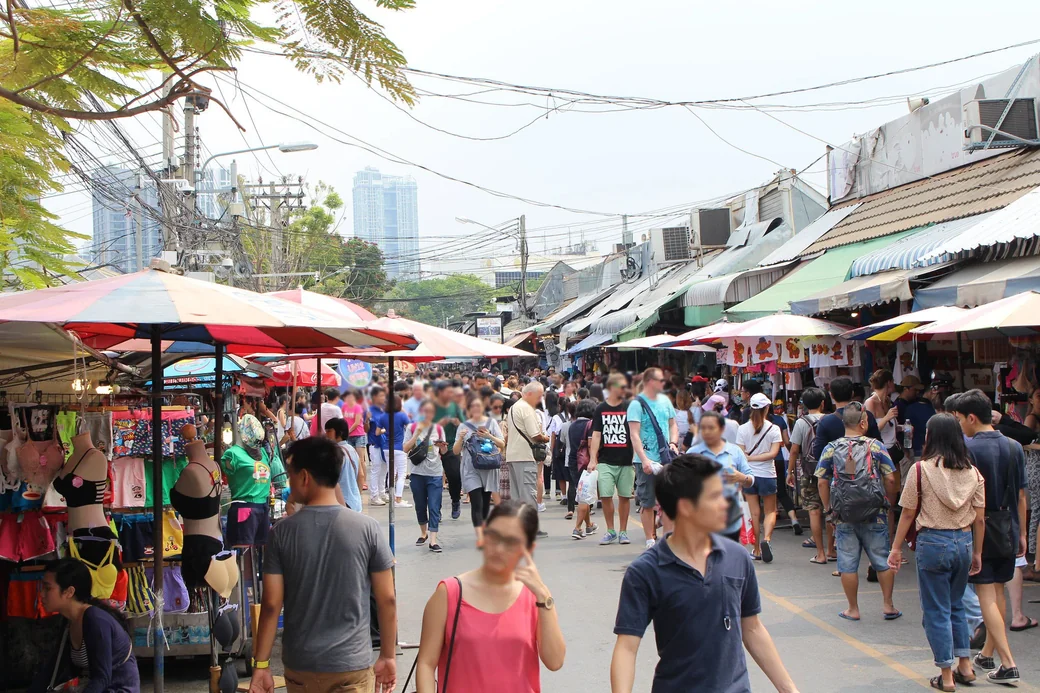
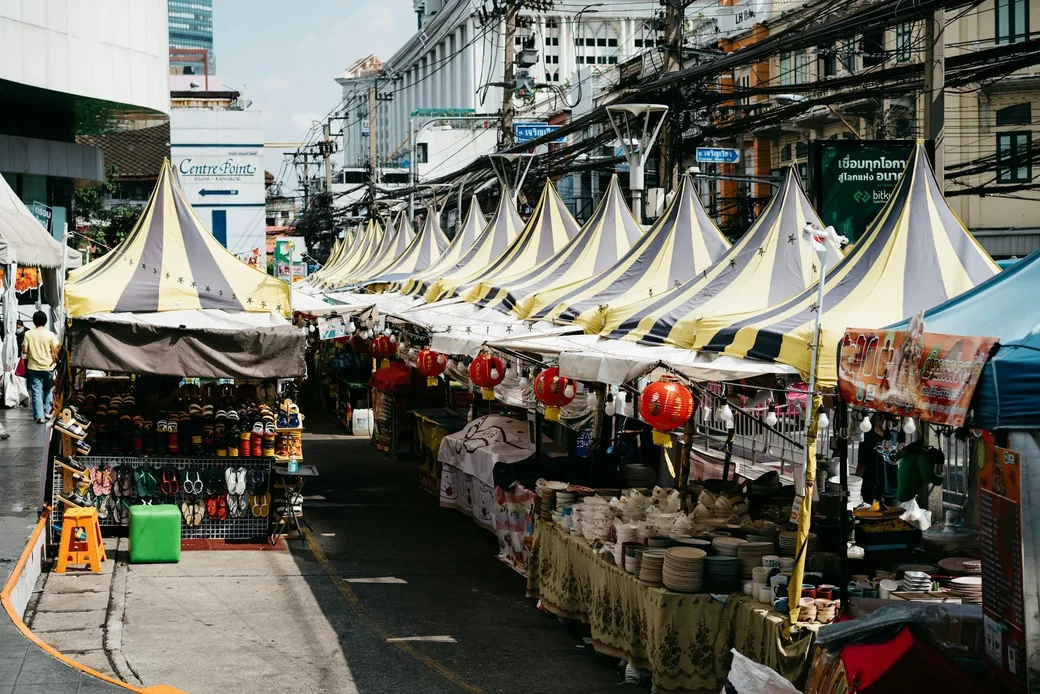
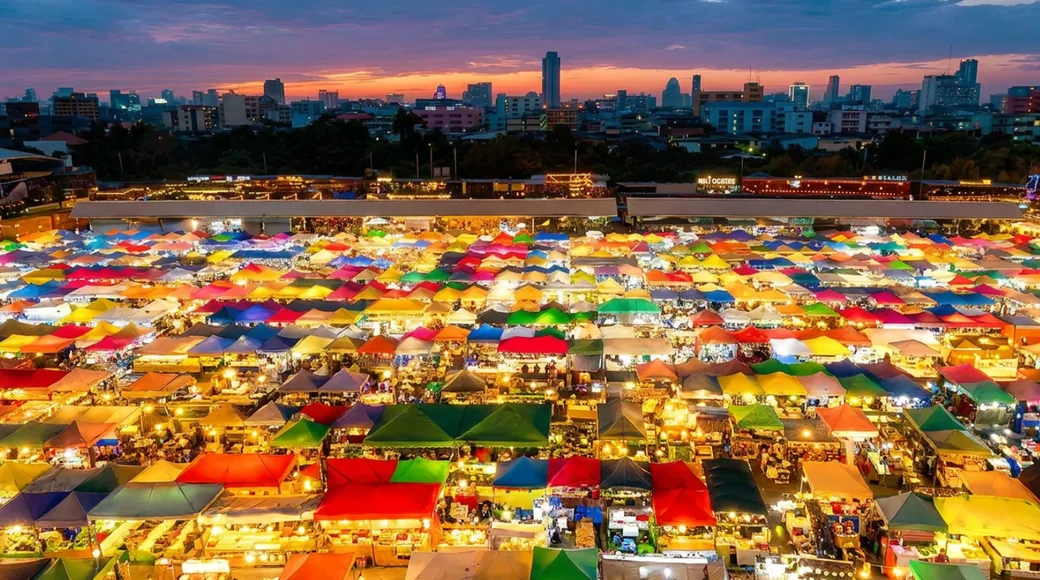
Chatuchak Weekend Market is a vast open-air market in Bangkok's Chatuchak district, where a maze of covered lanes is packed with small stalls selling an enormous variety of goods. It ranks among the best-known shopping destinations in Thailand and is a classic weekend experience in the capital. For newcomers, it offers a lively, colourful snapshot of Thai trade, creativity and everyday street life, all gathered in one sprawling, bustling place.
Chatuchak Weekend Market: Location, accommodation options and contact
The place's location on the map and nearby accommodation and hotel options are shown by Stay22. Cookies are used. Your consent is remembered on every page; you can turn it off at any time in the cookie settings.
History of Chatuchak Weekend Market: From 1942 to Today
Chatuchak Weekend Market traces its roots back to 1942, when Thailand's government under Prime Minister Plaek Phibunsongkhram introduced a policy requiring every province to have its own market. Bangkok's version began at Sanam Luang, the royal ceremonial ground in the old city, before being relocated several times over the following decades. In 1982 the market found its permanent home in the Chatuchak district of northern Bangkok, the location it still occupies today. Five years later, in 1987, the market's now-iconic clock tower was built to commemorate the 60th birthday of King Bhumibol Adulyadej, becoming both a functional landmark and the market's most recognizable symbol. What started as a modest flea market for local vendors has grown, over eight decades, into one of the largest open-air markets in the world, drawing shoppers from every corner of Bangkok and, eventually, from around the globe. Despite its expansion, Chatuchak has kept much of its original character: narrow lanes, family-run stalls, and a mix of goods that reflects the everyday life of the city as much as it does its tourist appeal. Walking through the older sections near the clock tower today, visitors can still sense the decades of history layered into its stalls.
Chatuchak Market Sections Explained: A Zone-by-Zone Guide
Chatuchak is organized into 27 numbered sections. Each section is loosely dedicated to a category of goods, though in practice categories overlap and spill into neighboring sections. A continuous ring road connects all sections, branching into smaller numbered lanes inside each one. Because the market is so large, most repeat visitors rely on a handful of landmarks rather than memorizing every section number. The clock tower at the center is the single most useful reference point — nearly every lane eventually loops back toward it, making it a natural meeting place if your group splits up. Information booths near the main entrances hand out printed maps, and photographing one on arrival is far more reliable than a phone's map app, since mobile signal can weaken in the densely packed, covered alleys. First-time visitors are often better served by picking two or three sections that match their interests and exploring those thoroughly, rather than attempting to cover the entire market in a single visit. On a typical weekend the market hosts thousands of stalls, and walking its lanes feels less like visiting a single market than exploring a dense, self-contained neighbourhood.
Where to Shop for Fashion, Vintage Clothing and Antiques
Clothing and fashion make up the single largest portion of Chatuchak, spread across many sections in the market's mid-range numbering. Here you'll find everything from contemporary Thai streetwear and independent designer labels to secondhand denim and military surplus — the kind of vintage hunting that has made Chatuchak a pilgrimage site for collectors across Southeast Asia. Quality varies from stall to stall, so it's worth checking stitching and fabric before committing to a piece. A separate cluster of sections is dedicated to antiques and collectibles, where Thai, Burmese, Khmer and Chinese pieces sit alongside well-made reproductions — genuine antique dealers here tend to be knowledgeable and happy to explain a piece's history if asked. This is also where rare books, vintage postcards and old stamp collections tend to surface, appealing to a very different kind of browser than the fashion crowd nearby. Because the numbering system groups similar goods together only loosely, part of the fun — and the challenge — is that a promising antique shop might sit just a few stalls down from a rack of secondhand band t-shirts, with no clear boundary between the two worlds.
Handicrafts, Ceramics, Home Decor and Collectibles at Chatuchak
Beyond clothing, Chatuchak is one of the best places in Bangkok to find handmade goods: Thai silk, woven textiles, wood carvings and hand-poured soaps sit alongside ceramics ranging from traditional celadon (green-glazed ceramics) and Benjarong (five-colour porcelain) porcelain to more contemporary designs. Several sections specialize in home decor and furniture, including Thai-style wooden pieces, vintage furnishings and small decorative accents that pack easily for travel. Music-related crafts — hand drums, flutes, whistles and items used by Thailand's highland communities — turn up in a couple of dedicated corners, alongside carved Khon (Thailand's classical masked dance-drama) masks that make distinctive souvenirs. Local fragrance makers have also carved out a niche here, producing Thailand-themed scents and natural remedies that double as gifts. Because so many of these goods are handmade by small producers rather than mass-manufactured, quality can vary considerably even within the same section, and many artisans are happy to take custom commissions if you describe what you're looking for. Shoppers looking for one focused experience rather than a scavenger hunt may want to concentrate on just one or two of these craft sections rather than trying to see all of them in a single visit.
The Chatuchak Plant Market: Bangkok's Green Corner
The plant and gardening section occupies a cluster of sections along the market's edge and has a noticeably different rhythm from the rest of Chatuchak — quieter, greener, and shaded by the sheer density of potted plants stacked along the lanes. Much of Bangkok's houseplant culture is said to have taken root here, with orchids, succulents, bonsai and tropical foliage of every kind lined up alongside the pots, soil and tools needed to keep them alive. Unlike the rest of the market, this section isn't limited to weekends — it also operates on Wednesdays and Thursdays, drawing a mostly local crowd of hobbyist gardeners and landscapers rather than tourists. Even visitors with no intention of buying a plant often find it a pleasant detour, simply for the change of atmosphere it offers after the noise and density of the clothing and food sections. Given that live plants aren't practical souvenirs for most international travelers, this area tends to appeal most to Bangkok residents and to visitors who simply enjoy the browsing experience itself, camera in hand, rather than those looking to carry something home.
A Note on the Pet Section at Chatuchak Market
A cluster of sections near the market's edge is given over to pets and pet supplies — small animals, ornamental fish, and accessories of every kind. Animal lovers will find plenty to browse here, while visitors who prefer to skip live-animal stalls can simply continue to the craft, clothing and food lanes, which have a very different atmosphere.
Section 7 Art Zone: Chatuchak's Open-Air Gallery
Section 7 functions as Chatuchak's open-air art gallery, and it's a favorite detour even for visitors who have no intention of buying anything. Small studios and stalls display everything from traditional religious paintings to contemporary abstract work, often created by the very artists sitting behind the easel. Many are happy to take commissions, so if a particular style catches your eye, it's worth asking whether the artist can produce a custom piece rather than assuming you can only choose from what's already on display. The area is noticeably calmer than the market's clothing and food lanes, making it a good place to slow down for a few minutes. Look out too for Bangkok-themed murals and local fragrance makers clustered nearby, both popular with visitors looking for a souvenir with a bit more personality than a mass-produced trinket. A quiet stroll through this section, even without buying, is one of the more memorable ways to experience Chatuchak's creative side away from the crowds.
What to Eat at Chatuchak: A Street Food Guide
Chatuchak's food scene is dense enough to justify a visit on its own. Fresh coconut ice cream served straight out of the shell is close to a rite of passage here, usually finished with a scattering of toppings and a small cup of coconut water on the side. Mango sticky rice is a seasonal favorite worth seeking out, and savory options run the full range of Thai street food — grilled skewers, spicy salads like som tum, noodle dishes, and heartier plates built around grilled meat or seafood, including whole grilled octopus sliced to order at a few well-known stalls. Food stalls tend to cluster most densely around the market's southern sections and near the clock tower, though smaller snack vendors and drink stalls are scattered throughout, ready to provide a cold drink the moment the heat becomes too much. For a calmer sit-down meal away from the crowds, the neighboring Or Tor Kor Market and the air-conditioned Mixt Chatuchak complex both sit within easy walking distance and are worth considering as an alternative when you need a proper break.
How to Bargain at Chatuchak Weekend Market
Bargaining is part of the culture at Chatuchak, though it's a gentler practice here than at some of Bangkok's more tourist-heavy night markets. The general approach is simple: ask the price, offer noticeably less, and settle somewhere in between — all done with a smile rather than an aggressive back-and-forth. Buying more than one item from the same stall tends to be the most effective way to secure a better overall deal, often more so than haggling hard over a single piece. It's also worth watching for stalls with a clearly posted price tag, which usually signals a fixed price that the vendor won't negotiate, particularly among independent designers and boutique-style stands. Walking away, even briefly, is a time-honored and perfectly polite way of testing whether a seller has more room to move — sometimes they'll call you back with a better offer, and sometimes they simply won't, which is a normal part of the process rather than a rejection to take personally. Staying relaxed and friendly throughout tends to get better results than treating the exchange as a contest to win.
Practical Tips for Visiting Chatuchak Weekend Market
A few habits make a Chatuchak visit noticeably smoother. Most stalls only accept cash, and small-denomination notes are far more useful than large bills when buying inexpensive items throughout the day. Comfortable, closed-toe shoes are worth the effort given how far most visitors end up walking — often several kilometers — across uneven ground and narrow lanes. Lightweight, breathable clothing helps too, since the covered sections trap heat even when a breeze is moving outside. Carrying a refillable water bottle, or simply grabbing a cold drink from one of the many stalls along the way, is an easy way to stay comfortable through a long visit. Mobile signal can weaken in the densest, most covered parts of the market, so it's worth taking a photo of a section map at one of the information booths near the entrances rather than relying entirely on a phone. Keeping bags zipped and valuables close is a sensible habit in any busy market. Entry to the market is free, and browsing without buying anything is entirely normal.
Best Time to Visit Chatuchak Weekend Market
Timing shapes the Chatuchak experience more than almost anything else. Within a single visit, the sweet spot is generally the first couple of hours after opening, when the heat hasn't built up yet and the lanes are still walkable rather than shoulder-to-shoulder. By early afternoon, both the temperature and the crowds tend to peak, especially inside the more enclosed sections, and many regular visitors either retreat to an air-conditioned break or simply push through with frequent stops for cold drinks. Late afternoon offers a second, calmer window as the heat eases slightly before closing time. Zooming out to the level of seasons, Bangkok's cooler, drier months bring noticeably more comfortable conditions for a few hours of outdoor walking, while the hottest stretch of the year makes an open-air market considerably more demanding, even for visitors used to tropical weather. None of this makes the market unvisitable outside the ideal window — Chatuchak runs rain or shine, hot season or cool — but travelers with flexible plans may want to weigh the season and time of day against how much walking and lingering they intend to do. Most of the market trades only on Saturdays and Sundays, while a handful of wholesale traders keep parts of it running on Fridays as well.
Getting Around Chatuchak: Accessibility and Crowd Tips
Chatuchak's ground is largely flat and paved, which makes the market more navigable for wheelchair users and strollers than its maze-like layout might suggest at first glance. That said, the practical challenge here isn't the terrain so much as the density of people: narrow lanes packed with shoppers, especially in early afternoon, can make maneuvering with a wheelchair, a stroller, or simply a lot of shopping bags genuinely difficult regardless of the flat ground beneath. Visitors with mobility considerations, or anyone travelling with small children, may find it easier to visit during the quieter early-morning hours, when there's simply more physical space to move through the lanes. The market's main entrances and the connecting public transit stations are generally step-free, which helps with the first and last stretch of the journey, even if the interior lanes themselves demand a bit more patience once the crowds build up later in the day.
Beyond Shopping: Massages, Cafes and Street Entertainment
Shopping aside, Chatuchak has a handful of experiences that surprise first-time visitors. A short foot massage is an easy way to recharge partway through a long visit, and several stands offer henna tattoos or quick caricature portraits for anyone looking for a lighthearted souvenir that isn't a physical object. Small cafes and drink stalls are scattered throughout, offering a place to sit for a few minutes rather than eating on the move, and a handful of low-key bars near the market's edges make for a natural way to wind down at the end of a shopping day. Buskers and street musicians add to the atmosphere in several corners, particularly around the busier lanes near the clock tower, giving the market a festival-like energy that goes well beyond its role as a shopping destination. Taken together, these small details are part of why so many visitors describe Chatuchak as an experience rather than simply an errand — the kind of place where a slower, more curious pace tends to be rewarded.
Good to Know: Export Rules and Genuine Goods
A handful of Chatuchak's most tempting purchases come with rules worth knowing before you buy. Genuine antique Buddha images cannot legally leave Thailand under any circumstances, while newly cast religious images generally can, provided the appropriate documentation or licence is obtained — a distinction worth asking about directly if you're buying anything that looks properly old. Branded goods bearing counterfeit logos are common throughout markets like this one, and carrying them across borders can create problems with customs in many countries, quite apart from the ethical questions around counterfeit goods generally. Loose gemstones and unset jewelry are difficult for a non-expert to evaluate on the spot, so significant purchases in this category are generally safer made through an established jeweler rather than a market stall. None of this should discourage browsing — the vast majority of what's sold at Chatuchak carries no such complications — but it's worth knowing which categories deserve a second thought before committing to a purchase.
Nearby Green Spaces: Chatuchak Park and Rot Fai Park
Chatuchak's shopping lanes sit directly beside one of Bangkok's largest connected green spaces, formed by several adjoining parks: Chatuchak Park, Vachirabenjatas Park — also known as Rot Fai Park, or Railway Park — and Queen Sirikit Park. Together they offer a genuine change of pace after the market's density and noise: shaded walking and cycling paths, a canal running through Chatuchak Park where turtles and monitor lizards are a common sight, and a multi-story butterfly garden inside Rot Fai Park that's popular with families. Rot Fai Park also rents out bicycles at its entrance and includes a small miniature-town circuit where children can pedal past scaled-down versions of Bangkok's landmarks. Queen Sirikit Park leans more botanical and contemplative, making it a pleasant final stop for anyone looking to wind down before heading back into the city. For travelers planning a full day around Chatuchak, pairing a morning at the market with an afternoon walk through these parks is a natural way to balance an otherwise intense shopping experience with something considerably quieter.
Fun Facts About Chatuchak: Names, Numbers and Little-Known Details
Chatuchak carries more nicknames than most Bangkok landmarks. Locals commonly shorten it to "JJ" or "JJ Market" — a nod to its older English spelling, Jatujak — and you'll hear the abbreviation used just as often as the full name. The name itself has a neat story behind it: "Chatuchak" is Thai for "four cycles," a name King Bhumibol Adulyadej gave to the adjacent Chatuchak Park in 1976 to mark his 48th birthday, four twelve-year cycles of the Thai zodiac. The market, and later the whole district, borrowed the name from the park next door. It's also worth untangling the market's air-conditioned neighbors, since their names are easy to mix up: JJ Mall is the older complex right beside the market, while Mixt Chatuchak is a newer mall a short walk away, both open daily and unrelated to each other beyond sharing the neighborhood. Despite its global reputation as one of the world's largest markets, Chatuchak remains, at heart, a working market that Bangkok residents still use for everyday shopping — not just a stop on a tourist itinerary.
Chatuchak Weekend Market: Visitor Tips
Bring cash in small bills, wear comfortable closed shoes, and expect to walk several kilometers. The market is busiest and hottest in early afternoon, so mornings or late afternoon work best. Pick two or three sections that match your interests rather than trying to see everything, and use the clock tower as your main landmark if you get turned around. Most vendors are open to gentle bargaining, and buying more than one item from a stall usually gets a better overall price.
Chatuchak Weekend Market: Best Time to Visit
Cooler months (Nov-Feb) and the first two hours after opening or the late afternoon are most comfortable; avoid early afternoon heat.
Chatuchak Weekend Market: Admission Fees
Free admission
Walking through the market costs nothing; you pay only for what you buy at the stalls. Weekend days bring the biggest and liveliest selection.
Free
Quick Info
4h
moderate
Chatuchak Weekend Market: Getting There
The easiest route is the BTS Skytrain to Mo Chit station (Sukhumvit Line), followed by a five-minute walk to the market's entrances. Alternatively, take the MRT to Chatuchak Park station for the central and southern gates, or to Kamphaeng Phet station for the plant and pet sections. If arriving by taxi or car, ask to be dropped on Kamphaeng Phet 2 Road rather than the more congested Phahonyothin Road, especially on weekend mornings when traffic around the market builds up quickly.
Nearby stops & parking
Nearest stations: BTS Mo Chit (~5 min walk), MRT Chatuchak Park, and MRT Kamphaeng Phet (closest to the plant and pet sections). Metered taxis and ride-hailing apps can drop off along Kamphaeng Phet 2 Road. Limited paid parking is available near the market and inside JJ Mall, though spaces fill quickly on weekend mornings.
Chatuchak Weekend Market: Dress Code & Etiquette
There is no formal dress code - Chatuchak is an open-air public market, not a religious site. Light, breathable clothing and closed, comfortable walking shoes are recommended given the heat, crowds and uneven ground underfoot.