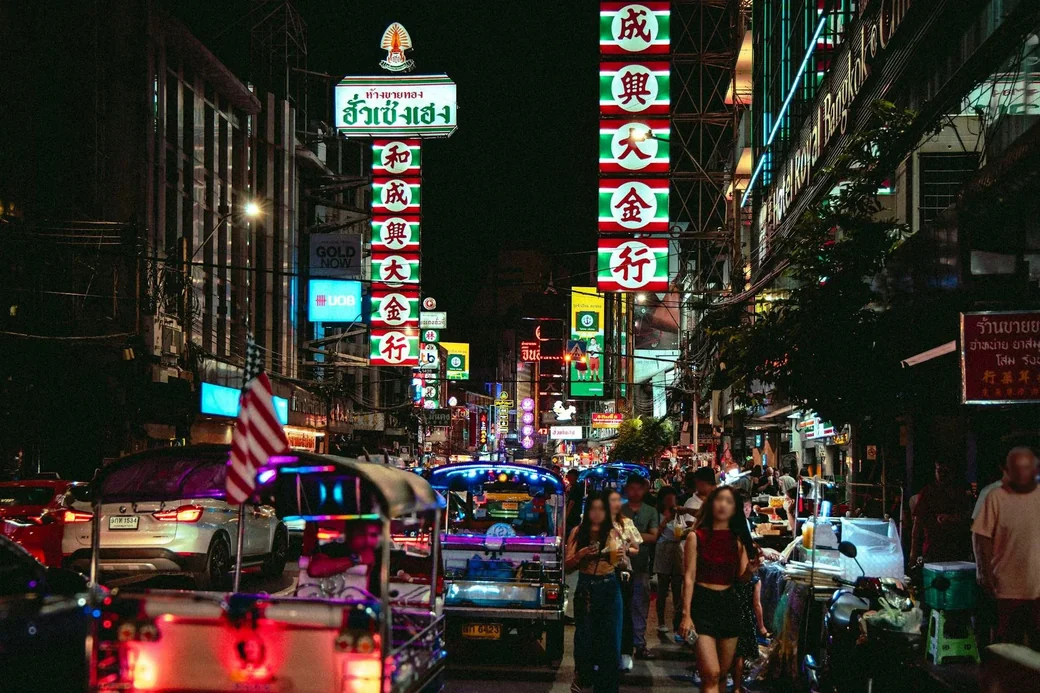
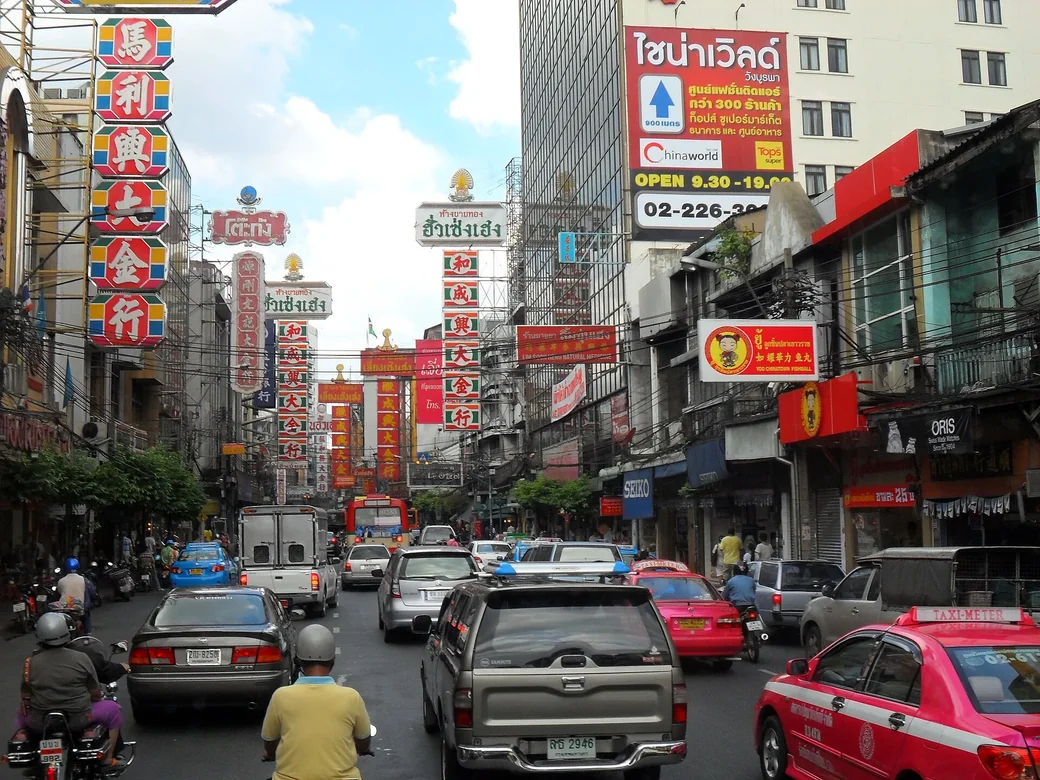
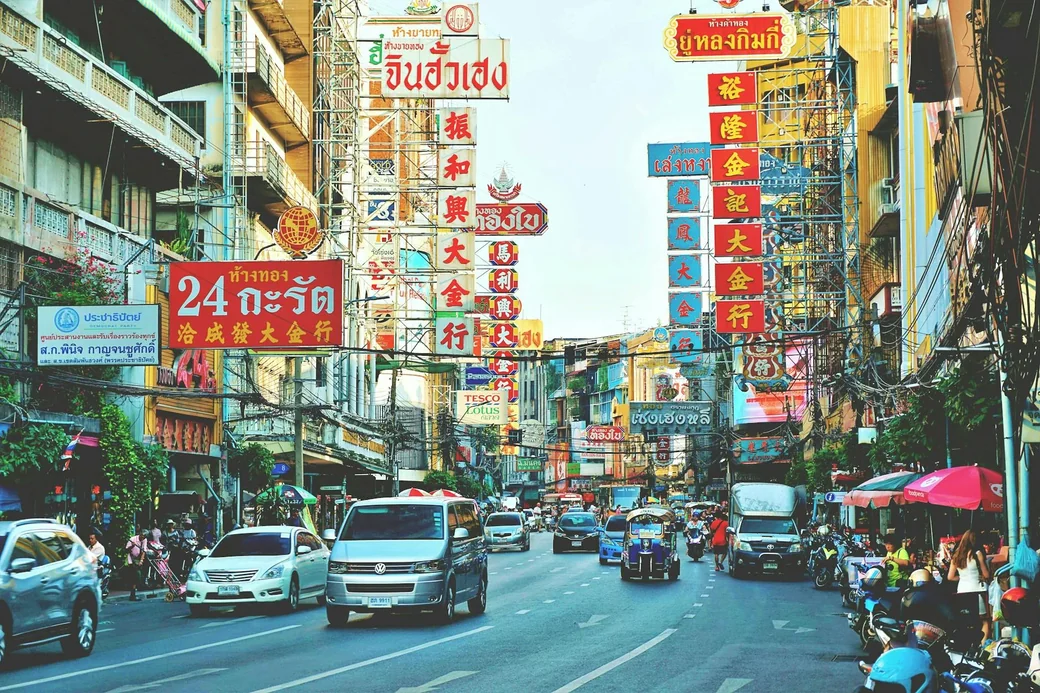
Bangkok's Chinatown, centred on Yaowarat Road in the Samphanthawong district, is one of the city's oldest and liveliest neighbourhoods, stretching along the Chao Phraya River just downstream from the old royal quarter. By day it is a dense trading district of gold shops, narrow market lanes and Chinese temples; after dark its neon-lit main road fills with food stalls and becomes one of Bangkok's great street-food destinations. Rich in Thai-Chinese heritage and still a working community, it shows the city's commercial energy at its most concentrated.
Chinatown (Yaowarat), Bangkok: Location, accommodation options and contact
The place's location on the map and nearby accommodation and hotel options are shown by Stay22. Cookies are used. Your consent is remembered on every page; you can turn it off at any time in the cookie settings.
Take the MRT to Wat Mangkon — Chinatown Traffic Is Not Worth It
Wat Mangkon station on the Blue Line drops you under the district; from the platform you are on the main road in about two minutes. Road traffic here builds up from late afternoon, so a journey that takes fifteen minutes underground can take three times that in a taxi. Check the exit map before you ride up, because surfacing on the wrong side of a one-way lane costs you ten minutes. Long before the metro, electric trams ran along Charoen Krung and Yaowarat roads, from 1894 until the service ended in 1968.
Monday Night in Yaowarat: What to Expect
Monday is the city's pavement-cleaning day, and a large share of street vendors take it off. Arrive on a Monday evening expecting the full spread and you will find roughly half the strip dark, including several of the best-known stalls. Some sit-down restaurants close that day too. Tuesday through Sunday the scene runs at full strength, with Sunday among the busiest. Plan your food night accordingly and keep Monday for temples.
Best Times to Visit: Morning Temples, Evening Street Food
Split the district by time of day. Early in the morning the market alleys are already working, the shrines are quiet and the heat is still bearable; that is also when you may see monks collecting alms around Sampeng. Shops wind down towards the evening. The food stalls set up as the light fades and the strip is fully alive after dark, running late into the night. Between those windows, use an air-conditioned cafe.
Wat Traimit and the World's Largest Solid Gold Buddha
The seated image here weighs five and a half tonnes, and its gold varies in purity: about 40 percent in the body, about 80 percent from the chin to the forehead and 99 percent in the hair and topknot. It spent generations under a plaster coating, thought to have been applied to hide it from invaders, and its true nature emerged only in the 1950s when the covering cracked during a move. The same complex holds the Yaowarat Chinatown Heritage Centre, whose exhibits cover the early migrants. Mornings are calmest; allow about an hour. Through the nineteenth century, waves of Teochew and Hokkien migrants (groups from southern China) arrived, many driven out by famine. Newcomers who attached themselves to an official and did compulsory labour were tattooed on the wrist, while those who paid a government tax instead wore a wrist token and were free to find their own work, a distinction that shaped who came to own the district's shophouses. The image is cast in the Sukhothai style. It was moved to Wat Traimit in 1935, and since 2010 it has sat in a gleaming hall built to display it, whose lower floors hold the heritage centre and an exhibition on the statue's origins.
Start at the Chinatown Gate on Odeon Circle
The red ceremonial gate marks the district's eastern entrance and was built by the Thai-Chinese community for King Bhumibol's seventy-second birthday, inaugurated by Princess Sirindhorn. Look down: a brass plate set in the ground carries the character for earth, with the character for heaven above you, and by feng shui (Chinese geomancy) belief anyone standing on that spot receives cosmic energy. The white jade lions were later gifts from the Chinese government. The gate stands at the dragon's head: locals read the curve of Yaowarat Road as a dragon's body and call it the Dragon Road.
Wat Mangkon Kamalawat, Bangkok's Largest Chinese Temple
Founded in the early 1870s and renamed Dragon Lotus Temple by King Chulalongkorn, this is the most important Chinese Buddhist temple in the city — and it is full of worshippers rather than tour groups. Four four-metre guardian statues stand inside the entrance, and separate halls serve Buddhist, Taoist and Confucian deities. Note that it technically sits just outside the Samphanthawong boundary, in the neighbouring district. The temple stands on Charoen Krung Road, the first road in the country built with modern methods: laid out between 1862 and 1864 and long known simply as New Road, it was later named Charoen Krung, meaning prosperous city.
Leng Buai Ia: Thailand's Oldest Chinese Shrine, Hidden in Talat Kao
An inscription inside dates this small Teochew shrine to 1658, during the Ayutthaya period, which makes it the oldest Chinese shrine in the country. It sits inside the Talat Kao market lanes off Yaowarat Soi 6, easy to walk past. The main altar honours Leng Buai Ia and his wife, with Guan Yu and the Queen of Heaven either side; there are Qing-dynasty plaques and a bell, plus an incense container given by King Chulalongkorn. A few steps away on the same soi (side lane), Talat Mai has traded for more than two centuries despite a name that means new market: dried squid, goji berries, loose-leaf tea, ginseng, incense and paper offerings shaped like phones and handbags.
How to Shop Sampeng Lane Without Wasting Time
Sampeng, officially Soi Wanit 1, runs about a kilometre and is primarily a wholesale market: prices are fixed, haggling gets you nowhere, and discounts appear only when you buy in quantity. Small vendors take cash only. It is arm's-width narrow, and delivery scooters push through regardless, so keep bags in front of you and stay alert. Go early — weekends turn it into a slow-moving crush. This is where the district began: when King Rama I founded his new capital in 1782 and started work on the Grand Palace, the Chinese community living on that riverbank was moved downstream to Sampheng, and the lane has been trading ever since, which makes it one of the oldest markets in the city. In its name, soi means a side lane. The streets around it are lined with herbal pharmacies, dried-goods wholesalers, stationery and textile stalls. On 3 June 1946, King Ananda Mahidol (Rama VIII) and his younger brother, the future King Bhumibol, spent a whole morning walking through Yaowarat and Sampheng.
How to Eat Your Way Down Yaowarat Road
Work one side of the road outbound and the other on the way back. The reliable signals are simple: a queue of locals, a stall that cooks to order, and a kitchen doing one dish only. Rolled rice-noodle soup in peppery pork broth, handmade fish balls with no flour in them, grilled river prawns, oyster omelettes and charcoal-toasted buns are the classics. Bring wet wipes; stall napkins are useless. Look out too for chestnuts turned in woks of black sand. Many stalls are run by families who have cooked the same single dish for fifty or sixty years, and several have been recognised by the Michelin Guide. The road itself, roughly 1.5 kilometres long and 20 metres wide, was cut through the old quarter under King Rama V and took eight years to complete; rather than expropriate land, the king had it follow existing oxcart tracks, which is why it bends. The name itself honours royalty: first called Yuppharat, the road was renamed Yaowarat, meaning young king, in honour of Crown Prince Vajirunhis, the first son of King Chulalongkorn.
Understanding Yaowarat's Gold Shops Before You Buy
These are traders, not souvenir counters. Thai gold here is 96.5 percent pure, noticeably richer in colour and softer than the 18-karat standard common in Europe. Weight is quoted in the baht unit, about 15.2 grams, not in the currency of the same name, and the daily rate is posted on boards inside. Keep the receipt and hallmark for resale, and compare the shop's buy-back figure, not just the selling price. Yaowarat holds one of the densest concentrations of gold shops in Southeast Asia, and many have traded from the same address for three or four generations. Before Silom rose, this was the city's main commercial avenue, and the early concrete commercial blocks along it were among the first of their kind in Bangkok.
Talat Noi: Street Art, Old Mansions and Riverside Shrines
The lanes between the main road and the river hold the oldest layer of the district. So Heng Tai, a Chinese courtyard house from the era of King Rama I, still stands here with a diving pool in its courtyard; it closes on Mondays. Around it are engine-parts workshops, murals on every shutter and small riverside shrines, including one of the country's oldest Hokkien shrines at the end of an alley. The area is genuinely mixed: on the same riverbank stands the Holy Rosary Church, first built in 1787 by settlers who came downriver after the fall of Ayutthaya.
Song Wat Road: Warehouse Cafes Next to Century-Old Shops
Laid out under King Rama V after fires in Sampheng, this riverside street spent decades half-empty before murals and a local business collective revived it. Today spice warehouses hold galleries, specialty coffee and independent shops, while braised-goose stalls and Teochew steamed-bun bakeries carry on beside them. Come in daylight for the cafes and stay into the evening for the bars.
Soi Nana After Dark: Chinatown's Cocktail Lane
Not the Sukhumvit street of the same name. This narrow lane of century-old shophouses became the city's most interesting bar strip, with a pioneering gin bar behind a heavy Indian door, a neo-Chinese bar known as much for its sesame pudding as its cocktails, and a Thai-spirits bar with live traditional music.
Phahurat, the Little India Next Door
Five minutes west of the gold shops, the street layout changes and so does the soundtrack. Phahurat was laid out in the late 1890s and became a textile quarter: saris, trims, tailoring supplies and curry houses. At its heart is a white, gold-domed Sikh temple, first built on this site in 1933 and rebuilt in its present form in 1981, open to all visitors who cover their head and remove their shoes, with a free vegetarian meal served daily and rooftop views over the rooftops. At the edge of Phahurat, on Charoen Krung Road, stands the Sala Chalermkrung Royal Theatre, opened on 2 July 1933 with royal funds to mark Bangkok's 150th anniversary. Its air-conditioning was a novelty in its day, and the theatre now stages khon (masked dance drama) and other performing arts.
Festivals, Crowds and Small Safety Details
Two events transform the district. During the nine-day vegetarian festival, stalls run up yellow flags, devotees dress in white and meat-free kitchens line the main road. At Lunar New Year the road closes to traffic for a few days for lion and dragon dances. Both bring huge crowds. Crime is not the concern here — density is: watch pockets, motorbikes in the alleys and uneven kerbs. The yellow flags of the vegetarian festival carry the red character for jay (abstaining from meat and other animal products), so follow them to find meat-free stalls.
Chinatown (Yaowarat), Bangkok: Visitor Tips
Treat Chinatown as two visits rather than one. Mornings belong to the market alleys, the shrines and the gold-shop stretch, when the light is good and the heat is manageable. Evenings belong to the food, which comes alive once the sun goes down. Wear closed shoes, because the lanes are uneven and often wet, and keep bags in front of you in the crush along the main road. If you are travelling in a group, agree on a meeting point before you start walking — phone signal is fine, but hearing anyone is not.
Chinatown (Yaowarat), Bangkok: Best Time to Visit
Mornings for temples and market lanes, evenings for street food. Tuesday to Sunday — many stalls close on Monday. November to February is the cooler, drier stretch.
Chinatown (Yaowarat), Bangkok: Admission Fees
Free admission
Strolling along Yaowarat Road and its side lanes costs nothing; you pay only for food and shopping at the stalls and shops. The street is especially atmospheric in the evening.
Free
Quick Info
4h
easy
Chinatown (Yaowarat), Bangkok: Getting There
The MRT Blue Line is the sensible way in. Wat Mangkon station (BL29) sits directly under the district and puts you on the main road in a couple of minutes on foot; Hua Lamphong (BL28) is a ten-minute walk from the eastern end near the Chinatown gate, and Sam Yot (BL30) is handy for the canal walking street and Little India. Coming from the river, take a Chao Phraya Express boat to Ratchawong Pier and walk up Ratchawong Road. Arriving by MRT keeps the journey smooth, as road traffic around the district builds up from the late afternoon. Once you are inside, everything is walkable.
Nearby stops & parking
Wat Mangkon station has several exits onto different parts of the street grid, so check the exit map on the platform before riding up. Hua Lamphong station is linked by an underground passage to the historic Bangkok Railway Station, which still runs a limited number of local and excursion trains after long-distance services moved to Krung Thep Aphiwat Central Terminal. Ratchawong Pier and the Marine Department pier serve the riverside edge. For drop-offs, Odeon Circle is the easiest landmark to give a driver.
No dress code applies on the street, but the temples expect shoulders and knees covered — Wat Traimit enforces this, and scarves or sarongs can be rented or bought at the entrance. Shoes come off before you enter shrine halls. At the Sikh temple in Phahurat, cover your head and leave your shoes with the attendants. Photography is generally allowed at shrines, but avoid flash and keep clear of people mid-prayer. Light, breathable clothing and closed shoes are the practical combination.