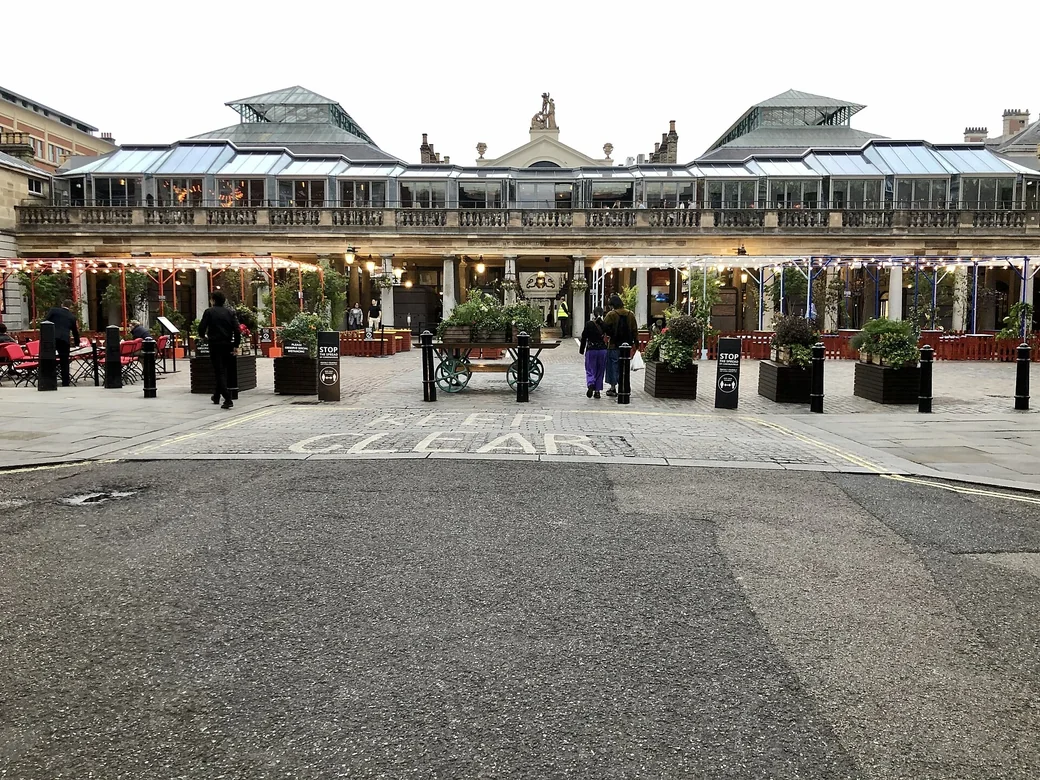
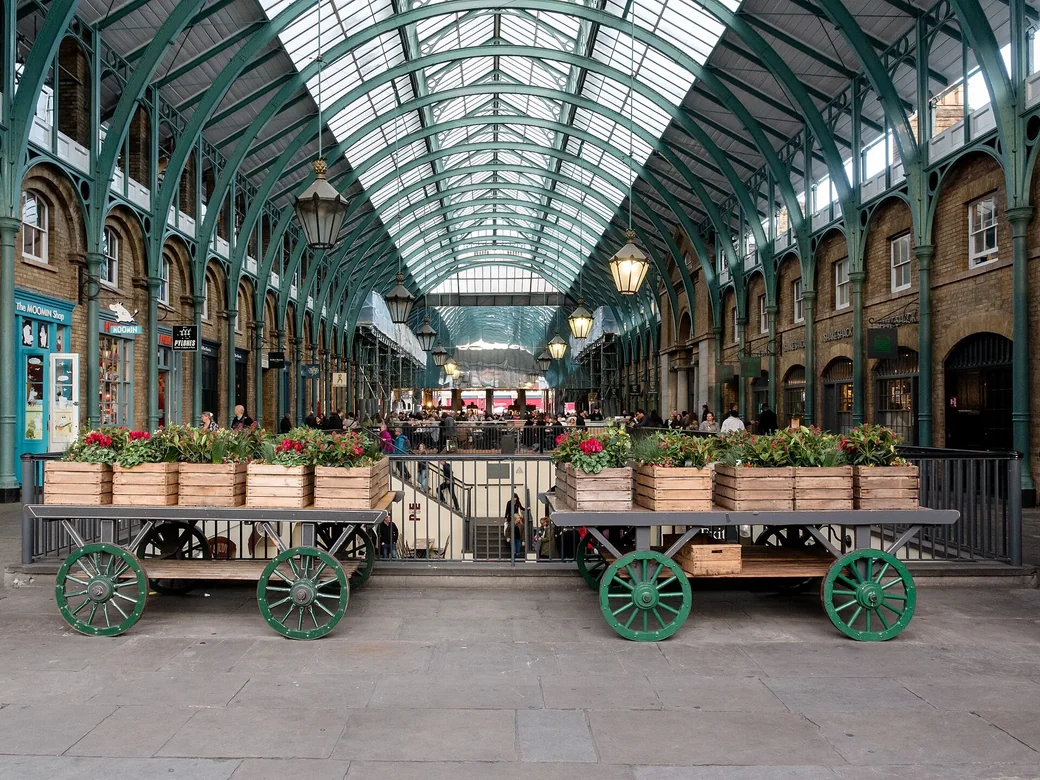
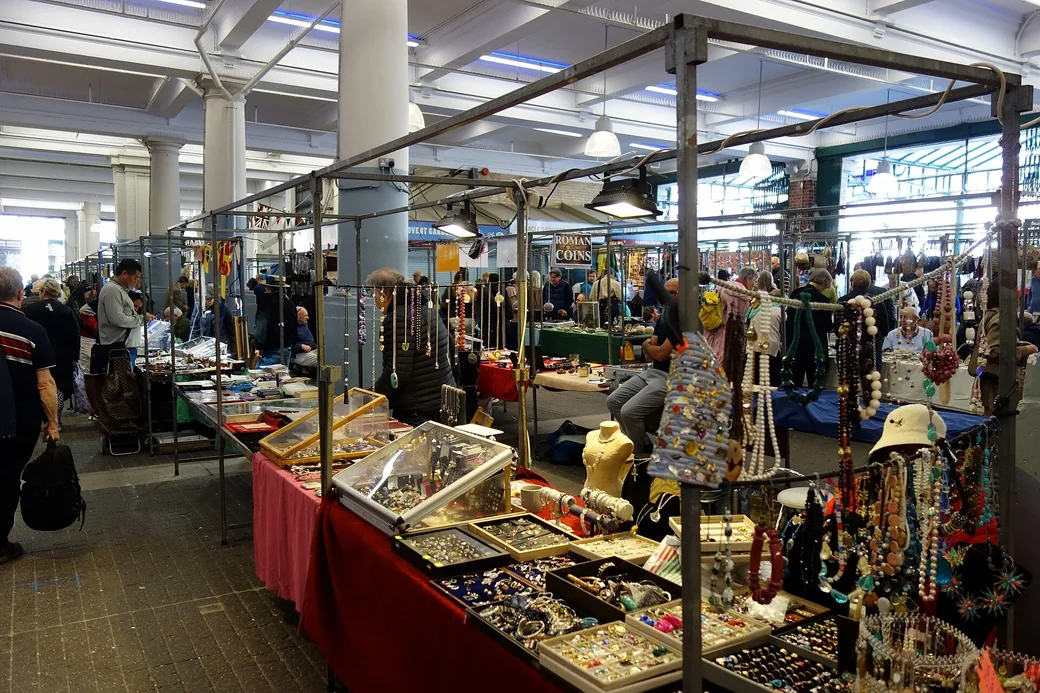
Covent Garden is a historic district on the eastern edge of London's West End, just north of the Strand. Its heart is the Piazza (an open square lined with arcades), centred on an elegant former market hall. For centuries this was the city's great fruit, vegetable and flower market; today its cobbled streets bring together covered markets, boutiques, restaurants, historic pubs, theatres and lively street performances, making it one of London's most atmospheric places to stroll, shop and spend an evening.
Covent Garden: Location, accommodation options and contact
Covent Garden Piazza, The Market Building, London WC2E 8RF
The place's location on the map and nearby accommodation and hotel options are shown by Stay22. Cookies are used. Your consent is remembered on every page; you can turn it off at any time in the cookie settings.
Covent Garden history: from a convent garden to London's first planned square
The name goes back to a walled garden that belonged to Westminster Abbey and its religious community; a lease of 1515 already mentions "a garden called Covent Garden". In the 1630s the Earl of Bedford commissioned a residential square with arcaded houses and a church, and the layout has long been attributed to Inigo Jones, although firm documents are missing. Excavations also show that this ground held a trading settlement called Lundenwic around the year 600. According to legend, when the Earl asked for a modest building, Jones promised him "the handsomest barn in the land"; the church on the square's western side is the result.
Covent Garden Market, Apple Market and Jubilee Market: what to expect
Charles Fowler's neoclassical Market Building opened in 1830 and still dominates the Piazza. Inside and around it you will find the Apple Market, devoted to handmade local crafts and, on some days, antiques and collectables, plus the East Colonnade Market. Jubilee Hall, built in 1904 on the south side, hosts the Jubilee Market, whose character shifts through the week between antiques, general stalls and arts and crafts. Everything is under cover, so rain does not spoil the visit. Stall hours vary, so check the official sites.
How Covent Garden was saved: the 1970s campaign and the Rent Ceremony
The wholesale market had outgrown its narrow streets and moved to Nine Elms in 1974. A large redevelopment had been planned, but residents campaigned, and hundreds of buildings around the square were protected by listing, so the old quarter was restored instead of demolished. The central market reopened in 1980, described by the estate as the first speciality shopping centre of its kind in Europe. A charming trace of that story is the annual Rent Ceremony each summer, when the trustees of a local trust parade around the Piazza with a town crier to hand over five red apples and five posies of flowers as a symbolic rent.
Covent Garden street performers: three stages and a tradition since the 1600s
The earliest record of street entertainment here is Samuel Pepys's diary of 1662, which mentions a puppet show featuring Punch. Today performers work on separate stages: the open West Piazza hosts the big circle shows of juggling, acrobatics and comedy; the covered North Hall hosts variety acts and acoustic musicians; and the lower courtyard of the Market Building is home to opera singers and classical players, helped by the acoustics of the listed hall. Performers audition for the Market Building pitches and live on voluntary tips, so stay for the finale and show your thanks. Each May a puppet fair at St Paul's celebrates Mr Punch. The performers have organised themselves through their own association since 1975, and several well-known entertainers began on this stage; the open West Piazza falls under the local council's jurisdiction, outside the Market Building audition system.
St Paul's Church, the Actors' Church of Covent Garden
Completed in 1633 and consecrated in 1638, St Paul's was the first entirely new church built in London since the Reformation. Its grand portico facing the Piazza is not the entrance: the altar had to stay at the east end, so the real door is at the opposite (west) end, reached through a quiet churchyard garden. The church earned its nickname through its long ties with the theatres; plaques honour performers such as Vivien Leigh, Noël Coward and Charlie Chaplin, and the portico is the opening setting of Shaw's play Pygmalion. A fire in 1795 gutted the interior, and it was rebuilt to the original design. Opening hours vary, so check before visiting.
Royal Ballet and Opera at the Royal Opera House: history, public spaces and tickets
A theatre has stood on Bow Street since 1732, when it opened as a playhouse; Handel gave regular seasons here from 1735. Fires destroyed the first and second buildings in 1808 and 1856, and the present building opened in 1858 to a design by E. M. Barry, with a major renovation completed in 1999. The resident companies, The Royal Opera and The Royal Ballet, have used the joint name Royal Ballet and Opera since 2024. The glass-and-iron Paul Hamlyn Hall, once a flower market hall, and other public areas, with a café and a terrace, welcome visitors at set times. Tours, short lunchtime performances and last-minute ticket schemes exist, so see the official website for the current programme.
London Transport Museum in Covent Garden Piazza
The museum fills the iron-and-glass Flower Market building of 1871 on the south-east corner of the Piazza and has been here since 1980. It tells how London grew with its buses, trams, trains and Underground, and it shows famous transport posters and the original Tube map drawn by Harry Beck. Interactive galleries make it a favourite with families. Entry works with timed slots and a pass system, so book through the official website, and look at its Hidden London tours of disused stations, which fill up quickly. The museum shop can be visited without going into the galleries.
Seven Dials and Neal's Yard: the sundial pillar and the colourful courtyard
A short walk north, Thomas Neale laid out Seven Dials in the early 1690s as a star of streets that maximised rentable frontage. The central Sundial Pillar by Edward Pierce had six dials, with the column itself as the seventh; seven roads but six faces is a favourite puzzle. The original was removed in 1773 and now stands in Weybridge, and a faithful replica was unveiled in 1989. According to legend, a crowd pulled the first pillar down while hunting for buried treasure. Nearby Neal's Yard, shaped in the 1970s by Nicholas Saunders, is a courtyard of painted buildings, cafés and natural-health shops, and it is said that astrologers and healers have gathered around this star-shaped layout since the seventeenth century. Many of the original houses from Neale's 1690s development still stand, most of them refaced in the late eighteenth and early nineteenth centuries.
Covent Garden theatres and a West End evening
Few districts hold so many stages. Theatre Royal Drury Lane stands on a site used for theatre since 1663, and its present building dates from 1812; the Lyceum, Adelphi, Novello, Fortune, Cambridge and the intimate Donmar Warehouse are all within a short walk. Many restaurants offer early sittings for theatregoers, and booking a table ahead is wise on show nights. The Fortune is known for a bar inside its stalls. Evening is also when the Piazza glows, with lit arcades and open terraces, so allow time before the curtain. Allow two to three hours for a relaxed visit to the district, or a full day if you add a museum, a meal and an evening performance.
Ghost stories of Covent Garden: William Terriss and the Man in Grey (legends)
Theatre districts breed ghost stories. According to legend, the actor William Terriss, who died after an attack at the Adelphi's stage door in 1897, still walks the Adelphi and even Covent Garden Tube station, which opened ten years later; staff reported a figure in a cloak and gloves from the 1950s, and a séance is said to have named him. At Drury Lane the "Man in Grey" is said to cross the upper circle in daylight in eighteenth-century dress, and seeing him is thought to foretell a hit. Legend adds that a walled-up room with a skeleton was found in the building and that the clown Joseph Grimaldi gives mischievous kicks. None of this is proven; enjoy it as folklore.
Where to Eat, Drink and Shop in Covent Garden: Historic Pubs, Local Favourites and Independent Shops
The Lamb & Flag in Rose Street, a listed pub (a traditional drinking house) tucked down a narrow lane, was nicknamed the "Bucket of Blood" for the bare-knuckle contests held there in the nineteenth century. In 1679 the poet John Dryden was beaten in the alley beside it; who ordered the attack is unknown, and the stories name different figures. Its upstairs room carries Dryden's name, and, according to legend, Charles Dickens drank here too. Rules in Maiden Lane claims to be London's oldest restaurant, while Balthazar and Hawksmoor suit a special meal, and Seven Dials Market, a food hall in a former banana warehouse, suits a casual one.
Long Acre is the main high-street artery, Floral Street is the cobbled stretch for designer boutiques, King Street suits womenswear, and Neal Street and Earlham Street around Seven Dials are good for footwear and independent labels. Stanfords is a long-established map and travel bookshop, Benjamin Pollock's Toyshop in the Market Building keeps alive the tradition of paper toy theatres, and Neal's Yard Remedies sells natural beauty products. A simple walking route: Market Building, Floral Street, Long Acre, Neal Street, Seven Dials, Neal's Yard. Shops usually trade from morning until evening, with shorter hours on Sunday.
Hidden corners of Covent Garden: Goodwin's Court, Cecil Court and more
Goodwin's Court is a gas-lit alley of bow-fronted shops from the late eighteenth century, and Cecil Court nearby is a lane of antiquarian booksellers. Harry Potter fans say that one or both inspired Diagon Alley, but that is a popular theory, not a confirmed fact. According to legend the actress Nell Gwyn once lived in Goodwin's Court; there is no proof. Also worth finding are the Art Deco Freemasons' Hall, whose Grand Temple can be seen on a guided tour, the Bow Street museum of policing and justice in former station cells, and the quiet community garden called Phoenix Garden. Hitchcock's film Frenzy (1972) was shot around the old market, where his father had worked in the produce trade.
Covent Garden in literature and film: Pygmalion, Jane Austen and Hitchcock's Frenzy
Shaw's play Pygmalion opens under the portico of St Paul's, where the flower seller Eliza Doolittle meets Professor Higgins; the story later became the musical and film My Fair Lady. Eliza is said to have been inspired by a real flower-stall holder on the nearby Strand, and Shaw reportedly gave the play's royalties to the Royal Academy of Dramatic Art. Jane Austen stayed at 10 Henrietta Street, in her brother Henry's flat above his bank, in the summer of 1813 and in March 1814; a plaque marks the house, and from there she visited the Lyceum and Drury Lane theatres. Hitchcock's film Frenzy (1972) also uses the old market and a flat on the same street.
Surprising facts about Covent Garden: the Beggar's Opera, the O.P. Riots and the Bow Street Runners
The Beggar's Opera, produced in 1728 by the manager John Rich, was such a hit that its profits are said to have helped pay for the first Theatre Royal on Bow Street; on opening night in 1732 his actors carried Rich into the theatre in procession. In 1809 the O.P. (Old Prices) Riots saw audiences disrupt performances for over two months until the management gave way. During the Second World War the opera house served as a dance hall, and it reopened in 1946 with The Sleeping Beauty. Bow Street's first court dates from 1740, and the Bow Street Runners of 1749 are often described as London's first organised police force. The actress Nell Gwyn performed at the first Theatre Royal on Bridges Street, the forerunner of Drury Lane. St Paul's holds the grave of the woodcarver Grinling Gibbons, and its pulpit is attributed to him or his pupils.
Covent Garden Visitor Tips: Crowds, Photo Spots, the Tube Station and Dos and Don'ts
The listed oxblood-red station building of 1907, designed by Leslie Green, serves the Piccadilly line. There are no escalators: platforms are reached by four lifts or an emergency spiral stair of 193 steps, about a fifteen-storey climb. Leicester Square is only some 260 metres away, the shortest gap between two stations on the network, so at busy times it is often quicker to get off there and walk. The station is not step-free. Holborn and Embankment are about ten minutes on foot and the Elizabeth line at Tottenham Court Road about fifteen. A 1929 proposal to close the station was never carried out.
Weekday mornings before midday are quietest, and early light on the cobbles is best for photographs; Saturday afternoon is the busiest time. Good photo spots are the Piazza seen from the church side, the arcades at dusk, the glass roof of the Market Building, Neal's Yard and the Seven Dials pillar. Do keep bags closed in crowds, step back so everyone can see a show, and carry a refillable bottle. Don't block the arcades, and don't film performers without showing your thanks. In the festive season the Piazza is lit with hundreds of thousands of lights and a large tree, which draws big evening crowds. From the Piazza, Leicester Square, Soho, Trafalgar Square with the National Gallery, and Somerset House are each roughly ten to fifteen minutes away on foot.
Covent Garden: Visitor Tips
Come on a weekday morning for a calm visit and stay into the evening for the theatre crowds and festive lights. Keep bags closed in crowds, wear comfortable shoes for the cobblestones, and use Leicester Square instead of Covent Garden station when it is busy. The Piazza is open at all hours; shops, markets and sights keep their own hours. The balcony of the Punch & Judy pub above the Market Building gives a view over the West Piazza, and Sunday mornings are calmer than Saturdays.
Covent Garden: Best Time to Visit
Weekday mornings are calmest; street shows peak in the afternoon; evenings suit theatre and dining; festive lights glow in the Christmas season.
Covent Garden: Admission Fees
Free admission
The piazza, the Market Building and the street performers are free to enjoy; shops, restaurants and show tickets are paid for separately.
Free
Quick Info
2h 30m
easy
Covent Garden: Getting There
Covent Garden Piazza is in central London, in Zone 1. The closest Tube (London's underground railway) station is Covent Garden on the Piccadilly line, a short walk along James Street to the Market Building. It has no escalators, only lifts and a long staircase, so at busy times get off at Leicester Square (Piccadilly and Northern lines) and walk. Holborn (Central and Piccadilly lines) and Embankment (Circle, District, Bakerloo and Northern lines) are about ten minutes on foot, and Tottenham Court Road (Elizabeth, Central and Northern lines) about fifteen.
Charing Cross, for national rail services, is an eight-to-ten-minute walk via Bedford Street. Many buses run along the Strand, Aldwych and Kingsway. The Piazza is pedestrianised and the area lies inside central London's congestion-charging zone, so public transport, walking or a taxi is recommended rather than driving.
Nearby stops & parking
Closest stations: Covent Garden (Piccadilly line), Leicester Square, Holborn, Embankment and Charing Cross. Bus stops are on the Strand, Aldwych and Kingsway. Car parks within a short walk include the underground one at Parker Mews off Drury Lane, the one at Newport Place and the one in Bedfordbury; as in any busy city centre, do not leave valuables in a parked vehicle.
Taxis can drop off in the streets around the Piazza, but the square itself is pedestrian only. Bicycle racks are placed around the area. Toilets are in the Market Building and beside the portico of St Paul's Church, and an accessible toilet is in Tavistock Court next to Jubilee Market. Step-free routes into the Market Building are the ramps from Russell Street and from the bottom of James Street; the security office in Central Avenue, inside the Market Building, can provide assistance.
Covent Garden: Dress Code & Etiquette
There is no dress code in the Piazza, shops or markets; comfortable shoes are best for the cobbles. Inside St Paul's Church, Freemasons' Hall and similar interiors, dress modestly, keep your voice low and ask before photographing. For an evening at the opera or theatre, smart-casual clothes are common but not obligatory. Dogs are welcome to walk through public areas; please pick up after them.