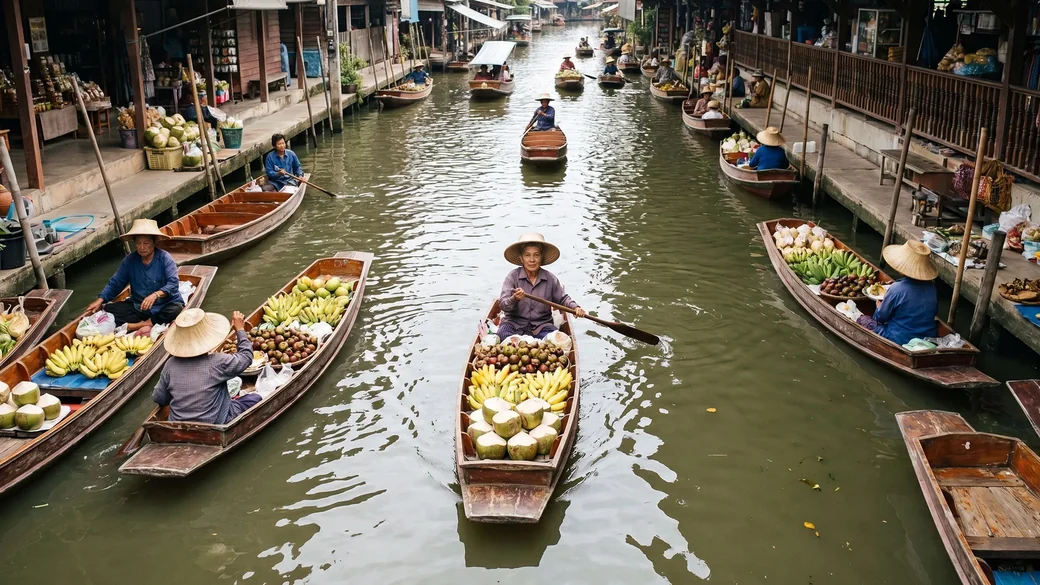
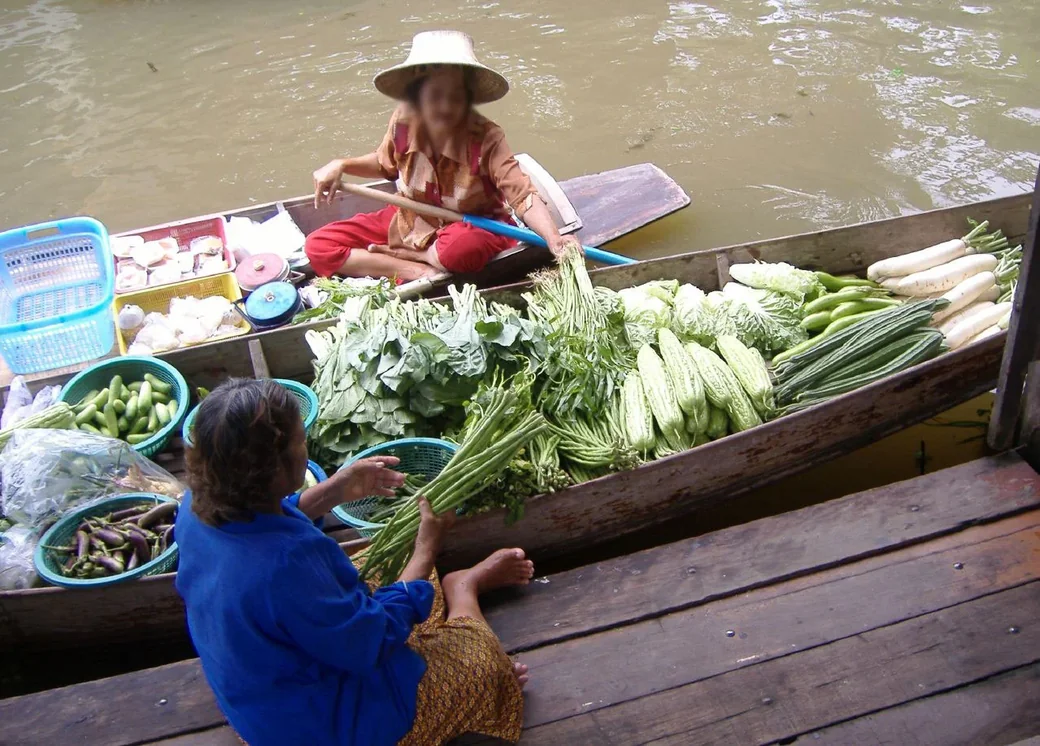
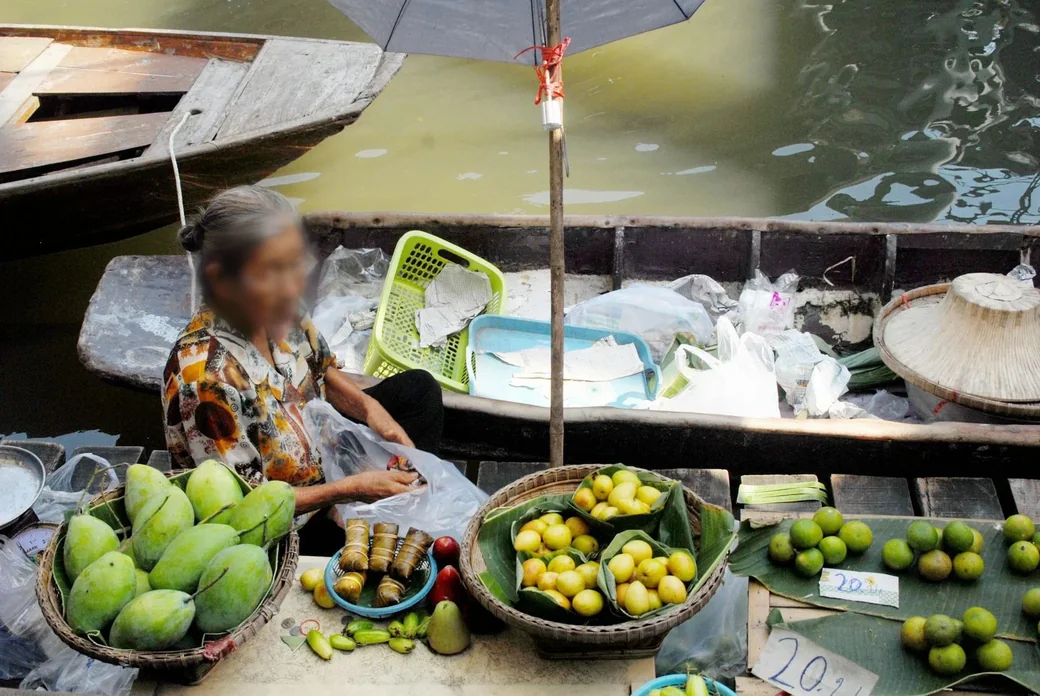
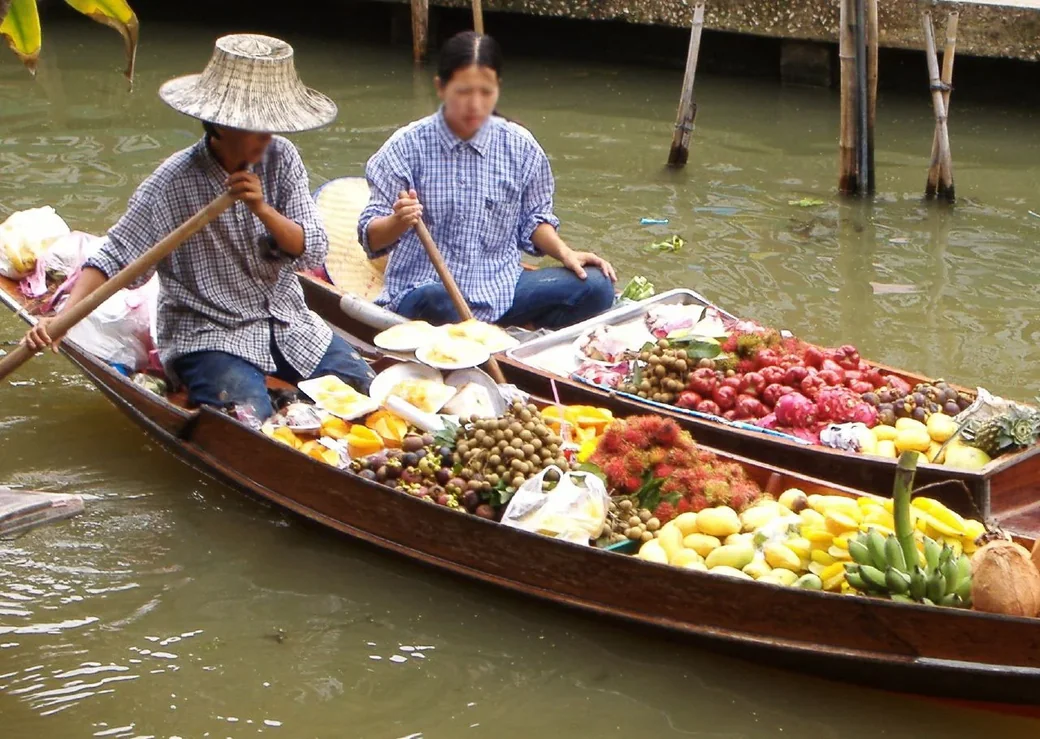
Damnoen Saduak Floating Market is Thailand's best-known floating market, set on a canal in Ratchaburi province, about 100 kilometres south-west of Bangkok. Its narrow waterways fill with wooden boats laden with tropical fruit, noodles and snacks, while visitors watch from the canal-side boardwalks or glide past by boat. A classic morning excursion from the capital, it offers a lively, colourful glimpse of the water-trading way of life that once shaped central Thailand.
Damnoen Saduak Floating Market: Location, accommodation options and contact
Damnoen Saduak Subdistrict, Damnoen Saduak District, Ratchaburi 70130, Thailand (approx. 100 km southwest of central Bangkok)
The place's location on the map and nearby accommodation and hotel options are shown by Stay22. Cookies are used. Your consent is remembered on every page; you can turn it off at any time in the cookie settings.
Arrive Early to Beat the Boat Traffic at Damnoen Saduak
Trading starts in the early morning and the canal is at its best in the first hours: cool air, vendors still loading, shade on the water. Later the coach groups land and the narrow khlongs jam hull to hull. Leaving central Bangkok at first light is the single decision that changes the whole visit. If an early start is impossible, the other quiet window is late morning, once the buses have gone — thinner on boats, but far easier to move.
Know the Three Markets: Ton Khem, Hia Kui and Khun Phitak
Most visitors never realise they are walking through three separate markets. Ton Khem, on the main canal, is the biggest and the source of every postcard image. Hia Kui runs parallel and is lined with souvenir shops built for coach parties, which is why it feels the most commercial. Khun Phitak, about two kilometres south of Hia Kui, is the smallest and quietest: orchards, canal-side homes, hardly any trinkets. Ask your driver or boatman by name for the stretch you actually want.
A Canal from 1868, a Market from 1981: the Real History
King Rama IV ordered the canal dug in 1866 to link the Mae Klong and Tha Chin rivers; it was finished in 1868 and remains Thailand's longest straight man-made canal, its name meaning "convenient travel". The original trading place, Lad Plee, was a genuine village market for nearly a century. The market visitors walk through today was laid out in 1981, after a road reached the Ton canal. Knowing this makes the place easier to enjoy for what it is. The digging was supervised by Somdet Chaophraya Sri Suriwongse, and the canal runs for roughly 35 kilometres, a vital link in an era when central Thailand had almost no roads. From the main channel, some two hundred smaller canals were later dug out to reach the orchards, and the canal's official inauguration took place in 1868 at Bang Nok Khwaek, where it meets the Mae Klong.
Enter by the Main Bridge in Town
Ask to be set down at the main bridge in the middle of town, where steps lead straight down to the walkways and where the official piers are. Some drivers drop visitors a kilometre short of the market at a private pier and say the only way in is by boat; a polite, firm request for the main bridge settles it. The bridge also gives you a first overview of the canal, so you can decide on the spot whether to explore on foot or by boat.
Paddle Boat or Longtail? Choosing the Right Ride at Damnoen Saduak
The rowed sampan is slow, quiet and close to the water, which makes it the better choice inside the market itself: you drift between vendors and can buy straight from a passing boat. The motorised longtail (boat with a long propeller shaft) is loud but useful if you want to get out of the market — into the side canals, past orchards, stilt houses and the odd family workshop. Many visitors are happiest doing the market on foot and the countryside by longtail. The households along these banks descend largely from the labourers brought from southern China to dig the canal, who settled on both sides once the work was done. Eight stone milestones were set along the waterway, and the communities that grew beside them still carry their numbers in their names. The orchard landscape you pass is itself a legacy of the diggers: they brought the ridge-and-ditch planting system known as suan yok rong (raised beds separated by water channels), and Thai Song Dam families who settled later added their own traditions. Each year, usually from late January into February, a Buddha image is carried by boat along the canal from the first milestone to the eighth so that the waterside communities can pay homage.
Agree the Route and the Time Before You Step Into Any Boat
The most common complaint here is not about money but about control: boatmen who stop at shop after shop because they earn commission, while the clock runs. Before you board, say where you want to go, how long you want to be out, and that you do not want shopping stops. Repeat it once you are on the water. A polite, specific instruction at the start is far easier than an argument halfway round.
Eat Straight from the Boats: Boat Noodles and Coconut Pancakes
The canoe kitchens are the real attraction. Boat noodles — small, intense bowls of pork or beef broth — are ladled straight from a charcoal burner on the deck. Kanom krok, little coconut-milk pancakes cooked in a dimpled pan, arrive hot and collapse in the middle. Add seasonal fruit from the orchards along the canal, and palm sugar, which families in this district have made from coconut blossom for generations. Look out too for local grapes: Damnoen Saduak district is known for sweet table grapes, which are celebrated each year at a grape fair held together with the floating market.
Walk the Canal-Side Boardwalks Before You Commit to a Boat
Walking shows you the market's shape: which stretch is souvenirs, where the food boats cluster, which bridge gives the best angle. You can shop from the walkway just as easily as from a boat — vendors pass their goods up on a pole. Do the loop first, then decide whether the water adds anything for you. Walking also reveals the daily life behind the stalls: wooden houses on stilts, spirit houses at the water's edge and family boats moored at their own landings.
How to Bargain Politely at a Thai Floating Market
Bargaining is expected on souvenirs and clothing, and roughly half the opening figure is a normal place to start before meeting somewhere in the middle. Food and fruit are usually near-fixed, so haggling there reads as rude. Keep it light: a smile, one counter-offer, and a genuine willingness to walk away work better than pressure. If you cannot agree, thank the vendor and move on — the next boat almost certainly has the same thing. For a souvenir with roots in the province, look for ong mangkon, the glazed dragon jars (stoneware storage jars decorated with dragons) that potters in Ratchaburi have made since the 1930s.
Going Independently from Bangkok Without a Tour
Public buses leave from Sai Tai Mai, the Southern Bus Terminal in Thonburi, and reach Damnoen Saduak town in around ninety minutes. Aim for one of the first departures; later ones arrive after the best hour has passed. From the bus stop it is a short walk or a songthaew hop to the canal. Getting back is the weak link, so check the return timetable on arrival rather than at midday. Sai Tai Mai is the main departure point for the southern and western provinces, so look for the Ratchaburi or Damnoen Saduak signs at the ticket windows.
Pair It with Maeklong Railway Market in the Same Morning
About half an hour away in Samut Songkhram, the Maeklong Railway Market spreads its stalls over a live railway track. The train comes through several times a day and the awnings fold back within seconds, then everything slides out again. Check the day's train times locally, because the whole point is the timing. Most visitors do the floating market first, then the railway market, and are back in Bangkok by mid-afternoon. Its Thai name, Talat Rom Hup, means the umbrella-closing market, after the speed with which the awnings are pulled back.
Want Something Quieter? Amphawa and Tha Kha Nearby
If the crowds at Damnoen Saduak put you off, two alternatives sit in the same corner of the country. Amphawa, in Samut Songkhram, trades mainly at weekends and into the evening, along a canal lined with old wooden shophouses. Tha Kha is smaller again and keeps a genuinely local rhythm. Neither has Damnoen Saduak's scale or its photographs — that is exactly the point. Closer still is Bang Nok Khwaek, at the canal's mouth on the Mae Klong, whose name means place of the black-crowned night herons. Its old market sits right beside the main river, and next to it rises the Nativity of Our Lady Cathedral, a Gothic church begun in 1890 and consecrated in 1896, often described as one of the most beautiful in the country.
What to Wear and Carry for Heat, Sun and Splashes
Light, quick-drying clothes, a hat and sunscreen are the basics; shade on the walkways is patchy and the heat builds fast as the morning goes on. Shoes with grip matter more than they sound: the wooden boards get wet and the step down into a boat is narrow. Keep phone and camera in a dry bag, since low boats splash. Carry small notes — many vendors cannot change large ones — and drink more water than you think you need. Part of the market is roofed, so trading carries on all day whatever the weather.
Best Photo Spots: Shoot from the Bridges Over Ton Khem
The classic frame — a corridor of hats and fruit boats — comes from the small footbridges over the Ton Khem canal, shot looking along the water rather than across it. Early light is soft and the canal is still shaded. From a boat, shoot low: you are almost at water level, which flatters the sampans. The market is widely associated with the 1974 Bond film The Man with the Golden Gun, although sources disagree on which scenes were shot here; the famous boat chase is usually placed in the canals of Bangkok's Thonburi side. The figures in that frame are the market's signature: women in indigo farmers' shirts and wide straw hats, paddling with one long oar while weighing out mangosteens with the other hand. The shirt is called mo hom (an indigo-dyed farmer's shirt) and the hat ngob (a broad-brimmed woven hat).
Skip the Animal Attractions and Come with Realistic Expectations
Along the approach roads you will be offered elephant rides, crocodile shows and animals held up for photographs. None of these are part of the market's history and all of them rest on poor welfare standards; declining is the single most useful thing a visitor can do here. Expect souvenirs, crowds and prices pitched at tourists rather than a working village market. Arrive early, take it for what it is — a canal with a real past and a lively morning — and it repays the trip. That tourist focus has a history: once roads replaced boat trading, the Tourism Authority of Thailand gave the market a second life from the early 1970s, and the layout visitors walk through today was created by private operators.
Damnoen Saduak Floating Market: Visitor Tips
Treat the early start as non-negotiable: leaving central Bangkok at first light is what separates a good visit from a crowded one. Walk the canal-side boardwalks first to get your bearings, then decide whether you want a boat at all — the walkways give you the same view with more control. Agree your route and how long you want to be out before stepping into any boat, and say clearly if you do not want shopping stops. Carry small notes, sun protection and drinking water; shade is patchy and the middle of the day gets fierce. Skip the elephant rides and animal photo props sold on the approach road. If you have a second morning, pair the market with Maeklong Railway Market rather than staying here all day.
Damnoen Saduak Floating Market: Best Time to Visit
Early in the morning, before the coach groups arrive; the cooler months from November to February are the most comfortable.
Damnoen Saduak Floating Market: Admission Fees
Free admission
Walking around the market is free; boat rides on the canals are priced separately.
Free
Shared boat ride – adult (121 cm and taller)
A shared boat ride along the market's canals, priced per person; fares are often negotiated at the pier, so it is worth agreeing on the price and duration before boarding.
THB 150
Shared boat ride – child (91–120 cm)
Fare for children 91 to 120 cm tall on the shared boat; height, not age, decides.
THB 100
Shared boat ride – infant (up to 90 cm, free)
Free for infants up to 90 cm tall on the shared boat.
Free
Quick Info
2h 30m
easy
Damnoen Saduak Floating Market: Getting There
There is no rail link: everything starts with a road journey of roughly 100 km and 1.5 to 2 hours from central Bangkok. The cheapest independent option is the public bus from Sai Tai Mai (Southern Bus Terminal) in Thonburi, which runs to Damnoen Saduak town in about 90 minutes; from the drop-off it is a short walk or songthaew (shared pickup-truck taxi) hop to the canal. By car or taxi, take Highway 4 (Phetkasem Road) south-west, then Route 325 towards Damnoen Saduak; a private car gives you the flexibility to leave before dawn and add the Maeklong Railway Market. Whichever way you come, insist on being dropped at the main market bridge in town rather than at an outlying private pier.
Nearby stops & parking
The reference point for everyone is the road bridge over Khlong Damnoen Saduak in the middle of town: stairs on both sides lead down to the canal-side walkways and the main Ton Khem market. Buses from Bangkok's Sai Tai Mai terminal stop in town within walking distance of that bridge, and local songthaews shuttle between the bus stop, the town and the piers. Drivers and taxis can park in the signposted lots around the bridge; Hia Kui, the souvenir stretch, has the larger coach parking and is where most organised groups are set down. Grab and metered taxis are easy to arrange out of Bangkok but scarce for the return leg, so agree a pick-up time with your driver before you walk off.
No dress rules apply at the market itself, but the canal sets its own: light, quick-drying clothes, a hat and sunscreen, and shoes with grip for wet wooden walkways and boat steps. Boats sit low and splash, so keep cameras and phones in a dry bag. If you plan to stop at a temple in Ratchaburi or Samut Songkhram on the same trip, bring something that covers shoulders and knees.