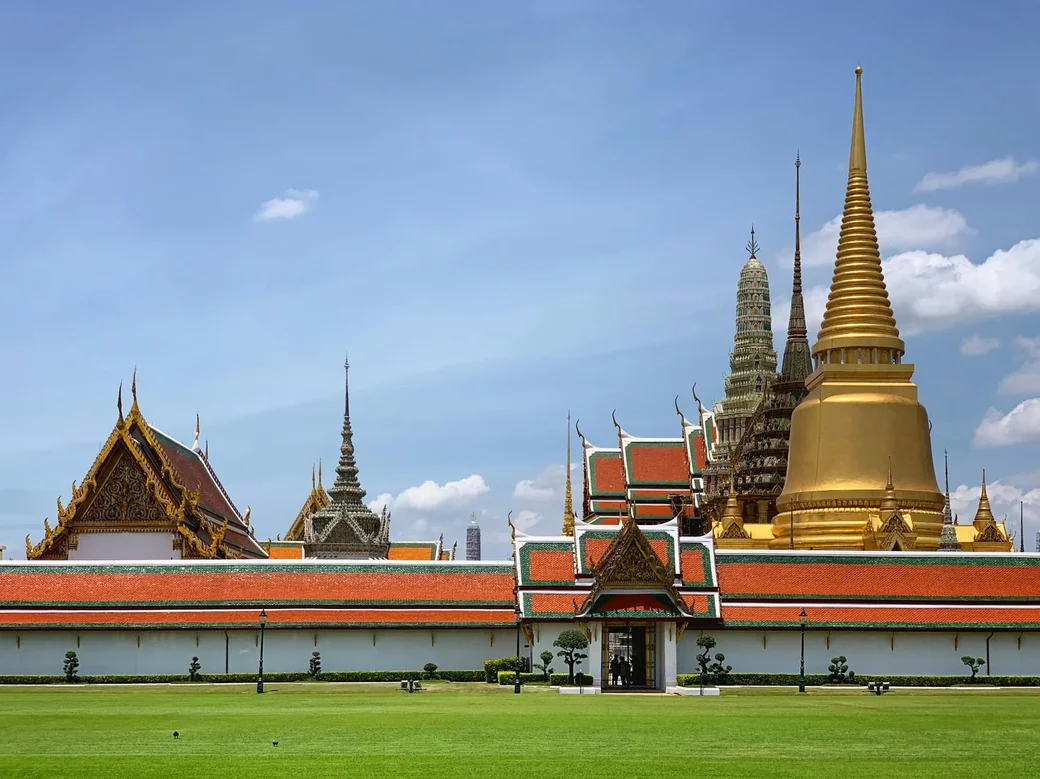
The Grand Palace is the historic seat of Thailand's kings: a walled royal city on the east bank of the Chao Phraya River, in the heart of Bangkok's old Rattanakosin quarter. Behind its walls rises a dense ensemble of ceremonial halls, pavilions and gilded spires, together with Wat Phra Kaew, the Temple of the Emerald Buddha, the most revered temple in the country. With its glittering roofs, mosaic-clad towers and painted galleries, it is Bangkok's best-known landmark and the natural starting point for discovering the city's royal history.
Grand Palace: Location, accommodation options and contact
Na Phra Lan Road, Phra Borom Maha Ratchawang, Phra Nakhon District, Bangkok 10200, Thailand
The place's location on the map and nearby accommodation and hotel options are shown by Stay22. Cookies are used. Your consent is remembered on every page; you can turn it off at any time in the cookie settings.
Grand Palace dress code: what gets you turned away at the gate
Shoulders and knees covered, no exceptions. Sleeveless tops, shorts of any length, torn or tight trousers, see-through fabric and miniskirts are all refused, and a scarf draped over bare shoulders does not count because it slips. Wear closed shoes you can slip off easily. Cover-ups are rentable near the entrance, but the queue costs you the quiet early hour. The strictness has a reason: this is still a working royal site, where coronations, state banquets, royal funerals and the year's great Buddhist ceremonies take place behind the walls.
Arrive at opening: the only reliable way to beat the crowds and the heat
Coach groups pour in from mid-morning and the courtyards stay packed until mid-afternoon. The first ninety minutes after opening give you softer light, bearable temperatures and murals you can actually stand in front of.
The palace is closed today scam: why you should just keep walking
A well-dressed stranger, sometimes backed by a fake guard, tells you the palace is shut for a holiday and flags down a tuk-tuk to a gem or tailor shop instead. The story is almost always false. Genuine closures happen only for royal ceremonies and are announced on the official website, so verify there or at the gate itself, never on the pavement.
Use the right entrance: Mani Noppharat Gate on Na Phra Lan Road
Visitor access moved from the Viset Chaisri Gate to the Mani Noppharat Gate, and plenty of guidebooks and map pins still point at the old one. Walk along the white perimeter wall on Na Phra Lan Road and follow the official signs. Some tuk-tuk drivers drop tourists at a closed side gate on purpose so the palace looks shut. The wall you are following runs 1,900 metres around the whole compound. Short of money and building material, Rama I had it raised, together with the new capital's defences, from bricks salvaged from the ruins of Ayutthaya, destroyed in 1767, and floated down the river to Bangkok.
Tickets, and how to check for royal closures
Buy at the ticket office beside the visitor gate on the day of your visit, and carry cash for it. Resellers advertise advance tickets, so check the official website before paying one of them. Look at that site before you set out in any case: royal ceremonies occasionally shorten the hours or close the complex, and that notice appears nowhere else reliably. Once through the ticket gate, you can pick up an audio guide offered in several languages at its own counter; it is the easiest way to put names to the buildings if you are not joining a guided group.
Inside the ordination hall: shoes off, feet tucked away, camera down
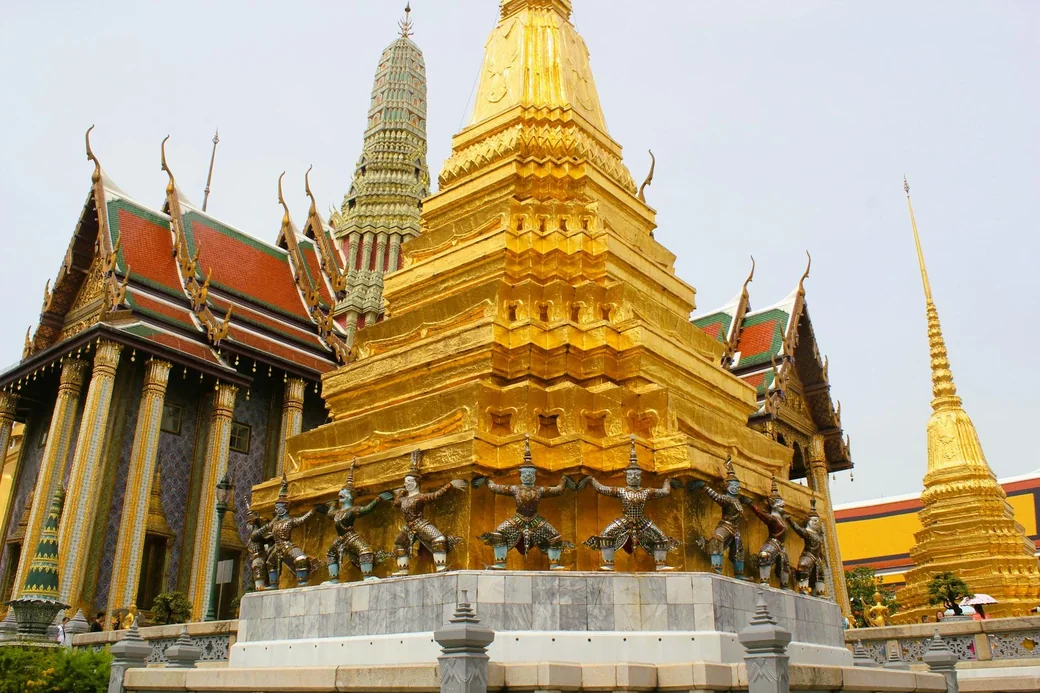
Photography stops at the threshold of the hall that shelters the Emerald Buddha. Leave your shoes outside, sit with your feet folded behind you so the soles never point at the image, keep your head lower than the altar, and do not turn your back to the Buddha for a photograph. Women should never touch a monk, even in passing. The figure on the high golden altar is small, just 66 centimetres tall, yet Thais regard it as the palladium (protective talisman) of the nation, which is why conduct in the hall is taken so seriously. The hall itself is a lesson in Thai temple architecture. It was modelled on Wat Phra Si Sanphet, the royal temple of Ayutthaya, and its base is ringed by 112 golden garudas (mythical bird-men), each gripping a naga (serpent spirit) in either hand. Twelve bronze lions flank the steps, the gable pediments show the god Vishnu riding Garuda, and the doors are inlaid with mother-of-pearl scenes of mythical beasts and foliage.
The Emerald Buddha is not emerald: the statue's six-century journey to Bangkok
Lightning split a stupa in Chiang Rai in 1434 and revealed a stucco-covered figure; when the plaster flaked from its nose, green stone appeared beneath. It travelled to Lampang, Chiang Mai, Luang Prabang and Vientiane before a Siamese general, the future Rama I, brought it home in 1778. In Thai, emerald simply means green. Four years later, crowned as Rama I and founder of the Chakri dynasty, he moved the capital across the river from Thonburi to a marshy bend he named Rattanakosin, laid the palace's first stone on 6 May 1782 and built Wat Phra Kaew as his private royal chapel to house the image. That origin is why, unlike other Thai temples, it has no resident monks.
Three robes a year: the ceremony only the king of Thailand may perform
Three times a year, at the turn of the hot, rainy and cool seasons, the reigning king personally changes the Emerald Buddha's gold garments. Rama I created the first two sets and Rama III added the third. The robes not in use are displayed in the pavilion of regalia and coins, and Thais understand the rite as a blessing for the whole country. Each set has its own character: a crown and jewellery for the hot season, a gilded robe with a headdress for the rainy season and a golden shawl for the cool season. The ceremony follows the lunar calendar, falling in the fourth, eighth and twelfth lunar months. For King Bhumibol's Golden Jubilee in 1996, a replica set was made in the same materials and funded entirely by donations, and the original pieces, more than two centuries old, were retired to the Emerald Buddha Museum.
Read the Ramakien murals clockwise: 178 panels over two kilometres
The covered gallery around the temple carries the Thai Ramayana in 178 painted panels, first laid down under Rama I and repainted many times since. Begin opposite the spired hall and move clockwise to follow the story of Phra Ram, the monkey general Hanuman and the demon king Thotsakan. Look into the backgrounds: painters hid jokes and scenes of ordinary village life there.
Meet the twelve yaksha giants guarding the temple gates
Armoured demons several metres tall stand in pairs at the gates of Wat Phra Kaew, twelve in all, each a named character from the Ramakien. The best-known pair shares a gate: green-faced Thotsakan, the demon king, and white-faced Sahatsadecha. All of them face inward, towards the ordination hall, rather than out at the street, a sign that they stand guard for the Emerald Buddha within.
Chakri Maha Prasat: the throne hall Bangkok calls a foreigner in a Thai crown
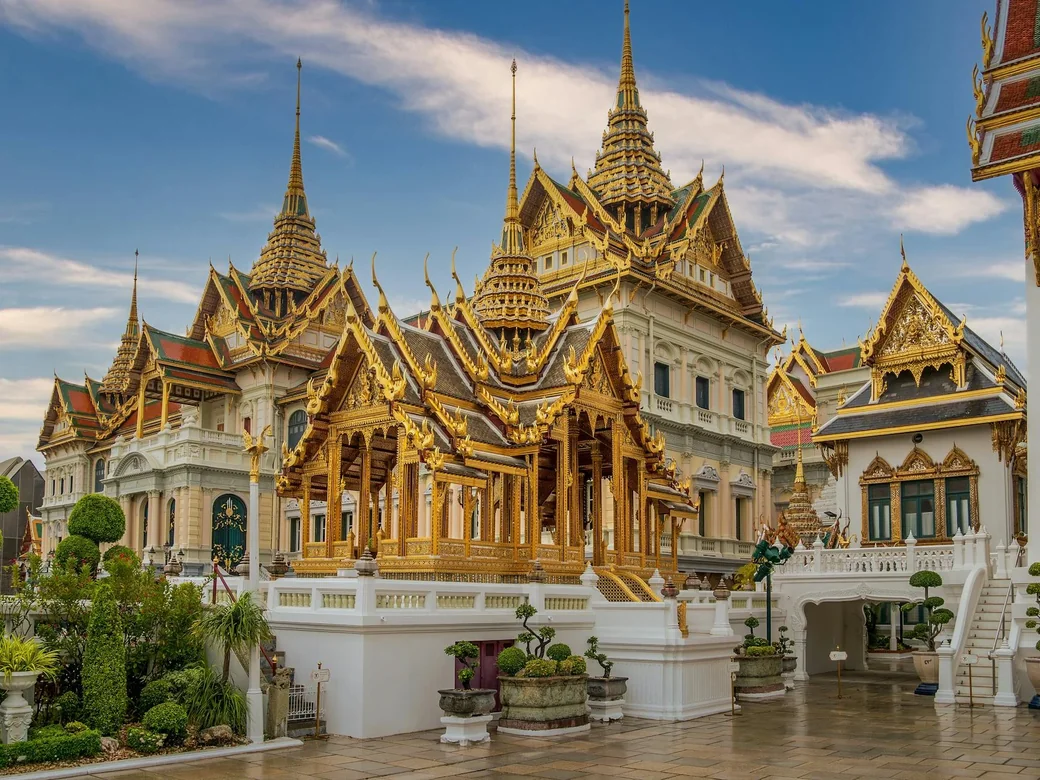
King Chulalongkorn returned from Singapore in 1875 with two British architects and wanted a wholly European palace with domes. His chief minister pressed him to keep Thai roofs, so the building rose in 1876 and was inaugurated in 1882 with three gilded Thai spires on a Victorian body. It was also the first building in the country wired for electricity. The hall stands in the Middle Court, part of a layout deliberately modelled on the lost royal palace of Ayutthaya: an Outer Court for government offices, a Middle Court of throne halls and royal residences that also holds the Dusit Maha Prasat and the Phra Maha Monthien halls where coronations take place, and an Inner Court once reserved for the king, his consorts and their children. Kings and their court lived and governed here until 1925, and the ministries moved out for good after the end of absolute monarchy in 1932; the present king resides elsewhere. Two neighbours complete the picture. The Amarin Winitchai Hall, the most important building of the Phra Maha Monthien group, is where court ceremonies have long been held before a throne crowned by a nine-tiered white umbrella (the royal parasol of state). Nearby, the neoclassical Boromphiman Mansion was built by King Chulalongkorn for his heir at the turn of the twentieth century and now hosts visiting heads of state; it is not open to the public.
The Upper Terrace and a pantheon that opens one day a year
Three monuments share the raised terrace: the golden Phra Si Rattana Chedi in Sri Lankan style, the Phra Mondop library with mother-of-pearl doors, and the Royal Pantheon holding life-size statues of the Chakri kings. The pantheon opens to the public only on Chakri Day, the sixth of April. The rest of the year you admire its Khmer-style tower from outside. Built under Rama I as a library, the Phra Mondop holds a mother-of-pearl cabinet for the Tripitaka (the Buddhist scriptures) above a floor woven from silver strands. Its interior stays closed, so enjoy the tiered spire and the guardian figures on its stairs from the terrace.
Three corners most visitors walk straight past
A scale model of Angkor Wat, commissioned after a Siamese attempt to move the real temple failed, sits north of the library. Near the entrance gate a bronze hermit, credited with healing powers, receives quiet offerings from Thai visitors. And opposite the Dusit Maha Prasat stands the Emerald Buddha Museum, air-conditioned, nearly empty, and full of the retired royal robes. Two more details reward a closer look. Beside the cruciform Dusit Maha Prasat, built by Rama I around 1789 and still used for royal lying-in-state, stands the Aphorn Phimok Prasat, a slender gilded pavilion where the king changed his regalia before and after audiences; it is widely regarded as the perfect model of Thai architectural proportion. And along the eastern side of the temple runs a row of eight prang (Khmer-style towers), raised under Rama I and later clad in coloured porcelain under Rama III, each in its own colour and each dedicated to a different aspect of Buddhism, beginning with a white one for the Buddha.
Heat, security and what you cannot carry inside
Expect an airport-style bag check. Drones are banned outright, and tripods, selfie sticks, oversized backpacks, food and drink are usually turned away. There are no lockers, so travel light and leave valuables at your hotel. The marble courtyards throw back the heat and offer almost no shade; carry water, wear a hat and use the shops inside the grounds when you need to sit down in the cool. Plan for distance as well as heat: the compound covers 218,400 square metres and holds more than a hundred halls, pavilions, chapels and spires.
Build the day around the palace: Wat Pho, Wat Arun and the amulet market
Wat Pho and its reclining Buddha lie seven hundred metres south, and the cross-river ferry from Tha Tien reaches Wat Arun in minutes. North-west, the Trok Maha That amulet market hides riverside kitchens where students and office workers take their lunch. Tha Maharaj has air-conditioned cafes if you need one. Two to three hours inside the walls, a full day for the whole quarter. Just north of the palace walls lies Sanam Luang, the open royal field where great state ceremonies are staged, from royal cremations to the annual Royal Ploughing Ceremony that marks the start of the rice-planting season.
Grand Palace: Visitor Tips
Arrive right at opening and walk the temple gallery first, before the coach groups reach it. Dress for a royal ceremony rather than a hot city: covered shoulders, long trousers or a skirt below the knee, closed shoes. Ignore anyone outside who tells you the palace is shut today and offers a tuk-tuk (three-wheeled taxi) alternative; genuine closures for royal ceremonies are announced only on the official website. Carry water, a hat and cash, since shade is scarce on the marble courtyards and cash machines are not on the doorstep. Photography is fine across the grounds but not inside the ordination hall of the Emerald Buddha, and drones, tripods and selfie sticks are refused at the security check. Finish at the quiet Emerald Buddha Museum, then walk south to Wat Pho.
Grand Palace: Best Time to Visit
Right at opening, for cool air and thin crowds; November to February is the driest, mildest season.
Grand Palace: Admission Fees
Foreign visitors (adult)
One ticket covers the Grand Palace, Wat Phra Kaew (the Temple of the Emerald Buddha) and the Queen Sirikit Museum of Textiles. Shoulders and knees must be covered.
THB 500
Children under 120 cm (free)
Free for children under 120 cm; height, not age, decides.
Free
Thai nationals (with ID card)
Free for Thai citizens on showing a Thai ID card.
Free
Audio guide (optional add-on)
An optional audio guide is available in several languages at the counter inside the complex; an ID or card is usually left as a deposit.
THB 200
Quick Info
3h
easy
Grand Palace: Getting There
The classic approach is by river. Take the BTS Silom Line to Saphan Taksin, leave by Exit 2 and walk down to Sathorn Pier, then board an orange-flag Chao Phraya Express boat to Tha Chang (N9); the palace wall is a five to ten minute walk straight ahead. Tha Tien (N8) works too and drops you closer to Wat Pho. By metro, take the MRT Blue Line to Sanam Chai and walk about fifteen minutes; city buses also pass the complex on several roads.
Nearby stops & parking
Nearest river piers: Tha Chang (N9) about 500 metres north-west, Tha Tien (N8) about 900 metres south, and the Tha Maharaj pier used by the tourist boat. Nearest metro: MRT Sanam Chai on the Blue Line, Exit 1, roughly fifteen minutes on foot. Nearest skytrain: BTS Saphan Taksin, connected by express boat. Bus stops line Na Phra Lan, Maharaj and Sanam Chai roads on all three sides. Drivers will find paid car parks at Wat Mahathat, Tha Maharaj, beside the City Pillar Shrine, on Ratchadamnoen Road, in Soi Wat Pho and at the Wat Rakang parking building; all fill early. Taxis and Grab drop off on Na Phra Lan Road, a short walk from the visitor gate.
Grand Palace: Dress Code & Etiquette
This is the strictest dress code of any site in Thailand and it is checked before you reach the ticket desk. Shoulders and upper arms must be covered and knees must be hidden. Refused as outer garments: sleeveless shirts, vests, crop tops, see-through blouses, shorts of any length, torn or ripped trousers, tight or cycling leggings, miniskirts, culottes and sleepwear. A scarf thrown over bare shoulders is not accepted because it slips. Closed shoes or sandals with a heel strap are safest, and you will take them off before entering the ordination hall, so choose something easy to slip on. Cover-ups can be rented near the entrance. Inside, do not point your feet at any Buddha image, do not turn your back to the Emerald Buddha for a photo, never touch a monk if you are a woman, and keep your head lower than the image when you sit.