Hyde Park is one of the largest Royal Parks in central London and one of the best-known city parks in the world. Its wide lawns, tree-lined avenues and a long lake at its heart create a vast green escape right on the doorstep of Mayfair, Knightsbridge and Kensington. Loved for walking, boating, sport and picnics, and long a stage for royal celebrations, concerts and public debate, it is one of the great open spaces where Londoners and visitors come together.
Hyde Park: Location, accommodation options and contact
Hyde Park, London W2 2UH, United Kingdom
The place's location on the map and nearby accommodation and hotel options are shown by Stay22. Cookies are used. Your consent is remembered on every page; you can turn it off at any time in the cookie settings.
Hyde Park London at a glance: location, size and opening hours
Hyde Park sits in the City of Westminster in central London, bounded by Bayswater Road to the north, Park Lane to the east and Knightsbridge to the south. It covers about 142 hectares (350 acres) with a perimeter of roughly three miles, which The Royal Parks compares to twelve Wembley Stadiums. The gates are open to visitors every day of the year. To the west the park merges with Kensington Gardens, which belongs to the same chain of green spaces but closes at dusk. The whole landscape has been a Grade I registered historic park since 1987. Together with Kensington Gardens, Green Park and St James's Park, it forms an almost continuous belt of green from Kensington Palace towards Buckingham Palace.
History of Hyde Park: from Henry VIII's hunting ground to the People's Park
The land belonged to Westminster Abbey until 1536, when Henry VIII acquired it and enclosed it as a deer park. James I allowed limited access, and in 1637 Charles I opened the park to the public. In the 1730s Queen Caroline had the Serpentine created by damming the River Westbourne, and the park was divided to form Kensington Gardens. Hyde Park then hosted the Great Exhibition of 1851 in Joseph Paxton's Crystal Palace and, in 1857, the first Victoria Cross ceremony. May Day parades, royal celebrations, rallies and concerts followed, which is why Londoners often call it the People's Park.
Hyde Park has always been the city's stage. In the Civil War of 1642 forts were built along its eastern edge, and during the Great Plague of 1665 Londoners camped here. After William III moved to Kensington Palace in 1689, his private road became Rotten Row, believed to be the first road in London lit at night. A great fair marked the Allied sovereigns' visit in 1814, with a mock sea battle on the Serpentine, and balloons and fireworks celebrated George IV's coronation in 1821. In 1866 crowds demanding the vote pulled down railings after the gates were closed, and in 1908 around 250,000 women are reported to have gathered for Women's Sunday. The Lido opened in 1930 at the request of a sunbathing and swimming society, and the first rock concert, on 29 June 1968 with Pink Floyd, Roy Harper and Jethro Tull, drew about 15,000 people. Blind Faith and the Rolling Stones followed in 1969, Queen played to a record crowd in 1976 and Live 8 filled the park in 2005. Residents have long campaigned for sound limits; in 2012 the microphones were switched off at the evening curfew during a headline set. Dutch elm disease later removed more than 9,000 elms, which were replaced mainly by limes and maples.
Speakers' Corner in Hyde Park: London's free-speech tradition on Sunday mornings
Speakers' Corner lies in the north-east corner of the park, close to Marble Arch. Its story begins in the 1860s, when crowds demanding the right to vote gathered here, and the Parks Regulation Act of 1872 then set out the right to meet and speak freely. Figures such as Karl Marx, Vladimir Lenin and George Orwell are known to have been associated with the tradition, and suffragettes held large meetings in the park between 1906 and 1914. On Sunday mornings anyone can stand on a soapbox and talk about almost any subject, as long as the police consider the speech lawful. Come to listen, to question and to enjoy a uniquely London spectacle.
The Serpentine: pedalos, rowing boats, Lido swimming and the Peter Pan Cup
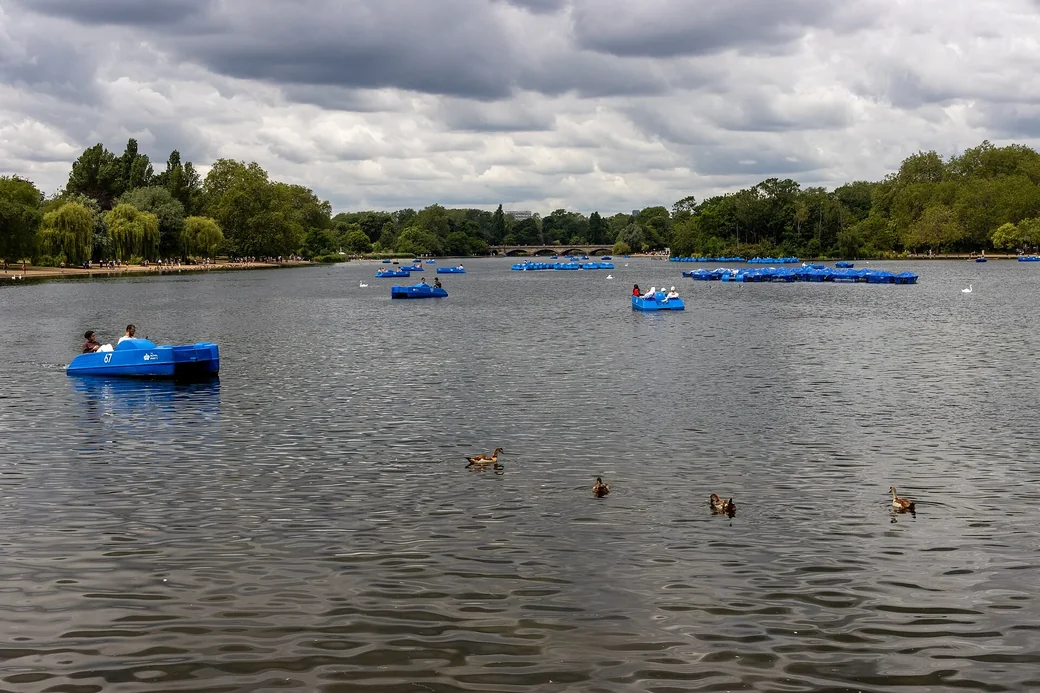
The Serpentine is the long lake that cuts through the park. Most of it is reserved for boating and wildlife, and swimming is only allowed at the marked open-water Lido in the south-west corner, which has lifeguards and a seasonal timetable. The Boathouse hires pedalos and rowing boats from spring to autumn, including electric pedalos and accessible boats. The Serpentine Swimming Club, the oldest swimming club in Britain, has held a Christmas Day race since 1864, and since 1904 the winner has received the Peter Pan Cup donated by J. M. Barrie. Spectators are welcome on the bank, but only members may swim. To the west the lake continues as the Long Water inside Kensington Gardens, and together the two stretches of water separate the park from its neighbour.
Diana Memorial Fountain, the Rose Garden and the gardens of Hyde Park
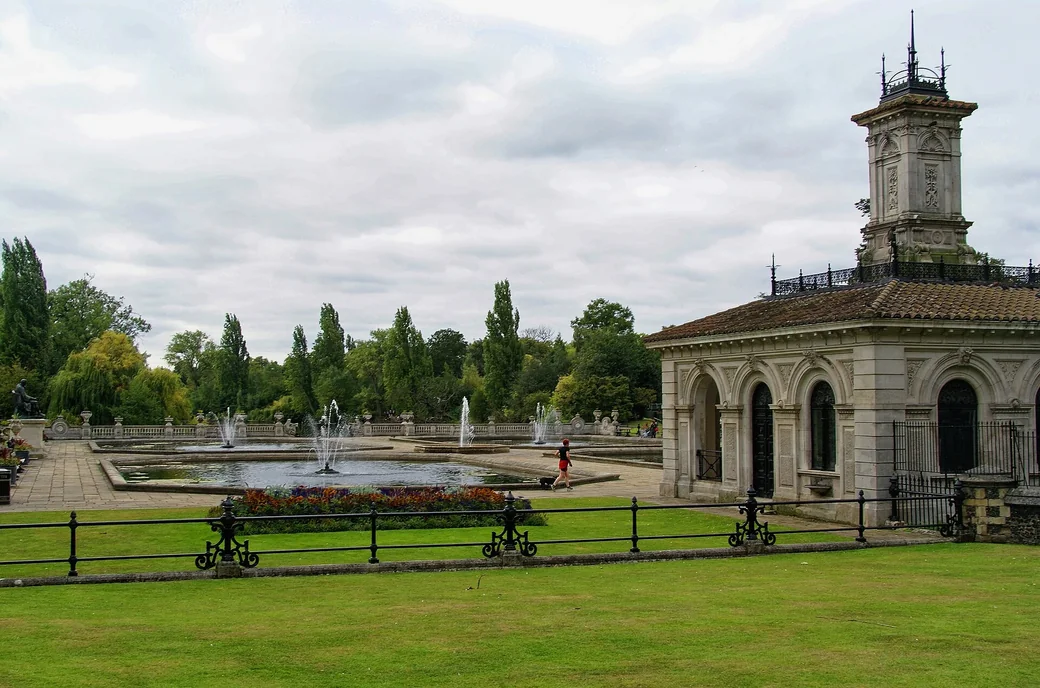
Opened in July 2004, the Diana, Princess of Wales Memorial Fountain is an oval ring of 545 pieces of Cornish granite. Water flows from the highest point in two directions and meets in a calm pool, and visitors may sit on the edge and cool their feet; dogs and alcohol are not allowed in the area. Opening hours change with the seasons and the area can close in severe weather or for maintenance, so check The Royal Parks website before you visit. Near Hyde Park Corner, the Rose Garden (opened in 1994) is at its best in June and July and contains the Boy and Dolphin and Huntress fountains, while the Dell and the wildflower meadow add a quieter, wilder side.
Memorials, fountains and sculptures in Hyde Park: Achilles, the 7 July memorial, Joy of Life and more
Hyde Park holds many memorials. The 18-foot bronze Achilles near Queen Elizabeth Gate, unveiled in 1822 in honour of the Duke of Wellington, was the first statue in the park and was cast from captured cannon. Decimus Burton's Apsley Gate and the nearby Wellington Arch frame the Hyde Park Corner entrance. The 7 July Memorial (2009) consists of 52 stainless-steel pillars, each 3.5 metres high, one for each victim of the 2005 London bombings. East of the Dell, a garden of boulders among birch trees is Britain's first Holocaust memorial (1983). Others include the Cavalry Memorial, the Norwegian memorial, Queen Caroline's urn and, just outside the park near Brook Gate, the Animals in War Memorial.
Beyond the big memorials, the park hides smaller treasures. The Boy and Dolphin fountain (1862), by Alexander Munro, a friend of Lewis Carroll, moved to The Regent's Park in 1962 and returned to Hyde Park in 1995. The Joy of Life fountain (1963) by T. B. Huxley-Jones shows dancing bronze figures beside Park Lane, the Huntress (1906) is by Countess Feodora Gleichen, and Simon Gudgeon's bronze Serenity (2009) stands near the Diana fountain. Jacob Epstein's last sculpture, Pan (Rush of Green), stands near Edinburgh Gate, while his Rima relief at the Hudson Bird Sanctuary sparked lively public debate in the 1920s. The Norwegian memorial (1978) is a granite boulder given in thanks for wartime hospitality, and Queen Elizabeth Gate (1993), with its lion and unicorn, honours the Queen Mother's ninetieth birthday. The friezes at Apsley Gate copy the Elgin Marbles, the platforms of Wellington Arch offer views over the park, and the bronze Achilles was cast from about 33 tonnes of captured cannon.
Wildlife in Hyde Park: birds, parakeets, wildflower meadows and ancient trees
Hyde Park shelters thousands of trees, including London planes, sweet chestnuts and oaks, as well as reedbeds along the Serpentine, native wildflower meadows and quiet corners such as the Hudson Memorial Bird Sanctuary. Look for Egyptian geese, grey herons, great crested grebes, swans and bright green ring-necked parakeets, and among the smaller birds goldcrests, wrens and tits; bats hunt over the lake at dusk. The meadows also support butterflies, bees and beetles. Please keep a respectful distance and do not feed the animals, because feeding does more harm than good.
Things to do in Hyde Park: horse riding, cycling, tennis, boating and picnics
Hyde Park is made for outdoor activity. Riders can trot along Rotten Row with a local stable, cyclists may use the signed cycleways (not the smaller footpaths), and The Courts at Hyde Park offer tennis, netball, padel, lawn bowls and five-a-side football. Runners circle the Serpentine, families head for the playgrounds, and the Senior Playground offers exercise equipment for adults. Informal picnics are welcome (barbecues are not), a deckchair makes a relaxing afternoon, and the Hyde Park Learning Centre runs discovery days for children. An augmented-reality experience also brings the Great Exhibition of 1851 back to life on site.
Events in Hyde Park: legendary concerts, Winter Wonderland and sports festivals
Hyde Park has hosted famous gatherings: the open-air rock concerts of 1968–1971 with Pink Floyd, Blind Faith and the Rolling Stones, Queen's open-air show in 1976, Live 8 in 2005, and the triathlon and open-water swimming events of the 2012 Olympics. Each summer the BST Hyde Park concert series takes over part of the park, and since 2007 the Winter Wonderland Christmas festival has filled a large area with an ice rink, rides and markets. Swim Serpentine gathers open-water swimmers in September, and the autumn half marathon runs through the Royal Parks. Parts of the park are fenced off during big events, so check the official website before you go.
Hyde Park ghost stories and legends: the phantom coach and the haunted tree
Like any old London park, Hyde Park has its ghost stories, and all of them belong to folklore rather than fact. According to a tale that gripped London in 1877, a phantom coach drawn by four horses and driven by a figure in white circled the park before vanishing into thin air; some said the driver was King George IV, and the park keepers reportedly complained about the crowds of curious visitors. The paranormal writer Elliott O'Donnell claimed that couples avoided one particular tree between Marble Arch and Lancaster Gate, and he described an unsettling dream beneath it. A 1967 author imagined an army of ghostly riders galloping beside him at Hyde Park Corner, and, according to old chronicles, the young Queen Henrietta Maria is said to have once walked barefoot across the park to Tyburn.
Myths and curiosities of Hyde Park: the Stonehenge stone, Hendrix's parakeets and the sparrowhawks
According to an urban legend, the seven-tonne Standing Stone in the Dell was brought from Stonehenge by Charles I, although it was originally part of a drinking fountain. London's green parakeets are said to descend from birds released by Jimi Hendrix or escaped from the set of The African Queen, but researchers have found no evidence for either story. According to other versions of the parakeet legend, the birds escaped from an aviary at Syon Park or from aviaries wrecked by the Great Storm of 1987, but no evidence supports these stories either. Rotten Row is said by some to take its name from "Route du Roi" (the King's Road); others suggest an old word meaning "to muster" or the soft surface of the track, and nobody knows for sure. And when sparrows nested inside the Crystal Palace in 1851, Queen Victoria is said to have asked the Duke of Wellington for advice, to which he replied: "Sparrowhawks, ma'am."
Hidden stories of Hyde Park: the Victorian pet cemetery, duels and the Top Hat bandstand
Behind Victoria Lodge on Bayswater Road lies a Victorian pet cemetery. It began in 1881, when the gatekeeper agreed to bury a family's beloved Maltese terrier called Cherry, and it holds hundreds of small headstones; it opens only on occasional guided tours. In the 18th century the park was a popular place for duels, and in 1652 Parliament briefly sold it off. The bandstand, built in 1869 and moved here in 1886, appears in the 1935 film Top Hat, although the scene was actually shot in a Hollywood studio. The statue of Achilles was completely nude when it was unveiled, and the public reaction was so strong that a small fig leaf was soon added.
Best time to visit Hyde Park, how long to stay and the best photo spots
Plan two to three hours for a relaxed visit. Spring and early summer bring blossom, and the Rose Garden peaks in June and July; autumn paints the plane trees gold, and winter offers crisp light and quiet paths. Early mornings and weekday afternoons are the calmest times, while sunny weekends are busiest around the Serpentine. Good photo spots include the view from the Serpentine Bridge towards the boathouses, the Rose Garden, the Diana fountain, Queen Elizabeth Gate and Apsley Gate at Hyde Park Corner, and the old bandstand. For fewer people, head to the north-west near the Hudson Bird Sanctuary and the wildflower meadow, or visit the lake early in the morning.
Hyde Park rules and etiquette: what to do and what to avoid
Do enjoy a picnic, bring a blanket, keep dogs under control (on a lead around the Rose Garden and the Serpentine), cycle only on signed cycleways and give pedestrians priority, follow lifeguard instructions at the Lido and check notices about temporary closures. Don't feed birds or squirrels, swim in the lake outside the Lido, light barbecues, bring dogs into the Diana fountain area, or cycle on small footpaths. Personal photography with a phone is fine, but professional filming needs a permit from The Royal Parks. Please stay quiet and respectful at memorials.
Hyde Park facilities, accessibility, guide languages and nearby London attractions
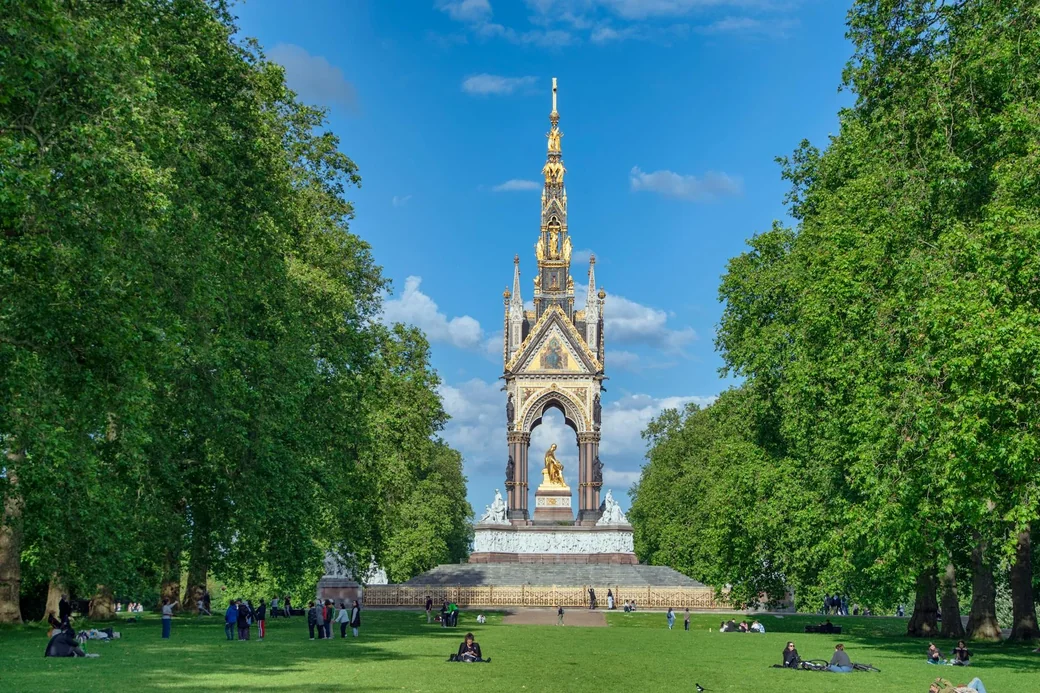
Four main cafés (Serpentine Bar & Kitchen, Serpentine Lido Café, The Lodge Café and the Park Sports Café) and smaller kiosks serve food and drinks, and public toilet blocks are spread through the park. Most paths are wide and flat; a mobility transport service for visitors with limited mobility runs from the Triangle car park, and accessible boats are available at the Boathouse. Signs and guided walks are in English, so a translation app is useful for international visitors. Nearby attractions include Kensington Gardens, Kensington Palace, the Albert Memorial, Wellington Arch, Apsley House, Harrods, Buckingham Palace via Green Park, and the museums of South Kensington. Four Underground stations sit right on the park's edge: Marble Arch and Lancaster Gate (Central line) on the north side, and Hyde Park Corner and Knightsbridge (Piccadilly line) on the south side.
Hyde Park: Visitor Tips
Enter through Hyde Park Corner for Apsley Gate and the Rose Garden, or through Marble Arch for Speakers' Corner on Sunday mornings. Walk the Serpentine shore early for soft light and fewer people, rent a pedalo in spring or summer, and picnic on the lawns, but leave barbecues at home. Bring layers, a refillable bottle and a camera, and check The Royal Parks website for temporary closures before you set off. Combine your visit with Kensington Gardens, but remember that it closes at dusk, while Hyde Park stays open much later.
Hyde Park: Best Time to Visit
Late spring to early autumn for lawns and the Lido; June–July for the Rose Garden; early morning or golden hour for photos; Sunday mornings for Speakers' Corner.
Hyde Park: Admission Fees
Free admission
The park's lawns, gardens, paths and the Serpentine shoreline are free to enjoy at any time of year; boating and swimming are paid activities.
Free
Serpentine boating (60 minutes) – Adult (18+)
Row boats and pedal boats glide around Heron Island and to the Serpentine Bridge; rates vary with peak and quieter times, and boating runs year-round, on fewer days in winter. Full fare for adult visitors aged 18 and over.
Row boats and pedal boats glide around Heron Island and to the Serpentine Bridge; rates vary with peak and quieter times, and boating runs year-round, on fewer days in winter. Fare for children aged 3 to 15, who must be accompanied by an adult aged 18 or over.
£6.95
Serpentine boating (60 minutes) – Family (2 adults + up to 3 children)
Row boats and pedal boats glide around Heron Island and to the Serpentine Bridge; rates vary with peak and quieter times, and boating runs year-round, on fewer days in winter. Family fare for two adults and up to three children sharing a boat.
A marked open-water swimming area at the south-west corner of the lake, open in the warm season, with rates that vary by session length. Full fare for adult visitors aged 18 and over.
£8.40
Serpentine Lido (open-air swimming area) – Child (3-15 years, full day)
A marked open-water swimming area at the south-west corner of the lake, open in the warm season, with rates that vary by session length. Fare for children aged 3 to 15, who must be accompanied by an adult aged 18 or over.
A marked open-water swimming area at the south-west corner of the lake, open in the warm season, with rates that vary by session length. Reduced fare for eligible visitors such as seniors, students and young people aged 16 and 17, with valid ID.
£4.70
Quick Info
2h 30m
easy
Hyde Park: Getting There
Four Tube stations sit right on the park's edge: Marble Arch and Lancaster Gate on the Central line, and Hyde Park Corner and Knightsbridge on the Piccadilly line. Each is only a few minutes' walk from the nearest gate. Queensway (Central line) and Bayswater (Circle and District lines) lie further north-west on the Kensington Gardens side, from where a pleasant walk through the gardens leads into the park.
London Paddington, served by GWR, Heathrow Express and the Elizabeth line, lies about 500 metres north of West Carriage Drive. Many bus routes run along Bayswater Road, Park Lane and Knightsbridge, so use the TfL journey planner or Google Maps to choose the best line from your hotel.
Cyclists can follow the marked cycleways through the park, with cycle hire points around the edges and a segregated cycle route starting at Lancaster Gate. Driving into central London is possible but traffic is heavy, so the Tube is usually the easiest option. On foot, Green Park and Buckingham Palace lie a short walk beyond Hyde Park Corner.
Nearby stops & parking
The closest stops depend on where you want to start. Marble Arch and Lancaster Gate suit the north side (Speakers' Corner, Bayswater Road), while Hyde Park Corner and Knightsbridge are best for Apsley Gate, the Rose Garden, Rotten Row and the southern lawns. Queensway and Bayswater bring you in from the west, through Kensington Gardens.
Bus stops line Park Lane, Bayswater Road and Knightsbridge, and routes such as 10, 148, 274 and 390 run along the park's edges.
Two public car parks are reached from West Carriage Drive. Motorcycle spaces and Blue Badge bays (including West and South Carriage Drive) are provided, and further car parks run by Q-Park are found at Marble Arch near Speakers' Corner and on Park Lane. During major events some roads and car parks close, so check The Royal Parks website first. Taxis and ride-hailing cars can set down at the main gates such as Hyde Park Corner, Marble Arch and Albert Gate.
Hyde Park: Dress Code & Etiquette
There is no dress code in the park itself, so wear comfortable shoes and layers, because London weather changes quickly. Near the 7 July Memorial and the Holocaust memorial, keep your voice low, dress respectfully and avoid loud music or ball games.
At the Serpentine Lido, swimwear must be suitable for water use, such as swimsuits, trunks, rash vests, wetsuits or burkinis; denim, underwear and loose cotton clothing are not allowed in the water, and music, glass and smoking are not permitted on the beach.
At Speakers' Corner you may listen, ask questions and join the debate, but keep the tone good-natured. Keep dogs under control, put litter in the bins, give pedestrians priority when cycling and follow the stewards' instructions at events.