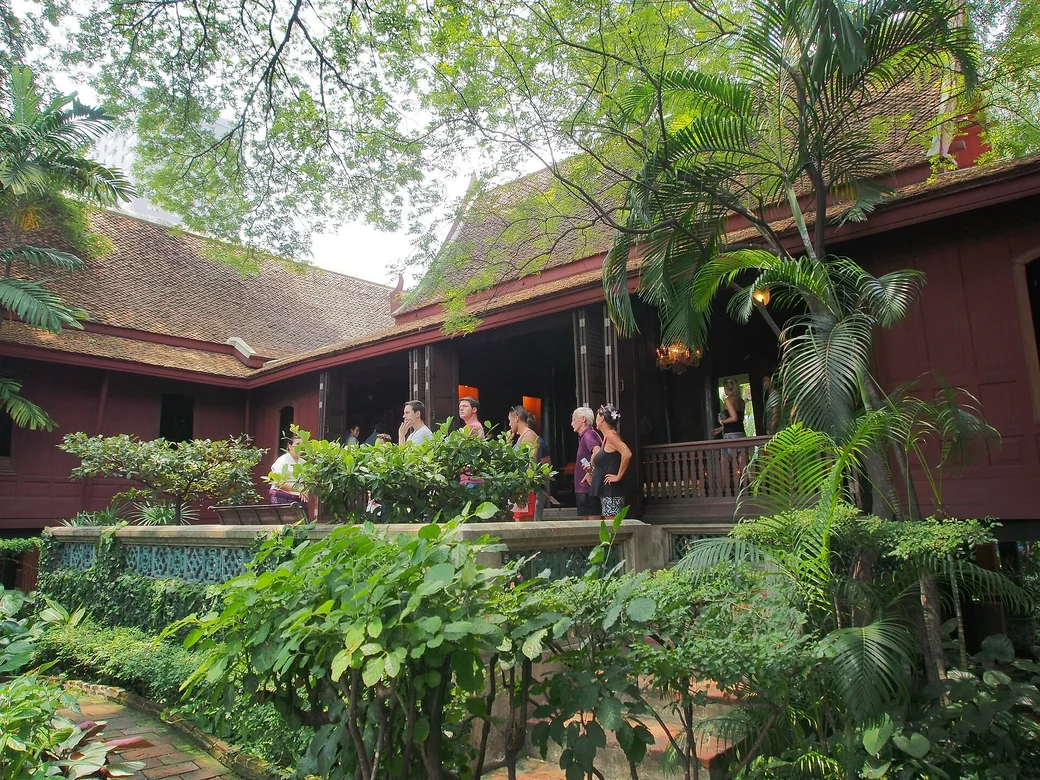
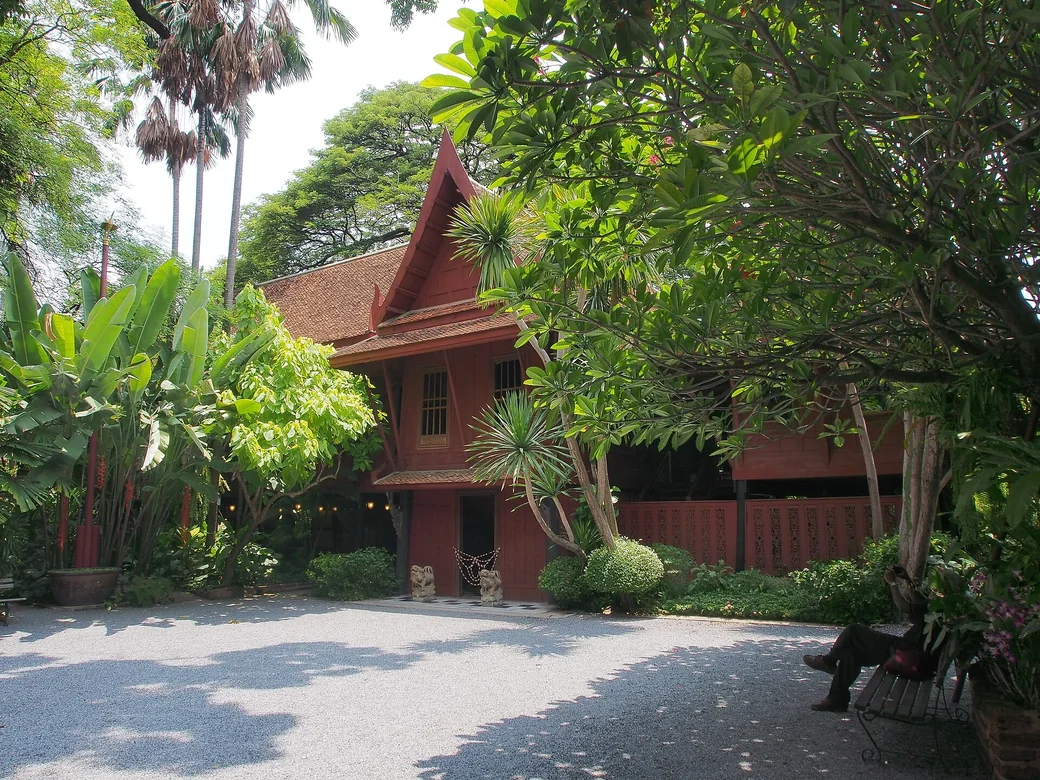
The Jim Thompson House is a museum in central Bangkok, tucked down a quiet canal-side lane just off the city's busiest shopping district. It was the home of Jim Thompson, the American entrepreneur who revived hand-woven Thai silk, and it brings together traditional teak houses, a lush tropical garden and a fine collection of Southeast Asian art. Part house museum and part portrait of a remarkable life, it offers a calm, intimate look at Thai architecture and craftsmanship in the middle of the modern city.
Jim Thompson House: Location, accommodation options and contact
6 Soi Kasemsan 2, Rama I Road, Wang Mai, Pathum Wan, Bangkok 10330, Thailand
The place's location on the map and nearby accommodation and hotel options are shown by Stay22. Cookies are used. Your consent is remembered on every page; you can turn it off at any time in the cookie settings.
American architect James Thompson served with the OSS, the wartime forerunner of the CIA, before settling in Bangkok after 1946. Noticing that hand-woven Thai silk was nearly a dying craft, he founded the Thai Silk Company in 1948 and rebuilt it into a global luxury business. Born James Harrison Wilson Thompson, he had trained as an architect before the Second World War and was posted to Thailand near its end; he fell for Bangkok and stayed on after his discharge. In those years the craft survived only thanks to a small community of weavers. He was nearly forty when he settled in Bangkok, spoke no Thai and knew nothing about weaving or the textile trade, which makes what he built all the more remarkable.
The Silk Broadway Made Famous
In 1951, costume designer Irene Sharaff chose Thompson's silk for Broadway's The King and I, later reused in the 1956 film. The exposure turned Thai silk into an internationally recognised fabric almost overnight and made Thompson a celebrated figure across Asia. From then on he was known across Asia as the Thai Silk King. Part of the appeal lay in the cloth itself: hand-reeled Thai silk has a slightly uneven, nubbly texture, and when warp and weft are dyed in different colours it shimmers between two tones as it moves.
The Unsolved Disappearance of 1967
On Easter Sunday, 26 March 1967, Thompson walked out of a rented cottage in Malaysia's Cameron Highlands for an afternoon stroll and was never seen again. One of Southeast Asia's largest manhunts found no trace of him, leaving one of Asia's most enduring mysteries unsolved to this day. The search involved hundreds of police officers, army trackers and even consulting psychics. He had left his cigarettes and medication behind, which has fed decades of theories, from a tiger attack to a Cold War-era abduction linked to his intelligence past; none has ever been proven. The mystery deepened later that year when his sister was murdered in the United States. The story has fed books, articles and documentaries for decades, and the house, kept much as he left it, remains the place where most people first meet the man behind the mystery.
Six Antique Houses Became One
The residence was assembled between 1958 and 1959 from six genuine antique teak houses gathered from Ayutthaya and Bangkok, some over two centuries old. The oldest and grandest, now the living room, was a 19th-century weaver's house bought directly from Ban Khrua village. Three of them came from Pak Hai, near the old capital of Ayutthaya, and were floated down the river by barge; two more came from elsewhere in Bangkok. Traditional Thai houses were made of prefabricated wall panels held together by interlocking joints rather than nails, which is exactly why Thompson could buy them, take them apart and raise them again here. The red-brown paint on the outer walls is a traditional preservative seen on many old Thai buildings, and the gable ends sweep up into stylised naga (serpent spirit) finials like those on temple roofs. The whole ensemble was completed in about seven months.
Architectural Twists Thai Tradition Never Allowed
Trained as an architect, Thompson broke local convention by moving the staircase indoors instead of leaving it outside as custom dictated, and by reversing some exterior wall panels so their carved decoration now faces into the rooms rather than the street. The living room, the grandest space, has a ceiling about four metres high and one side left open towards the canal, while the study is the only room with glass windows and air-conditioning, there to protect the most delicate pieces. The master bedroom was built from one of the Pak Hai houses. Like traditional Thai homes, the residence stands on teak pillars a full storey above the ground, which keeps the rooms airy and safe from floods.
A Private Museum of Southeast Asian Art
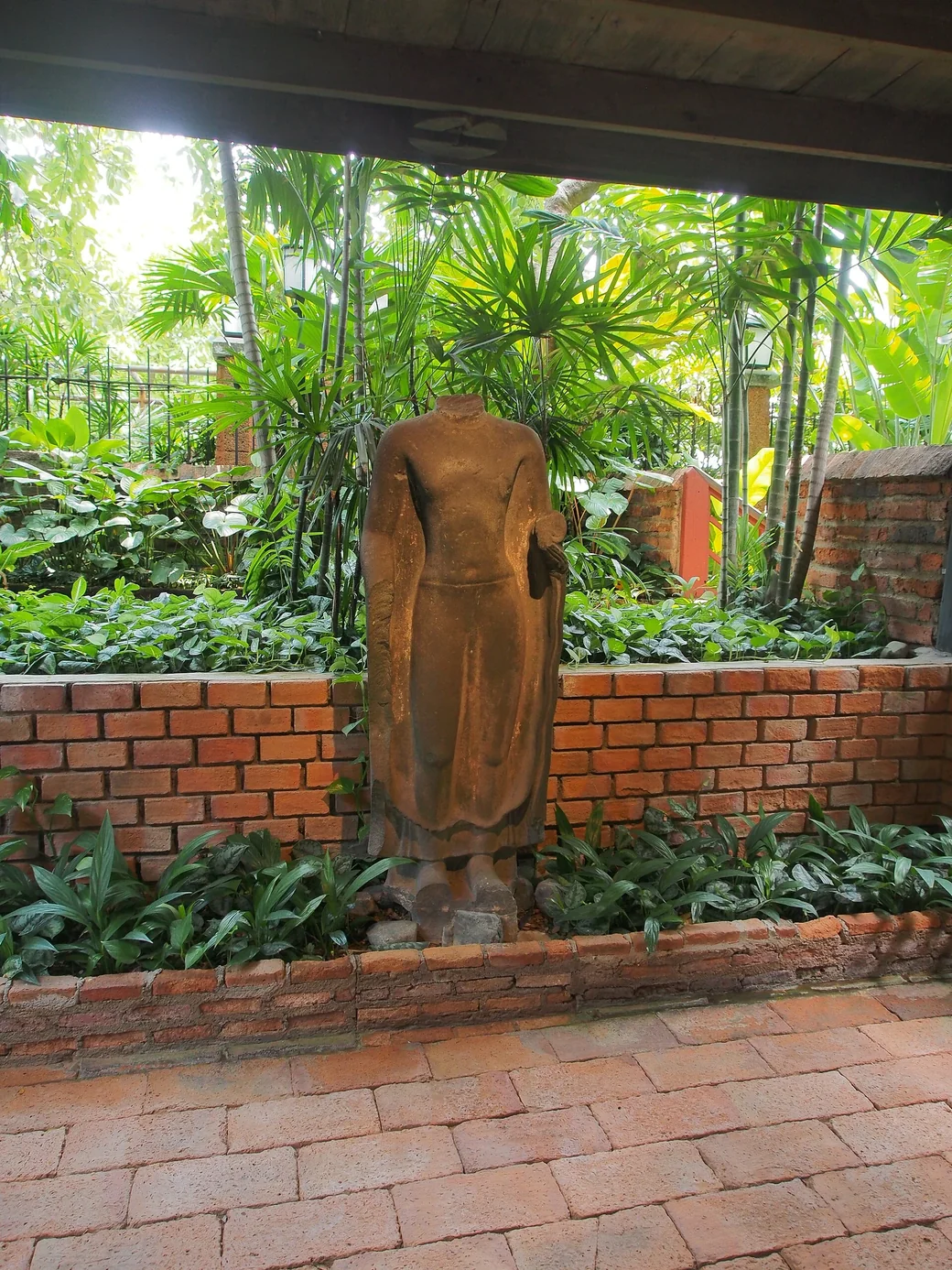
Inside are Dvaravati and Khmer Buddhist sculptures, Thai temple paintings on cloth, blue-and-white Chinese porcelain, delicate Benjarong enamelware, and carved Burmese spirit figures, all displayed beneath Belgian chandeliers and on Italian marble floors. Thompson spent two decades assembling the collection. The Dvaravati pieces belong to the early Buddhist Mon culture, the cloth paintings depict the life of the Buddha, and the Burmese carvings are nat (spirit beings of Burmese folk belief). Setting imported chandeliers and marble alongside Asian art in this way was his own idea. He began collecting in 1946, the year he settled in Bangkok. Look for the eighth-century Dvaravati Buddha in the study and the Chinese mahjong tables he used as dining tables; one of the most charming pieces is the so-called Mouse House, a fanciful little structure carved by nineteenth-century Chinese craftsmen as a home for pet white mice.
The Spirit House Hidden in the Garden
A miniature replica of the main residence stands in the garden as a spirit house, built in the traditional Thai way to appease any spirits disturbed by construction — a small but genuine window into local animist belief. Traditional religious rites accompanied every stage of the work: monks blessed the building site on 15 September 1958, and the spirit house went up so that the guardian spirits of the land had a home of their own before Thompson moved into his.
The Horoscope That Foretold His Fate
Two framed horoscopes still hang above Thompson's old writing desk: one predicting good fortune for 1959, the year he moved in, and another warning of danger at 61 for anyone born, like Thompson, in the Year of the Horse — exactly the age at which he vanished. Astrologers also chose the moving day, and the house was formally opened with ceremonies on 3 April 1959. It soon became one of the city's liveliest meeting places, where Thompson entertained artists, writers and travellers almost every evening.
Ban Khrua, the Weaving Village Across the Canal
Directly opposite the house, across Khlong Saen Saep, lies Ban Khrua, the Cham Muslim community whose looms launched Thompson's silk business in the late 1940s. A few family workshops there still weave silk using traditional methods today. It was with these weavers that Thompson refined the colours and patterns of the cloth for buyers around the world. The James H. W. Thompson Foundation describes Ban Khrua as a community some two and a half centuries old.
You Can Only Enter With a Guide
The main house is closed to independent exploration; every visitor joins a guided tour, offered in Thai, English, French, Chinese and Japanese and departing regularly throughout the day. Tours usually end at a silk demonstration in the garden. Baskets of yellow and white cocoons show the raw material; the cocoons are softened in hot water to loosen their natural gum before the thread is reeled off by hand, and displays nearby explain the rest of the journey from silkworm to woven cloth.
Shoes Off, No Flash: House Rules to Know
Shoes must come off before entering the main house, and bags larger than about 20 cm go into the lockers at the entrance. You are welcome to take pictures inside the main house, but flash, selfies, individual portraits and video recording are not allowed, so keep the camera discreet indoors and save posed shots for the garden and the exterior. Expect several stairways inside the main house and no lift, so allow extra time if stairs are difficult for you, and note that the whole museum is smoke-free, including electronic devices.
Easiest Way There: BTS National Stadium
Take the BTS Skytrain to National Stadium station, exit 1, then walk about five minutes down Soi Kasemsan 2. A canal boat to Hua Chang Pier and a direct taxi or tuk-tuk drop-off are also easy alternatives. The canal boat on Khlong Saen Saep also links Hua Chang Pier with the old city and with Pratunam, where you can change boats, so the water route works in both directions. On foot, the house is also an easy walk from the shopping centres around Siam and MBK, so it slots neatly into a day in the city centre.
When to Visit for the Best Experience
Arrive right at opening or in the late afternoon to beat both the heat and the tour-group crowds, and try to avoid the hottest months of April to June. In peak season, ask about English tour times on arrival. The garden is at its greenest in the rainy season, when it feels most like a small jungle; whatever the month, bring insect repellent, as mosquitoes thrive among the plants and ponds. The cool, drier months from November to February are the most comfortable time to linger in the garden after the tour.
Next Door: Art Center, Shop and Café
The adjoining Jim Thompson Art Center hosts rotating contemporary exhibitions, while the on-site silk shop and café make it easy to linger. Both pair naturally with a visit to the historic house itself. Beside the lily pond, the museum's own Thai restaurant serves set menus made for sharing, a calm place for a meal after the tour. Beyond its exhibitions, the Art Center runs educational programmes, produces publications and works with cultural institutions at home and abroad.
A Brand That Outlived Its Founder
More than half a century after Thompson vanished, the Thai Silk Company he founded still trades under his name, with stores across Bangkok's malls. The house itself is preserved separately, by the James H. W. Thompson Foundation. The Foundation was established in 1976, the same year the house opened to the public as a museum. It operates under the royal patronage of Princess Maha Chakri Sirindhorn and supports research, publications and seminars on Thai art and culture.
Jim Thompson House: Visitor Tips
Visits are guided-tour-only, so head to the ticket desk first and ask for the next available time slot in your language. Wear shoes that slip off easily, since they must come off before the main house, and carry cash and a bottle of water; the shaded garden, silk shop and café are pleasant places to wait between tour groups.
Jim Thompson House: Best Time to Visit
Weekday mornings right at opening, or late afternoon; avoid April-June heat and, in high season, ask about English tour times on arrival.
Jim Thompson House: Admission Fees
Adult (guided tour included)
Admission includes the guided tour of the historic teak houses; the interiors are seen on the tour.
THB 250
Youth aged 10–21 (ID or passport required)
For visitors aged 10 to 21; a valid ID or passport must be shown.
THB 150
Visitors with disabilities
Reduced rate for visitors with disabilities. The guided house tour includes several staircases, so it is worth asking the staff about access.
THB 150
Children under 10 (free with an adult)
Free for children under 10 who are accompanied by an adult.
Free
Jim Thompson Art Center – Entry (exhibitions only)
Admission to the contemporary art center's changing exhibitions only, without the house museum.
THB 50
Quick Info
1h 30m
easy
Jim Thompson House: Getting There
The easiest route is the BTS Skytrain to National Stadium station, then a short walk of about five minutes along Soi Kasemsan 2 to the entrance. A canal boat along Khlong Saen Saep also stops within a few minutes' walk at Hua Chang Pier. Taxis and tuk-tuks can drop passengers directly at the gate, though drivers occasionally need the Thai name or a map pin to find the narrow lane.
Nearby stops & parking
National Stadium BTS station is the closest, about five minutes on foot; Siam, Chit Lom, Ratchathewi and Ratchadamri stations are all within easy walking or a short ride away, putting Siam Square, MBK Center and the malls of Ratchaprasong nearby. There is no dedicated visitor car park, so travelling by taxi, ride-hailing app or public transport is far more practical than driving.
Jim Thompson House: Dress Code & Etiquette
There is no strict religious-site dress code here, but comfortable, modest clothing and shoes that slip off easily are the practical choice, since footwear must be removed before entering the main house and visitors walk on wooden floors throughout the guided tour.