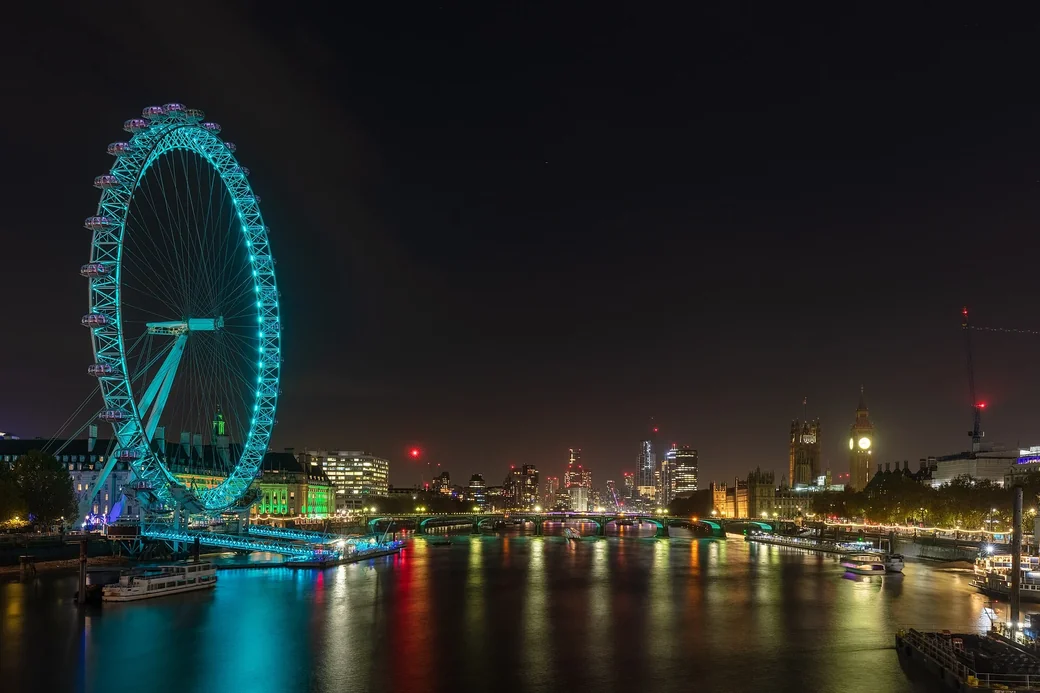
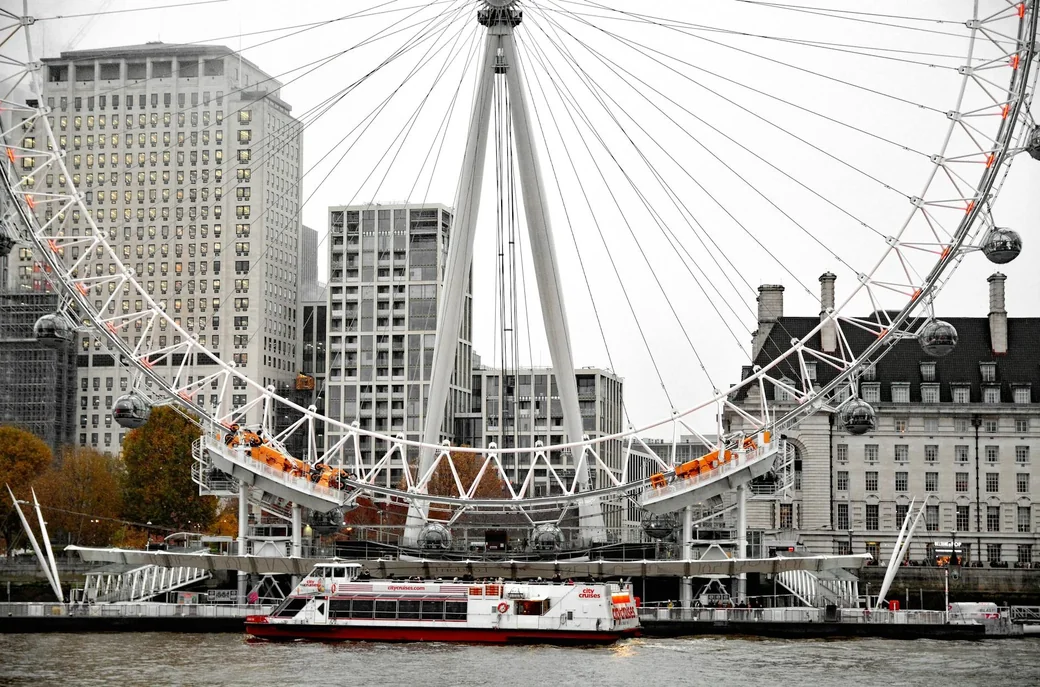
The London Eye is a giant observation wheel on the South Bank of the River Thames in central London, standing between Westminster Bridge and the Golden Jubilee Bridges, directly across the water from the Houses of Parliament and Big Ben. As Europe's tallest cantilevered observation wheel, it lifts visitors in enclosed glass capsules on a slow, gentle rotation high above the river, opening up wide panoramic views over the city. Today it is one of the defining symbols of modern London and one of its best-loved sights.
London Eye: Location, accommodation options and contact
The London Eye, Riverside Building, County Hall, Westminster Bridge Road, London SE1 7PB, United Kingdom
The place's location on the map and nearby accommodation and hotel options are shown by Stay22. Cookies are used. Your consent is remembered on every page; you can turn it off at any time in the cookie settings.
London Eye History: From a Rejected Idea to a Global Icon
The London Eye began in 1993, when architects David Marks and Julia Barfield proposed a giant observation wheel for a millennium landmark competition that ended with no winner. They carried on by themselves, found support, and construction started on the South Bank in 1998. The wheel was ceremonially opened on 31 December 1999 and welcomed the public in March 2000. Planned as a temporary feature, it earned permanent status and now stands among the best-known symbols of London. The couple's practice, Marks Barfield Architects, also found the South Bank site, and the project was first known as the Millennium Wheel.
How the Cantilevered Wheel Stands: Engineering Behind the Eye
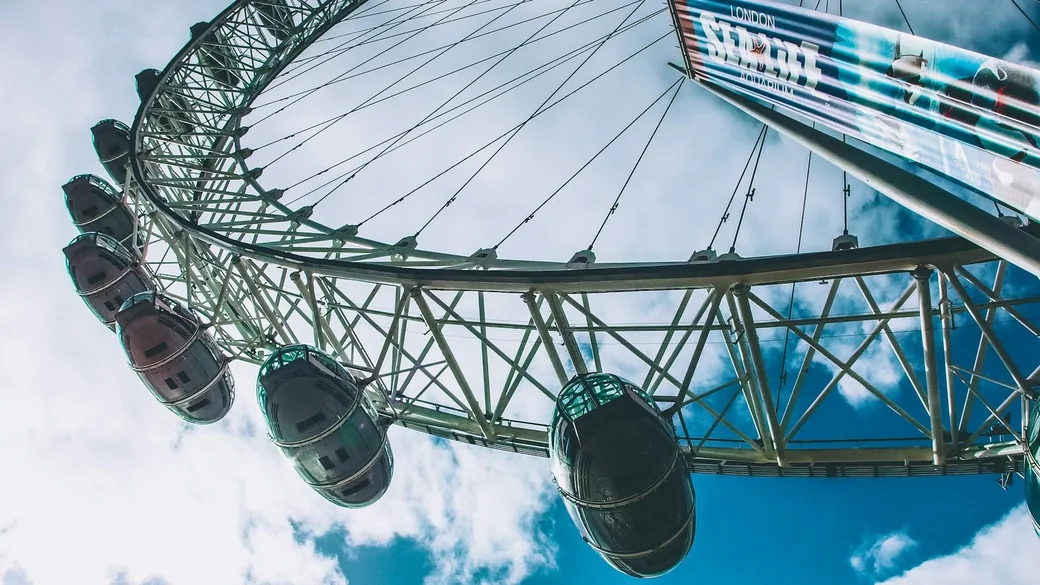
Unlike most big wheels, the London Eye is held by an A-frame on one side only, so it leans out over the Thames like a cantilever. Its rim is braced by tensioned cables, and the capsules sit on the outside of the rim, which keeps your view free of steel. The wheel was built lying flat on the river and raised upright in careful stages with strand jacks. Components arrived from six European countries, making it a truly international effort. Seen from the riverbank, the rim seems to hover over the Thames like an enormous bicycle wheel whose spokes are cables rather than steel.
32 Capsules, 135 Metres: Key Facts and Figures
The wheel is 135 metres tall and 120 metres across. Its 32 sealed, air-conditioned capsules were built by Poma, each weighing about ten tonnes and holding up to 25 people. Each capsule stands for one of London's boroughs, and the numbering runs from 1 to 33 with no number 13. The wheel travels at about 26 centimetres per second, so one rotation takes roughly 30 minutes, and it keeps moving while you board. When it opened to the public it was the tallest big wheel in the world, and it remained London's highest public viewing point until 2013, when the viewing deck of The Shard took that title.
What You Can See from the London Eye: Views and Landmarks
Across the river you look straight at the Houses of Parliament, Big Ben and Westminster Abbey, with Buckingham Palace further on. Turn around for St Paul's Cathedral, Tate Modern, Tower Bridge and the City skyline; Wembley Stadium is also visible. On a clear day the view stretches about 40 kilometres, as far as Windsor Castle. By day the details are sharp, and at dusk the lights of the city switch on beneath you. The ride itself is calm rather than thrilling, and you are free to walk around the capsule throughout the rotation and look out in every direction.
Best Time to Visit the London Eye, Opening Hours and Queue Tips
Opening times change with the season and the day: weekends, school holidays and the warmer months usually have longer hours, while quieter weekday periods close earlier. The wheel is closed on 25 December and for annual maintenance in January, so check the official calendar. For short queues choose early morning or the last slots; sunset is lovely but busy. Plan about 90 minutes in total.
London Eye Tickets and Booking: Timed Slots, Fast Track, Discounts and Combination Tickets
Book online in advance for a guaranteed timed slot. The time on your ticket is when you join the queue, not when you board, and you cannot join early; a short grace period applies if you are late. Fast Track tickets use a dedicated lane, and Flexi Fast Track lets you arrive at any time on your chosen day. Tickets cannot be refunded or transferred, but you may reschedule online until shortly before your slot. Adult tickets cover ages 16 and over, child tickets ages 2 to 15, and under-twos ride free but still need a booking.
Groups can book ahead at a group rate, and members of the Blue Light Card and UK Defence Discount Service schemes (discount programmes for emergency-service staff and armed-forces personnel) can reserve discounted tickets through the official portals; there are no discounts at the gate, because tickets are meant to be pre-booked. Merlin Annual Pass holders must still reserve a slot. Combination tickets pair the wheel with the London Eye River Cruise, a circular Thames cruise from the neighbouring pier, or with partner attractions such as Madame Tussauds and SEA LIFE London; each partner venue needs its own reserved time slot. For couples, Cupid's Pod is a private pod for two adults, and the Proposal Pod adds a host, rosé champagne and a souvenir photograph.
Arriving at the London Eye: Security, Facilities and What to Bring
Every guest passes a security check, so travel light. Small bags, backpacks, cameras, phones and drinking water are welcome, while large bags, suitcases, sharp objects, drones, scooters, bicycles and alcohol are not allowed. A paid left-luggage service operates at the ticket hall, with collection required the same day. Toilets and baby changing are in the ticket office, Wi-Fi covers the main hall, and the gift shop is at the exit. Pushchairs may board only if fully folded.
London Eye Accessibility, Languages and Visitor Support
The wheel is fully accessible. Wheelchair spaces on the wheel are limited, so pre-book a wheelchair slot. Mobility scooters, walking frames and assistance dogs are welcome, and carers can request a carer ticket with proof. Braille guides, induction loops, staff who sign in British Sign Language, ear defenders, a social story and a symbol-based guide support other needs. The official website is available in English, French, German and Italian, and a landmark guide can be downloaded.
Photosensitive guests should know that camera flashes fire at two points: at the green-screen photo in the queue and near the end of the ride, and staff will happily advise. Medicines, including injectors and EpiPens, may be brought, subject to the brief security check. The sunflower lanyard for hidden disabilities is recognised, ear defenders can be borrowed, and a quiet space for breastfeeding is available on request. Mobility scooters can board if they fit through the boarding gate and ramp. Technical stops are rare; each capsule has an intercom to the control team, and in past stoppages guests were looked after with water and blankets and brought down safely.
How to Get to the London Eye by Tube, Train, Bus and River
Waterloo is the closest station, about five minutes on foot, served by four Underground lines and National Rail trains. Westminster station lets you approach across Westminster Bridge, while Embankment and Charing Cross lead you over the Golden Jubilee footbridges in ten to fifteen minutes. Many bus routes stop nearby, and river boats call at the London Eye Pier. The site lies inside the Congestion Charge zone and has no car park, so public transport is far easier. Taxis use a rank at the end of the site.
Best Photo Spots for the London Eye: Angles from the Ground and the Bridges
For the full wheel with space for people in the frame, stand on the Belvedere Road side of Jubilee Gardens around sunset. The steps of the Golden Jubilee Bridge give a raised view of the wheel and the river. Westminster Bridge offers a classic side view, and the Victoria Embankment on the north bank shows the Eye across the water. Morning and late afternoon light is gentler. Inside the capsule, stand back from the glass to reduce reflections.
VIP Experiences on the London Eye: Champagne, Afternoon Tea and Private Capsules
For something special, the London Eye offers a Champagne Experience with a dedicated host, an Eye Lounge package with drinks before or after the ride, an Afternoon Tea lasting two full rotations, and private capsules for two to twenty-five guests. Couples can choose romantic pods, and proposals have taken place on the wheel many times. VIP guests check in at a dedicated desk and board with priority. Book ahead, since these slots sell out, and mention dietary needs when you reserve.
Legends and Stories of the London Eye: The Missing Capsule 13 and the Great Wheel
According to the story usually told, capsule number 13 is missing because the organisers feared superstitious guests would refuse to board it, so the numbers jump from 12 to 14. London also had an earlier giant wheel, the Great Wheel of Earls Court, built for an exhibition in 1895 and removed in 1907; it stood about 94 metres tall, had 40 cars of 30 people each and is said to have carried around 2.5 million riders. Reports tell of passengers stranded on it for hours who dropped notes wrapped in handkerchiefs to friends below, and such an episode reportedly inspired a music-hall song. Its souvenir medal reportedly claimed that Windsor Castle could be seen from the top. These are stories, not verified facts.
Do's and Don'ts at the London Eye: Practical Etiquette
Do book a timed slot, arrive within it, and keep your ticket on your phone or printed. Do fold pushchairs, walk around the capsule and share the windows. Do wear layers for the riverside breeze. Don't bring alcohol, large luggage, drones or scooters. Don't expect to join the queue before your slot. Don't press your lens against the glass; step back to reduce reflections, and keep a firm grip on your phone near the ramp, because the wheel keeps moving as you board.
Places Near the London Eye: Big Ben, Southbank Centre and the Thames Path
Jubilee Gardens sits beside the wheel and makes a pleasant pause. Cross Westminster Bridge on foot for Big Ben, the Houses of Parliament and Westminster Abbey. County Hall houses SEA LIFE London Aquarium and The London Dungeon. Along the South Bank you pass the Southbank Centre, the National Theatre, the BFI, Tate Modern, Shakespeare's Globe and Borough Market before reaching Tower Bridge; the whole walk takes about 45 minutes at a photographer's pace.
London Eye in Culture: New Year's Eve Fireworks, Film and Fun Facts
The Eye is the focal point of London's New Year's Eve celebrations: since 2005 the fireworks display has been fired from the wheel itself. The wheel often lights up in special colours for occasions, and it appears in films and television series as a shorthand for London. For many couples it is a favourite place to propose. It also ranks among the most visited paid attractions in the United Kingdom.
London Eye: Visitor Tips
Book a timed slot online before you go and arrive inside it: the time on your ticket is when you join the queue, not when you board. Travel light, keep a small bag, and shoot photos of the wheel from Jubilee Gardens or the Golden Jubilee Bridges before or after your ride. Sit down for a quiet moment, but also walk around the capsule to catch every direction. Hours are shorter on weekdays than at weekends and in the school holidays, and the wheel closes for about two weeks of maintenance each January, so check the date you have in mind.
London Eye: Best Time to Visit
Early morning or the last slots before closing for shorter queues; late afternoon on a clear day for sunset light, and evening for the glowing skyline.
London Eye: Admission Fees
Standard – Adult (16+)
A full rotation of the 135-metre observation wheel with views over Big Ben, Buckingham Palace and the Thames; online advance prices vary with demand and walk-up tickets cost more. Full fare for adult visitors aged 16 and over.
£29
Standard – Child (2–15 years)
A full rotation of the 135-metre observation wheel with views over Big Ben, Buckingham Palace and the Thames; online advance prices vary with demand and walk-up tickets cost more. Fare for children aged 2 to 15, who must be accompanied by an adult aged 18 or over.
£26
Children under 2 (free)
Children under 2 enter free of charge, but a free ticket must still be booked.
Free
Flexi Fast Track (priority entry any time that day) – Adult (16+)
Priority entrance that lets you board at any time during opening hours on your chosen day, skipping the standard queue. Full fare for adult visitors aged 16 and over.
£49
Quick Info
1h 30m
easy
London Eye: Getting There
The easiest approach is by Underground to Waterloo station, which is served by the Bakerloo, Jubilee, Northern and Waterloo & City lines. Follow the signs for the South Bank and the wheel appears after about five minutes on foot. From Westminster station (Jubilee, District and Circle lines) take exit 1 and cross Westminster Bridge on foot, which gives you the best views of the wheel and of Big Ben. From Embankment or Charing Cross, cross the Golden Jubilee footbridges for a pleasant walk of ten to fifteen minutes. Many bus routes stop nearby, among them 12, 76, 77, 148, 211 and 381, and river boats call at the London Eye Pier right beside the wheel. Driving is discouraged: the area lies inside the Congestion Charge zone and the attraction has no car park of its own.
Nearby stops & parking
The nearest stops are Waterloo station, with its Underground and National Rail platforms, and the London Eye Pier and Westminster Pier on the river. Bus stops line Westminster Bridge Road and Belvedere Road. A taxi rank stands at the edge of the site, and coaches may briefly set down and pick up groups. There is no parking at the attraction itself, but the Q-Park Westminster car park nearby accepts pre-booked spaces with a discount for visitors. Blue Badge holders should check parking arrangements in advance.
London Eye: Dress Code & Etiquette
There is no dress code. Wear comfortable clothes and shoes for queueing and for strolling along the river, and bring a light layer for the wind on the embankment, even though the capsules themselves are climate-controlled. Security checks apply to everyone, so avoid large bags and luggage. Be considerate in the shared capsule: keep voices moderate, let others reach the glass for photos, and keep any pushchair folded throughout.