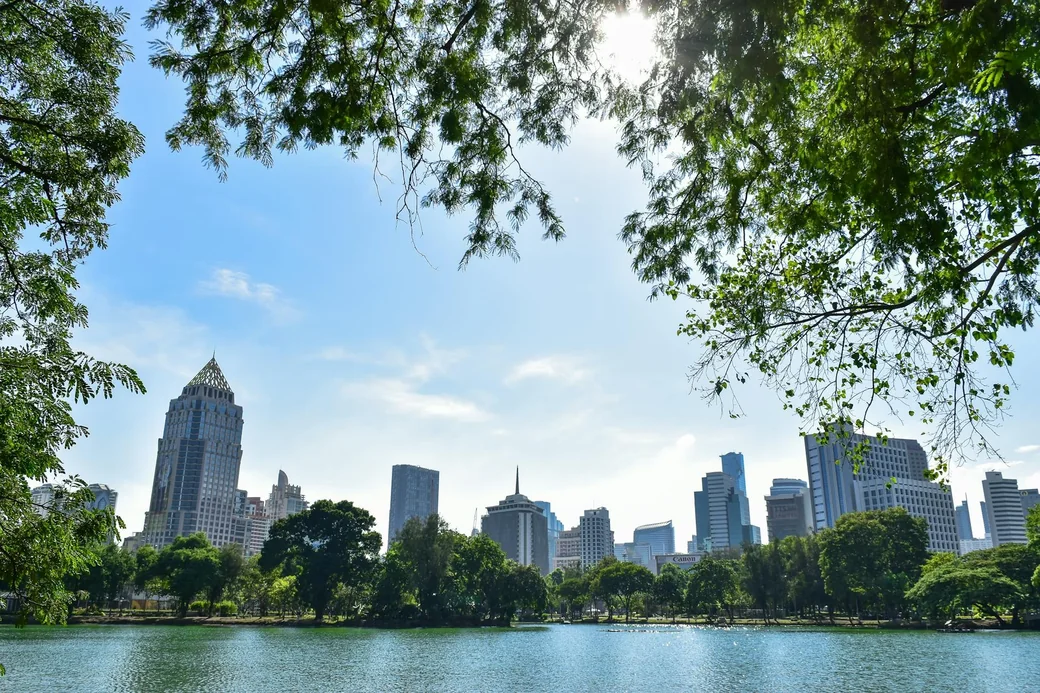
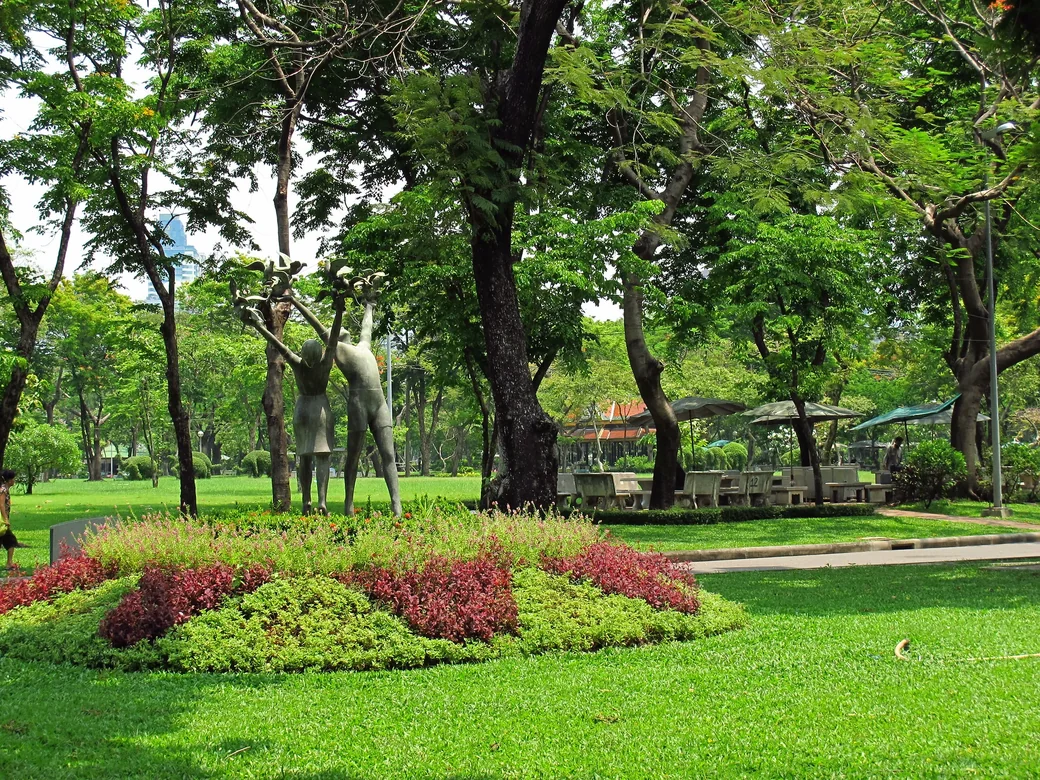
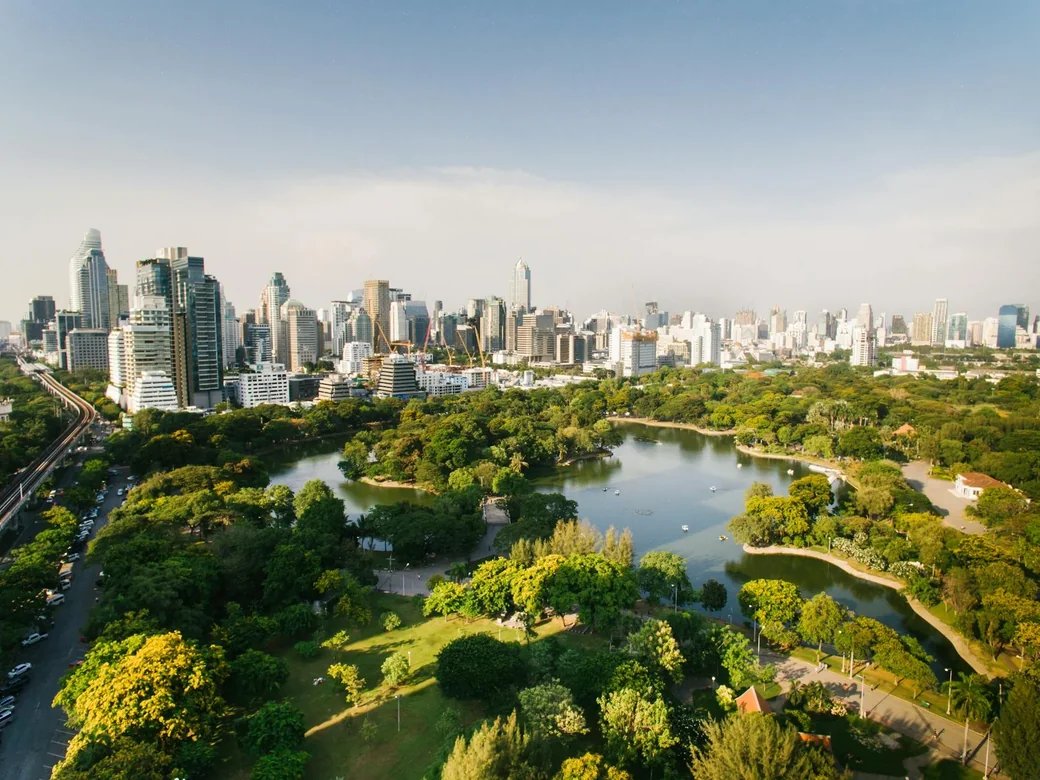
Lumphini Park is the green heart of downtown Bangkok and the oldest public park in Thailand: a broad sweep of lawns, shade trees and open water in the Pathum Wan district, right beside the Silom business quarter. Ringed by glass towers, it is where the city comes to breathe. Locals jog, exercise and unwind here from early morning until evening, while visitors find a free, easy escape from traffic and heat, and one of the best places to watch everyday Bangkok life at an unhurried pace.
Lumphini Park: Location, accommodation options and contact
Rama IV Road, Lumphini, Pathum Wan District, Bangkok 10330, Thailand
The place's location on the map and nearby accommodation and hotel options are shown by Stay22. Cookies are used. Your consent is remembered on every page; you can turn it off at any time in the cookie settings.
Arrive at first light and you get cool air, mist over the lake and the park at its most local: tai chi circles, sword forms and hundreds of runners. Sunset is the other sweet spot, when the light hits the towers behind the trees. The middle of the day is hot, glaring and surprisingly empty. Early morning is also when the park's resident birds are at their most active, and birdwatching sessions with instructors are held here every year.
How Long to Stay at Lumphini Park
Allow around two hours to walk a good part of the grounds, take a boat out and find the lizards; add another hour for a picnic or a concert. Weekends and public holidays are busiest, so weekday mornings feel noticeably calmer. The grounds cover 360 rai (a Thai unit of land area), roughly 57.6 hectares or 142 acres, so pace yourself. When you get hungry, the hawker centre (open-air food hall with stalls) on the Ratchadamri side is the park's proper place to eat. For breakfast among the locals, the Sri Thai Derm food centre inside the park opens before dawn for the exercise crowd and closes by mid-morning. If you plan to walk on to Benjakitti, add the round trip over the Green Bridge to your time.
How to Get to Lumphini Park by MRT and BTS
Take the MRT Blue Line to Si Lom for the main southwestern gate and the Rama VI statue, or to Lumphini for the Witthayu Road corner. From Sukhumvit, ride the BTS to Sala Daeng and change at Si Lom — about twenty minutes door to door. Both metro exits put you within a couple of minutes of a gate. The park is framed by Rama IV Road to the south, Ratchadamri Road to the west and Witthayu (Wireless) Road to the east. The name of Sala Daeng station recalls Thung Sala Daeng, the Sala Daeng Field, the open country that once covered this ground and belonged personally to King Rama VI. Gate 5 on Ratchadamri Road, beside the hawker centre, is reached from BTS Sala Daeng exit 6 or MRT Lumphini exit 1, and taxis and motorcycle taxis wait at the main gates. The Blue Line also runs straight here from Sanam Chai near the Grand Palace and from Wat Mangkon in Chinatown, so the park slots easily into a day in the old city.
Bangkok Air Quality and Heat: What to Check Before You Go
Bangkok's dry season, roughly December to March, brings PM2.5 haze, and Pathum Wan regularly ranks among the worst-affected districts. Check IQAir, AQICN or Air4Thai the morning of your visit. On bad days, skip the run and shorten the walk. Heat and humidity peak from March to May.
Lumphini Park Rules Every Visitor Should Know
Smoking and alcohol are banned throughout, and guards enforce it. Dogs are not allowed inside except certified assistance animals, although there is now a separate dog park nearby. Cycling is permitted only during limited daytime periods.
Running and Walking the 2.5 km Loop
The main circuit measures about 2.5 kilometres, so two laps make a neat 5K on flat, shaded, well-lit paving. Runners dominate the loop at dawn and again in the late afternoon. There is an old-school outdoor weights area in the southeast, a calisthenics zone, basketball courts near the playground and scattered bodyweight machines. Sport was part of the plan from the start: King Rama VI wished the ground to become a public botanical garden for ordinary people, with a football field, a children's playground and a swimming pool. Several facilities serve particular groups: the Smiling Sun Ground (Lan Tawan Yim) offers equipment, play areas and parking designed for people with disabilities, the Bangkok Elder Citizens Club gives older residents a place to exercise, relax and take dance classes, and the Lumphini Youth Center offers its members football, swimming, basketball and dance.
Join the Outdoor Aerobics and Morning Tai Chi
In the late afternoon, instructors set up speakers near the gates and anyone can join the mass aerobics — dozens of rows of Bangkokians moving in sync to Thai pop. At dawn the mood is slower: tai chi, sword forms and yoga on the lawns. Nobody will mind if you fall in at the back and copy along. At dawn you will also see groups of retirees swinging their arms in unison, and by evening the lawns fill with ballroom dancers, badminton players and couples looking for somewhere cheaper than a mall.
Swan Boats on Lumphini Lake
Swan-shaped pedal boats and rowing boats work the artificial lake, and there is no better angle on the Silom skyline than from the middle of the water. Late afternoon is the best light. Landing stages sit on the western shore, the boats are shared happily by couples and families, and a loop takes about half an hour. Around the water grow rain trees, banyans and coconut palms, home to more than thirty bird species as well as squirrels and turtles. In the 1960s the lake had a landmark of its own, the floating restaurant Kinnari Nava, whose bow carried a kinnari (a mythical half-woman, half-bird); it closed after a fire.
Concert in the Park: Sunday Music in the Palm Garden
In the cool season the Royal Bangkok Symphony Orchestra performs its long-running Concert in the Park at Sala Bhirombhakdi (pavilion), in the Palm Garden, on Sunday evenings from around December to February. Bring a mat and a picnic, arrive early for a spot on the lawn near the front, and remember that alcohol is not permitted. Entertainment has a long history here. In the late 1920s the Interior Ministry let a nobleman lease about ninety rai, some 14 hectares, at the southern end; the pleasure garden built there, with a theatre, stage shows, food stalls and rides such as a carousel, was opened by King Prajadhipok, Rama VII, on 7 November 1929, and the rent went straight back into improving the rest of the ground. Admission to the concerts is free, which is why the lawn fills early with families, friends and picnic mats.
Walk the Green Bridge to Benjakitti Forest Park
The Green Bridge, a 1.3-kilometre elevated walkway and cycle path, links Lumphini to Benjakitti Forest Park without touching a main road. Rebuilt with ramps, lifts, granite paving and a slip-resistant cycle surface, it starts at Sarasin junction where Witthayu meets Sarasin Road. Allow twenty-five minutes on foot between the two parks. Benjakitti, at the far end, was laid out on land once occupied by the Tobacco Monopoly's factory and is known for its lake and the boardwalks that wind through its planted wetlands.
Meeting Lumphini's Water Monitor Lizards Safely
Several hundred Asian water monitors live here, some reaching two and a half metres. They are scavengers, not predators, and they ignore people entirely — but give them room on narrow paths, never corner one, and keep small children and food at a distance. They are most visible at the water's edge in the early morning and after rain. They are far more numerous here than in the wild for a simple reason: visitors feed the fish, the fish multiply, and the monitors eat very well indeed. Estimates put the population at around four hundred, and in 2016 the city captured and relocated a number of them to keep numbers in check.
The Thai Word You Should Never Use for a Monitor Lizard
Thais call the water monitor hia, and using that word for a person is one of the harshest insults in the language. The polite name is tua ngern tua thong, roughly “the lucky animal”, tied to an old belief that seeing one brings fortune. Point at the lizard, admire it, and let your guide supply the vocabulary.
The Morning and Evening National Anthem Ritual
Every morning and evening the Thai national anthem plays over the park loudspeakers and everything stops — runners, cyclists, couples, vendors. Stand still, stay silent and take your headphones off until it ends. It lasts under a minute and is one of the most quietly memorable moments of a Bangkok day. The park keeps quieter rituals too: on the last Sunday of every month, monks lead early-morning Dharma activities (Buddhist teaching and merit-making) that anyone may join.
King Rama VI and the Fair That Never Happened
King Rama VI gave this land to the nation in 1925 for a great national exhibition that never took place; he died while it was still being planned. The park kept the name he chose, after the Buddha's birthplace in Nepal, and the deed carried a condition that the ground serve as a public park and nothing else. The planned fair was the Siam Rath Phiphitthaphan, meant to showcase Thai agriculture and industry and lift an economy that had sagged after the First World War; the king died in November 1925. The name Lumphini comes from Lumbini, and the deed's condition held unless the king or his heirs decided otherwise. That single clause is why a park still occupies some of the most valuable land in Southeast Asia, while the boxing stadium, the night bazaar and the old hotel that once stood around it have given way to towers. The name also travelled beyond the park. Lumpinee Boxing Stadium, opened on 8 December 1956 on Rama IV Road beside the park as the country's second national Muay Thai (Thai boxing) stadium after Rajadamnern, took its name from it; after its last fights there in February 2014 it moved to Ram Inthra Road but kept the name. In November 2025 the city marked both the park's centenary and the hundredth anniversary of Rama VI's death with several days of commemorative events here, a reminder of how closely the park is still tied to its founder.
Clock Tower, Statue and the Park's Forgotten Rubbish Years
Look for the Chinese-style clock tower built in 1925, the bronze statue of Rama VI raised in 1942 at the southwestern gate, and the restored Lumphini Hall where ballroom dancing has returned. Less advertised: from 1927 the city dumped its rubbish in the park's northeastern pond for more than two years until it was full. The pond's water turned foul and bred mosquito larvae, the old drainage into the canal was blocked, and residents' complaints did not stop the dumping. During the Second World War the Japanese Army used the grounds as a camp, as photographs dated January 1942 record. Look out, too, for Bangkok's first public library; the park's centenary in 2025 coincided with a long restoration that left it looking better than it had in decades. Lumphini Hall itself, known in Thai as Lumphini Sathan, was built in 1952–53, in the years when the park hosted the national Constitution Day fairs with trade stalls, government pavilions and stage shows.
Lumphini Park: Visitor Tips
Come twice if you can: the park at dawn and the park at dusk are two completely different places, and most visitors only ever see the dead middle of the day, when the heat empties the lawns. Enter from the southwestern gate by the Rama VI statue for the classic first view, and carry small change for a drink from the vendors near the gates rather than expecting shops inside. Bring a hat and more water than you think you need — shade is generous but the humidity is not. Sit on a mat rather than directly on the grass; red ants are common and their bite is memorable. If you want a photograph of the skyline reflected in the lake, stand on the northern shore in the late afternoon so the towers catch the low sun. And do not feed the water monitors, however photogenic they are.
Lumphini Park: Best Time to Visit
Dawn and the golden hour before sunset; November to February for comfortable temperatures
Lumphini Park: Admission Fees
Free admission
The park is open to everyone free of charge, with shaded paths, lawns and a lake in the middle of the city.
Free
Quick Info
2h
easy
Lumphini Park: Getting There
The MRT Blue Line is the easiest approach, and the park is one of the rare Bangkok attractions you can reach without ever crossing a major road. Lumphini station sits at the southeastern corner by Witthayu Road, and Si Lom station at the southwestern corner near the Rama VI statue; both have exits within a minute or two of a gate. If you are staying on Sukhumvit or near the river, take the BTS Skytrain to Sala Daeng and change to the MRT at Si Lom, or simply walk the short link between the two stations — the whole journey usually takes about twenty minutes. Taxis and ride-hailing apps know the park instantly; insist on the meter or book through an app so the fare is fixed, and expect central-Bangkok traffic to double your travel time in the late afternoon. Cycling to the park is possible via the elevated Green Bridge from Benjakitti Forest Park, which keeps you off the traffic entirely.
Nearby stops & parking
Closest stations: MRT Lumphini (Blue Line), exits 1 and 3, about 100 metres from the Witthayu Road gate; MRT Si Lom (Blue Line), exit 1, roughly 150 metres from the main southwestern entrance; BTS Sala Daeng (Silom Line), exit 4, about a five-minute walk across Sala Daeng intersection. Numerous BMTA bus routes run along Rama IV Road and Ratchadamri Road with stops directly opposite the park railings. There is limited parking inside the park itself and at the Ratchadamri hawker centre, but driving is the worst option in this district; the Silom and Wireless Road office towers charge by the hour and fill up early. Motorcycle taxis wait at every gate and at the mouth of most sois nearby, and are the fastest way in and out during rush hour.
Lumphini Park: Dress Code & Etiquette
There is no formal dress code — this is a city park, not a temple — but a few local conventions are worth respecting. Thais dress modestly in public spaces, so running shorts and sports tops are fine on the jogging loop while beachwear, bare chests and swimwear are not. Comfortable closed shoes matter more than style: the paths are paved but the lawns are uneven and ant-prone. Remember that the park stops for the national anthem in the morning and evening; if you are walking, stand still and stay quiet until it finishes, and remove headphones. The park is officially smoke-free and alcohol-free throughout, and guards enforce both. Cover up with a hat and light long sleeves rather than relying on shade alone during the hot season.