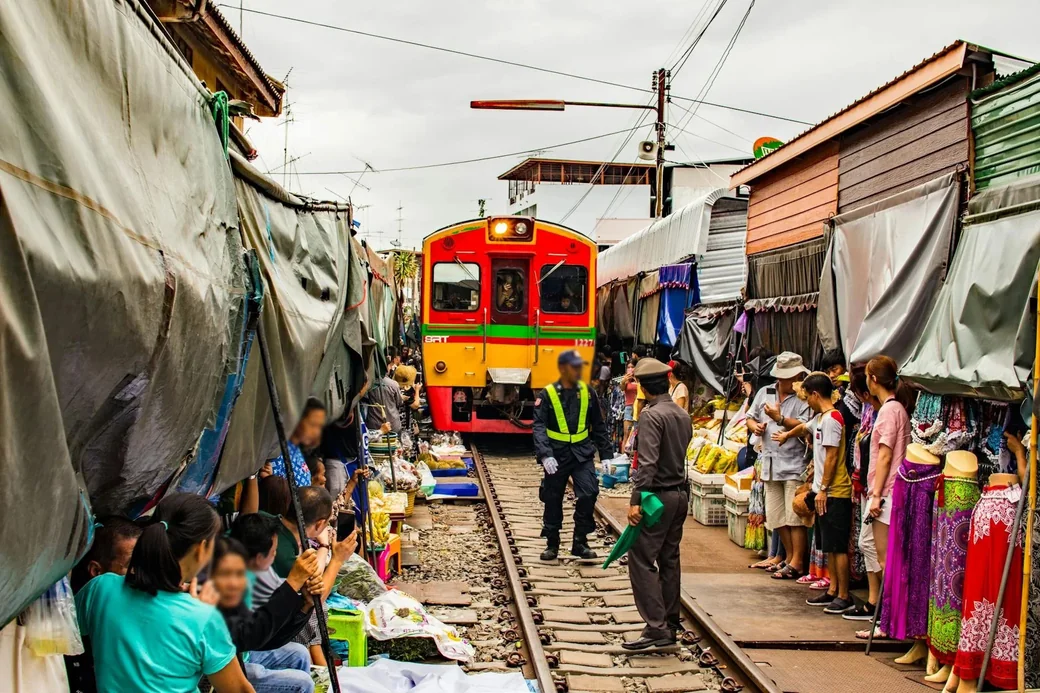
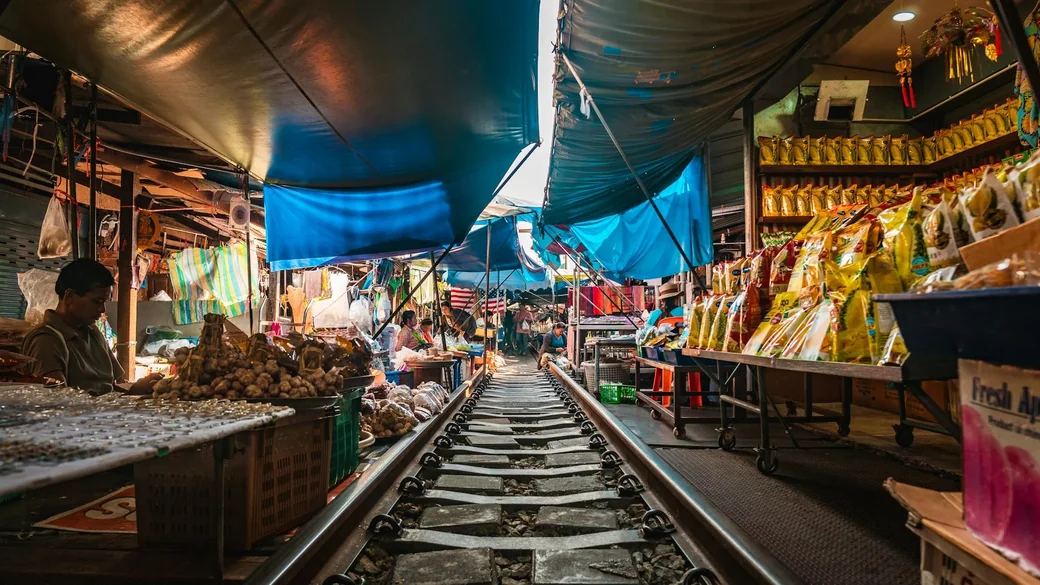
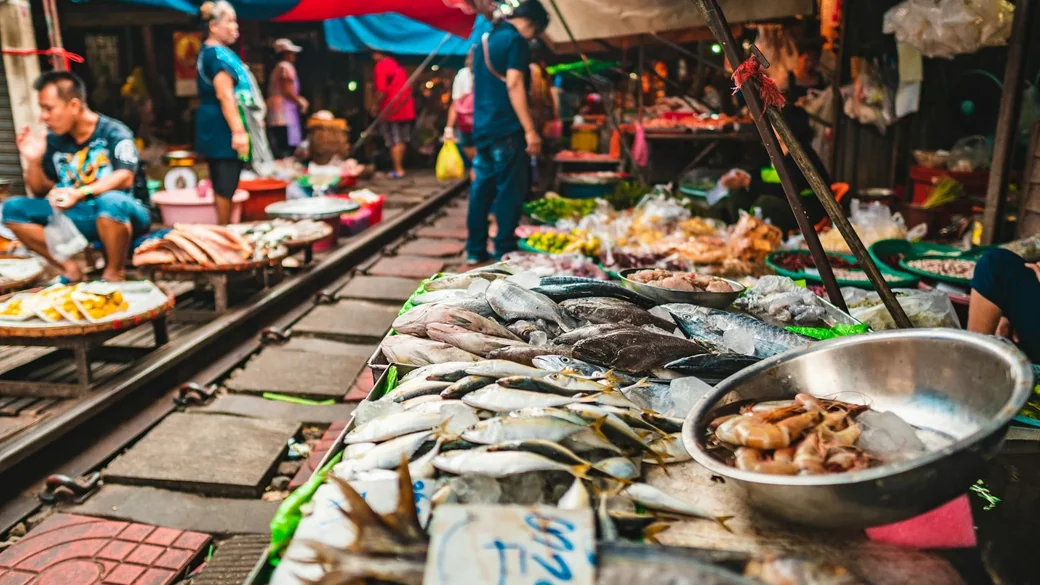
Maeklong Railway Market is a busy local fresh market laid out directly along the railway line beside Maeklong station in Samut Songkhram, about 80 kilometres south-west of Bangkok. Traders sell seafood, fruit and regional produce right on the tracks, and each time a train is due they fold back their awnings and pull in their goods so it can roll slowly through, then set everything out again moments later. This everyday routine makes it one of the most unusual markets in Thailand.
Maeklong Railway Market: Location, accommodation options and contact
The place's location on the map and nearby accommodation and hotel options are shown by Stay22. Cookies are used. Your consent is remembered on every page; you can turn it off at any time in the cookie settings.
The train passes several times a day in both directions, from early morning to early evening. Those passes are the entire reason most people come, so pick one and plan the journey around it rather than hoping to be lucky. Because Maeklong is the end of the line, every train passes through the market twice: once on arrival and again when it sets off back towards Ban Laem.
Arrive 20 to 30 minutes early for a front-row spot
The best standing positions along the track fill up well before the horn sounds, especially near the station end where you see the train head-on. Arriving half an hour early also gives you time to walk the stalls once in peace, which is when the market is at its most photogenic.
Visit on a weekday morning to beat the crowds
Weekends bring coach groups and the aisles become a slow shuffle. On a weekday the first arrival of the morning is noticeably calmer, the produce is freshest and the shoppers around you are mostly local. Traders start packing up in the afternoon, so a late visit sees a thinner market. On an ordinary morning that means prawns on crushed ice, pyramids of pomelo, buckets of squid and herbs sold by the handful.
Confirm the day's timetable at Maeklong station
Times shift for maintenance, public holidays and the occasional delay, and printed schedules online are not always current. The station staff at the end of the market will tell you exactly when the next train is due, and a quick check on arrival saves an hour of waiting for a train that has already gone. The line has no signalling system at all; staff at each station coordinate train movements by hand. Train tickets are bought at the station counter shortly before departure, and the staff there are used to helping visitors.
Take a minivan from Bangkok for the easiest trip
Minivans run from the Southern Bus Terminal at Sai Tai Mai and from the Mo Chit area, leaving when full and taking about ninety minutes, and they stop within a short walk of the tracks. Departure bays have moved more than once, so confirm the current one when buying your ticket. Samut Songkhram is Thailand's smallest province by area, so most of its sights lie within a short ride of the market; from the Maeklong side, taxis and songthaew (shared pick-up trucks) link the station with Amphawa.
Arrive by train through the market for the best experience
The full rail route runs Wongwian Yai to Mahachai, ferry across the Tha Chin River, then Ban Laem to Maeklong — around three hours in total. Riding the last leg puts you inside the spectacle rather than watching it, sliding between the awnings as the traders wave at the windows. At roughly 67 kilometres, this is the only stretch of the national railway with no physical connection to the rest of the network, and the line is itself split in two by the Tha Chin River, which has no rail bridge. A concession granted in 1901 produced the Mahachai line out of Thonburi in 1904; the Ban Laem to Maeklong section opened the following year, with Maeklong station taking its first train on 10 June 1905. The line was built to carry fish and produce from the coastal ports to Bangkok's markets; its two companies merged in 1907, and the State Railway of Thailand absorbed the whole line in the early 1950s. Between Ban Laem and Maeklong the line runs past salt pans, shrimp ponds and mangroves, and at the market's far end Maeklong station is a small working terminus where the train waits before heading back.
Combine Maeklong with Amphawa or Damnoen Saduak
Amphawa's canal market is ten minutes away and comes alive on weekend afternoons, with firefly boats after dark. Damnoen Saduak, the classic floating market, is about half an hour in the other direction. Either one turns a two-hour stop at Maeklong into a full and varied day out. In the town itself, a few steps from the tracks, Wat Phet Samut Worawihan shelters a standing Buddha that, according to local lore, was pulled from the sea in a fisherman's net; Mae Klong people still visit it when they need luck on the water. Amphawa is also the birthplace of King Rama II, honoured by a riverside memorial park with traditional Thai houses, and Wat Bang Kung, a small chapel wrapped entirely in the roots of a giant banyan tree, is a short drive away. Damnoen Saduak grew up along a canal dug in the reign of Rama IV to link the Mae Klong and Tha Chin rivers.
Driving: take the Thonburi–Pak Tho road to Samut Songkhram
Drivers follow the Thonburi–Pak Tho highway to roughly the 63rd kilometre, then bear left into the centre of Samut Songkhram, ninety minutes to two hours from Bangkok depending on traffic. Park on the streets behind the market rather than trying to get close to the tracks. The Thonburi–Pak Tho road is Highway 35, better known in Bangkok as Rama II Road.
Taste Mae Klong mackerel, the market's signature catch
Pla thu Mae Klong is a protected local speciality, sold curled into round bamboo baskets with its head bent — the traders call it bent face, broken neck. The estuary's muddy seabed and same-morning landings are why people travel for it. Eat it grilled or steamed with chilli paste and rice. The fish is a short-bodied mackerel, curled so the neck is tucked, and it is a geographical indication registered to the province. Richer feeding on the muddy seabed explains the flavour, and boats land the catch the same morning rather than holding it overnight. Samut Songkhram celebrates the fish with its own mackerel festival. The classic pairing is nam phrik kapi, a pungent chilli dip made with shrimp paste, served with fresh and blanched vegetables.
Shop for shrimp paste, coconut sugar and dried seafood
The souvenirs worth carrying home are the ones locals buy: fermented shrimp paste from Khlong Khon, palm and coconut sugar boiled in the orchards inland, dried squid and prawns, pickled shellfish and razor clams from the Don Hoi Lot sandbar. Ask for vacuum packing if you are flying. Look out too for sea-blite leaves (a salty coastal green), and for lychees and pomelo in season. Don Hoi Lot, the sandbar at the mouth of the Mae Klong river where the razor clams are dug at low tide, is a wetland of international importance protected under the Ramsar Convention. Many stalls also sell khanom (traditional Thai sweets) made with the province's coconut sugar.
Bring small banknotes — the stalls do not take cards
This is a working wet market and trade is in cash, usually in small notes. Cash machines are in the town centre, a short walk from the tracks, so it is easiest to arrive with some small notes already in your pocket. Change money before you leave Bangkok. Prices are usually quoted on request, and gentle bargaining is part of the market's rhythm, especially when buying several items.
Step well back the moment the horn sounds
A bell over the loudspeakers and the train's horn give you plenty of warning, and the crowd parts naturally. The train crawls through barely faster than walking pace, with under two metres of clearance, so stand where the traders point, keep children by the hand and never stop in the middle of the rails for a photograph. Across the whole line trains average about 30 kilometres an hour, and through the market the driver slows to roughly 15, close enough that you could reach out and touch the carriage. The entire retraction and reset takes the traders two or three minutes, and they have done it so long that nobody looks up.
Mind your footing: rails, low awnings and narrow aisles
The walking surface is uneven, the steel rails catch the toes of unwary shoes and the awnings hang low enough to clip a tall head. Wet fish water makes the ground slippery. Closed shoes with grip are the right call, and the site is genuinely unsuitable for wheelchairs, prams and large luggage. In the rainy season the lanes can hold puddles, so quick-drying footwear is a good choice.
Photograph the umbrella pulldown, not just the train
Thais call this Talat Rom Hup (the umbrella pulldown market), after the shades the traders once folded away: real golf and garden umbrellas in the early days, now mostly canvas sheets stretched on frames. A blunter local nickname translates as the market that risks death. The famous shot is the retraction itself: awnings swinging back, trolleys rolling away, hands moving fast. A wide lens helps in the narrow lane, morning light is kinder than midday glare, and a low angle from the edge of the track catches the awning line and the locomotive together. Ask before pointing a lens at faces. Within seconds of the last carriage passing, the stalls slide back out and the haggling picks up mid-sentence. The spectacle itself came later than the railway: it grew up as the market spread right up against the track and visitors began arriving for the daily routine of folding and reopening. For a calmer viewpoint, walk along the tracks away from the station end, where the awnings fold just as dramatically with fewer people around.
Remember it is a working market, not an attraction
People here are buying dinner. Do not block a stall to frame a shot, do not handle produce you are not buying, and step aside when a trolley needs to pass. Buying a snack or a bag of dried shrimp from the stall you have photographed is the simplest courtesy, and it is how the market survives. Hundreds of stalls trade here, and the great majority of buyers are Samut Songkhram residents doing their daily shop. Nothing has been staged for visitors: the fish is for sale, the prices are local prices, and the train really is going to Ban Laem. Many residents still call the town itself Mae Klong after the river, and for them the market is simply where daily life happens.
Maeklong Railway Market: Visitor Tips
Work backwards from the train, not from your breakfast: decide which pass you want to see, then build the journey around it, allowing an hour and a half from central Bangkok and twenty minutes of spare time at the other end. The first morning arrival is the calmest of the day and the late-morning one is the most crowded, so if you want space to stand, go early. Stand where the traders tell you to stand — many of them mark a safe line in front of their goods, and they have a far better sense of the clearance than you do. Keep bags in front of you rather than on your back, because the aisle narrows sharply once the awnings come down. Buy something small from the stall you have been photographing; a bag of dried shrimp or a basket of mackerel costs little and changes the exchange from intrusion into trade. And do not leave the moment the train has gone — the crowd thins within minutes, and the market that is left behind, with its butchers and its sleeping cats, is the better half of the visit.
Maeklong Railway Market: Best Time to Visit
Weekday mornings, when the light is soft, locals are still shopping and two train passes fall within a single visit.
Maeklong Railway Market: Admission Fees
Free admission
Browsing the market is free; the train passes through the stalls several times a day, and the awnings are pulled back just before it arrives.
Free
Train ride (Ban Laem to Mae Klong line)
A short ride on the local train between Ban Laem and Mae Klong; the line runs right through the market stalls in Mae Klong.
THB 10
Quick Info
1h 30m
easy
Maeklong Railway Market: Getting There
From Bangkok the simplest independent option is a minivan. Services run from the Southern Bus Terminal, Sai Tai Mai, and from the minivan area beside the Northern Terminal at Mo Chit, leaving when full through the morning and taking around an hour and a half; they drop passengers within a couple of minutes' walk of the tracks. Departure points for these vans have changed more than once in recent years, so check the current bay when you buy the ticket.
The slower, better story is the railway itself. Take the BTS Silom line to Wongwian Yai, walk ten to fifteen minutes to the separate State Railway station of the same name, and ride to Mahachai — around an hour through backyards and salt flats. Cross the Tha Chin River by ferry, walk five to ten minutes to Ban Laem station, and take the final train to Maeklong, which delivers you through the market itself. Only a few trains a day run on that last section, so the connection has to be planned; tickets are sold on the day at the station window, cannot be booked online and never sell out.
By road, drivers take the Thonburi–Pak Tho highway to roughly the 63rd kilometre and bear left into central Samut Songkhram. A taxi or private car from Bangkok takes ninety minutes to two hours depending on traffic, and most organised day tours combine the market with a floating market nearby.
Nearby stops & parking
Maeklong station sits at the end of the market strip and is the natural meeting point; it has benches, shade and a few drink stalls for waiting out the gap between trains. Minivans back to Bangkok pick up from the main road a short walk away and from a parking area behind the shophouses — ask any driver and you will be pointed to the right queue. Songthaew shared pickup taxis to Amphawa leave from near the market for a short hop of twenty to thirty minutes. Taxis do not cruise here; arrange a return with your driver or ask a shop to call one.
Maeklong Railway Market: Dress Code & Etiquette
There is no dress code at the market itself, but wear closed shoes with grip — the ground is wet, uneven and crossed by steel rails. Light, quick-drying clothes and a hat make the midday heat bearable, and an umbrella is more useful than a raincoat in the wet season. If you continue to Wat Phet Samut Worawihan or any other temple in town, cover shoulders and knees and remove shoes before entering the halls.