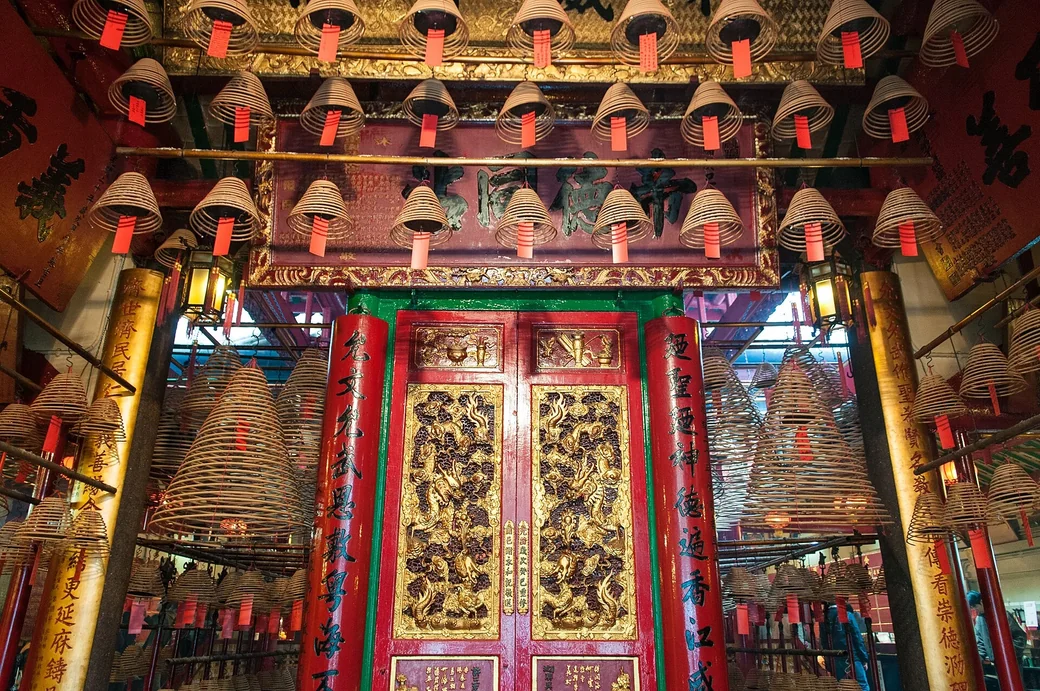
Man Mo Temple is a traditional Chinese temple on Hollywood Road in Sheung Wan, on the hillside rising above the old commercial heart of Hong Kong Island. Its low halls with green-tiled roofs sit among modern residential towers, and inside, dim light and drifting incense smoke create a calm that feels far removed from the busy streets outside. Dedicated to the gods of literature and martial virtue, it is one of Hong Kong's oldest and best-loved temples and remains an active place of worship.
Man Mo Temple (文武廟): Location, accommodation options and contact
124-126 Hollywood Road, Sheung Wan, Hong Kong Island, Hong Kong (the compound covers 124-126, 128 and 130 Hollywood Road)
The place's location on the map and nearby accommodation and hotel options are shown by Stay22. Cookies are used. Your consent is remembered on every page; you can turn it off at any time in the cookie settings.
Man Mo Temple was built between 1847 and 1862, in the decades when Sheung Wan was becoming the heart of Hong Kong's Chinese commercial life. It was funded by two leading merchants of that community, Lo Ah-guo and Tam Ah-choy, and quickly grew into the main gathering point for residents of the whole district. One of them was a building contractor responsible for some of the colony's earliest public works, which makes the temple a rare case of the same hands shaping both the official and the everyday city. The three blocks did not go up at once. The main temple came first, Lit Shing Kung was built at about the same period, and Kung Sor followed in 1862, by which point the compound had reached the size it has today. Official recognition came much later: the compound was listed as a Grade I historic building in 1994 and declared a monument in 2010.
Three buildings, one compound
What everyone calls Man Mo Temple is really three halls standing side by side, separated by two narrow lanes. The largest is the temple itself. Beside it is Lit Shing Kung (the Hall of All Saints), built for the worship of a wider circle of deities. At the end stands Kung Sor (the public meeting hall), where community matters were once discussed. Many visitors photograph the first hall and leave; walking through all three takes only a few extra minutes and gives a much fuller picture of what the place was for. Behind Kung Sor there is also a modern addition, Virtue Court ('hall of virtue'), built in 1994 so that families can place tablets for their ancestors. It belongs to the working life of the temple rather than to the sightseeing route.
Man and Mo: literature and martial virtue
The temple's name comes from its two main gods. Man Cheong presides over learning, examinations and official advancement, and was the natural patron of scholars preparing for the imperial examinations. Mo Tai, also called Kwan Tai, is honoured for loyalty, courage and integrity, and is venerated by merchants and working people alike. One figure holds a writing brush, the other a blade. Students still come before school and public examinations, and people changing jobs or starting a business often stop here too.
The giant incense coils overhead
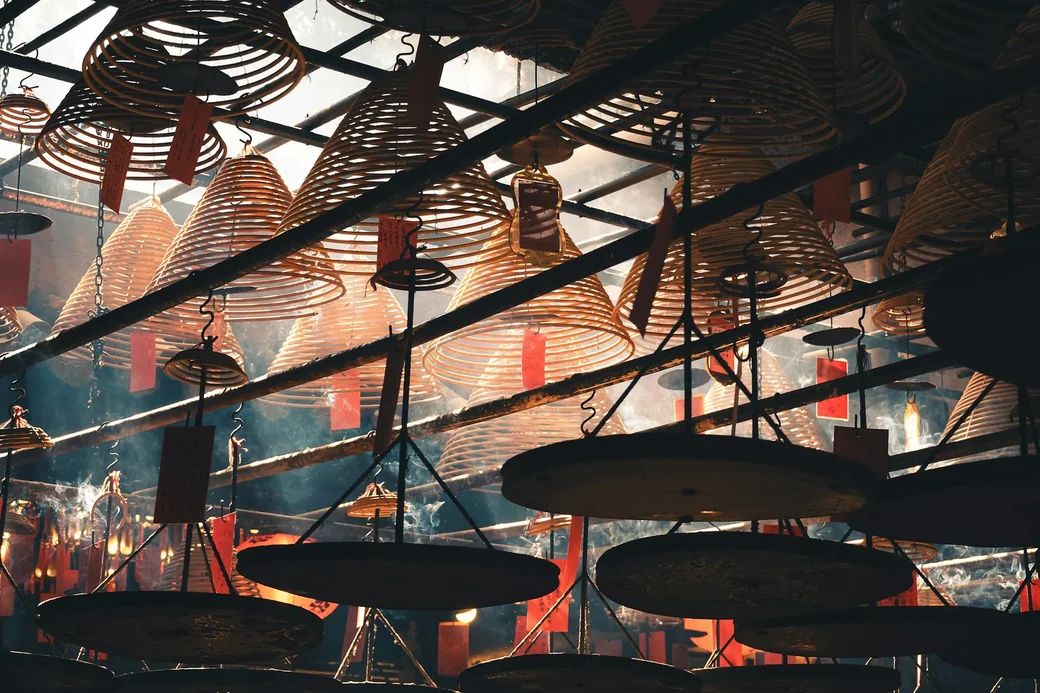
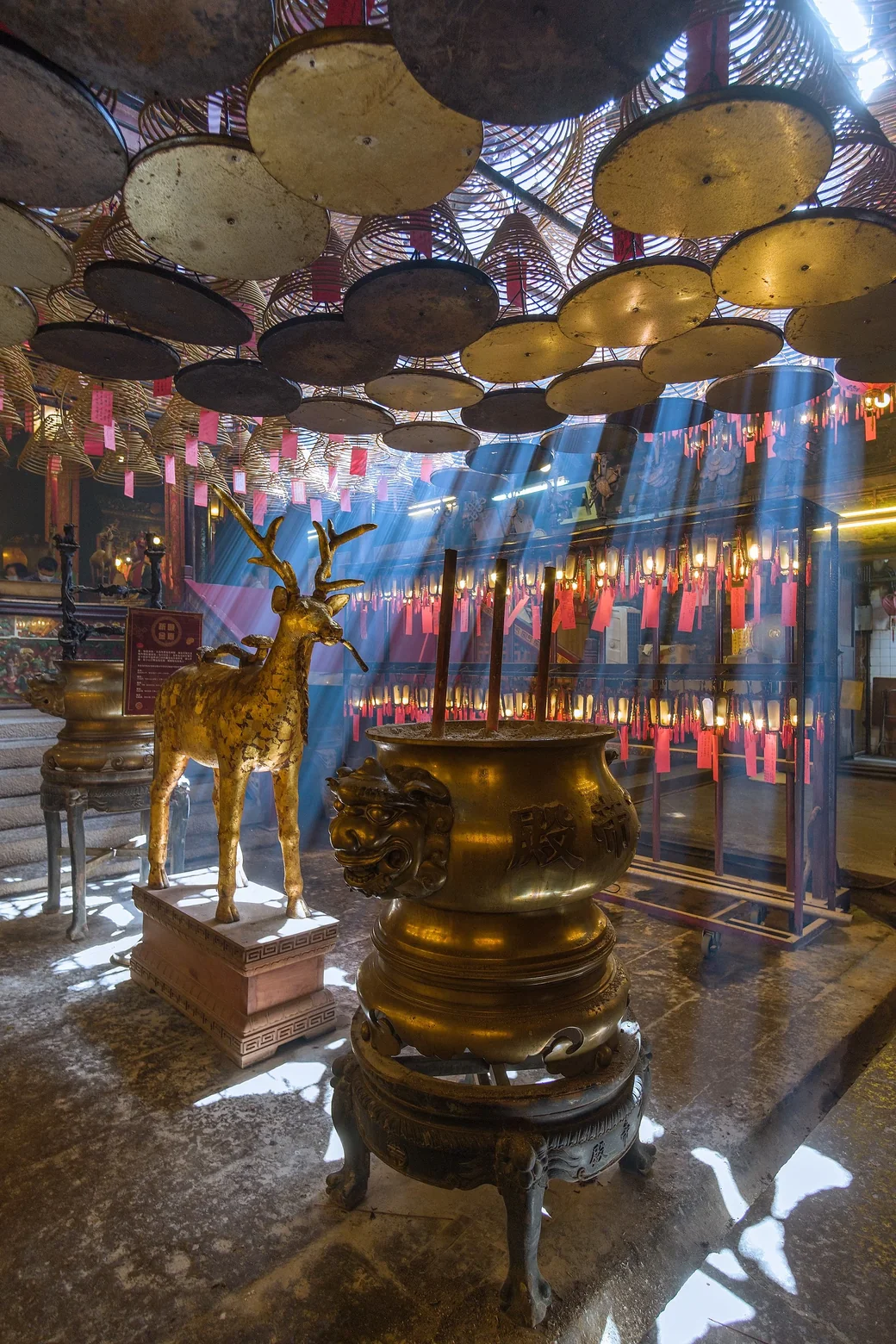
The thing most visitors remember is the ceiling. Large cone-shaped incense coils hang in rows above the courtyard, left burning as offerings and lasting for weeks at a time. The belief is that the rising smoke carries the wishes attached to them upward. Together with the dim interior and the shafts of daylight that come through the roof openings, they create the atmosphere the temple is famous for. The smoke is heavy, so if it bothers you, stay closer to the front hall where the air moves more freely.
According to legend: oaths sworn with yellow paper
According to accounts passed down about the early colonial period, Chinese residents sealed a binding oath by burning yellow paper and beheading a rooster — and, it is said, such an oath only carried weight if it was sworn in this temple. Stories are still told of disputes in which one party refused the ritual and was judged to have weakened their own case. These accounts belong to local tradition rather than to documented record, but they explain why this particular building carried so much authority in the life of the district.
Kung Sor, where the neighbourhood talked things through
The hall at the end of the compound was not built for worship. Kung Sor served as the assembly room where residents brought disagreements — over ownership, debts or business — and worked through them in front of respected members of the community rather than taking them elsewhere. In the city's early years the temple committee that met here mediated disputes and received officials passing through. Today the hall holds a small shop and a service where fortune sticks are interpreted in both Chinese and English. In this way the temple grew into an informal centre of Chinese civic life in the district, where worship and public affairs met under one roof.
Lit Shing Kung and the days the temple opens early
The middle hall is dedicated to a broader group of deities, among them Kwun Yam, a god of wealth, the city god Shing Wong, and Pau Kung — a Song-dynasty magistrate remembered for his fairness. That last detail quietly explains the temple's festival calendar: the days the compound opens earlier than usual include the birthdays of Pau Kung and of the city god, figures associated with justice, which fits a place that once served as a hall of arbitration. Those early-opening days are the first and fifteenth of each lunar month plus four festivals: the day of the God of Literature (third day of the second lunar month), the birthday of Pau Kung (sixth day of the sixth month), the birthday of Kwan Tai (twenty-fourth day of the sixth month), and the Shing Wong festival (eleventh day of the fifth month and twenty-fourth day of the seventh month). On those dates the gates open earlier than usual.
A bell from 1847, lions from 1851, roof figures from 1893
Several objects here can be dated precisely. The bronze bell in the side chamber was cast in 1847 and is the oldest dated object in the compound. The pair of stone lions at the entrance was presented in 1851 by the pork traders of the Sheung Wan and Central markets — a reminder that the temple was built and furnished by working guilds. The ceramic figurines along the roof ridge were fired in 1893 in the Shiwan kilns, and the pair of tall granite columns inside was donated by worshippers in 1850.
The sedan chairs that carried the gods
Inside the temple stand two ornately carved sedan chairs from the nineteenth century. They were not for people: on major festival days the statues of the two gods were placed inside and carried through the surrounding streets so that residents could pay their respects without entering the temple. The tradition is tied to some of the most significant occasions in the district's history. The chairs are no longer taken out, but they remain on display and are among the finest pieces of woodwork in the compound. The better documented of the two is dated to 1862.
How a temple came to fund schools and a hospital
Man Mo Temple has long been more than a place of prayer. In 1880 a free school was established with the temple's income so that local children could receive a free education. In 1908 the Man Mo Temple Ordinance formally placed the temple under the care of Tung Wah Hospital, and a later revision of the law set out that its revenue should go to schools, charitable work and medical services. The link is still visible once a year, when the organisation's directors gather here for the Autumn Sacrificial Rites. Tung Wah Hospital itself was founded in 1870 and its building opened in 1872; until then the temple committee had been the leading body of the local Chinese community. A revision of the law in 1958 spelled out that the temple's income should go to schooling for local children, to Chinese charitable work and to the expansion of Tung Wah's medical services. The Autumn Sacrificial Rites have been held here every year since 1957, and in 2014 they were added to Hong Kong's inventory of intangible cultural heritage. At the ceremony they pay their respects to the two gods and pray for the wellbeing of the city.
Exams, careers and a calm year ahead
Two traditions bring most local visitors here. Before school and public examinations, students and parents come to ask Man Cheong for clarity and good fortune; the same prayers are offered by people seeking a promotion or a new direction at work. Around Lunar New Year the temple becomes one of the city's busier places for sip tai sui (paying respects to the deity governing the year), a custom followed by those whose zodiac sign clashes with the year ahead. Expect queues and a thicker haze of incense on those days. On ordinary days, too, people come to light incense, shake fortune sticks or simply sit for a moment in the dim light of the halls.
Reading the architecture
Look past the smoke and the building itself is worth attention. The plan is two halls and three bays, built in grey brick with granite door frames and columns. Two granite drum platforms flank the entrance, and a pair of red screen doors stands just inside. The courtyard between the halls is roofed and carried on granite columns at its four corners, with barrel-roofed side chambers. The rear hall sits a few steps higher than the front one — a traditional arrangement that raises the altars above the people standing before them. Two details are easy to miss: brick carvings on the gable fronts of Man Mo Temple and Kung Sor, and Shiwan ceramic figures on the gable front of Lit Shing Kung. Taken as a whole, the compound is a fine and compact example of traditional southern Chinese vernacular architecture, with granite carving, woodwork, plaster mouldings and wall paintings covering almost every surface.
The best hour to come, and where to point your camera
Come on a weekday within the first hour after opening. The halls are quiet, the morning light angles through the smoke, and you can stand still without being in anyone's way. The strongest viewpoints are the Hollywood Road frontage with the towers rising behind the green roof, the coils seen from directly below in the courtyard, the red screen doors framing the main altar, and the side wall of the compound seen from the steps of Ladder Street. Keep the flash off; the available light is part of the picture. A visit takes less than an hour, but the temple rewards a slow pace far more than a quick look.
Quiet manners make a better visit
A few habits make the difference between visiting a temple and interrupting one. Step over the raised threshold rather than on it, and enter on the right as you face the building. Keep conversations low and your phone silent. Do not touch the altars, the offerings or the carved objects, and do not point at the statues. If you strike the bell or the drum, do it gently — both are more than a century old. And give anyone who is praying their space and their privacy, in front of your camera as much as in the room.
Where to walk afterwards
The temple sits at the top of Ladder Street, one of the stepped lanes that climb the hillside, and that is the natural way to continue. Downhill are the antique and curio stalls of Upper Lascar Row, better known as Cat Street. Hollywood Road itself runs east past galleries and antique shops towards PMQ and Tai Kwun, and west towards Possession Street and Hollywood Road Park. Uphill, the quieter temples of Tai Ping Shan Street are a five-minute walk. Allow two to three hours if you want to see the whole neighbourhood properly.
The two lanes that have names of their own
The three blocks are separated by two narrow lanes, and those lanes carry names carved into the entrance porches: Bou Yuet ('walking beneath the moon') and Lei Chung ('treading the middle path'). Almost everyone walks past them without looking up. They also explain why the compound has three street numbers rather than one: 124-126 for Man Mo Temple, 128 for Lit Shing Kung and 130 for Kung Sor. Three addresses that to most visitors read as a single building. Before you step inside, look for the carved characters above the openings.
A film set at the foot of the steps
The corner where Hollywood Road meets Ladder Street, immediately beside the temple, served as a filming location for the 1960 film The World of Suzie Wong. The story is set in Wan Chai, but much of the street work was shot on this slope. The street hawkers and old tenement blocks of those scenes are long gone and the stepped lane is quieter now, yet the gradient, the stone steps and the temple's side wall are still recognisable. It is worth a couple of minutes on the way down, and it also gives you the best view of the compound from outside.
Man Mo Temple (文武廟): Visitor Tips
Arrive within the first hour after opening if you want photographs without crowds — the light falling through the incense smoke in the courtyard is at its best then. Walk the compound from right to left: the main temple, then Lit Shing Kung, then Kung Sor, which many visitors miss because it looks like a shop from the street. Remember that this is an active place of worship: keep your voice low, do not use flash, and never photograph someone in the middle of a prayer. The smoke is genuinely dense, so anyone with asthma or a sensitivity to smoke should stay near the front hall and keep visits short. Offerings and incense can be bought inside if you would like to take part, but nobody is expected to. Note that the site is not step-free: there are steps at the entrance and the rear hall sits higher than the front one. A stair-climbing device for wheelchair users has been reported here, so it is worth contacting the temple in advance to arrange help.
Man Mo Temple (文武廟): Best Time to Visit
Weekday mornings right at opening, when light cuts through the incense smoke; the first and fifteenth days of the lunar month are the liveliest.
Quick Info
40m
easy
Man Mo Temple (文武廟): Getting There
The simplest route is by MTR. Take the Island Line to Sheung Wan station and leave by exit A2, then walk uphill for roughly eight to fifteen minutes — along Hillier Street to Queen's Road Central and up the steps of Ladder Street, or along Morrison Street and then left onto Hollywood Road, which avoids the stairs. From Central station, exit D2 and ride the Central–Mid-Levels Escalator up to Hollywood Road, then walk west for about ten minutes; this is the gentlest approach because the escalator does the climbing for you. Buses 26 and 40 run along Hollywood Road and stop directly outside. The tram along Des Voeux Road Central drops you at Western Market, from where it is a short but steep walk up. Taxis know the temple by name; Hollywood Road is narrow and one-way in places, so drivers will usually stop just outside the entrance.
Nearby stops & parking
The nearest bus stop is on Hollywood Road directly in front of the compound, served by routes running between Sheung Wan and Central. Sheung Wan MTR station (exit A2) is the closest rail access, with Central station a slightly longer walk via the Central–Mid-Levels Escalator. The nearest tram stop is at Western Market, downhill on Des Voeux Road Central. There is no car park at the temple and street parking on Hollywood Road is not practical; drivers should use one of the public car parks in Sheung Wan or Central and finish the trip on foot. Designated accessible parking bays are available nearby on Lok Ku Road, Gough Street and Po Hing Fong.
Man Mo Temple (文武廟): Dress Code & Etiquette
There is no enforced dress code and nobody is turned away at the door, but this is a working temple and modest clothing is appreciated: covered shoulders and knees, and nothing resembling beachwear. You do not need to remove your shoes or cover your head. By tradition, visitors step over the raised threshold rather than on it, and enter on the right-hand side as you face the building. Keep conversation quiet, switch your phone to silent, do not point at the statues, and leave offerings on the altars untouched. Photography is allowed in the general areas without flash; worshippers in prayer should be left out of the frame.
Guide / Language
en
zh
Man Mo Temple (文武廟): Amenities & Facilities
Photography allowed without flash
Free entry
Fortune sticks with bilingual interpretation
Bilingual signage (Chinese and English)
Souvenir shop
Staff assistance for visitors with reduced mobility