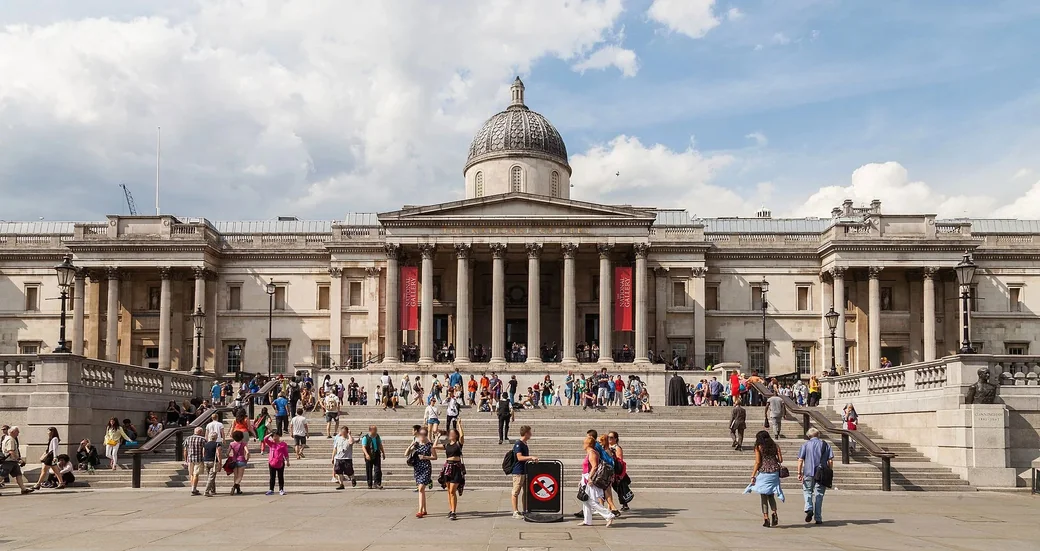
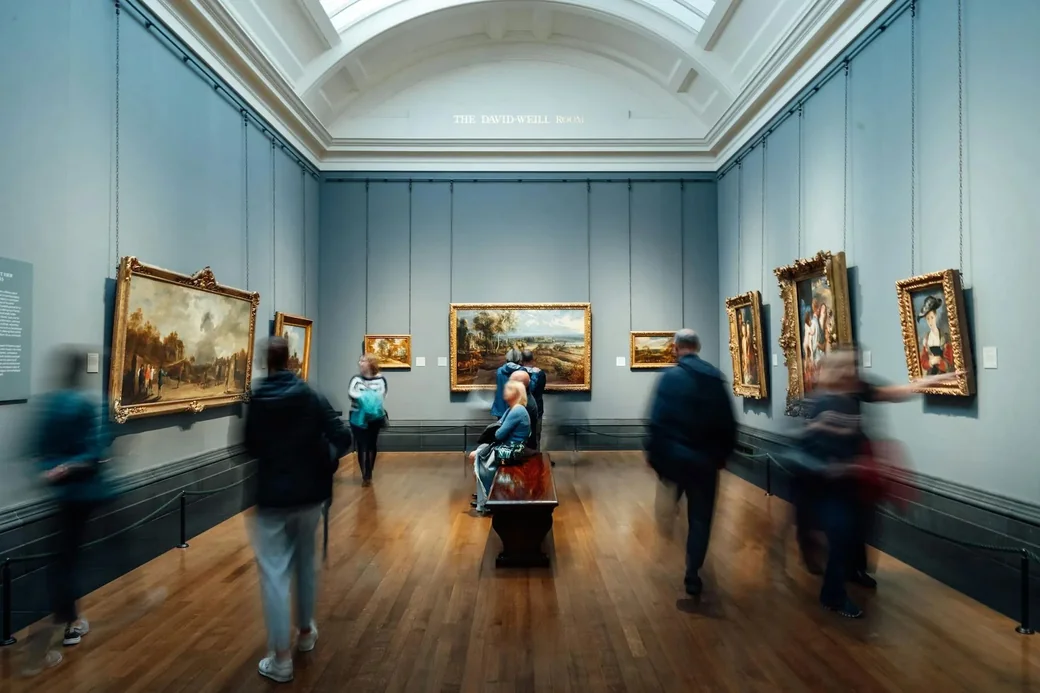
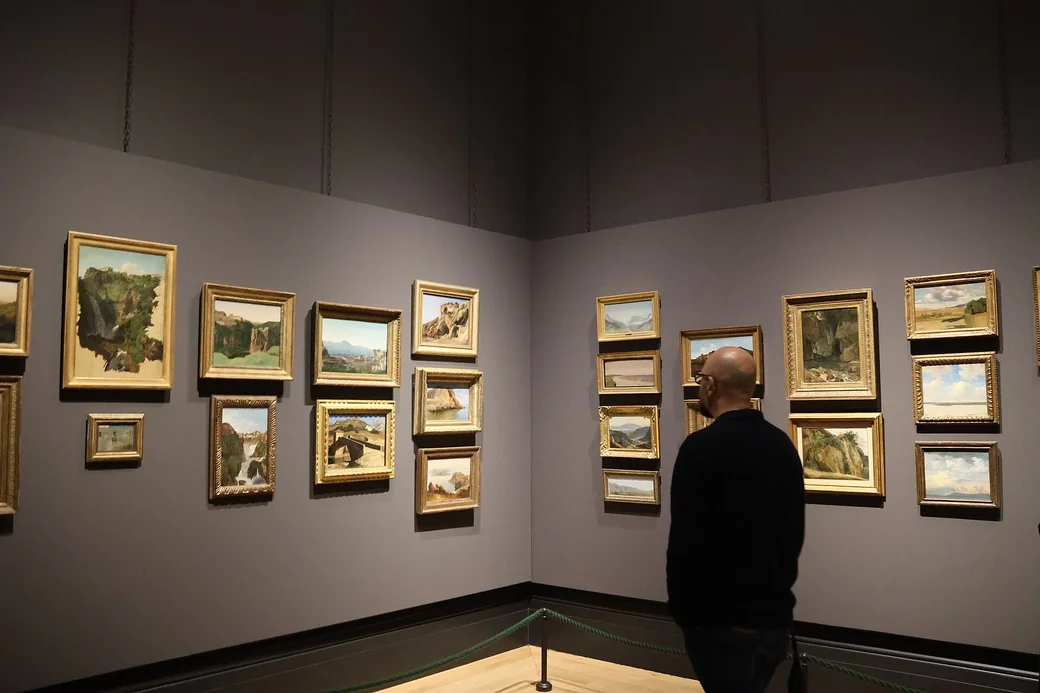
The National Gallery is the United Kingdom's national museum of Western European painting, set on the north side of Trafalgar Square in the heart of London. Its collection traces the story of European art from the thirteenth century to around 1900, so masterpieces by many of the best-known names in art history hang within a few rooms of each other. Housed in a stately building overlooking one of the city's busiest squares, it is a natural first stop for anyone curious about European art.
The National Gallery: Location, accommodation options and contact
Trafalgar Square, London WC2N 5DN, United Kingdom
The place's location on the map and nearby accommodation and hotel options are shown by Stay22. Cookies are used. Your consent is remembered on every page; you can turn it off at any time in the cookie settings.
Free entry explained: timed tickets, which door to use and what security will not let in
The collection belongs to the nation, and seeing it has cost nothing since the Gallery first opened its doors. You can walk in off the square without a ticket, and nobody will ask you to pay. A free timed ticket booked in advance is still worth having on a busy weekend or in high summer, because it gets you through the door faster and brings useful updates before you arrive. Donations are invited rather than expected. Some temporary exhibitions are ticketed separately; the paintings in the permanent rooms never are.
The Sainsbury Wing, on the corner of the square towards Pall Mall, is the main entrance for everyone, including members and exhibition ticket holders, and it has level access from the pavement. The Getty entrance serves people holding paid exhibition tickets, and the learning centre on Orange Street at the back is for school groups and event guests. Every door has a walk-through metal detector and bags are inspected, so the less you carry the faster you are inside. Wheeled luggage and suitcases are refused outright, even cabin size, which catches out travellers arriving straight from a station.
The quietest hours and the Friday late opening
The Gallery opens mid-morning and closes in the early evening, with one late night a week on Friday when the rooms stay open several hours longer. That Friday evening is the connoisseur's slot: the school groups have gone, the light in the staircase hall turns warm, and you can stand alone in front of a famous picture for minutes at a time. The first hour after opening on a weekday runs it close. Weekend afternoons and the middle of summer are the busiest, and the Gallery closes for a handful of days around Christmas and on New Year's Day. Several million people come through the doors each year, which is why the hour you choose makes such a difference.
A collection that began with thirty-eight paintings
In 1824 the government bought thirty-eight pictures from the estate of a London banker and opened them to the public in his former town house. That was the whole museum. The very first work in the inventory, a vast altarpiece of the raising of Lazarus for which Michelangelo supplied drawings to the painter, still carries the catalogue number one and still hangs in the building. The year before, the painter and collector Sir George Beaumont had offered his own pictures to the nation on condition that the banker's collection be bought and a proper home be found; his gift followed in 1826. The idea that pictures could belong to everybody, rather than to a court, is the thread that runs through everything here. That banker was John Julius Angerstein. The collection has grown in the same spirit ever since: roughly two thirds of its paintings arrived as gifts and bequests from private owners.
The Wilkins building: the criticism it could not shake, and why the Gallery never left the square
The building that faces the square opened in 1838 on the site of the old royal stables, designed by William Wilkins. It was criticised for the perceived weaknesses of its design and, above all, for its lack of space. For about thirty years the eastern half housed the Royal Academy, so painters trained under the same roof as the old masters. Grand top-lit galleries were added behind the facade in the 1870s, and the building today carries the highest level of heritage protection. The shortage of space it was built with eventually led to a separate gallery for British art being founded elsewhere in the city.
The site was not chosen for the view. When the first home on Pall Mall proved cramped, the search was for a spot that people from every part of the city could reach, the poorer districts on foot and the wealthier ones by carriage, and the old royal stables beside what was becoming Trafalgar Square sat almost exactly in the middle. A generation later there were serious proposals to move the collection out to a cleaner, roomier suburb. The argument that won was not about air or space but about access: taking the pictures further away would quietly shut out the people they belonged to. The Gallery stayed, and still opens straight onto one of the busiest public spaces in the country.
The Sainsbury Wing, an architectural quarrel and a hidden note
The wing you now enter through has an argumentative past. In the 1980s a competition-winning modern extension was publicly condemned in a speech as a monstrous carbuncle on the face of a much-loved and elegant friend, the design was refused permission, and the project collapsed. Three brothers of a grocery family then offered to pay for a new wing, and a second competition produced the postmodern building that opened in 1991. It is now listed in the highest heritage grade. During a recent remodelling, workers found a typed note hidden inside one of its false columns, left by a donor who had thought that column a mistake all along. A raised walkway, nicknamed by its architects after a famous Venetian bridge, links the wing to the older building, and the recent work also opened a new public space on the corner facing the square.
Look down: the mosaic floor with famous faces
One of the finest works here is not on a wall at all. Between the late 1920s and the early 1950s a mosaicist laid marble pavements in the old entrance hall and on the landing above it, showing the muses and a set of modern virtues. Instead of idealised figures he used people he knew and admired. A film star appears as the muse of tragedy, a novelist as the muse of history with pen in hand, a wartime prime minister as defiance, a ballerina as delight and a philosopher as lucidity. Thousands of visitors walk over them every day without noticing.
How the rooms are arranged and how to plan a route
The hang runs roughly in time order. The Sainsbury Wing holds the earliest work, gold-ground panels and the Italian and Northern Renaissance; the older building picks up the sixteenth century and carries on to the end of the nineteenth, with some rooms given over to a single painter. A sensible plan is to start upstairs in the Sainsbury Wing, follow the centuries through the linking bridge into the main galleries, and finish with the Impressionists before descending. Free introductory tours and a free app that lets you scan any picture are on offer, and a paid audio guide is available in several languages, including sign-language and audio-described versions. Always check the website on the day, because loans and building work move paintings about.
Early masterpieces: mirrors, mathematics and gold ground
In the early rooms a Flemish double portrait of 1434 stops almost everyone. Look past the couple to the convex mirror on the back wall: it reflects their backs and two more figures in the doorway, and above it the painter wrote in Latin that he was here, like a signature scratched on a wall. Nearby hang a small portable diptych made for an English king, a baptism built on pure geometry by the first painter to write a treatise on perspective, a chaotic cavalry battle in which the lances fall into perspective lines, and a reclining god of war disarmed by love, with a nest of wasps tucked into one corner.
Skulls, candlelight and mirrors: the age of the old masters
Further on, the sixteenth and seventeenth centuries fill room after room. A double portrait of two ambassadors hides a stretched skull across the floor that only resolves into shape when you stand to one side, which is why visitors here are forever crouching. A supper scene lit like a stage shows the moment two travellers recognise a guest they thought dead. A goddess lies with her back to us and her face returned by a mirror held by a winged child. A painter in his thirties looks out in fur and velvet, dressed as a gentleman of a century earlier, and a woman at a keyboard holds the viewer's gaze without blinking.
Steam, haystacks and sunlight: the last rooms
The final stretch belongs to British painting and to France. A veteran warship is towed up the river at sunset by a small black tug, a picture often voted the nation's favourite. A cart stands in the shallow water of a Suffolk millpond in a landscape that startled Paris when it was shown there. A life-size chestnut stallion rears against bare pale ground with no rider, no saddle and no landscape at all. Then come the bathers on a riverbank near Paris, built up from tiny strokes of pure colour, a pond of water lilies, and the sunflowers whose yellow changed what paint could be asked to do.
Legends, rumours and the Gallery's only theft
Rumour has it that the great horse portrait was left bare because the animal, seeing the almost finished canvas propped against a stable wall, took it for a rival and attacked, whereupon the owner told the painter to stop. Another story claims a king was meant to sit in the saddle and vanished when politics soured. The Gallery treats both as tales rather than fact, and the neat shadows under the hooves suggest the picture was finished as intended. Separately, in the 1960s a retired driver walked out with a small portrait of a duke and returned it four years later; a court found him guilty only of taking the frame. The disappearance gripped the public so completely that the missing portrait was given a joking cameo in a spy film of the period, propped up in the villain's hideout.
A slate mine, deflated tyres and lunchtime concerts
During the Second World War the collection was moved for safety into a slate mine in the Welsh mountains. The single-track road had to be widened and tunnel mouths raised; for one enormous equestrian portrait the lorry's tyres had to be deflated to creep under a low railway arch. The empty building did not close. A pianist organised daily lunchtime recitals that ran for years and drew hundreds of thousands of listeners, and from 1942 a single painting was brought back each month so that Londoners had something to look at. That picture of the month has been kept up ever since. The decision not to send the pictures overseas came from the prime minister himself, who insisted they be hidden in caves or cellars at home rather than leave the islands at all.
Access, comfort and where to sit down
Every entrance is level, lifts reach all floors, and accessible and Changing Places toilets are provided near the doors. Manual wheelchairs and a rollator can be reserved by telephone, with a few kept at the desks for whoever arrives first. Folding stools are handed out freely around the building and you may bring your own. Hearing loops sit at the information desks, large-print labels hang beneath the room signage, and talks are offered with sign language interpretation and live captioning. Water points are easy to find, service and assistance animals are welcome with water bowls at the desks, and the cafés run from a quick espresso to a full meal. For a proper break there is an espresso bar with Italian coffee and cream-filled buns in the new wing's foyer, an osteria upstairs looking over the square, a brasserie and a counter-service kitchen on the lower floor, and a second espresso bar by the Getty exit. The shops sell prints, books, cards and small gifts, and what you spend goes back into the collection. You may carry your own food into the building, but space to eat it is limited and it cannot be eaten in the cafés.
What to do, what to avoid, and what is next door
Do bring a pencil and sketch; it is encouraged, while pens and paint are not. Do photograph for yourself unless a sign says otherwise, and do take the free tour if the timing suits. Avoid trying to see everything, avoid the busiest afternoons if you can, and avoid building a whole trip around one painting without checking it is on the wall. Outside, the square itself rewards ten minutes, with the column, the lions and the changing sculpture on the empty plinth. A portrait collection and a parish church with a crypt café stand within a minute's walk, and Covent Garden, Leicester Square and the government quarter are all close enough to continue on foot.
Women painters on these walls
Some of the steadiest gazes in the building belong to pictures painted by women, and the Gallery has been working to give them better walls and better light. One of the great painters of the seventeenth century shows herself in the guise of a saint, resting a hand on the spiked wheel of her martyrdom and meeting your eye without a flicker. A Dutch flower specialist assembles a bouquet of blooms from different seasons that could never have stood together in one vase. An eighteenth-century portraitist paints herself in a straw hat with her palette, borrowing the pose from an older master she admired. A nineteenth-century animal painter fills a huge canvas with the heave and muscle of horses at market. The free tours and the audio routes often pick several of them out, and the website lets you plan a visit around them before you arrive.
The National Gallery: Visitor Tips
Give yourself two to three hours and accept that you will not see everything. Pick five or six paintings in advance, find their current rooms on the Gallery website the morning of your visit, and let the rest be a pleasant accident. Travel light: large bags and wheeled luggage are turned away. For photographs, the top of the Sainsbury Wing staircase and the portico steps looking south over Trafalgar Square are the two reliable spots, and the light on the steps is best in the last hour before closing.
The National Gallery: Best Time to Visit
Weekday mornings right after opening, or the Friday late opening; winter weekdays are the calmest of all.
The National Gallery: Admission Fees
Free admission
The permanent collection of Western European paintings from the 13th to the early 20th century is free to visit; a free timed ticket is recommended and some temporary exhibitions are ticketed.
Free
Quick Info
2h 30m
easy
The National Gallery: Getting There
The Gallery sits at the top of Trafalgar Square, so almost any route into the centre of London ends within a few minutes' walk. The nearest Underground station is Charing Cross on the Bakerloo and Northern lines, with the mainline rail terminus directly above it; Leicester Square on the Northern and Piccadilly lines and Embankment on the Bakerloo, Circle, District and Northern lines are both an easy stroll, and Piccadilly Circus is barely further. Many bus routes circle Trafalgar Square and stop on the Strand, Whitehall and Charing Cross Road, among them routes 3, 6, 9, 11, 12, 13, 15, 23, 24, 29, 53, 87, 88, 91, 139, 159, 176 and 453. Walking is often the pleasantest approach: from the South Bank, cross the Hungerford footbridge and the portico appears straight ahead. Driving is the weakest option, since the area falls inside the city's congestion and emission charging zones.
Nearby stops & parking
The closest bus stops are St Martin's Place (stop K), the Trafalgar Square and Charing Cross Station stops (C, D and G) and Leicester Square Station (stop L). Charing Cross rail station, about two hundred metres away, is the nearest station with step-free access, and the nearest step-free Underground stations are Tottenham Court Road and Westminster. There is one designated Blue Badge parking bay on Orange Street behind the building, which must be reserved by telephone well in advance, plus further bays on St Martin's Street; the space on Orange Street is not owned by the Gallery, so it cannot be held for you. Public car parks operate under Leicester Square and Trafalgar Square. Cycle stands stand on Orange Street, St Martin's Street, St Martin's Place and Duncannon Street, with public hire docks nearby on Pall Mall East and William IV Street.
The National Gallery: Dress Code & Etiquette
There is no dress code: come as you are. What matters is gallery etiquette. Keep a hand's distance from the canvases and never touch a frame or a surface, speak quietly, and switch your phone to silent. Leave large bags, wheeled luggage and umbrellas at the cloakroom, carry rucksacks in front of you or at your side, and keep food and drink out of the picture rooms. Sketching in pencil is welcome; pens, ink and paint are not. Move along if a crowd forms at a popular painting, and let people in wheelchairs reach the front.