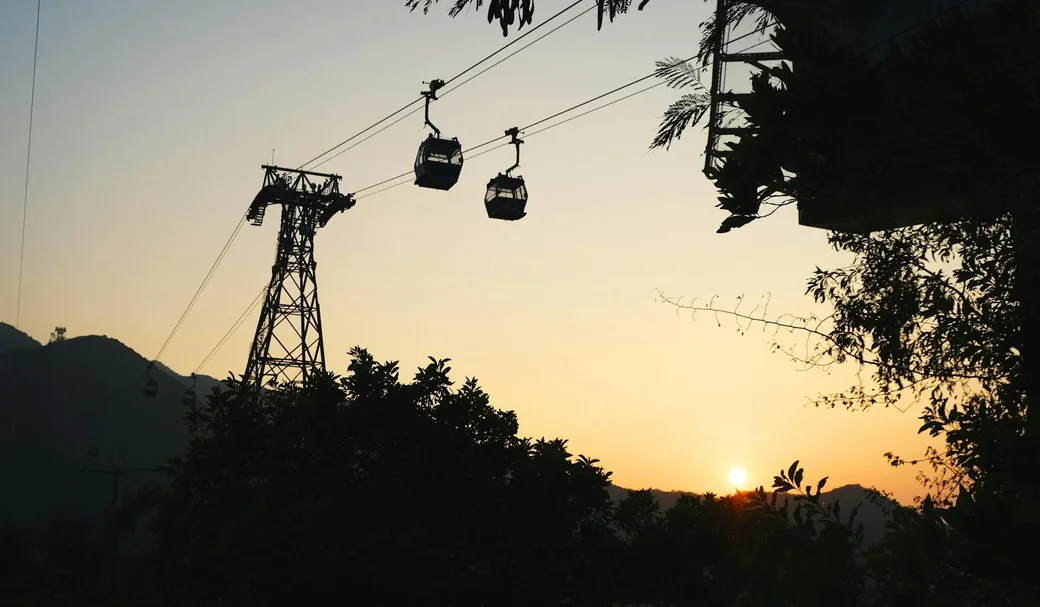
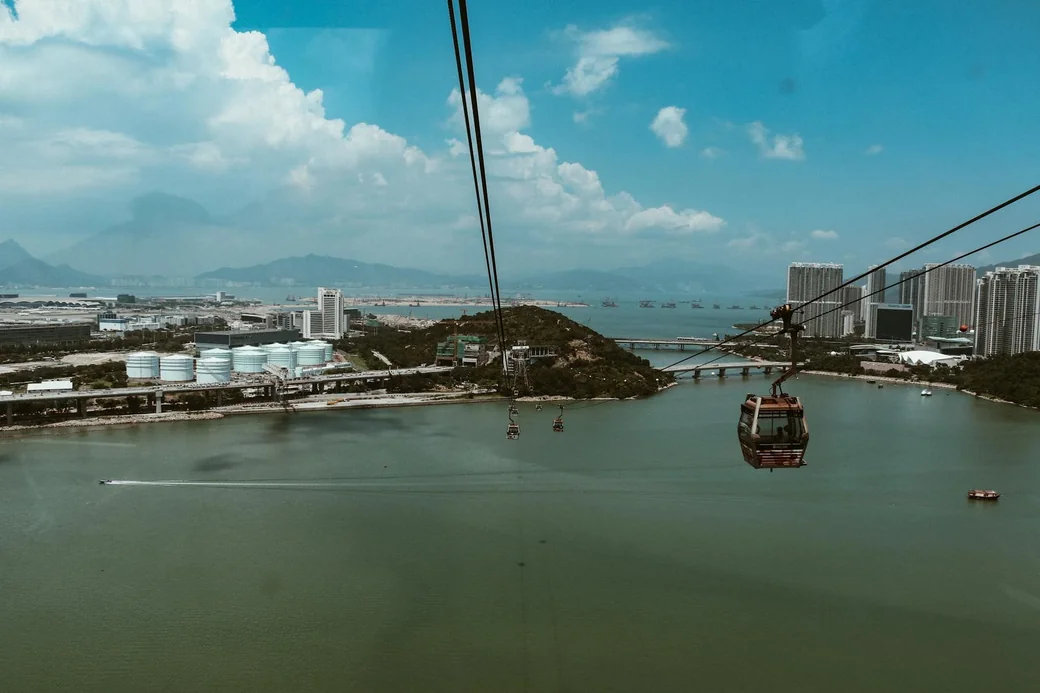
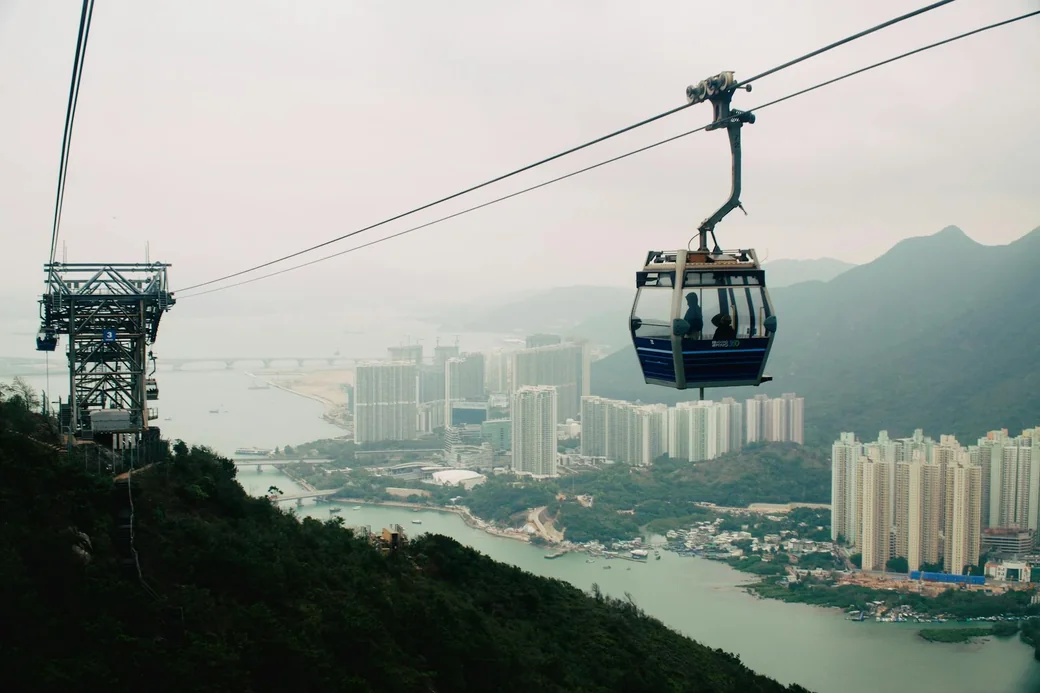
Ngong Ping 360 is a cable car on Lantau Island in Hong Kong, linking the new town of Tung Chung, close to the international airport, with the Ngong Ping plateau high in the mountains. Its gondolas glide over open sea, green ridges and protected countryside, with wide views of the coast and the surrounding peaks. The ride is both an attraction in its own right and the most scenic way to reach the Big Buddha and Po Lin Monastery, which makes it a highlight of almost any day spent on Lantau.
Ngong Ping 360 Cable Car: Location, accommodation options and contact
Tung Chung Cable Car Terminal, 11 Tat Tung Road, Tung Chung, Lantau Island, Hong Kong
The place's location on the map and nearby accommodation and hotel options are shown by Stay22. Cookies are used. Your consent is remembered on every page; you can turn it off at any time in the cookie settings.
The line covers 5.7 kilometres in roughly 25 minutes and the view changes completely three times. First the shallows and wetlands of Tung Chung Bay slide past below. Then, after a sixty-degree turn at the airport-island angle station, comes the long open crossing: runways on one side, the distant line of the Hong Kong–Zhuhai–Macau Bridge on the other. Finally the cabin climbs over the ridges of Lantau North Country Park, and the Big Buddha appears on the far hillside.
On the opening stretch the cabin passes directly over seagrass beds and the Shan Tau wetlands. On the final climb it crests the mountain at the highest point of the line before dropping gently towards Ngong Ping.
Standard, Crystal or Crystal+: Choosing a Cabin
Three cabin types share the same cable. The Standard Cabin is fully enclosed with large windows and takes the most passengers. The Crystal Cabin adds a glass floor running the full width of the car and is limited to ten people. The Crystal+ goes further: sides and floor are all transparent tempered glass, and solar panels on the roof power the lighting and announcements. Each type has its own queue, so the line that looks shortest is not always the one your ticket is for.
Each cabin type also has its own ticket, so choose before you buy.
How to Beat the Queue at Tung Chung
Weekends and holidays regularly produce an hour or more of waiting, even for people who booked ahead. The reliable fix is to be at the terminal before opening on a weekday. The electronic queue system shortens time at the ticket counter, and a one-way ticket up with bus 23 back removes the second queue entirely. Buy only from the official website, the ticket offices or authorised sellers; tickets from other channels are refused at the gate.
Weather, Cloud and the Backup Plan
The plateau makes its own weather. From roughly October to March the air is clearest; in the warm months cloud often sits on the ridge, and strong wind can suspend the ride altogether. None of that strands you: bus 23 leaves from the terminus across the road and climbs the mountain road to Ngong Ping whatever the cable car is doing. If the summit is in cloud when you reach Tung Chung, an hour's wait often clears it, especially in autumn.
Eight Towers, Two Turns: How the Line Was Built
Eight towers carry the line, and two angle stations turn it — sixty degrees above the airport island, twenty degrees on the shoulder of Nei Lak Shan. Between them runs the longest span, about 1.5 kilometres over open water, and the cable reaches its highest point at roughly 585 metres above sea level. Because so few towers were permitted, each one carries an enormous load; the largest was designed for more than 210 tonnes on each side.
The system is a bi-cable gondola: at both angle stations the cabins change direction without ever stopping.
Built by Mule and Helicopter
Five of the eight towers stand inside a country park, so no access road was cut for them. Instead more than 12,000 tonnes of material went up by helicopter and by mule — among the first times either method had been used on a Hong Kong construction site. The towers were given recessive colours to blend into the slope, walkways were raised on boards to protect the ground, and woodland was replanted near the upper angle station.
The Names Along the Route and the Stories Behind Them
The mountain the cable turns around is Nei Lak Shan, a name translating the Buddhist figure Maitreya, the Buddha yet to come, which is why it is sometimes read simply as Buddha Mountain. The island's own name, according to local lore, comes from an old expression meaning broken head, said to describe how the main peak looks split in two from a distance. That peak also carries the name Phoenix Mountain, and the story goes that its twin summits were read as the wings of a male and a female phoenix.
Ngong Ping Village: What Waits at the Top Station
The upper terminal opens straight onto a planned village of shops, tea houses and cultural attractions, built as the gateway to the plateau rather than as a historic settlement. Beyond the shopfronts the real highlights are out in the open: the Bodhi tree, the blessing drums, the stupa (a Buddhist monument housing relics) square, and above all the straight avenue towards the Big Buddha, lined with statues bearing offerings. It is the single best composition on the plateau, and it is only a short walk away.
The Big Buddha and Its 268 Steps
The bronze figure was completed on 29 December 1993, a date chosen because it is reckoned as the day of the Buddha's enlightenment. Its base echoes the Temple of Heaven in Beijing, which gives the statue its formal name, while the face follows a Buddha of the Longmen Caves and the robes a figure from Dunhuang. Six smaller statues around the platform present offerings. It is said that, unlike the other great seated Buddhas of China, this one was set facing north.
Po Lin Monastery, from Thatched Hut to Landmark
Three monks from Jiangsu settled on this plateau in 1906 and built little more than a thatched hut, which is what the place was first called; the present name came in 1924. Over a century later it is a working monastery with a famous vegetarian restaurant, where monks and visitors share the same courtyards. Walk in quietly, let worshippers pass, and remember that the incense, the bells and the chanting belong to a daily routine rather than a performance.
Wisdom Path: The Quietest Fifteen Minutes on the Plateau
About fifteen minutes on foot beyond the Buddha, thirty-eight tall wooden columns stand on the hillside in a looping figure-of-eight, each carrying verses of the Heart Sutra in calligraphy. Most day-trippers never make the walk, so the path is usually close to empty even when the steps behind you are not. On a day with low cloud the columns drift in and out of the mist, which is when photographers find it at its best.
Rules on Board: Water Only, No Pets, Size Limits
Inside the cabin only water may be drunk, and smoking is banned both on board and at the terminals. Children under twelve must travel with someone aged fifteen or over. Pets are not carried, with the exception of guide dogs and internationally recognised therapy dogs. Luggage above a modest size and weight cannot come on board, which matters if you are arriving straight from the airport; a left-luggage counter operates at both ends, with no booking needed.
Step-Free Boarding and What Is and Is Not Accessible
Boarding platforms are built level with the cabin floor and the bench seats lift up to clear space, so a wheelchair rolls straight in; staff slow the cabins and help at both ends. Lifts, accessible toilets and a small number of reserved parking bays are provided, and strollers come aboard as they are. The limit is the Buddha itself: reaching the statue's platform means climbing 268 steps, so plan the village, the monastery grounds and the avenue instead.
Beyond the Buddha: Tai O, the Trail and Lantau Peak
A bus from the Ngong Ping terminus reaches Tai O, a fishing village of stilt houses on the western shore where small boats run out into the channel and sometimes meet the Chinese white dolphins. Hikers have two options from the same plateau: the maintenance trail that shadows the cable line back down to Tung Chung, a long half-day on foot, or the climb up Lantau Peak, which is where people go for sunrise.
Most visitors treat Ngong Ping as a half-day outing: cable car up, the Buddha and the monastery, lunch, then the cable car or the bus back down. Add the Wisdom Path, an unhurried meal and a detour to Tai O, and it easily becomes a full day on Lantau.
Cattle on the Path: Sharing the Plateau with Lantau's Herds
Herds of free-roaming cattle and water buffalo have lived on Lantau for generations and wander through Ngong Ping as a matter of course; signs at the terminal ask visitors not to feed them. Keep a good distance, roughly ten metres, give extra room to any animal with a calf, and never put food in an outstretched hand. They are calm animals in a working landscape, and the easiest way to enjoy them is from a few steps back with the camera.
Who Designed It, and What the Design Had to Protect
The idea goes back a long way. Studies of northern Lantau in 1992 and of visitor demand in 1995 both pointed to the same gap: the plateau had no decent access. The government announced the project in 1998 as a tourism initiative, and in 2002 the MTR Corporation secured the right to build and run it. Architecture came from Aedas, civil and electrical-mechanical engineering from ARUP, the building works from Maeda and the ropeway system itself from Leitner.
What shaped the design more than anything was where the line had to go. The route crosses Tung Chung Bay above the Shan Tau wetlands, an area recognised as a Site of Special Scientific Interest, and then runs through a country park. So the brief ran in two directions at once: move up to several thousand passengers per hour, at an operating speed of around six metres per second, while leaving as little trace as possible. Motor and system noise was brought within the requirements of the territory's building-environment assessment standard, and exterior lighting was held to levels that limit light spill over the hillside at night. The approach was recognised with environmental awards from a Hong Kong environmental association and from the territory's Environmental Protection Department. The operator describes the result as the longest bi-cable ropeway in Asia, and the ride has been named in international round-ups of the world's finest cable cars.
The cable car opened to the public on 18 September 2006.
Names, Paths and Forts: Details Most Visitors Walk Past
A few things on and around the plateau repay a second look. The verses on the columns of the Wisdom Path were set down in the hand of Jao Tsung-i, one of the most respected calligraphers and scholars of the region, which is part of why the installation is treated with such care. The monastery below was founded by three monks whose names are still recorded there — Da Yue, Dun Xiu and Yue Ming — who arrived from Jiangsu and built a thatched hut on an empty plateau.
The maintenance trail that shadows the cable line has its own landmark: a steep flight built by the cable car company that walkers know as the stairway to the sky, which tops out near the upper angle station. If you would rather stay low, the Ngong Ping Nature Centre, housed in a former village school, explains the ecology of the surrounding country park.
Down at the other end, Tung Chung has more than a shopping mall. A small stone fort with old cannon stands a short ride from the station, and the Tung O Ancient Trail — the flat coastal route villagers once used between Tung Chung and Tai O — begins nearby, passing under the cable line with the bay opening on both sides.
Ngong Ping 360 Cable Car: Visitor Tips
Buy tickets only through the official website, the ticket offices or authorised sellers — tickets from unauthorised channels are not accepted at the gate. Arrive before opening on a weekday if you can; queues of an hour or more are normal at weekends even with a booking, and the Crystal and Crystal+ lines move separately from the Standard one. Check the weather before you set out: the plateau is often under cloud in summer, and strong wind can suspend the ride, in which case bus 23 from the terminus opposite still gets you up. If cloud is sitting low when you reach Tung Chung, a coffee and an hour's wait often pays off. Take the ride up and the bus down (or the reverse) to see the mountain road as well. Remember that a return ticket does not let you stay in the cabin — you alight at the top and join the queue again later. Large luggage is not allowed on board, but there is a left-luggage counter at both ends.
Ngong Ping 360 Cable Car: Best Time to Visit
October to March for the clearest air; weekday mornings right at opening. Late afternoon light is best for photos, but leave time for the last cabin down.
Quick Info
4h
easy
Ngong Ping 360 Cable Car: Getting There
By MTR: take the Tung Chung line to its terminus, Tung Chung station, and leave by Exit B. The Tung Chung Cable Car Terminal is adjacent to the station, about a five-minute walk along signposted paths. From Hong Kong station the journey takes roughly half an hour.
From the airport: there is no direct service to Ngong Ping. Bus S1 (about fifteen minutes) or the less frequent S56 runs from the terminals to Tung Chung, from where you walk to the cable car.
By bus: frequent routes reach Tung Chung from across the territory, including E11 and E11A from Hong Kong Island, E21, E22, E23 and N21 from Kowloon, and E31, E32, E33, E36, E37, E41 and E42 from the New Territories. On Sundays and public holidays route 1R runs directly from Hung Hom to Ngong Ping.
By road: from the Kowloon side follow Route 3 and Route 8 across the Lantau Link, leave at Exit 6C towards Tung Chung (N) and turn into Tat Tung Road. The drive from the central districts takes about half an hour outside peak times.
Without the cable car: New Lantao Bus route 23 climbs from Tung Chung to Ngong Ping in roughly 45–50 minutes on a winding mountain road, and runs when the cable car is suspended.
Nearby stops & parking
Nearest station: Tung Chung (MTR Tung Chung line), Exit B, roughly 200 metres from the cable car terminal. Nearest bus stops: the Tung Chung Tat Tung Road Bus Terminus sits across the road and is where New Lantao Bus route 23 to Ngong Ping departs; the covered Tung Chung Station Bus Terminus beside Citygate Outlets serves the city routes, and the Shun Tung Road stops are a ten- to fifteen-minute walk away. Taxis: a Lantau (blue) taxi rank is at Exit D of the MTR station, and blue taxis also wait outside the upper terminal at Ngong Ping. Parking: car parks operate near the Tung Chung terminal, the closest being Citygate Outlets and Wilson Parking at Fu Tung Estate; a small number of accessible bays for disabled visitors is available at the terminal itself on a first-come basis.
Ngong Ping 360 Cable Car: Dress Code & Etiquette
There is no dress code for the cable car itself, but the plateau sits high above the city and is noticeably cooler and windier than Tung Chung, so bring a light layer even in summer and shoes you can climb 268 steps in. Po Lin Monastery and the Big Buddha are an active place of worship: cover shoulders and knees, keep your voice down inside the halls, and do not photograph people at prayer. Step aside for anyone making offerings, and follow the one-way flow marked on the Buddha staircase. Inside the cabins only water may be consumed and smoking is not permitted at the terminals or on board.