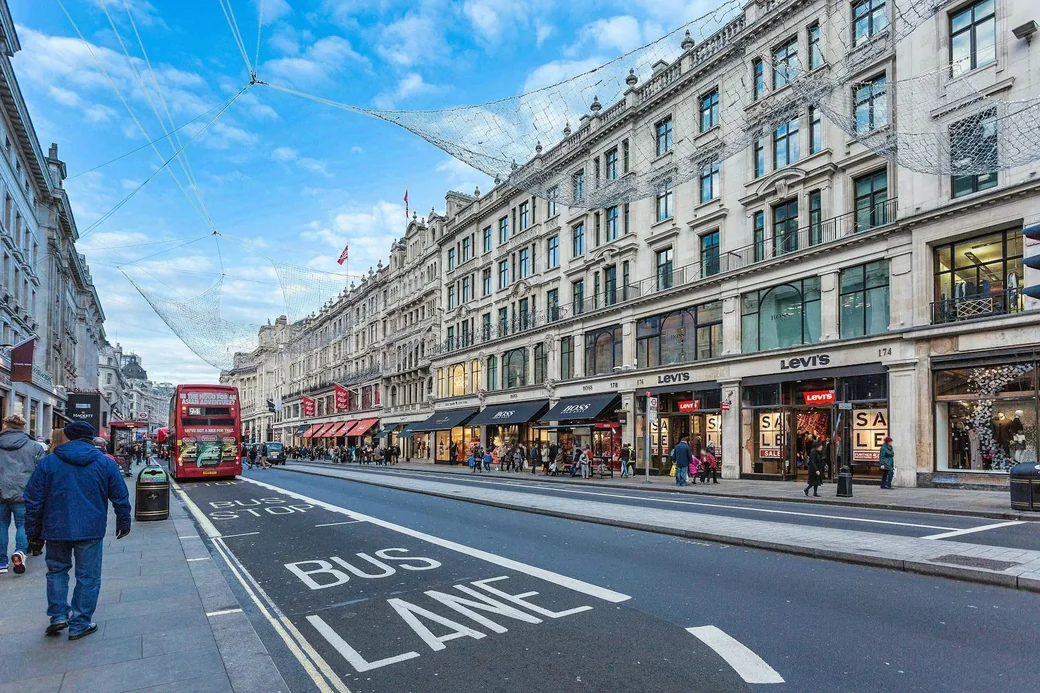
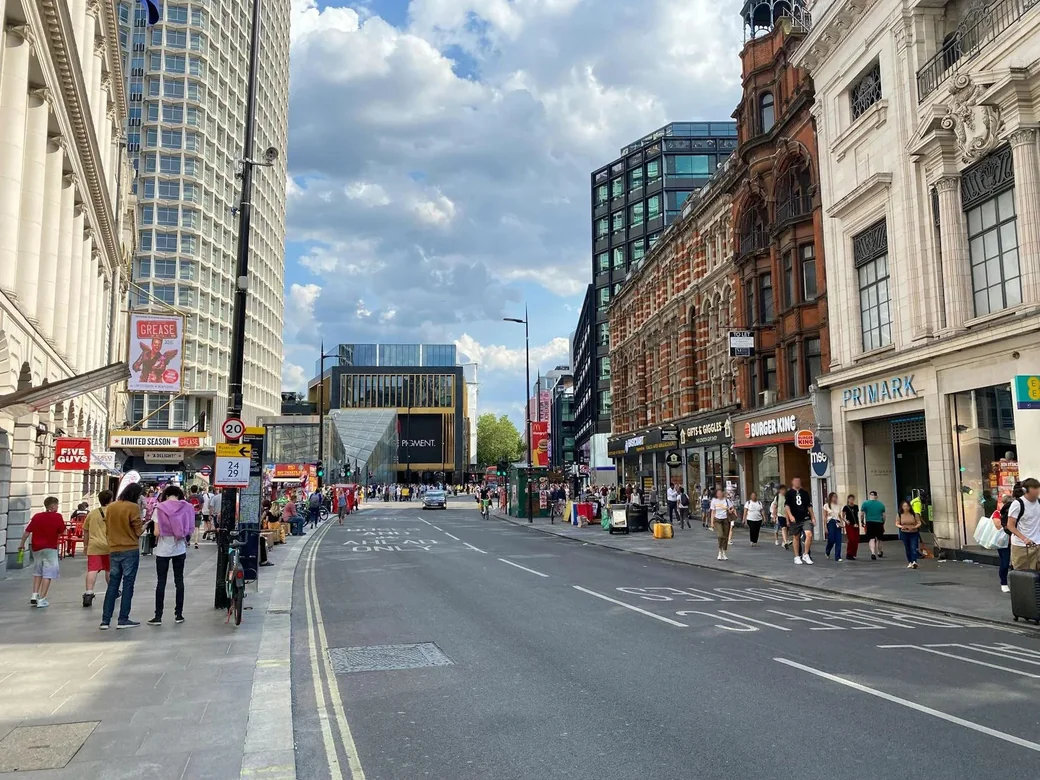
Oxford Street is London's best-known shopping street, a long, straight avenue that runs across the West End in the very centre of the city. Both pavements are lined with grand department stores, international flagship shops and high-street fashion, and the street draws shoppers and window-browsers from all over the world. For many visitors it is the classic place to shop in London and to feel the pace of the capital.
Oxford Street: Location, accommodation options and contact
Oxford Street, City of Westminster, London W1, United Kingdom
The place's location on the map and nearby accommodation and hotel options are shown by Stay22. Cookies are used. Your consent is remembered on every page; you can turn it off at any time in the cookie settings.
From a Roman Road to Europe's Busiest Shopping Street
The pavement you walk on follows a Roman route that once linked the Silchester area with Colchester by way of London, which is why the street runs so straight for almost two kilometres. Through the Middle Ages it was Tyburn Road, named after a brook that now flows out of sight beneath the city. Shops multiplied from the 1770s, the great stores arrived between the 1870s and the 1930s, and the Underground opened directly below the road in 1900, bringing customers into the West End without a change. Everything that feels modern here sits on a very old line. Today it is usually described as the busiest shopping street in Europe: several hundred shops line its pavements, and hundreds of thousands of people pass along it on a typical day.
Old Names and the Sayings That Are Said to Come From Here
Before the name settled in around 1729, the road answered to several: Tyburn Road, Uxbridge Road, Worcester Road and Oxford Road, the last of which stuck once the fields around it passed to the Earl of Oxford. Legend has it that travellers leaving the city westwards along this road paused at roadside inns for a final drink, and that the phrase "one for the road" grew out of those halts; the old expression "going west" is likewise said to have come from journeys along it. Language historians treat both as folk explanations rather than settled etymologies, but Londoners still enjoy telling them.
Selfridges, the Store That Changed How London Shopped
Selfridges opened at the western end in 1909 and turned shopping into an outing rather than an errand. Goods were laid out to be handled, windows were lit after closing time and the building itself, raised in stages on an American steel frame, carried the largest shop front in London when it was finished. In the 1920s and 1930s the roof held terraced gardens, cafes, a miniature golf course and a women's shooting club. Its founder, nicknamed the Earl of Oxford Street, is one of two retailers credited with the saying that the customer is always right.
Television's First Public Audience Sat in a Shop Here
In the spring of 1925 a Scottish engineer set up his apparatus inside Selfridges and, over three weeks, showed passers-by moving silhouettes transmitted from one machine to another: the first public demonstration of television technology. The same store had earlier pulled crowds by exhibiting the aeroplane that had just crossed the Channel, and its founder kept a club room for journalists complete with telephones and typewriters. Shopping, spectacle and publicity were deliberately mixed here long before anyone called it experiential retail.
Look Up: The Listed Facades Most Shoppers Walk Straight Past
Shop fronts change every few years; the upper storeys rarely do. The Marks & Spencer at No. 173 stands on the site of the Pantheon, an eighteenth-century assembly room, and still carries that name on its listed (officially heritage-protected) facade. Nos. 164-182 were built for Waring & Gillow, the first West End store to fill an entire city block, while Nos. 156-162, raised for Mappin & Webb, were an early steel-framed building. Selfridges at No. 400 holds the highest listing grade on the street, alongside the Flying Horse pub at No. 6. At Oxford Circus the four matching quadrants came from a single design by Henry Tanner, and the junction belongs to John Nash's Regent Street plan; the Centre Point tower closes the eastern end.
Two Ends, Two Moods: Where to Start Depending on What You Want
The western half, nearer Mayfair, belongs to the department stores: Selfridges at No. 400, with a cinema and cafes inside, and John Lewis trading across all of its floors with a cookery school upstairs. The eastern half, rebuilt around the newer station halls, leans towards value fashion, souvenirs and quick food and feels younger and louder; Primark anchors both ends. Halfway along, the listed former Topshop building at No. 214 now holds a large IKEA store, and the music shop at No. 363 still trades under the HMV name. Shoppers with a list usually start west; browsers and families more often start east.
One Surviving Pub and a Music Club in a Basement
The street once had around twenty pubs; one survives, the Flying Horse at No. 6, listed at Grade II* (a high level of UK heritage protection) and known for more than a century as The Tottenham. Its Victorian interior keeps painted panels by the music-hall decorator Felix de Jong, and a plaque downstairs recalls the old St Giles rookery (a historic district of crowded, poor housing) cleared when New Oxford Street was cut through. A few doors away, the 100 Club has run live music in the basement of No. 100 since 1942, from Glenn Miller and Louis Armstrong to The Who, and it hosted Britain's first punk festival in 1976. At No. 363, the HMV shop opened by Edward Elgar in 1921 is where the Beatles' manager Brian Epstein had the band's audition tapes cut onto disc in 1962, a step that led them to their first record deal.
The Legends: A Lost Street Below and a Tunnel That Was Never Dug
Three stories circulate. According to local lore, a complete older street with cobbles and forgotten shopfronts survives beneath the pavement and can be reached through certain cellars; nothing of the kind has ever been shown to exist, and it is told as an urban myth. Again according to legend, a secret passage links a great store to the Underground; in reality a subway connection was proposed in 1909 and simply never built. A third tale places a ghost in a disused station just beyond the eastern end, a story that grew out of publicity around a museum exhibit. Enjoy them as stories rather than history.
A Street Being Handed Back to People on Foot
Oxford Street is being handed back to people on foot in stages, so the walking experience here keeps changing. The first phase covers about a kilometre between Orchard Street, beside the largest department store, and Great Portland Street, just east of Oxford Circus. Along that stretch general traffic is removed altogether: buses, taxis, private hire cars, cycles, scooters and cycle taxis are all diverted, while the cross streets stay open to vehicles, so you still look both ways at every junction. Emergency vehicles and mobility scooters keep access. Bus routes move to the parallel streets behind the shops, and the layout began as a temporary scheme of seating, planters and bollards, so details can still change. Check which stops are in use before you travel rather than heading for a familiar one.
Four Stations on One Line, Plus a Quieter Way Out
All four Underground stations on the street share the same east-west line, so you can hop one stop instead of walking the whole length with heavy bags. Bond Street adds two further lines and the middle station adds two more, which makes the street unusually easy to reach from anywhere in the city. The practical trick: the two stations served by the newest line each have a second entrance set back from the main hall, one near a garden square south of the street and one on a Soho side street. Those exits are usually calmer, especially at the end of the day.
Why the Big Shops Keep Short Sunday Hours
English law limits large shops to six continuous trading hours on Sunday within a fixed window between mid-morning and early evening, which is why almost every department store and big flagship here settles on the same short Sunday day. Some open their doors a little earlier for browsing, when you may look but not buy. Monday to Saturday the same shops stay open into the evening, considerably later than most of central London. Public holidays tend to follow the Sunday pattern. Plan serious shopping for a weekday morning and keep Sunday for window displays, cafes and walking.
Five Minutes Away: What to Pair With a Walk Down the Street
Running from Marble Arch in the west to Tottenham Court Road in the east, the street splits the West End in two, with Marylebone and Fitzrovia to the north and Mayfair and Soho to the south. Turn south at Oxford Circus and you are on Regent Street, with Carnaby Street and the cafes of Soho a few minutes further; turn south at Bond Street station instead and New Bond Street leads into Mayfair. North of the street, the lanes of St Christopher's Place open towards Marylebone, where the Wallace Collection holds old-master paintings and armour in a townhouse. At the western end stand Marble Arch, Hyde Park and Speakers' Corner, with the Moco Museum of contemporary art beside them. From the eastern end the British Museum is about fifteen minutes on foot. Use the street as a spine and the half day plans itself.
Do's and Don'ts on the Busiest Pavements in the City
Do keep your phone in a pocket near the kerb; pavement markings warn that snatching from the hand is the common risk here, and bags are best carried on the shop side. Do step aside before stopping, and let people out of a doorway before you go in. Do agree the fare before boarding a cycle taxi and look for its licence; London's pedicabs now need a licence, must keep to maximum fares and may not play externally amplified music. Don't buy from unlicensed sellers or stalls offering designer goods at impossible prices. And don't expect a tax refund on purchases carried home, since visitors cannot reclaim it in store.
Accessibility: Which Stations Have Lifts and Where the Toilets Are
The street itself is flat and the pavements are wide, though bins, signs and crowds get in the way at busy hours. Two of the four Underground stations offer step-free access from street to platform, one of them through a lift entrance on a side street north of the shops; the other two have stairs only, so plan which end you arrive at. There is an accessible public toilet on the pedestrianised side street opposite the largest department store, and the big stores have accessible toilets, baby-change rooms, lifts to every floor and, in some cases, wheelchairs to borrow. Mobility scooters keep access to the traffic-free stretch.
Beating the Crowds and Finding the Best Photo Angles
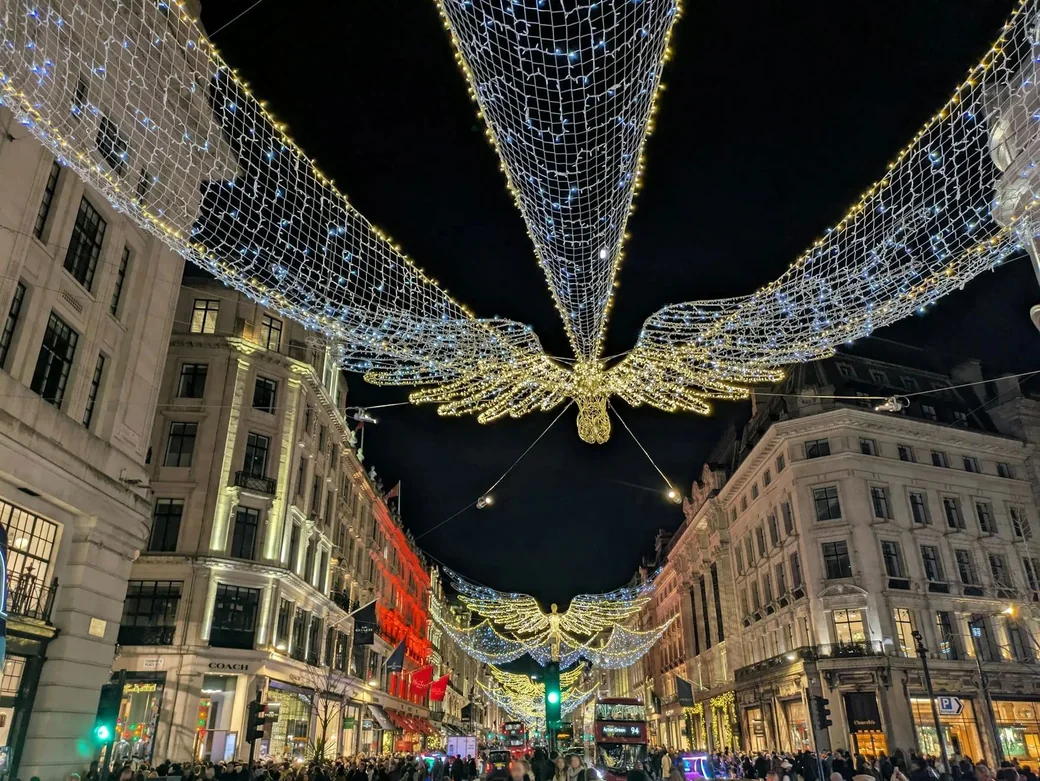
The street stays comparatively calm until late morning, fills at lunchtime and again in the late afternoon, and is busiest on Saturdays and in the weeks before the winter holidays. For photographs, the diagonal crossing at the central junction is the signature image and works best from a corner, waiting for the moment all four sides walk at once. The western end gives you the arch and open sky; side passages south of the street offer quieter frames with flowers and awnings. After dark in winter the overhead decorations photograph well from the middle of the street looking west.
A Street Rebuilt by Every Generation
Little here is original and that is the point. In 1931 new regulations restricted horse-drawn and other slow-moving vehicles on the street, and the first traffic signals went up the same year. During the Second World War the street was bombed and several stores were badly damaged; John Lewis lost its building entirely and a new one was raised between 1958 and 1960, while the basement of Selfridges held a communications link along which the British prime minister could speak securely to the American president. Part of the street closed to traffic from 1963 to 1968 so that Oxford Circus station could be rebuilt for a new line, a 1972 experiment removed private cars, and in 2009 a diagonal crossing modelled on the one at Shibuya in Tokyo doubled the junction's pedestrian capacity. In October 2026 the stretch between Orchard Street and Great Portland Street finally closed to traffic, the latest chapter of a very old argument.
Winter Lights, Monopoly and Other Cultural Footnotes
The winter lights have decorated the street since 1959, went dark for several years in the 1970s and returned in 1978; since the early 1980s a celebrity guest has switched them on each November, and they stay lit into early January. Switch-on night is the most crowded evening of the season. On the British Monopoly board the street shares the green set with Regent Street and Bond Street, grouped because all three are retail. Thomas De Quincey called it a stony-hearted stepmother in his Confessions, and it appears in Dickens as Oxford Road. For almost twenty-five years a man known as the Protein Man walked here with a hand-lettered placard; his boards are now in the London Museum. Above Oxford Circus, AIR Studios recorded from an upper floor between 1970 and 1991, and inside Marble Arch three small rooms served as a police post into the late 1960s.
Oxford Street: Visitor Tips
Start at the eastern end in the morning and walk west, so the crowds build behind you rather than in front. The diagonal crossing at Oxford Circus is the classic photograph; shoot it from a corner rather than the middle of the junction. For calmer views, duck into the side alleys such as St Christopher's Place. Upper floors of the department stores are the quietest places to sit, and their customer toilets are the most reliable along the street. Keep your phone in a pocket rather than in your hand near the kerb, remember that buses now stop on Wigmore Street and Henrietta Place behind the shops, and remember that Sunday hours are short.
Oxford Street: Best Time to Visit
Weekday mornings just after opening; late afternoon and early evening for lit shopfronts and the winter festive lights.
Oxford Street: Admission Fees
Free admission
Strolling along the street and window-shopping is free; purchases, dining and any attractions are paid for at each venue.
Free
Quick Info
3h
easy
Oxford Street: Getting There
Four Underground stations sit on or beside the street, all of them on the same east-west line: Marble Arch at the western end, Bond Street, Oxford Circus in the middle and Tottenham Court Road at the eastern end. Bond Street also serves the Jubilee and Elizabeth lines, Oxford Circus adds the Bakerloo and Victoria lines, and Tottenham Court Road the Northern and Elizabeth lines. The two Elizabeth line stations have second entrances away from the main halls, at Hanover Square and on Dean Street, which usually give a calmer exit. Since October 2026 the central stretch between Orchard Street and Great Portland Street has been traffic-free: bus routes 98, 139 and 390 run along the parallel Wigmore Street and Henrietta Place instead, while routes 7 and 94 have been shortened and no longer cross this section. Driving is discouraged: the street lies inside the central charging zone and the low-emission zone, and kerbside parking is minimal. Walking in from Hyde Park, Regent Street or Soho takes only a few minutes.
Nearby stops & parking
Marble Arch, Bond Street, Oxford Circus and Tottenham Court Road stations are spaced along the street, so no point on it is more than a few minutes from a platform. Buses 98, 139 and 390 stop on the parallel streets behind the shops, chiefly Wigmore Street, Henrietta Place and Cavendish Place. Taxis and private hire cars still work the area, picking up and dropping off on the side streets around the traffic-free stretch. The most practical car park is the underground one at the Marble Arch end, reached from Cumberland Gate, which has accessible bays near the office.
Oxford Street: Dress Code & Etiquette
There is no dress code: Oxford Street is an ordinary public street and shops expect everyday clothes. What matters is comfort and manners. Choose shoes you can walk a couple of kilometres in, bring a light waterproof layer, and carry bags on the inside of the pavement. Step aside before stopping to look at a window or a map, let people leave a shop before you enter, and keep to one side on escalators so others can pass. Photographing strangers up close without asking is considered rude.