Po Lin Monastery is a working Chan (Zen) Buddhist monastery on the Ngong Ping plateau, high in the hills of Lantau Island in Hong Kong. Its colourful halls and courtyards face the giant bronze Tian Tan Buddha across an open square, and together they form one of the city's best-known sights. Visitors come for the mountain scenery, the calm of the temple grounds and the chance to share a simple vegetarian meal, which makes it one of Hong Kong's most rewarding day trips.
Po Lin Monastery: Location, accommodation options and contact
Po Lin Monastery, Ngong Ping Road, Ngong Ping, Lantau Island, New Territories, Hong Kong
The place's location on the map and nearby accommodation and hotel options are shown by Stay22. Cookies are used. Your consent is remembered on every page; you can turn it off at any time in the cookie settings.
Three monks from Jiangsu — Dayue, Dunxiu and Yueming — reached this plateau in 1906 and judged it good for practice: clean air, water, and a ring of mountains that holds the world at a comfortable distance. They cleared the scrub, raised a stone cell and a thatched shelter, farmed a little and meditated a great deal. Neighbours called the place the Big Hut, and the name held for nearly twenty years. In 1924 the first abbot, Kei Sau, gave the community the name it still carries: Po Lin, the Precious Lotus. It is said that a later abbot, taking charge in a lean season, decided to open the gate to visitors, and that this decision carried the monastery into its second century. Monks live and practise here to this day.
How the Tian Tan Buddha Project Began
In the 1970s monks from this monastery travelled abroad and came home having seen the great seated Buddhas of Kamakura in Japan and Changhua in Taiwan. They wanted something of that scale for Hong Kong: a figure that would offer consolation, settle restless minds and stand for peace. The government granted land on nearby Muk Yue Peak in 1974. A building committee was formed in 1981 and ground was broken on the hill that December. Twelve years of design, casting and assembly followed before the statue was consecrated at the end of December 1993. By 2000 it was being counted among Hong Kong's engineering achievements. It was this statue that turned a quiet mountain retreat into one of the best-known places in Hong Kong.
202 Bronze Pieces: The Engineering Behind the Big Buddha
The figure is a steel skeleton wrapped in 202 cast bronze panels, roughly 160 for the body, 36 for the lotus throne and 6 for the cloud collar. Casting and assembly were carried out at the Nanjing Chenguang plant, part of China's aerospace industry, the same works behind several monumental Buddhas on the mainland. More than five thousand drawings were produced in under three months; the welds add up to over five kilometres; wind pressure and material strength were computed so the figure could face typhoons. The face left the mould as a single panel of roughly four by six metres and was hauled up Lantau's switchbacks; the final panel was set in place on 13 October 1989, three years after assembly began. The finished figure measures 26.4 metres on its own and about 34 metres including the lotus throne and the three-tier altar beneath it.
A Face from Longmen, Robes from Dunhuang
The design follows the thirty-two laksanas, the physical marks of a Buddha described in the sutras. For the face the sculptors looked to the Vairocana Buddha of the Longmen Grottoes, long admired for its fullness and calm; for the robes and headdress they took the soft, flowing lines of the Sakyamuni figure in Cave 360 at Dunhuang. The result reads as Tang in spirit rather than modern. Stand close on the platform and you can trace the borrowings one by one: the long earlobes, the urna (the tuft of hair that marks a Buddha) between the brows, the tight snail-shell curls, the folds of cloth that fall without a single hard edge.
Why the Buddha Faces North, and What His Hands Say
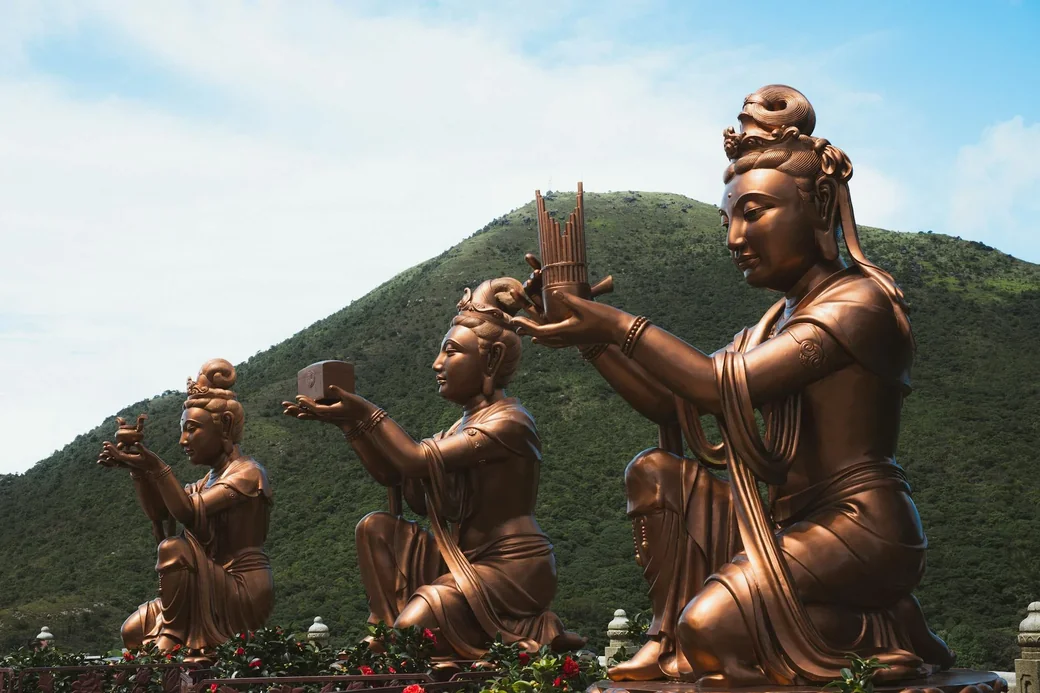
Most seated Buddha images in the region look south; this one turns north. The explanation usually given is that the figure faces the people of the mainland, and visitors often read the posture as an open, welcoming one. It is said locally that the choice was a mark of particular regard. The hands are less open to interpretation. The raised right hand forms the abhaya mudra, which lifts fear and suffering; the left lies open on the knee in the varada mudra, the gesture of granting a wish. Six kneeling bronze devas (heavenly beings) surround the platform, offering flowers, incense, lamp, ointment, fruit and music.
Wooden Fish Hill and the 268 Steps to the Buddha
The hill beneath the statue is Muk Yue, the Wooden Fish, named after the hand-struck wooden drum that keeps time during chanting. From its foot, 268 broad stone steps rise to the platform that circles the Buddha. The way is straightforward, handrails run the whole length, and at a steady pace with a pause or two the climb takes five to ten minutes. Keep right going up and coming down; the flow is marked. The steps are open to the sky and taken on foot, since the ascent counts as part of the visit, which is one reason the view back over the monastery roofs feels earned. Anyone who prefers to stay on the level will find the Buddha impressive from the base and the monastery courtyards flat and easy; a service road behind the hill reaches the podium by ramp, used mainly by coach groups, and the information counter in the village can point the way. The usual rhythm of a visit is to climb, walk a slow circle around the platform, then cross back to the monastery for incense and a vegetarian meal.
Inside the Lotus Base: Three Halls and the Bell of 108
Three floors are built into the base beneath the statue: the Hall of the Universe, the Hall of Benevolent Merit and the Hall of Remembrance. One holds a figure of the bodhisattva Ksitigarbha carved from century-old nanmu wood (nanmu is a prized Chinese hardwood long used for temple carving), and the walls carry paintings made by monks from Sri Lanka telling the Buddha's birth, awakening, teaching and passing. The Hall of Remembrance keeps what the monastery describes as a relic of the Buddha, said to have come as a gift from Sri Lanka. A large bronze bell hangs in the stairwell; it is said to sound one hundred and eight times a day, to release one hundred and eight kinds of affliction. This interior is the one part of the site that needs a ticket.
Walking the Monastery Axis, Gate by Gate
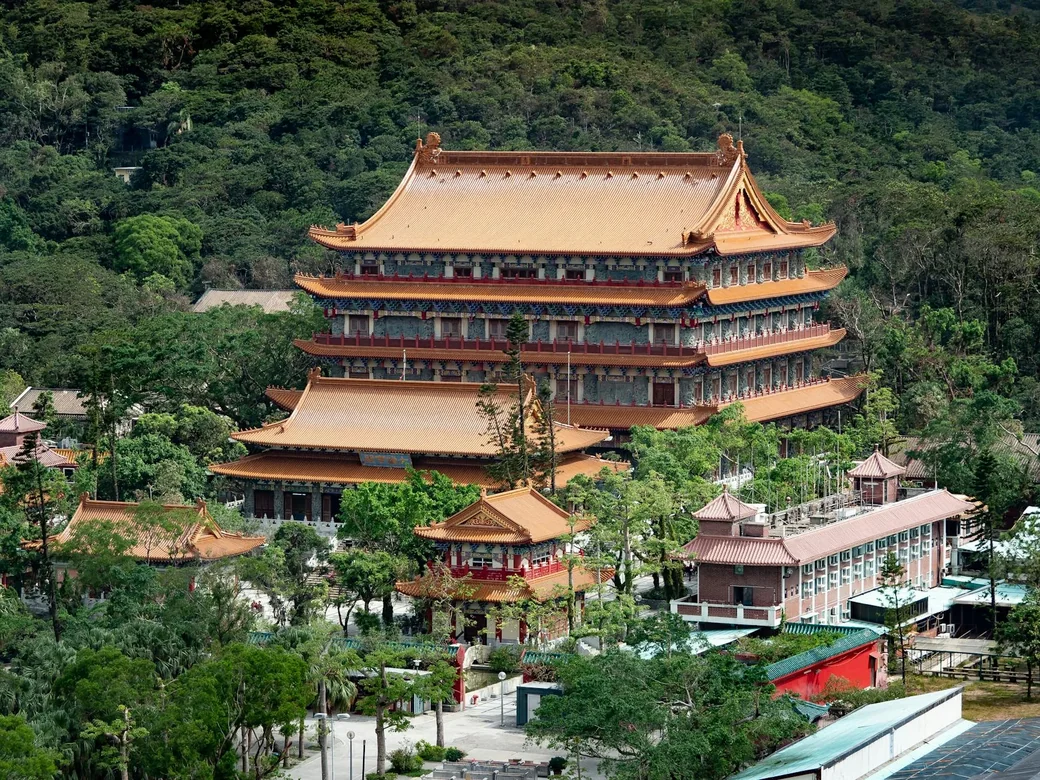
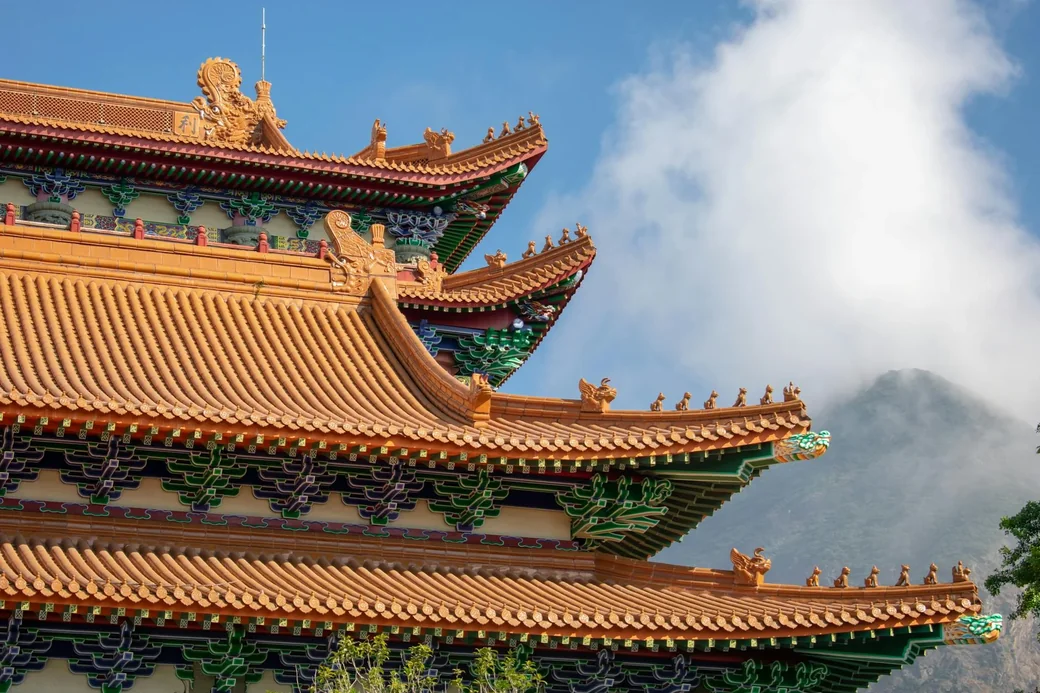
The compound rewards a slow walk along its axis. You enter through the mountain gate, then reach the Hall of Bodhisattva Skanda, the guardian who protects the teaching. Beyond it stands the Main Shrine Hall, finished in 1970, where three golden Buddhas represent past, present and future beneath a high ceiling hung with lamps and banners. At the top of the rise is the Grand Hall of Ten Thousand Buddhas, opened in 2014, whose Song-inspired design holds a shrine hall, a meditation hall, an abbot's chamber and a scripture library. Bell and drum towers stand to either side. The monastery has long been called the Buddhist Realm of the Southern Sky. The monks' quarters and the vegetarian kitchen complete the compound, arranged symmetrically around a sequence of courtyards.
The Di Tan Terrace and the Monastery That Had No Lotus
Just outside the monastery gate, facing the archway and the Buddha beyond it, lies a paved terrace known as Di Tan, the Altar of Earth, where the community holds its large ceremonies. It is said that the centre of the terrace behaves like an echo wall: stand on the middle stone, speak, and your own voice comes back to you. Visitors test it quietly when no ritual is underway. There is a second story people like here. The monastery's name promises a precious lotus, and bringing one to this plateau took patience: an abbot is said to have worked at it for three years before the flowers finally took root, after which the monastery held its first large lotus show, some four hundred varieties and close to four thousand pots.
Find Your Zodiac Guardian on the Bodhi Path
Between the village and the open piazza runs the Bodhi Path, around 120 metres of paving lined with forty lotus-shaped stone lanterns and twelve stone warriors. These are the Twelve Divine Generals, protectors of the Medicine Buddha. Each one guards a two-hour division of the day, and each carries a Chinese zodiac animal on his crown, so every visitor can find the general who belongs to their birth year. Walking the row slowly costs only a few minutes, and spotting the small animal above the helmet turns an ordinary approach into something you remember.
Eating at the Monastery Kitchen: How the Ticket System Works
The kitchen sells its meal by ticket rather than by order, which surprises most first-time visitors. Collect the ticket at the kitchen reception or at the entrance to the statue, then hand it in at the dining hall. Indoors you are seated and served a fixed set of dishes; outside, a separate counter sells snacks, noodles and the bean curd dessert that many people come back for, which suits anyone who only wants something light. The food is strictly vegetarian and cooked in the monastic manner, without the pungent vegetables. The kitchen serves around the middle of the day, so an early lunch fits the visit best; groups reserve by telephone in advance. Small counters near the statue also sell the monastery's wooden bracelets, the keepsake most associated with this hill.
Ngong Ping Weather: Choosing the Right Month and Hour
Ngong Ping is a level shelf of upland held between Lantau Peak and Nei Lak Shan, roughly 480 metres above the South China Sea. The plateau makes its own weather. From roughly March into May it often sits inside cloud, and the statue drifts in and out of view while you stand at the foot of the steps; the reward is mist moving through the courtyards, which many photographers prefer to a clear sky. June to September is warm and humid, the season of tropical weather, when the bus becomes the steady way up. October to December is the clearest stretch, with mild air and long views out to sea, and January and February are bright and crisp, with a real mountain chill at this height. Whatever the month, weekday mornings are the quietest, and the plateau settles again after the middle of the afternoon, when a glance at the return times keeps the end of the day easy.
Cable Car or Bus 23? Choosing Your Way Up
For most of the twentieth century the monastery was a remote place, reached only on foot or by a slow bus from Tai O, and the monks lived largely by farming the plateau; today the way up is far easier. Two routes climb to Ngong Ping and they suit different days. The cable car is the scenic one, about twenty-five minutes over ridges and water, with standard, glass-floor and premium cabins; a timed booking keeps the weekend wait short. Bus 23 takes the mountain road in roughly fifty minutes, boards quickly and runs in all weather. Many regulars split the difference: bus up in the morning, cable car down in the afternoon when the light lies flat on the sea. Either way you arrive at Ngong Ping Village, a visitor village built in traditional style, whose lane of shops and tea house leads straight on to the piazza and the monastery gate. From Tai O, bus 21 arrives in about twenty minutes and follows a published timetable, so a quick look before you set out makes the connection simple.
If a Ceremony Begins While You Are Inside
This is a working monastery rather than a museum, and services go ahead whatever the visitor numbers. If chanting begins while you are in a hall, step quietly to the side, stay where you are and let it pass instead of crossing the floor; cameras rest at that point. Rituals cluster around the observance days of the lunar calendar, and the monastery's year also takes in the Ullambana services, when families come to remember their ancestors. The largest gathering is the Buddha's Birthday, when the courtyards fill with people pouring water three times over a small image of the infant Buddha, a day that has been a public holiday in Hong Kong since 1999. Shoulders and knees stay covered, voices stay low, and one bundle of incense is enough.
Beyond the Gate: Wisdom Path, Lantau Peak and an Old Tea Garden
The plateau is a trailhead as much as a temple. A short walk past the monastery brings you to the Wisdom Path, thirty-eight timber columns inscribed with the Heart Sutra and laid out in a figure of eight. From the same point, section three of the Lantau Trail climbs Lantau Peak, the second highest summit in the territory and a long-standing place to watch the sun come up; walkers who want that start usually stay the night on the plateau, at the monastery's own guest beds or the hostel nearby. On the way you pass the old terraces of a tea plantation laid out in 1947 by a British lawyer, the only tea ever farmed in Hong Kong, now grown over with woodland. Two gentler routes leave from the same corner: the Shek Pik Country Trail, about five and a half kilometres down the southern slope to the coast road, and the short Ngong Ping Tree Trail, roughly ten minutes through young forest. Tai O, the stilt-house fishing village, lies twenty minutes west by bus.
Po Lin Monastery: Visitor Tips
Start early. The plateau is at its calmest in the first two hours of the day, and the 268 steps are open to the sky, so climbing them before the sun is high is the most comfortable plan. Carry water, a hat and a light rain shell: cloud settles on Ngong Ping quickly and the air up here runs several degrees cooler than in the city. Keep some cash for incense and the small counters. If you plan to eat at the vegetarian kitchen, pick up the ticket before you climb and lunch takes care of itself when the midday crowd arrives. The clearest pictures of the monastery roofs come from the Buddha platform looking back, while the Buddha itself frames best from the Bodhi Path below. Wild cattle graze freely across the plateau; give them room and let them be. Tung Chung station, where every route begins and ends, sits one stop from the airport line interchange, so the monastery fits neatly into a long layover.
Po Lin Monastery: Best Time to Visit
Weekday mornings shortly after opening; October to December for clear air and cool stairs.
Quick Info
2h 30m
moderate
Po Lin Monastery: Getting There
Take the MTR (Mass Transit Railway, Hong Kong's metro) Tung Chung Line to its last stop, Tung Chung, and leave by Exit B. From the plaza you have two good options. The Ngong Ping 360 cable car terminal is a few minutes on foot and the ride over the hills and the bay takes about twenty-five minutes, ending in Ngong Ping Village; from there it is a flat ten-minute walk past the piazza to the monastery gate. Alternatively, New Lantao Bus route 23 leaves from the Tung Chung bus terminus beside the station and climbs the winding South Lantau road in roughly fifty minutes, stopping right next to the site. The bus keeps running in weather of every kind, which makes it a dependable choice and, on busy weekends, often the faster way up. Coming from the east of the territory, you can also take the ferry from Central to Mui Wo and continue on bus 2, or arrive from Tai O on bus 21. Octopus card (Hong Kong's contactless travel card) or exact cash is accepted on all buses. Lantau's mountain road is a managed route, so the cable car, the buses and the island's blue taxis are the ways up, and all three set you down within a short walk of the gate. Tung Chung itself is one stop from the airport line interchange, which puts the monastery within reach of a long layover.
Nearby stops & parking
The Ngong Ping cable car terminal and the Ngong Ping bus terminus stand side by side at the entrance to the village, about ten minutes on foot from the monastery gate. Buses 23 from Tung Chung, 2 from Mui Wo and 21 from Tai O all use the same stand, so one platform covers every direction. Lantau's taxis are blue and there is a small rank beside the terminus; for the late afternoon the bus and the cable car are the steadiest way back, and both keep going into the evening. Since the mountain road is a managed route, everyone arrives on public transport and walks the last stretch through the piazza, which is part of the pleasure of the place. Coin-operated lockers at the cable car station down in Tung Chung look after luggage if you are travelling to or from the airport the same day.
Po Lin Monastery: Dress Code & Etiquette
Dress as you would for any place of worship: shoulders and knees covered, and comfortable shoes for the steps. Hats come off inside the halls and voices stay low. Photography belongs to the courtyards and the open platform; inside the shrine halls, and whenever monks or worshippers are at prayer, cameras rest, and the posted signs make clear where. Offering tables, bells, drums and censers are in daily use by the community, so they are best admired from a step back. One bundle of incense is the custom, and it is put out with a wave of the hand. When you take photographs, keep the Buddha images in the frame in front of you, and keep to the paths and floors rather than statues or railings. Meals with meat, alcohol and drones stay outside the gate.