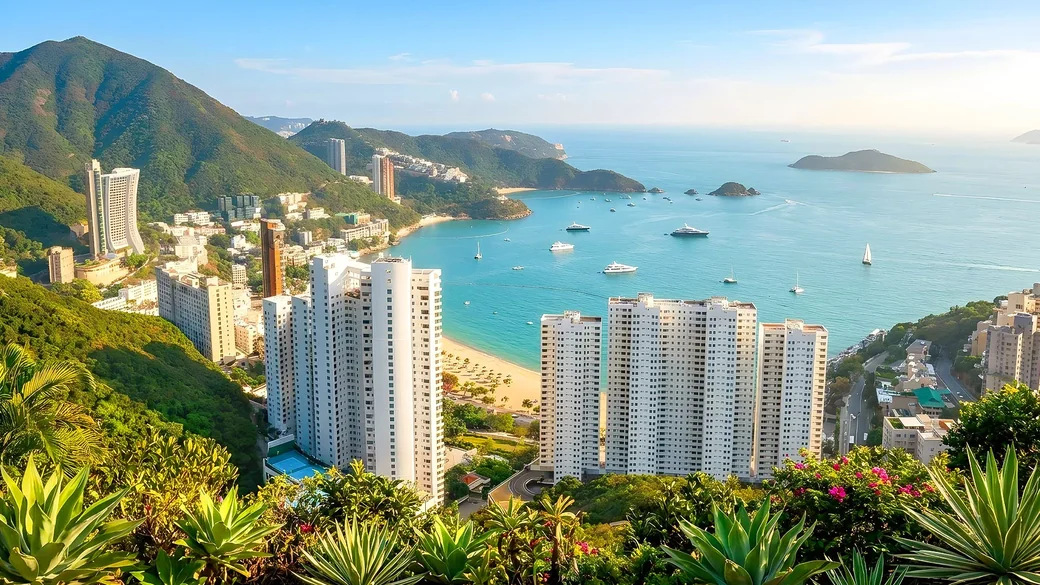
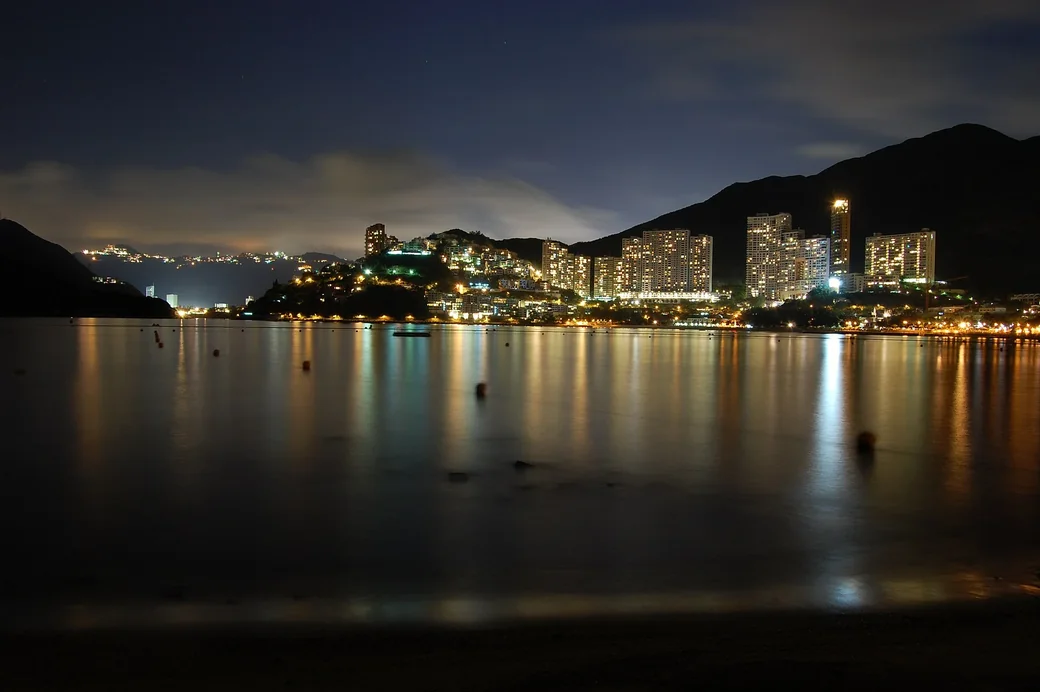
Repulse Bay is Hong Kong's best-known beach, a wide crescent of pale sand on the southern shore of Hong Kong Island. Calm water and a lively seafront make it a favourite for swimming, sunbathing and strolls along the sand. The shore around it also gathers some of the city's most distinctive sights, from a colourful statue park to striking seaside architecture, so the bay rewards curiosity as much as a lazy beach day.
Repulse Bay: Location, accommodation options and contact
Beach Road, Repulse Bay, Southern District, Hong Kong Island, Hong Kong
The place's location on the map and nearby accommodation and hotel options are shown by Stay22. Cookies are used. Your consent is remembered on every page; you can turn it off at any time in the cookie settings.
The Shallow-Water Bay: Hong Kong Island's Great Crescent of Sand
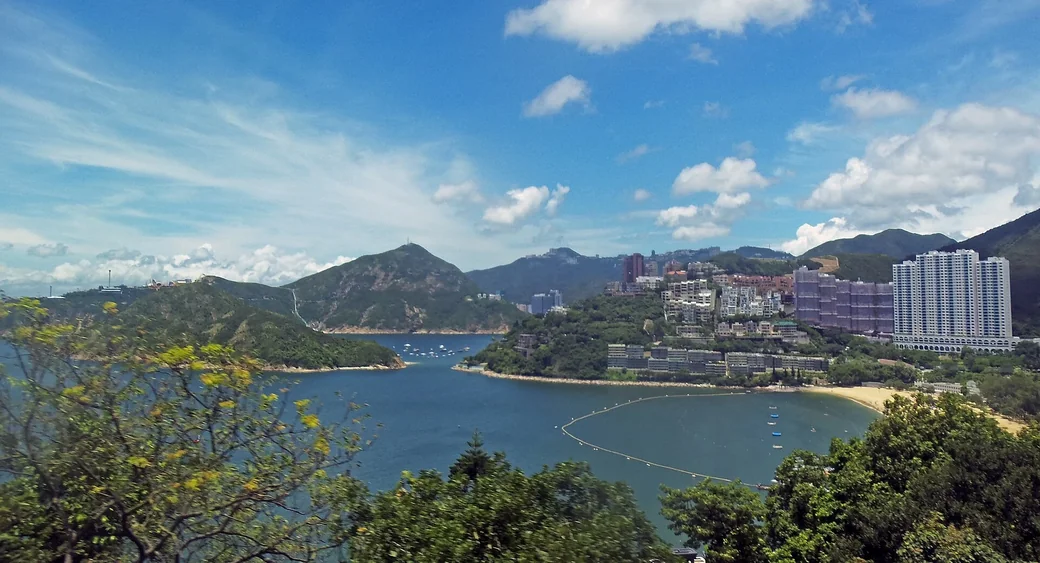
The Chinese name says it plainly: this is the bay of shallow water. The seabed slopes so gently that swimmers can wade a long way out and still stand, which is exactly why the shoreline became a bathing beach generations ago. The sand runs for close to three hundred metres between two headlands, making it one of the longest beaches on the island, and the low green shape offshore is Middle Island. Notice the grain underfoot: coarser near the road, finer towards the water, a trace of the sand added over the years to widen a strip that was originally much narrower. The headlands that frame the sand separate the bay from Deep Water Bay on one side and Middle Bay on the other.
Two Stories Behind the Name Repulse Bay
The Chinese and English names of this bay have nothing to do with each other, and only the Chinese one can be explained with confidence. Two accounts circulate for the English. According to one story, pirates once used the bay as a base and were driven off — repulsed — by naval ships. According to another, the bay took its name from a warship called Repulse that was moored here. Historians have found no record supporting either version, and the English name appears on an early survey map without explanation. Both remain hearsay, repeated because they are satisfying rather than because they are proven.
Kwun Yam Shrine: The Statue Park the Lifesavers Built
The park at the south-eastern end has a Chinese name that travel guides rarely use: Zhenhai Tower Park, "the park of the tower that calms the sea". Two figures some ten metres tall stand above the sand — Kwun Yam, associated with mercy, and Tin Hau, regarded as the protector of those who go to sea — surrounded by mosaic dragons, rams, a river god and a longevity star. The striking part is who commissioned them in the 1970s: not a temple trust, but a lifesaving association, which wanted both a symbol of water safety and a reason for visitors to come. The traditional building inside the grounds is its training headquarters. The society itself dates from 1956, its training headquarters took its present form in 1972 with government support, and its chairman explains that some of the statues came from mainland China and were brought to Hong Kong to be preserved.
Longevity Bridge and the Luck Rituals of the Shrine
A small red bridge stands at the eastern side of the shrine grounds. Local lore says that crossing it adds three days to your life, so most visitors walk over and back without comment. Other customs attach to individual figures: it is said that tossing a coin into the open mouth of the great fish brings good fortune, that running your hands over the money god and then putting them in your pockets draws wealth, and that touching the longevity dragon lengthens your years. None of this is presented as fact by anyone here — it is simply what people say, and joining in costs nothing.
The Tower with a Hole: Repulse Bay's Famous Dragon Gate
The pale residential towers behind the beach, opened in 1989 on the old hotel site, are pierced by a rectangular opening several storeys high — the best-known example of what Hong Kong calls a dragon gate. According to the popular story, spirit dragons live in the hills behind and pass through the gap on their way to the sea; one version has a mother dragon leading her young down to bathe each morning. Accounts differ on whether the opening was planned around this belief or whether the tale grew up around the building afterwards, so it is best enjoyed simply as local lore. Step back onto the beach road and the view through the gap, with the green slope behind, makes a favourite photograph.
The Vanished Hotel and the White Replica Above the Sand
Through most of the twentieth century a long, low hotel with striped awnings looked down on this beach. Opened in the 1920s by the family firm that also ran the city's grand hotels, it had a famously long verandah, gardens dropping towards the sea, and the letters RBH cut into the lawn. Over the decades it drew writers, film crews and visiting royalty. The hotel came down in the early 1980s, but part of its lobby block was rebuilt as a careful replica a few years later, complete with awnings and ceiling fans, and still serves as a restaurant above the bay.
A Bay Written Into Novels and Filmed for the Screen
One of modern Chinese literature's best-loved love stories, written in 1943, opens at the old hotel that stood on this hillside. Its author knew the place personally: as a young woman she often visited her mother, who stayed at the hotel for long periods, and the colonial setting stayed with her. The celebrated 1984 film adaptation recreated the hotel from old photographs, because the building had been demolished in 1982. In 1955 a full-size replica of the hotel was built for the Hollywood film Love Is a Many-Splendored Thing, whose star William Holden also visited the real one, and scenes of Ang Lee's Lust, Caution were later filmed in today's Verandah restaurant.
Eucliffe: The Castle That Once Crowned the Western Cliff
Look at the western headland above the sand and imagine a Gothic castle with a swimming pool, a greenhouse and a tennis court. It was built there in the 1930s by a businessman who had made his fortune in tin and herbal medicine, and it was one of three such houses he raised across the territory. The story attached to them is memorable: it is said that after a serious illness a fortune teller told him he would keep living as long as he kept building, so he never stopped. The castle was cleared in the late 1980s and apartments stand on the site today. Records place its completion in 1933 and its removal in 1988.
A Hotel's Own Bus Line: The Century-Old Route Over the Hill
When the hotel above the beach opened, there was no easy way to reach it. So the company that owned it started a bus service of its own, running from a pier in the central district over the hills to the bay. The line was later taken over by a public operator and given the number 6, then extended beyond the bay to the village on the far side of the peninsula. It still runs today on broadly the same alignment. If you board route 6 rather than one of the faster tunnel services, you are riding the slow, scenic original. The road that made all this possible has its own history: the hotel company agreed with the government that a road would be built if the hotel went ahead, the Aberdeen–Stanley road was completed in 1919, Stubbs Road over Wong Nai Chung Gap was begun in 1924, and by 1932 the drive to Central took about half an hour.
From Matsheds to a Seafront Arcade: A Century of Beach Life
Bathers were already coming here more than a century ago, long before today's roads were cut through the hills. Diaries from the 1930s already describe this as the busiest beach in the colony, crowded on Sundays. In those days bathers rented woven matsheds for shade; then an entertainment pavilion called the Lido opened and offered public changing rooms at a fraction of the cost. After the war the crowds grew far larger, and the pavilion was eventually replaced by a mall, which in turn gave way to the long, low, open-sided complex that lines the beach road today. Four generations of seaside architecture have stood on roughly the same patch of ground, each one wider than the last. The Lido pavilion opened in 1935, a Lido complex followed in 1976, and the current waterfront complex, The Pulse, was built on the same ground in the 2010s.
Swimming Season, Lifeguard Flags and the Shark Prevention Nets
From spring to autumn lifeguards keep watch over the bay, and a barrier net running from the surface to the seabed marks out a sheltered swimming zone beside the floating raft. Hong Kong developed this kind of shark prevention net in the 1990s and fits it at its public beaches, so the calm, shallow water, the lifeguard flags and the net work together. Swimming between the markers while the flags are flying is the simple routine that makes this bay one of the easiest places in the city for families to enjoy the sea. In midwinter the beach is quieter and ideal for long walks along the sand.
Water Quality and the Rhythm of the Sea at Repulse Bay
The bay's water is tested regularly, and its annual ranking has stood at the top ‘Good’ level since 1990. During the bathing season the beach mostly reaches Grade 1, with an occasional dip to Grade 2. After heavy rain the hillside runoff can briefly affect the water, so the usual advice is to wait up to three days before swimming again — a good moment for a walk, a meal or a visit to the statue park instead. Sea temperatures suit swimming for much of the year, and the bay's sheltered position keeps the waves gentle.
Beating the Crowds and Finding the Best Light
This is one of the most visited beaches in the city, and the difference between a packed afternoon and an empty one is mostly timing. Weekday mornings are reliably quiet; the cool months are quiet almost all day. Coach groups tend to work through the middle of the day and concentrate at the statue park, so walking the far end first and the sand afterwards often reverses the flow. For photographs, the bay faces the setting sun: the light sweeps along the whole crescent in the final hour, and the upper terraces of the beachfront complex give you height without a climb.
Bay to Bay: Walks to Deep Water Bay, Middle Bay and South Bay
Repulse Bay is the busiest link in a chain of coves, and the quieter ones are within walking distance. A level seaside promenade runs north-west to Deep Water Bay in roughly half an hour, with the water on one side and wooded slopes on the other. Heading the other way, a short walk along South Bay Road reaches Middle Bay in about ten minutes and South Bay in about twenty; both are smaller, calmer and far less photographed. For a view back over the whole crescent, the hill paths above the bay reward the climb on a clear winter day. The shore path is called the Seaview Promenade (‘the sea-view embankment path’), a flat, paved track that suits families, runners and dogs alike.
Beach Etiquette at Repulse Bay: What to Do and What to Avoid
The public beaches here are smoke-free, including the sand, the shower areas and the playground, which keeps the air fresh for everyone. Reusable containers and cans are a better companion to sand than glass. Barbecue pits are a short walk away at Deep Water Bay, Middle Bay and South Bay, while Repulse Bay itself is made for swimming, sunbathing and eating at the waterfront restaurants. Dogs are asked to stay off the beach, and the neighbouring Seaview Promenade is where they are welcome. Take your rubbish with you so the bay stays as pretty as you found it, and treat the statue park as the place of worship it also is: quiet voices, a respectful distance from the figures and room for those who have come to pray.
The Repulse Bay Hotel Guest Book: Writers, Actors and a Rose Garden
The Repulse Bay Hotel opened on New Year's Day 1920, officially inaugurated by the governor of the day, and was marketed as the Riviera of the East. Designed by the architects Denison, Ram and Gibbs, it later added a rose garden of roughly two thousand bushes brought from England, offered seaplane sightseeing flights from the bay from 1921, and hosted tiffin concerts (concerts at the light midday meal) and tea dances. Its guest list reads like a library and a film archive: George Bernard Shaw in the 1930s, Ernest Hemingway and Martha Gellhorn in 1941, William Holden in 1955 and Marlon Brando in 1956. When the hotel closed in 1982 it said farewell with balls and dinner dances; a temple bell found in its basement in 1960 is still on display at the complex, and the rebuilt Verandah restaurant opened in 1986.
Lifeguard Hours, Facilities and Accessibility at Repulse Bay Beach
The lifeguard calendar follows the seasons. Lifeguards are on duty from spring to autumn, with the longest hours on summer weekends and public holidays, and from December to February the service takes a winter break while the sand stays open for strolling. The beach offers a restaurant, a refreshment kiosk, self-service storage cages, changing rooms, showers, toilets, a swimming raft, a playground and a beach volleyball court, along with an accessible toilet and a Braille directory map. The shark prevention net protects the swimming zone, and the beach office answers questions on +852 2812 2483. Entry to the beach is free.
Repulse Bay: Visitor Tips
Come on a weekday morning if you can: the tour coaches arrive later, and the sand is at its emptiest before mid-morning. The bay faces south-west, so the last hour of daylight falls straight down the beach — this is the window photographers wait for, and the rooftop terraces above the beach road are the easiest place to use it.
Walk to the far south-eastern end for the statue park; the view back along the whole crescent, with the hills rising behind, is the shot most people miss because they stop at the first stretch of sand. For the tower with the rectangular opening, step back onto the beach road and frame it with the ridge behind so the "gate" lines up with the slope.
Changing rooms, showers and toilets sit at the centre of the beach and are free to use, and self-service storage cages keep your belongings safe while you swim. Swim inside the marked area while the lifeguard flags are flying, and give the sea a few days to settle after heavy rain.
With half a day rather than two hours, link the bay to its neighbours: the flat Seaview Promenade leads to Deep Water Bay in about half an hour, and the same buses that brought you here continue over the hill to Stanley in roughly a quarter of an hour.
Repulse Bay: Best Time to Visit
Late spring to early autumn for swimming; cool, clear winter days for walking and photography. Weekday mornings are calmest, and the bay faces the sunset.
Quick Info
2h 30m
easy
Repulse Bay: Getting There
The bay is reached by road, with frequent buses and taxis from Central, and the winding journey over the hills is part of the experience. From Central, buses 6, 6A, 6X, 66 and 260 leave the Exchange Square terminus and stop directly opposite the sand; the ride takes roughly twenty-five to forty minutes depending on traffic. Route 6 climbs over Wong Nai Chung Gap on the older, slower, more scenic alignment, while 6X and 260 take the Aberdeen Tunnel and are usually quicker. From Causeway Bay and North Point, routes 63 and 65 run the same way, and green minibus 40 is a faster, smaller alternative from Causeway Bay. From Kowloon, bus 973 is the only direct option, running from Tsim Sha Tsui via West Kowloon and Ocean Park. If you are already on the MTR, get off at Admiralty and pick up any of the Central routes there. Taxis take about twenty to thirty minutes from Central. Octopus is accepted on every bus; for the best views, sit upstairs at the front on the seaward side. The Exchange Square terminus is a short walk from Exit A of Central station or Exit B1 of Hong Kong station, and route 6X (‘the scenic journey’) is a favourite for sea views.
Nearby stops & parking
The Repulse Bay Beach stop sits on Beach Road directly opposite the sand, served by routes 6, 6A, 6X, 66, 260, 63, 65, 73 and 973 plus green minibuses 40 and 52, so the beach is a minute's walk away. Two covered car parks serve the bay — one beneath the beachfront complex on Beach Road, the other at the arcade on Repulse Bay Road a short walk uphill — and both offer discounts linked to the shops and restaurants inside. Taxis drop off and pick up along Beach Road.
Repulse Bay: Dress Code & Etiquette
The beach itself welcomes everyday swimwear on the sand, with a light cover-up for the road or a seat at the restaurants. The statue park at the south-eastern end is a place of worship as well as a photo stop, so a T-shirt or sarong over your swimwear is the gracious way to arrive. Quiet voices near people making offerings, a respectful distance from the altars and figures, and photographs that keep worshippers at a comfortable distance are all appreciated. Shoes stay on throughout. The coin-throwing and bridge-crossing customs are open to everyone — join them quietly and let those who have come to pray go first.