The Science Museum is London's great museum of science, technology, engineering and medicine. It stands on Exhibition Road in South Kensington, in the museum quarter it shares with the Natural History Museum and the V&A. Across several floors, real spacecraft, steam engines, aircraft, computers and medical objects show how discoveries and inventions have shaped everyday life, and its hands-on displays make it a favourite day out for families and for anyone curious about how the world works.
Science Museum: Location, accommodation options and contact
Science Museum, Exhibition Road, South Kensington, London SW7 2DD, United Kingdom
The place's location on the map and nearby accommodation and hotel options are shown by Stay22. Cookies are used. Your consent is remembered on every page; you can turn it off at any time in the cookie settings.
Entry to the museum's galleries is free. General admission is by timed ticket, which you choose online before you come; visitors without one are usually admitted when there is space, though weekends and school holidays can mean a wait. No fast-track or queue-jump ticket exists, whatever third-party sites claim, and your e-ticket lets you leave and return on the same day.
The museum is open every day. Last entry is shortly before closing, and the galleries start to close a little before the end of the day, so begin with the upper floors. It closes only from 24 to 26 December. If your plans change, you can return your ticket online before your slot so that someone else can use it.
The museum is open all year and entirely indoors, so it works as well on a cold, wet day as in summer. The calmest time is a weekday afternoon in school term time; weekends and school holidays are livelier. Come soon after opening if the Space gallery is your priority, and note that later time slots for the ticketed experiences tend to be quieter. The museum itself suggests about two hours; three to four hours suits most visitors, and Wonderlab or Power Up can turn it into a full day.
A short history: from the Brompton Boilers to the Wellcome Wing
It starts with the Great Exhibition of 1851, whose profits bought land in South Kensington. In 1857 the South Kensington Museum opened there in prefabricated iron sheds clad in corrugated iron, which Londoners nicknamed the Brompton Boilers. Its science collections grew from objects of the Royal Society of Arts and the Great Exhibition, under Bennet Woodcroft, and absorbed the Patent Office Museum in 1883. The name Science Museum came into use in 1885. When the art collections were rehoused in a new building named for Queen Victoria and Prince Albert, the science collections became a separate institution on 26 June 1909.
Sir Richard Allison began the building you see today in 1913; the First World War interrupted it and it opened in stages between 1919 and 1928. It was called the East Block because a far larger complex was planned around it, and that was never built. A pioneering Children's Gallery opened in 1931, the Centre Block followed in the early 1960s, and the Wellcome Wing, with its deep blue atrium, opened in 2000. Since 2012 the museum has been part of the Science Museum Group.
Arrive dry: the Victorian tunnel from South Kensington station
Most visitors arrive at South Kensington, five minutes away on the District, Circle and Piccadilly lines. From inside the station a tiled pedestrian subway runs beneath Exhibition Road and surfaces beside the museums; it was opened by the District Railway in May 1885, and it is now a listed structure. For step-free Underground access, use Knightsbridge or Earl's Court and finish the journey by bus.
Floor-by-floor guide: where to find every gallery
The collection holds more than 300,000 objects, and the galleries give the stories of the people behind them as much room as the machines themselves.
Level -1: The Garden (for young children), Power Up and the IMAX. Level 0: Energy Hall, Space, Making the Modern World and Pattern Pod. Level 1: Medicine, Who Am I?, Technicians and Engineers. Level 2: Mathematics, Information Age, Science City 1550–1800, the Clockmakers' Museum and Energy Revolution. Level 3: Flight and Wonderlab. A route that works is to take a lift to the top, then walk down so that you finish with Energy Hall and Space on Level 0. Volunteer-led tours run throughout the year, and an interactive guide device is available in English. Galleries are sometimes closed temporarily, so check the museum's website before you go.
Space gallery: Apollo 10 and the Soyuz that brought Tim Peake home
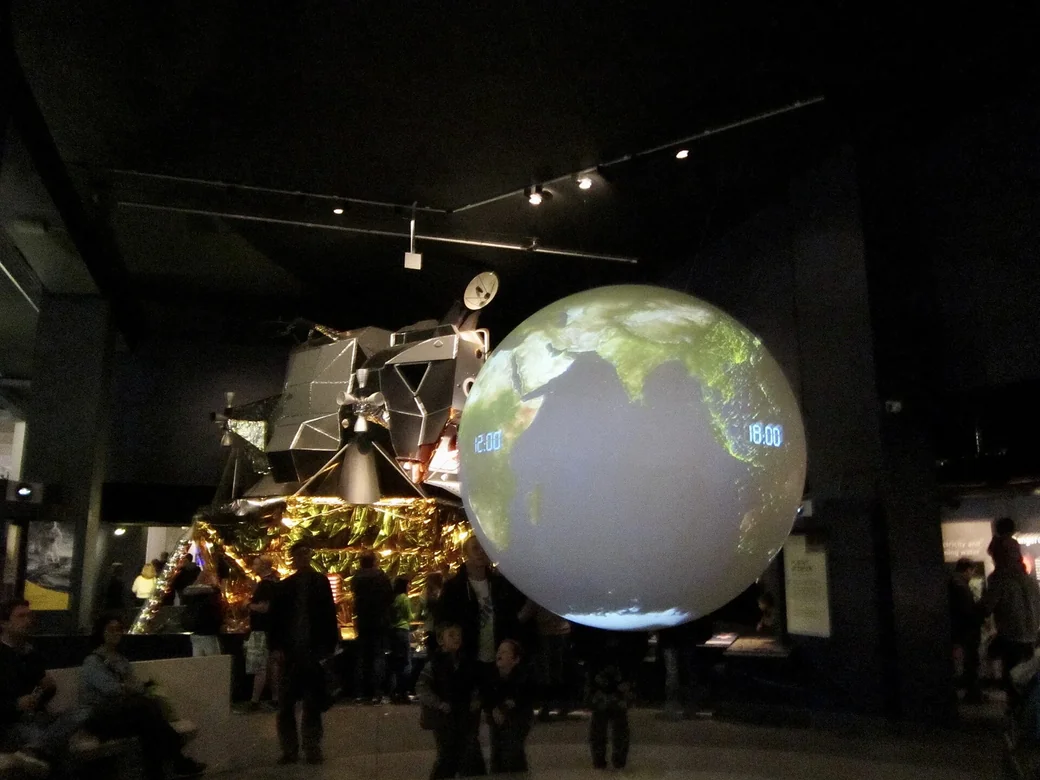
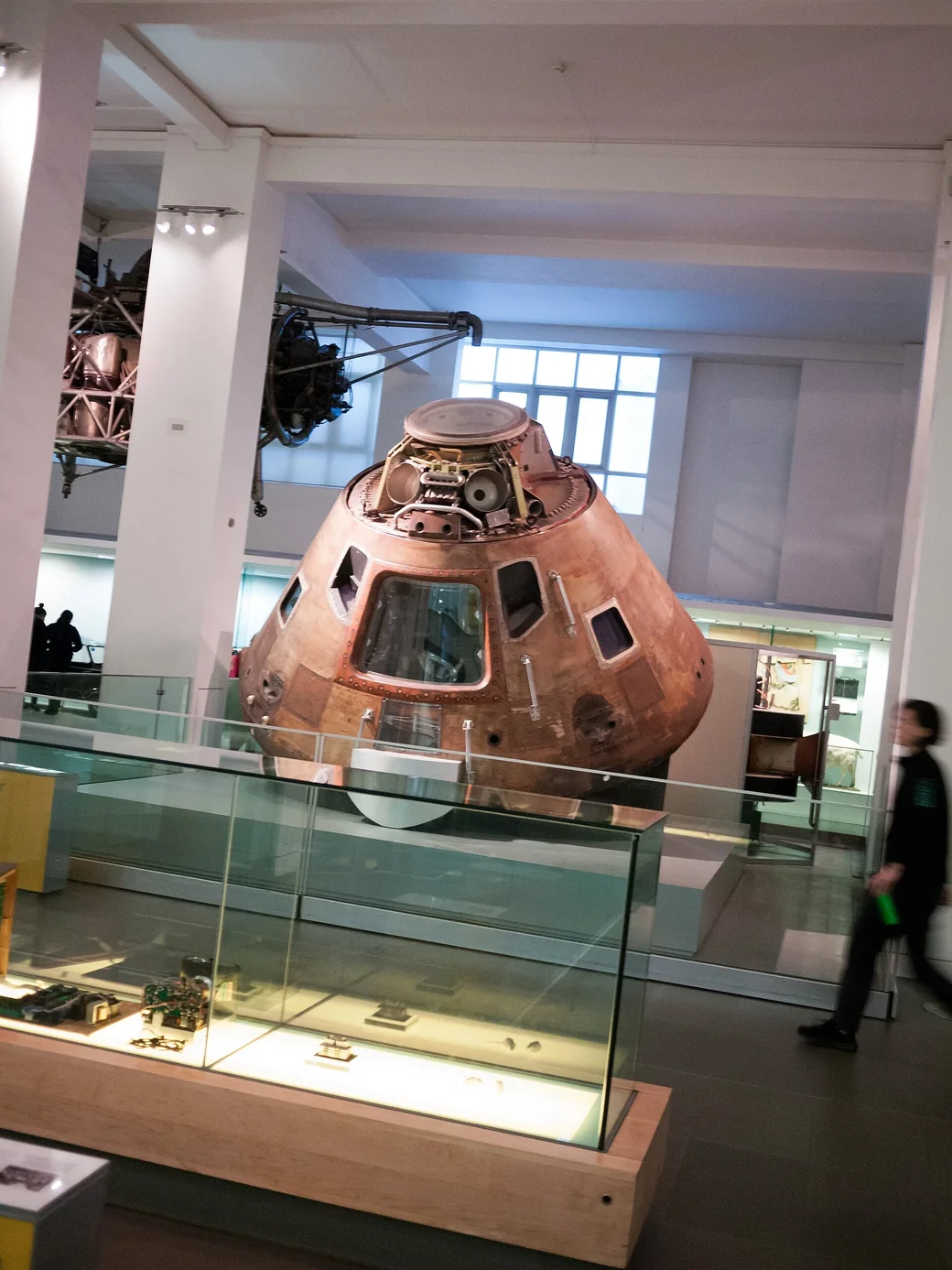
Level 0, Space gallery: two flown spacecraft stand side by side. Apollo 10's command module, nicknamed Charlie Brown, circled the Moon thirty-one times in May 1969 as the dress rehearsal for the first landing; its lunar module was called Snoopy, and its return speed remains a record for a crewed vehicle. It is on long-term loan from the Smithsonian's National Air and Space Museum. Beside it is the Soyuz capsule that returned Tim Peake from the International Space Station, with its 25-metre parachute overhead — the first time the two have been shown together. Nearby are a roughly three-billion-year-old Moon rock from Apollo 15, Neil Armstrong's Apollo 11 radio headset, Helen Sharman's spacesuit and a small Japanese lunar rover.
Energy Hall and Making the Modern World: Watt's workshop, Puffing Billy and the DNA model
The first hall you walk into is given to the machines that drove the Industrial Revolution, including the oldest surviving engine built by James Watt. Many of these machines are beam engines (steam engines worked through a large rocking beam). Behind them is the quietest marvel in the building: Watt's attic workshop, sealed after his death in 1819 and dismantled in 1924 when the house faced demolition. More than eight thousand objects were recorded and carried here, then set back exactly where they had stood.
This long ground-floor gallery lays out 250 years along a single timeline. Puffing Billy, the oldest surviving steam locomotive, worked a colliery (coal mine) line for almost fifty years. Further along stand Crick and Watson's DNA model, built with some of their original metal plates, part of Babbage's first calculating engine, a V-2 rocket, penicillin from Fleming's laboratory and the prototype of a clock designed to keep time for ten thousand years.
Flight gallery: how the aircraft got in, and the Wright Flyer that lived in London
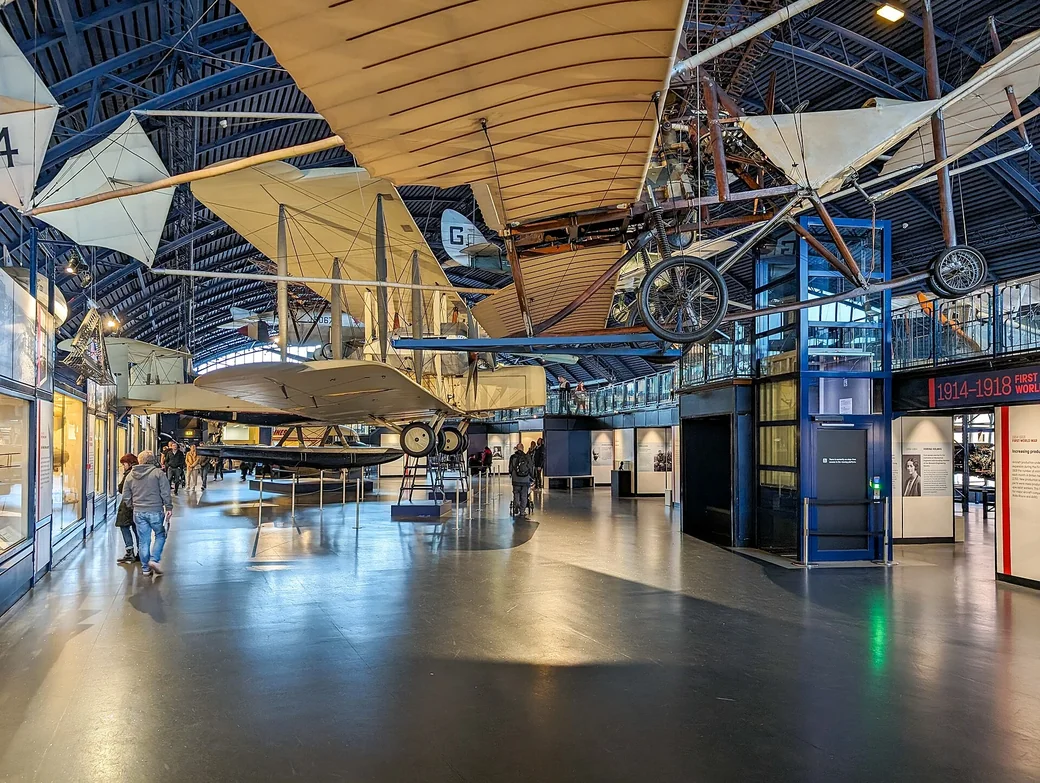
Level 3, Flight: around twenty full-size aircraft, most hanging from the ceiling, among them a Spitfire, a Hurricane, the record-breaking Supermarine S6B racer, an early Whittle jet engine and the Vickers Vimy that Alcock and Brown flew across the Atlantic in 1919. Raised walkways let you walk among them and see them up close. The gallery opened in 1963. The aircraft came in through removed windows, lifted by crane from the service road beside the building and rebuilt inside; the S6B went up in 1961. A stranger story belongs here too. In 1928 Orville Wright lent the original 1903 Wright Flyer to the museum in protest at the Smithsonian's claims about a rival machine. It stayed in London until 1948, spending the war in protective storage, and before it left Orville gave the museum the brothers' design drawings so a replica could be built.
Wonderlab, Power Up, IMAX and visiting with children
Three experiences need their own ticket. Wonderlab (Level 3) has more than fifty hands-on exhibits and live science shows, best for roughly 7–14 year-olds; it replaced Launchpad, which ran from 1986 to 2015. Power Up (Level -1) lets you play more than 150 consoles from five decades of gaming, for ages 5 and over, with under-16s accompanied by a paying adult. IMAX: The Ronson Theatre (Level -1) has a screen of 24.3 by 16.8 metres, with dual laser projection and a 15/70 mm film projector. Several Wonderlab exhibits use strong magnets, and warning signs are posted for visitors with pacemakers or similar medical devices. Allow at least fifteen minutes to reach them from the entrance, and book ahead for the best choice of times.
On Level -1, The Garden is designed for young children, roughly ages three to six, with water, light and sound to play with; Pattern Pod on Level 0 suits a similar age. Pushchair parking sits beside both and in the spare room opposite The Garden. Children under twelve must be with an adult aged 18 or over. Picnic areas on three levels let you eat what you bring, baby-changing facilities are on every level, and a quiet Family Room on Level -1 is there when a break is needed.
Levels 1 and 2: Medicine, mathematics, Information Age and the Clockmakers' Museum
The mathematics gallery (Mathematics: The Winton Gallery), designed by Zaha Hadid Architects, takes its sweeping form from the airflow around a 1929 experimental aeroplane hung at its centre; an Enigma machine and an Islamic astrolabe (a medieval instrument for measuring star positions) sit among the cases. Next door, Information Age follows two centuries of communication through six networks, and was opened in 2014 by Queen Elizabeth II, who sent her first message on social media from the gallery. The Clockmakers' Museum is a short walk away. It holds centuries of horology (the art and science of timekeeping).
Level 1 belongs to Medicine: The Wellcome Galleries, which opened in November 2019 with five galleries and more than three thousand objects, many from Henry Wellcome's collection, including a rebuilt Victorian pharmacy and a commissioned sculpture by Marc Quinn. On Level 2, Science City 1550–1800 follows London's rise as a centre of trade and science, and the museum's own working Difference Engine No. 2, built from Charles Babbage's designs and completed in 1991 for the 200th anniversary of his birth, is shown by the mathematics gallery.
Lates, Astronights and relaxed sessions: the museum after hours
On the last Wednesday of most months (December is the exception) the museum holds Lates: evenings for adults aged 18 and over, with themed talks, DJs, a bar, a pub quiz and a silent disco. The busiest nights have drawn thousands of people. On Astronights, children aged 7 to 11 sleep among the galleries with an adult, with night-time science activities, breakfast and a show the next morning. The museum also runs relaxed sessions: Early Birds opens early for families who want a calmer visit, and Night Owls is an evening session for visitors aged 16 and over who prefer a quieter atmosphere. Programmes change, so check the museum's website.
Food, shop, lockers and facilities: what to find on each level
Cafés: the Energy Café on Level 0 in the Energy Hall, the Space Café on Level 0 (self-service and table service), the Gallery Café on Level 2 beside the Clockmakers' Museum, and the Shake Bar on Level 3. Which cafés are open varies by day, so ask at the entrance. You may also bring your own food and eat it in the picnic areas on Level -1 (a terrace), Level 2 and Level 3, the last shared with school groups. The shop is on Level 0 and gives out cloth bags rather than plastic. Self-service lockers on Level -1 take card payment only. Wi-Fi is available throughout. A multi-faith room is on Level 2, and breastfeeding is welcome anywhere. Printed maps come in English, French, Spanish and Italian.
House rules, food and photography: the dos and don'ts
Photography with a phone or hand-held camera is fine for personal use, but tripods and lighting need prior arrangement, and you should not photograph other visitors without asking. Running, climbing on exhibits and crossing barriers are not allowed; eating and drinking are confined to the cafés and picnic areas. Balloons are refused because they interfere with alarms, and smoking or vaping is not permitted anywhere inside. Lockers on the lower level take card payment only. Bags may be searched. Knives, sprays, fireworks, thrown objects, flags, banners, leaflets, speakers and microphones are not allowed, nor are animals other than assistance animals or alcohol brought from outside. Electric scooters stay out, though mobility scooters are welcome and folding scooters fit in a locker. Lost property is kept for seven days.
Accessibility: lifts, tactile objects, ear defenders and quiet routes
Lifts serve every public level. A Changing Places toilet with a hoist is on Level 0 beside the Hans Rausing Lecture Theatre, and accessible toilets and baby-changing spaces are on every level. Wheelchairs and folding stools can be borrowed in limited numbers; telephone ahead to reserve one. Ear defenders are kept at the information desk and the IMAX box office on Level 0 and at the Wonderlab desk on Level 3. Braille and raised-line floor plans are at the Level 0 information desk, with tactile maps for Information Age and Medicine. Five galleries (Information Age, Medicine, Science City, Technicians and Who Am I?) have touchable objects with large-print and Braille labels. Audio description is available through the Audio Eyes app for Medicine and Information Age, and by QR code in Technicians. Hearing loops serve the ticket and information desks, the Hans Rausing Lecture Theatre and the Wonderlab show space, the IMAX has assistive listening headsets, and many gallery films are captioned, some with British Sign Language. A sensory map, visual story and 360-degree virtual tour can be viewed before you come; the Family Room on Level -1 is a quiet space, and the Hidden Disabilities Sunflower is recognised (the sunflower lanyard that discreetly signals a non-visible disability). Assistance animals are welcome. The mezzanines of Making the Modern World and Flight have no step-free access.
Nearby places within walking distance of the Science Museum
The Natural History Museum and the V&A are about three minutes away on foot, and Imperial College London's campus is next door. The Royal College of Music Museum is about six minutes away and the Royal Albert Hall about eight. The Albert Memorial and Kensington Gardens are around ten minutes away, Hyde Park and the Serpentine around twelve, Harrods in Knightsbridge twelve to fifteen, and Kensington Palace about twenty. The area is known as Albertopolis (Prince Albert's city, after the consort who drove the whole project), and the museum's Dana Research Centre and Library, where researchers and the public can consult books on site, stands nearby.
Stories told about the museum — and one mistake worth avoiding
This is not a building of ghost stories, but a few tales cling to it. It is said that James Watt's workshop stood untouched for a century, exactly as he left it; the records show every object was catalogued before the move. It is also said that Orville Wright swore his aeroplane would never return to America. It is also said that Londoners gave the first iron sheds on the site the nickname Brompton Boilers because they looked like giant boilers; the nickname is well recorded, but who first used it is not. One thing is simply a mistake: Stephenson's Rocket is no longer here — it is now on long-term display in northern England.
Science Museum: Visitor Tips
Choose a timed ticket online before you travel. Start on the top floor and work down, or go straight to Space before it fills. Allow fifteen minutes to reach Wonderlab or the IMAX. You may leave and return the same day, and you can eat your own food in the picnic areas. Best photographs: the engines in Energy Hall, the aircraft in Flight and the curved ceiling of the mathematics gallery.
Science Museum: Best Time to Visit
All year, fully indoors. Quietest on weekday afternoons in school term time; weekends and school holidays are livelier. Arrive soon after opening for Space.
Science Museum: Admission Fees
Free admission
The galleries, including the Space and Making the Modern World displays, are free to visit with a free general admission ticket booked in advance; Wonderlab and IMAX are paid.
Free
Wonderlab day pass (hands-on science gallery)
A hands-on science gallery of experiments and live shows led by Explainers, the museum's science presenters; day passes are cheaper when booked ahead and are not included in free general admission.
£13.50
IMAX documentary (The Ronson Theatre)
A documentary on the giant screen of The Ronson Theatre; prices vary by film and are lower when booked early, and family discounts apply.
£11
Children under 4 (free)
Children aged 3 and under join Wonderlab and IMAX screenings free of charge.
Free
Quick Info
3h 30m
easy
Science Museum: Getting There
The nearest Underground station is South Kensington, on the District, Circle and Piccadilly lines, about five minutes on foot. From the station a tiled pedestrian tunnel runs beneath Exhibition Road and brings you out beside the museum, which is useful in rain. Gloucester Road, on the same three lines, is roughly fifteen minutes away. For step-free Underground access use Knightsbridge or Earl's Court and continue by bus. Buses 14, 49, 70, 74, 345, 360, 414, 430 and C1 stop outside South Kensington station; routes 9, 52, 452 and 70 stop by the Royal Albert Hall. Coaches may drop off on Exhibition Road. There is no museum car park and street parking is very limited; the museum lies inside the Ultra Low Emission Zone (the central London zone where older, more polluting vehicles pay a daily charge), so drivers should check whether their vehicle is liable for the daily charge. Cycling is easy, with docking stations on Exhibition Road and near the station. On foot, Knightsbridge is about 15–20 minutes away (or take bus C1, 14 or 74 to South Kensington), and Earl's Court is 20–25 minutes away (or take bus C1 or 74).
Nearby stops & parking
South Kensington Underground station is the main arrival point, with the pedestrian tunnel to Exhibition Road; Gloucester Road and Knightsbridge are the next closest. Bus stops cluster outside South Kensington station and along Kensington Gore by the Royal Albert Hall. Coaches set down on Exhibition Road; the nearest coach parks are on Warwick Road, Bayswater Road and Park Lane. There is no museum car park: the closest pay-and-display bays are on Prince Consort Road and Queen's Gate, and a small number of Blue Badge spaces sit on Exhibition Road itself. Cycle docking stations stand outside the Natural History Museum, by V&A South Kensington and on Thurloe Place. Blue Badge holders (the UK disabled parking permit) may park on Exhibition Road for up to four hours during the day; the bays belong to the local council and cannot be reserved.
Science Museum: Dress Code & Etiquette
Comfortable shoes and layers suit a long indoor visit, as temperatures differ between the big halls and the upper rooms. Please eat and drink only in the cafés and picnic areas, touch objects only where signs invite you to, ask before photographing other visitors, and leave balloons and loudspeakers outside.