Soho is a lively historic district in the heart of London's West End. Its tight web of narrow streets is packed with theatres, music venues, independent shops, traditional pubs, cafés and restaurants serving food from across the globe. Long celebrated as the city's cosmopolitan and creative quarter, it buzzes from the first morning coffee until late at night, and it is one of the most rewarding parts of central London to explore on foot.
Soho: Location, accommodation options and contact
Soho, City of Westminster, London W1, United Kingdom
The place's location on the map and nearby accommodation and hotel options are shown by Stay22. Cookies are used. Your consent is remembered on every page; you can turn it off at any time in the cookie settings.
Where Is Soho? Boundaries, Location and the Story Behind the Name
Administratively, Soho belongs to the City of Westminster. It has no official boundary, but it is usually pictured between Oxford Street to the north, Regent Street to the west, Shaftesbury Avenue to the south and Charing Cross Road to the east, with Chinatown often counted as part of it. The name is generally linked to "So Ho!", an old hunting cry first recorded in the 1630s, although scholars still debate the exact explanation.
The neighbouring districts are Mayfair to the west, Fitzrovia to the north, St Giles and Covent Garden to the east and St James's to the south. Do not confuse it with New York's SoHo, whose name stands for "South of Houston Street" and also echoes this one. The word "soho" was already used as a watchword in 1685, when the Duke of Monmouth is said to have shouted it at the Battle of Sedgemoor.
A Short History of Soho: From Royal Hunting Ground to Immigrant Quarter
In 1536 Henry VIII took the farmland here to create a royal park for Whitehall Palace. By the late seventeenth century streets and Soho Square were being laid out for wealthy residents, but the aristocracy soon moved on to Mayfair. Huguenots (French Protestant refugees) arrived from France after 1685, followed by Greek, Italian, Irish and later Chinese communities, which is why Soho feels so international. In the twentieth century it also gained a reputation for nightlife and adult entertainment; today that trade is only a small remnant, and the area is a mix of restaurants, media offices, theatres and homes.
From the 1680s the district became known as London's French quarter, and the historian William Maitland wrote that a stranger could easily imagine himself in France. Irish worshippers built St Patrick's Church in 1792, and Greek and Italian families opened small cafes in the nineteenth century. By 1851 Soho was one of the most crowded districts in London. In 1972 residents founded the Soho Society, which helped secure conservation-area protection for the area. The narrow street grid has changed remarkably little in three centuries, so even a short walk still leads past old townhouses, blue plaques (round commemorative signs marking where notable people lived) and neon signs.
The 1854 Cholera Outbreak and the John Snow Pump in Soho
In 1854 the physician John Snow mapped cholera cases in Soho and traced them to the public water pump at the corner of Broad Street, today's Broadwick Street. Persuading the authorities to remove the pump handle is remembered as a founding moment of modern epidemiology. A handleless replica pump with a plaque stands near the corner of Poland Street, a pink kerbstone marks the original spot, and the John Snow pub on Broadwick Street is a popular stop for history lovers. A blue plaque on Frith Street marks where Snow lived.
The water beneath the pump was later found to be contaminated with sewage. The John Snow Society still remembers the story every year with a lecture, followed by a symbolic removal of a pump handle at the pub.
Soho's Music Heritage: Jazz Clubs, Rock Venues and Legendary Studios
Soho helped shape British music. Club Eleven brought bebop (a fast, complex jazz style) to London in 1948, the 2i's Coffee Bar on Old Compton Street launched early British rock and roll, and the Marquee Club on Wardour Street hosted the Rolling Stones, The Who, Jimi Hendrix and many others. Ronnie Scott's, open since 1959 and now on Frith Street, remains one of the best-known jazz clubs in the world. Trident Studios recorded parts of The Beatles' White Album and Queen's first albums, and nearby Denmark Street, the British Tin Pan Alley (the street of music publishers), is still lined with instrument shops.
Moka on Frith Street, opened by the actress Gina Lollobrigida in 1953, was one of Britain's first espresso coffee bars, and the Roundhouse pub on Wardour Street housed London's first skiffle club in 1952 (skiffle is a folk-jazz blend played on homemade instruments). Paul McCartney met Linda Eastman at the Bag O'Nails club on Kingly Street in 1967. Led Zeppelin held their first rehearsal in a Gerrard Street basement in 1968, and the Sex Pistols lived and recorded early demos on Denmark Street, where Elton John also wrote "Your Song".
Theatre, Comedy and Film in Soho: Soho Theatre, @sohoplace and the Windmill Story
Soho sits at the heart of Theatreland (London's West End theatre district). Soho Theatre on Dean Street is known for new writing, comedy and cabaret, while @sohoplace, opened in 2022 as the first purpose-built West End theatre in around fifty years, offers an in-the-round auditorium of 602 seats. The Windmill Theatre, which claimed it never closed during the Second World War, launched comedians such as Tony Hancock, and alternative comedy took off at the Comedy Store and the Comic Strip around 1980. Soho is also London's centre for film and television post-production, home to the BBFC and Sohonet.
The Soho Theatre company was founded in 1969 by Verity Bargate and Fred Proud. The Windmill Theatre on Great Windmill Street became a theatre in 1931 and closed in 1964, and the Comedy Store began in 1979 on the top floor of the Gargoyle Club on Dean Street. For film, Twentieth Century House on Soho Square was built in 1937, De Lane Lea Studios has been in Soho since 1947, the BBFC has stood on Soho Square since 1950 and Sohonet has run the area's fibre network since 1995.
Famous Streets and Residents of Soho: Dean, Frith, Greek and Old Compton Street
Almost every street has a story. Karl Marx lived on Dean Street around 1850. The young Mozart stayed on Frith Street in 1764 and 1765, and John Logie Baird demonstrated television at 22 Frith Street in 1926; the site is now Bar Italia. William Blake lived on Poland Street, Thomas De Quincey stayed on Greek Street after running away from school, and Josiah Wedgwood kept his showrooms there. Old Compton Street was a meeting place for French exiles. Look for blue plaques and for the Spirit of Soho mural on Broadwick Street.
Dean Street was also home to the Colony Room Club, where Francis Bacon, Lucian Freud and Frank Auerbach were regulars between 1948 and 2008. On Great Windmill Street the surgeon William Hunter opened an anatomy theatre in 1766. The magistrates' court on Great Marlborough Street held hearings in Oscar Wilde's libel dispute in 1895 and in the drugs cases of Mick Jagger in 1969 and Keith Richards in 1973. According to the Soho Society, Casanova and Canaletto also count among the area's past residents.
London Chinatown: Gerrard Street, the Gates and Lunar New Year
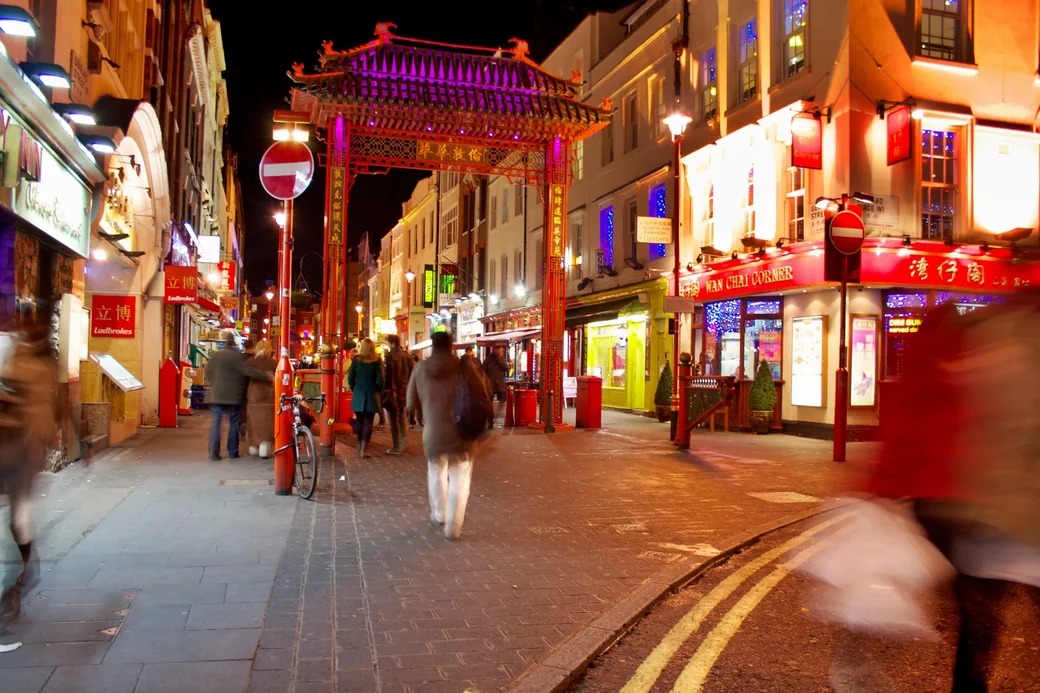
On the southern edge of Soho, Chinatown grew around Gerrard Street from the 1950s, when Chinese Londoners, many of them arriving from Hong Kong, opened restaurants and shops here after war damage to the older Chinatown in Limehouse. By 1970 it was the centre of the community. Lanterns, bilingual street signs and traditional gates define the streets; the gate on Wardour Street, completed in 2016, was made by artisans from China in Qing-dynasty style. The Lunar New Year celebrations, first organised here in 1985, are the capital's best-known.
The London Chinatown Chinese Association was founded in 1978. In the late 1980s the gates, a pagoda and street furniture were added, and Gerrard Street and parts of nearby streets were pedestrianised. Gerrard Street is only about 270 metres long, yet together with Lisle Street and Little Newport Street it holds a dense mix of restaurants, Asian grocers and importers.
Shopping in Soho: Carnaby Street, Liberty, Berwick Street Market and Record Shops
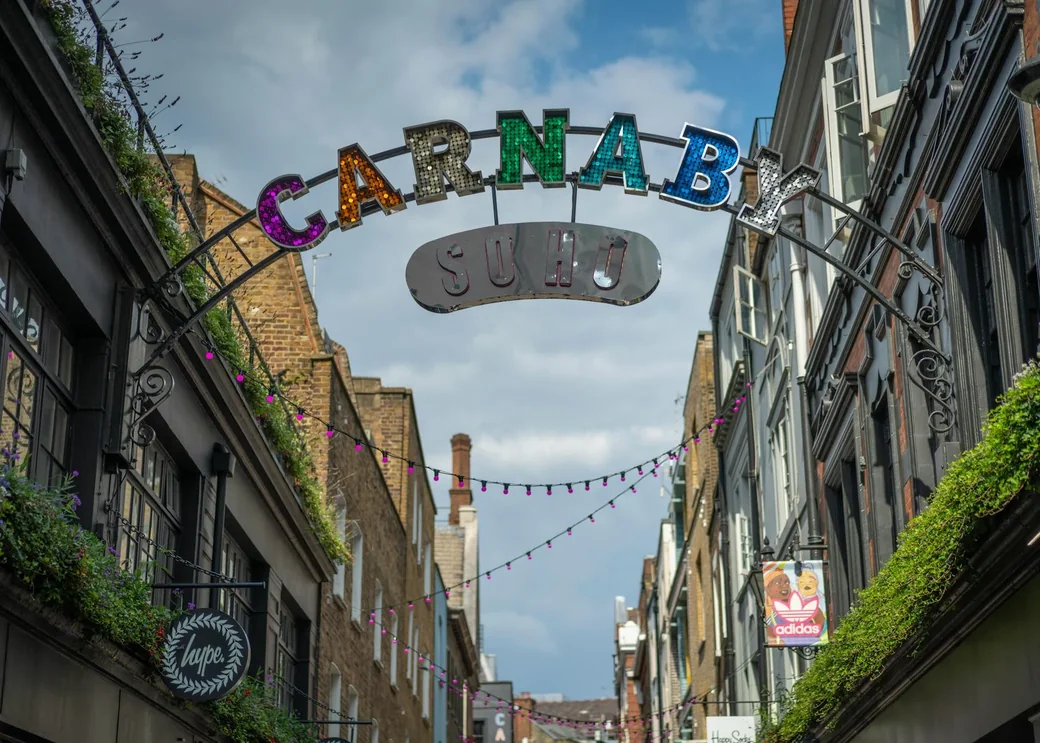
Carnaby Street, laid out in the 1680s and named after Karnaby House, became the fashion heart of 1960s Swinging London (the era's fashion and music boom) and has been pedestrianised since 1973. Around it you will find Kingly Court, a three-storey courtyard of cafes and boutiques, Newburgh Street, and Liberty on Great Marlborough Street with its half-timbered facade. Berwick Street Market has been formally organised since 1892 and today mixes street food with a few classic stalls, while the street keeps one of central London's densest clusters of independent record shops. Its pavement appears on a famous 1990s album cover.
Street trading on Berwick Street is said to have begun in the late 1770s, and tomatoes were reportedly first seen in London here in 1880 and grapefruit in 1890. In 2016 the traders gathered about 37,000 signatures to keep the market independent. Shops such as Reckless Records and Sister Ray line the street. Carnaby Street's first fashion boutique opened in 1957, and Kingly Street passes beneath the arch of Liberty, which carries the Liberty clock.
Where to Eat and Drink in Soho: Historic Cafes, Pubs and Restaurants
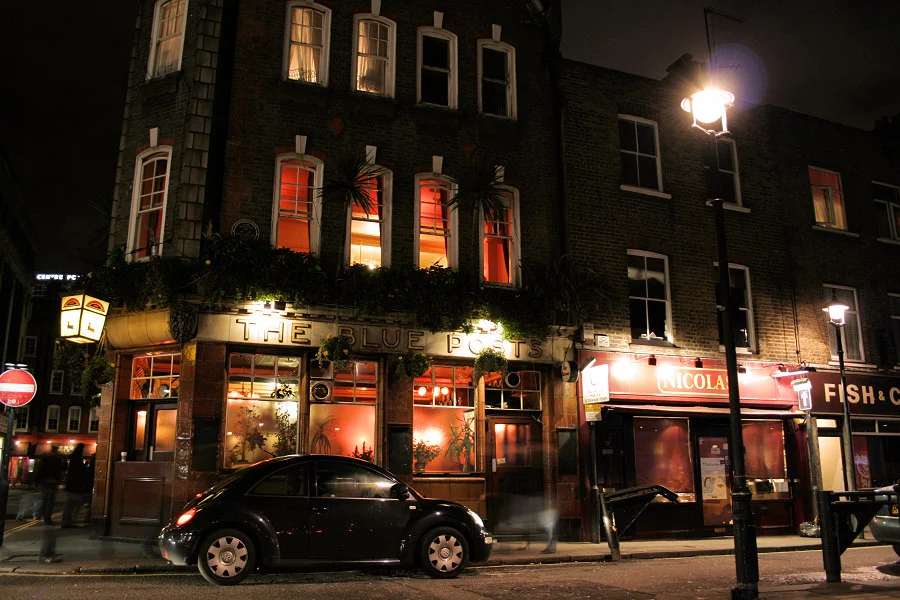
Soho's food scene is a layered history of migration. Maison Bertaux, founded in 1871 on Greek Street, is often called London's oldest patisserie, and L'Escargot, also on Greek Street, is regarded as the city's oldest French restaurant. Bar Italia on Frith Street has served espresso since 1949, Algerian Coffee Stores on Old Compton Street has sold coffee and tea since 1887, and the French House on Dean Street, Quo Vadis and Brasserie Zedel are long-standing favourites. Booking ahead is wise in the pre-theatre hours.
Bar Italia stands at Baird's old address on Frith Street. Quo Vadis on Dean Street opened in 1926 in a building that once housed Karl Marx. The French House at 49 Dean Street opened in 1891 as the York Minster pub, and its upstairs dining room followed in 1992. Algerian Coffee Stores at 52 Old Compton Street has been run by the Crocetta family since 1948, and Lina Stores is a much-loved Italian deli. Writers and painters long drank at the French House, the Coach and Horses on Greek Street and the former Colony Room.
LGBTQ+ Soho: Old Compton Street and London's Gay Village
Old Compton Street is the centre of London's best-known LGBTQ+ neighbourhood. Comptons of Soho opened in 1986 as the street's first gay venue, Village followed in 1991, and The Yard, with its open-air courtyard, in 1992. Bars, cafes, cabaret and clubs have since come and gone as rents change, so check current listings before you go. A plaque on the Admiral Duncan pub remembers the victims of the 1999 attack, and the pub remains a symbol of resilience. Soho is warmly welcoming, and most venues are open to everyone.
Comptons kept its front windows blacked out to protect customers from outside gazes. From 1986 Westminster used new licensing powers to curb the sex trade, and gay venues began to take over empty premises; the street's first gay shop, CloneZone, opened in 1992. The 1999 attack on the Admiral Duncan killed three people and injured seventy-nine.
Quiet Corners and Small Museums: Soho Square, Golden Square, St Anne's and More
Between the busy streets are pockets of calm. Soho Square, a public garden since 1954, has four lawns, a statue of Charles II and a half-timbered hut. Golden Square, with its statue of a king, was once home to foreign embassies, and Thomas Jefferson stayed there in 1786. The churchyard of St Anne's on Wardour Street is a peaceful courtyard beside the historic church tower. Art lovers can visit the Photographers' Gallery on Ramillies Street, the first public gallery in the United Kingdom devoted to photography, and the House of MinaLima, a Harry Potter graphic-art gallery and shop at 157 Wardour Street.
Soho Square was first called King Square after Charles II, whose statue by Caius Gabriel Cibber from 1681 stood above a fountain with figures of the Thames, Severn, Tyne and Humber. The fountain was removed in 1875 and the statue ended up at Grim's Dyke, the home of W. S. Gilbert, before returning in 1938 under the terms of Lady Gilbert's will. Golden Square was laid out from 1675 on land called Gelding Close, which explains its name, and which king its statue shows is debated. St Anne's church was built between 1677 and 1686; its first tower was completed in 1718 and replaced in 1801–1803 by the present tower designed by Samuel Pepys Cockerell. The church was burnt out in the bombing of 1940, the tower survived, and a new church building opened beside it in 1990. In summer Soho Square hosts open-air concerts.
The Seven Noses of Soho: The Quirkiest Treasure Hunt in London
Look up and you may spot small plaster noses fixed high on Soho walls. They are the work of the artist Rick Buckley, who in the 1990s secretly glued around thirty-five casts of his own nose to London buildings as a quiet protest against CCTV surveillance, and who only owned up in 2011. Reputedly, anyone who finds all seven noses will gain infinite wealth. Guides say only a few survive in Soho, for example near Quo Vadis on Dean Street, on Bateman Street and on Denmark Street, while the one on Meard Street is thought to be by another artist. Another tale claims the nose on Admiralty Arch is a spare for Nelson's statue; there is no evidence for it.
Buckley painted each nose to match its wall and hoped they would simply become part of the buildings. Guides also speak of an eighth, false nose and, by rumour, a mysterious ninth "ghost nose".
Legends and Rumours of Soho: Plague Pits, Secret Tunnels and Ghost Stories
Soho has more folklore than most districts. According to one rumour, the half-timbered hut in Soho Square hides a secret tunnel to Buckingham Palace; in fact it dates from the 1920s and was built to disguise the entrance to an electricity substation, which later served as an air-raid shelter. Reputedly, Golden Square was built over a mass grave from the 1665 plague, a story historians treat with caution. Legend has it that the French House serves only half pints because French sailors once smashed pint glasses in a brawl, and that Charles de Gaulle wrote his wartime appeal to the French upstairs. Theatre staff whisper of ghosts at the nearby Palace Theatre, including a ballerina said to be Anna Pavlova.
Because the square was once also called Monmouth Square, some people mistook the statue in Soho Square for the Duke of Monmouth, the king's illegitimate son; it shows Charles II. Theatre staff also say the composer Ivor Novello still watches shows from the back of the dress circle at the Palace Theatre, and that two balcony seats are left empty for ghostly guests.
When to Visit Soho: Best Times, Photo Spots and Annual Traditions
Mornings are calm and local, lunchtime is lively around Berwick Street Market, and evenings belong to theatres, music and bars. Weekend nights are the busiest, so choose side streets if you want quiet. Good photo spots include the Chinatown gates and lanterns, Carnaby Street's seasonal displays, the Broadwick Street mural, the tower of St Anne's and the half-timbered hut in Soho Square. Each summer the Soho Village Fete in St Anne's Gardens features the famous Waiters' Race, in which waiters sprint round the streets balancing a tray with a bottle, a glass and an ashtray.
The Waiters' Race, held since the 1950s, starts outside the French House, climbs Dean Street, circles Soho Square, passes Bar Italia and returns by Romilly Street; competitors may neither hold the tray nor drop it. The Soho Village Fete, first held in 1975 and run by volunteers of the Soho Society, also features snail racing, a "Human Fruit Machine" and a tug of war between the local police and fire service. Lunar New Year in Chinatown and Pride in London bring further crowds. Soho can be explored at any hour, and a single day can stretch from a quiet morning coffee to a late live-music set; each venue keeps its own opening times, so check the places you have in mind.
Soho Do's and Don'ts: Safety Tips, Etiquette and Nearby Places
Soho is generally safe and lively, but use common sense. Keep phones and bags secure in crowds, take taxis from official ranks or reputable apps rather than accepting offers from unlicensed minicabs (private hire cars that must be pre-booked), and be wary of strangers who steer you towards a particular bar. Do respect the people who live above the shops by keeping noise down late at night, and ask before photographing people. Within a short walk you can reach Covent Garden, Leicester Square, Piccadilly Circus, Trafalgar Square with the National Gallery, and Oxford Street.
Be especially wary of "clip joints", bars that lure customers in and then press them to overpay, and of unlicensed minicabs. Pickpockets work any crowded spot at busy hours, such as the edge of Oxford Street, so keep valuables close everywhere. Other places within easy reach include Mayfair, Fitzrovia and Regent Street.
Soho Street Names Explained and the District's Historic Places of Worship
Many Soho names are small history lessons. Old Compton Street honours Henry Compton, Bishop of London, and was laid out in the 1670s. Greek Street is named after a nearby Greek church, Poland Street after a pub called the King of Poland, Great Windmill Street after a windmill that once stood close by, Wardour Street after the landowner Edward Wardour, Berwick Street probably after the Duke of Berwick, Great Marlborough Street after the Duke of Marlborough and D'Arblay Street after the writer Frances Burney, Madame d'Arblay.
Places of worship tell the story of Soho's communities: St Anne's on Wardour Street, the Catholic church of Our Lady of the Assumption and St Gregory on Warwick Street (1788), St Patrick's on Soho Square (1792), the French Protestant Church of London on Soho Square (1893, in Flemish Gothic style) and the Hare Krishna temple near Soho Square (1979).
Soho in Books, Songs and Films: Literary and Pop-Culture Landmarks
Writers have long used Soho as a setting. Robert Louis Stevenson placed Mr Hyde's lodgings here in Strange Case of Dr Jekyll and Mr Hyde, Charles Dickens set the home of Lucie Manette and her father in Soho Square in A Tale of Two Cities and mentioned Golden Square in Nicholas Nickleby, and Joseph Conrad used the district in The Secret Agent.
Soho also appears in popular music: The Pogues' "A Rainy Night in Soho" and The Kinks' "Lola" are set in its nights, and The Who's "Pinball Wizard" mentions it. Edgar Wright's film Last Night in Soho takes its title and setting from the district.
Soho: Visitor Tips
Start early on a weekday for quiet streets and soft light, then follow the lunchtime crowd to Berwick Street Market. Wander the side alleys and courtyards, look up for blue plaques and the small plaster noses on the walls, and book restaurants and theatre tables ahead for the hours before the shows. Keep your phone and bag secure in crowds, choose licensed taxis late at night, and respect the people who live here by keeping noise down after dark. Comfortable shoes make the whole day easier.
Soho: Best Time to Visit
Weekday mornings for quiet streets, lunchtime for the market, evenings for theatre and music. Late spring to early autumn suits terraces and long daylight.
Soho: Admission Fees
Free admission
Wandering the streets of Soho and Chinatown, with their theatres, cafés and street life, is free; meals, shows and nightlife are paid for at each venue.
Free
Quick Info
3h
easy
Soho: Getting There
Soho is served by several Underground stations around its edges. Oxford Circus (Bakerloo, Central and Victoria lines) is the best choice for Carnaby Street and the north. Piccadilly Circus (Piccadilly and Bakerloo lines) suits Chinatown and the south-west. Tottenham Court Road (Central and Northern lines plus the Elizabeth line) is ideal for Soho Square and Dean Street, while Leicester Square (Northern and Piccadilly lines) and Covent Garden (Piccadilly line) are a short walk from the south and east.
Bus routes 12, 88 and 453 run along Regent Street, 14, 19 and 38 along Shaftesbury Avenue, and 14, 24, 29 and 176 along Charing Cross Road. Driving is not recommended: Soho lies inside central London's charging zones, the streets are narrow, and many are one-way or pedestrianised, so check Transport for London rules before you travel. On foot, Soho is about ten to fifteen minutes from Trafalgar Square and Covent Garden.
Nearby stops & parking
Nearest stations: Oxford Circus, Piccadilly Circus, Tottenham Court Road, Leicester Square and Covent Garden. The main bus stops are on Regent Street, Shaftesbury Avenue and Charing Cross Road.
Car parks: NCP Brewer Street, Q-Park Soho, Q-Park Chinatown on Newport Place and Q-Park Leicester Square. On-street metered bays are limited and often reserved for residents, so read the signs carefully or use the parking app approved in Westminster. For taxis, use licensed black cabs from the ranks or private hire booked through an app; drop-off is easiest on Shaftesbury Avenue, Charing Cross Road and Regent Street. Weekend night services run on several Underground lines, so confirm times with Transport for London.
Soho: Dress Code & Etiquette
There is no dress code for the streets of Soho. Comfortable walking shoes are the most useful item, and a light rain jacket is sensible in any season. Smart-casual (neat but relaxed) clothing suits theatres and upscale restaurants. When you step into churches such as St Anne's or into temples, cover bare shoulders if you can, speak softly and follow any signs about photography. In pubs, order at the bar and respect house customs; the French House, for example, serves beer by the half pint. Treat residents' doorways and quiet courtyards with respect, and ask before photographing people.