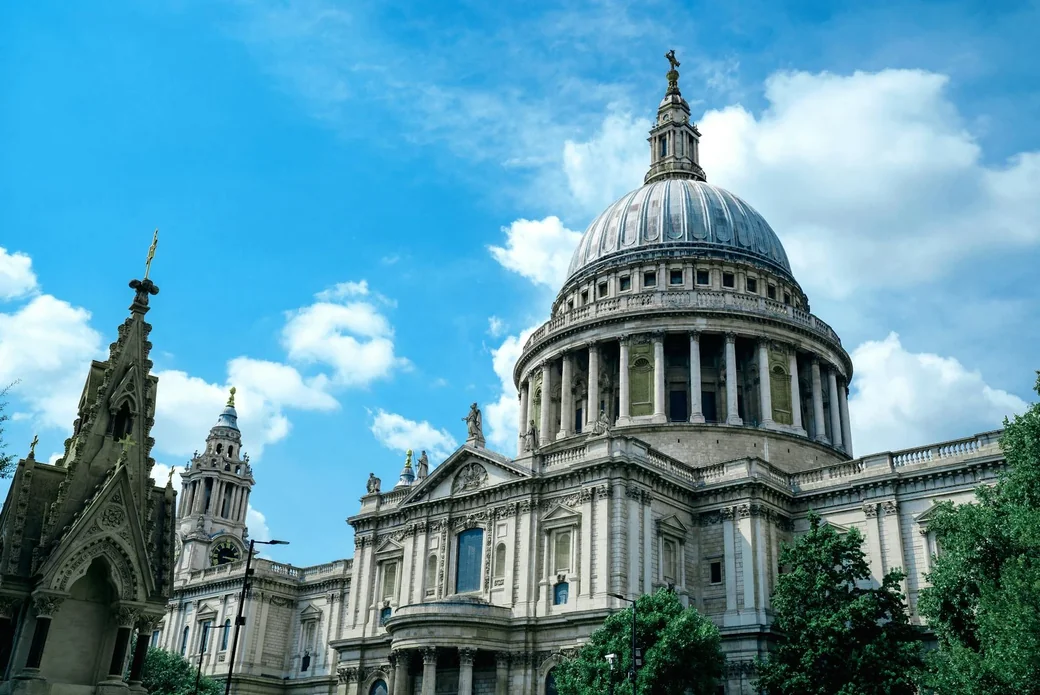
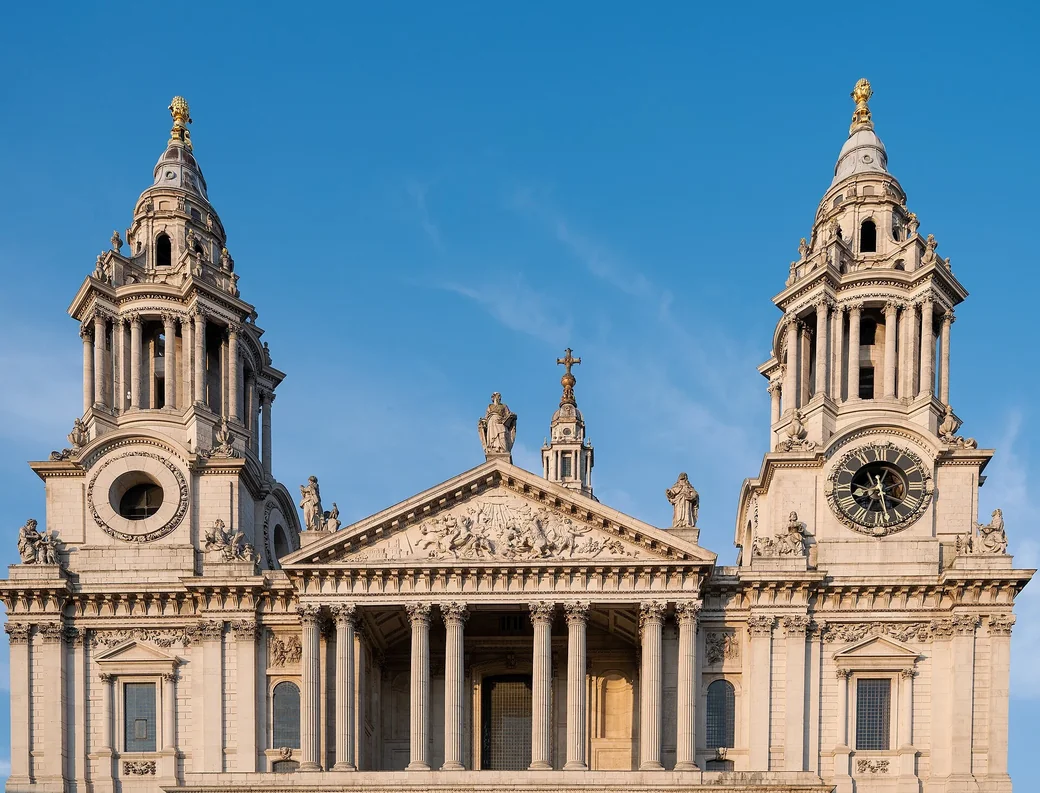
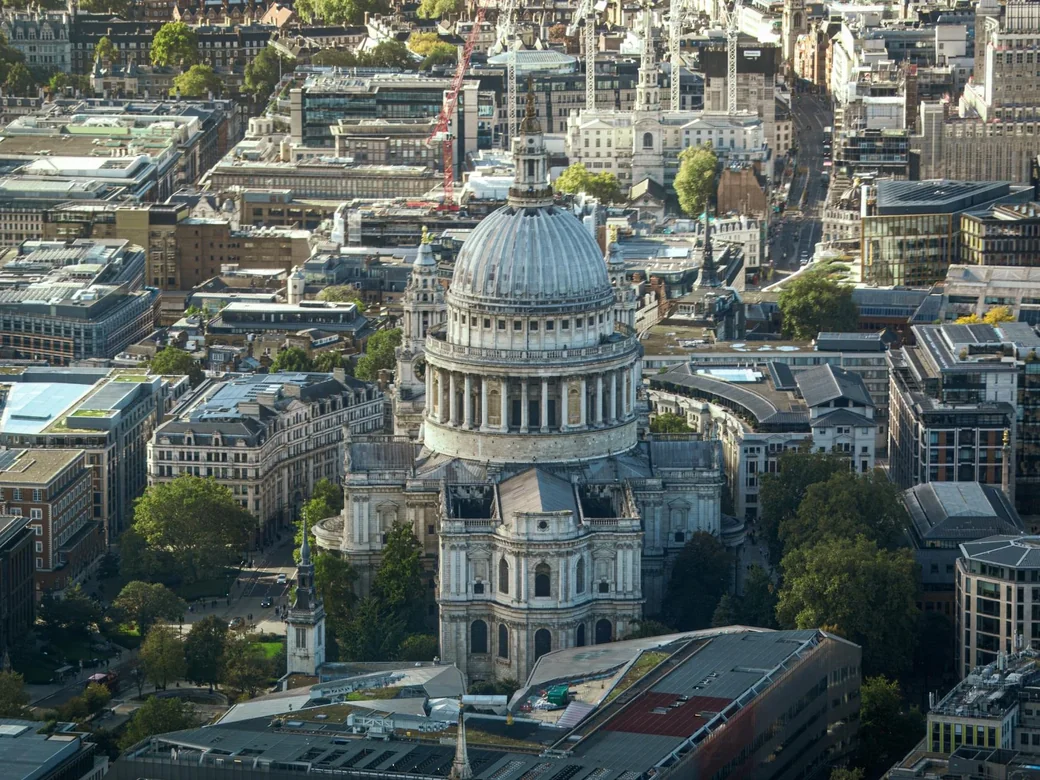
St Paul's Cathedral is the Anglican cathedral of London, standing on Ludgate Hill, the highest point of the City of London, the capital's historic financial district. Its great dome has been one of the defining shapes of the London skyline for centuries, and the building remains a working church as well as one of the city's best-loved landmarks. Visitors come to explore its richly decorated interior, its vast crypt and the galleries high up in the dome.
St Paul's Cathedral: Location, accommodation options and contact
St Paul's Churchyard, London EC4M 8AD
The place's location on the map and nearby accommodation and hotel options are shown by Stay22. Cookies are used. Your consent is remembered on every page; you can turn it off at any time in the cookie settings.
St Paul's Cathedral history: five churches on one hilltop since 604
A church dedicated to St Paul has stood on this hill since the year 604, when a bishop was installed in London. An early cathedral was followed by a vast medieval one, begun after a fire in 1087, consecrated in 1240 and enlarged over the following decades; its spire once reached about 149 metres. Centuries of wear, lightning, religious upheaval and the neglect of the 1640s left it fragile, even after a new classical portico by Inigo Jones. In 1666 the Great Fire gutted the old building and cleared the way for the fifth cathedral on the site: Wren's.
Sir Christopher Wren and the building of St Paul's Cathedral
Wren was formally asked to design the new cathedral in 1669. His early schemes, including a domed rotunda, a Greek cross and the oak-and-plaster Great Model of 1673, which still survives, were set aside, and in 1675 a Latin-cross Warrant Design won approval with permission for 'ornamental' changes. Wren used that freedom to rework almost everything, above all the dome. Building began in June 1675, the first service followed in 1697, the last stone of the lantern was laid in 1708 and the cathedral was declared complete in 1711, making it the only cathedral finished in its architect's lifetime. A tax on coal paid for much of it.
The dome of St Paul's: how three shells created London's skyline icon
The dome rises 111 metres to the top of the cross and is really three domes in one. The inner shell, seen from the floor, is low enough to feel intimate; the lead-covered outer shell is tall enough to rule the skyline; between them a brick cone, bound with iron chains, carries the stone lantern, which weighs about 850 tonnes. Wren drew both shells as catenary curves. The height is often linked to his love of astronomy. For roughly 250 years this was the tallest building in London, and the City's St Paul's Heights policy, in place since 1938, still protects key views of the dome from the river and its bridges.
Climbing the dome: 528 steps, the Whispering Gallery and the Golden Gallery
The galleries above the floor are reached by stairs only: 257 steps to the Whispering Gallery, 376 to the Stone Gallery and 528 to the Golden Gallery. In the Whispering Gallery, about 30 metres above the floor, a murmur spoken against the wall can be heard on the opposite side, and the view down shows Thornhill's paintings at close range. Quiet moments work best. The Stone and Golden Galleries are open-air balconies with 360-degree views over the river and the City. Strollers cannot be taken up, children need an adult, and the top gallery may be limited when it is busy. If heights worry you, the fly-through video on the multimedia guide is a good alternative.
Inside St Paul's: mosaics, carvings and works of art not to miss
Beneath the dome, look for Sir James Thornhill's eight scenes from the life of St Paul and the oculus at the apex, inspired by the Pantheon in Rome. The choir vaults glitter with mosaics by William Blake Richmond; the carved stalls and organ case are by Grinling Gibbons; the gilded gates are by Jean Tijou. Modern works sit comfortably alongside them: a copy of Holman Hunt's The Light of the World, Henry Moore's Mother and Child and Bill Viola's video altarpieces beside the high altar. The apse is a memorial chapel with a roll of honour of more than 28,000 names, and a small rocket is worked into its panelling.
The crypt of St Paul's: Nelson, Wellington and Wren's epitaph
The crypt runs beneath the whole cathedral and doubles as its foundation: half its volume is solid piers that spread the weight of the building above. It shelters more than two hundred memorials. Nelson lies in a marble sarcophagus originally made for a cardinal, and his coffin was made from the mainmast of an enemy flagship lost at the Battle of the Nile. Wellington rests close by. Wren was the first person buried here, in 1723; his Latin epitaph reads, 'Reader, if you seek his monument, look around you.' Florence Nightingale, J. M. W. Turner, William Blake and Alexander Fleming are also commemorated, and the café and shop are down here too.
Geometric Staircase, library and Treasures tour: behind the scenes at St Paul's
The Geometric Staircase (the geometric spiral stair) in the south-west tower is a Wren design: 88 stone steps spiral upward with no central support, each step carried by the one below and held only lightly in the wall. You cannot climb it, but you can see it on the Floor and Crypt tour or the Treasures tour, which also visits the restored library, the triforium and Wren's Great Model. The one-hour Treasures tour is an add-on with 141 steps and suits ages twelve and over; the Highlights and Floor and Crypt tours come with admission. Film fans will know the staircase from two Harry Potter films, and the cathedral also appears in Paddington 2, Sherlock Holmes and Mary Poppins Returns. The famous 1964 'Feed the Birds' scene, however, was filmed in a studio.
How St Paul's survived the Blitz: the St Paul's Watch and a famous photograph
In the Second World War the cathedral was guarded by the St Paul's Watch, about 200 volunteers, many of them architects who knew every roof space, patrolling day and night with stirrup pumps, buckets and sand. On the night of 29 December 1940, as fires raged across the City, they put out the incendiary bombs that fell on the roof and dome. Earlier, a delayed-action bomb had been defused by army engineers, who received the George Cross. Herbert Mason's photograph of the dome rising from the smoke became a symbol of resilience. The building was not untouched: the high altar was destroyed in 1940 and a bomb damaged the north transept in 1941. A tile in the floor honours the Watch.
Resurgam and the phoenix: the story of Wren's first stone
According to a family account written by Wren's son, when the site was cleared Wren asked a labourer to bring a stone to mark the centre of the future dome. The man fetched a piece of broken gravestone carved with a single Latin word: Resurgam, 'I shall rise again.' The story is a tradition and cannot be independently verified, but its symbol is real. Above the south transept door, the sculptor Caius Gabriel Cibber carved a phoenix rising from flames with the word Resurgam beneath it, a fitting emblem for a church that rose from the ashes of 1666. Look for it when you leave by the south side.
Legends of St Paul's Cathedral: a ghost, bells, a cask and a Roman temple
Several stories cling to the cathedral and are best read as folklore. It is said that a temple of Diana once stood on this hilltop; Wren, who dug the new foundations, found no trace of one. Local lore describes an old clergyman who whistles tunelessly in a chapel before fading into a wall, behind which, the tale goes, a hidden staircase was later found. The great bell Great Tom is said to strike oddly before the death of a royal. A sailors' tale claims the brandy that preserved Nelson on his voyage home was secretly drunk, which historians doubt. And it is said that Wren quietly changed the approved design far beyond what was allowed: the changes are real, the secrecy is storytelling. Accounts of how many people fitted inside the golden ball, once open to adventurous visitors, differ widely.
Evensong, organ and bells: music and great ceremonies at St Paul's
St Paul's has hosted great public moments: the funerals of Nelson, Wellington and Churchill, thanksgiving services for jubilees and the end of the Second World War, and the 1981 royal wedding, held here for its larger seating. Evensong is held every day in the late afternoon (earlier on Sundays), sung by the choir in term time and open to all; the choir's roots go back to 1127, and in 2024 girls joined it as full choristers. The Grand Organ has more than 7,000 pipes and a case carved by Gibbons. In the towers hang Great Paul, a bell of almost seventeen tonnes that is rung by hand on special days, the hour-striking Great Tom and a ring of twelve change-ringing bells.
Best photo spots and nearby sights around St Paul's Cathedral
The classic front view is from the west steps and churchyard, but the finest framing is from the Millennium Bridge, where the dome rises at the end of the river crossing; go at dusk when the stone glows. The public roof terrace at One New Change, just opposite, gives an eye-level look at the dome. Paternoster Square behind the cathedral is quiet and good for details of the east end, and the gardens in the churchyard trace the footprint of the medieval church. Across the bridge are Tate Modern and Shakespeare's Globe; on foot you can reach Postman's Park, Guildhall and Temple Church in about fifteen minutes.
Planning your visit to St Paul's: timed entry, duration and best time to go
Tickets are timed: you choose a date and an entry time online, arrive within your slot, and enter at the west end after a security check. Bookings can be changed ahead of the visit. Plan on about two hours, or up to three if you climb the dome and join a tour. Sightseeing runs Monday to Saturday, the building is a place of worship on Sundays, and services or events can change the hours of a day, so check the calendar before you go. Arrive as the doors open or in the late afternoon to avoid the midday crowds, then finish with Evensong. A standard ticket covers the cathedral floor, the crypt, the dome galleries and a multimedia guide.
St Paul's Cathedral dos and don'ts: photography, bags and etiquette
Bags above the cathedral's size limit are not admitted and there is no cloakroom, so travel light or use a nearby luggage-storage point. Food and drink are not allowed on the cathedral floor apart from water in a transparent container; glass bottles, alcohol and drones are banned. Photography without flash is welcome for personal use on the floor, in the crypt and on the two outdoor galleries, but not in the Whispering Gallery, in St Dunstan's Chapel or during services; video, tripods, monopods and selfie sticks are not allowed. Keep your voice low, silence your phone and keep your ticket with you.
Accessibility and family visits at St Paul's: lifts, stairs and guides
The North Transept entrance is ramped and leads straight onto the floor. Wheelchairs are available on request, a lift serves the crypt (usable space 1.4 × 1.3 metres) and a small stair lift reaches the choir. The dome galleries and triforium are stairs only. Support includes a hearing loop, signed and audio-described guides, touch tours for visitors with sight loss, assistance dogs, accessible toilets and a Changing Places facility (a large toilet with an adult changing bench), plus complimentary admission for a disabled visitor and one companion. Multimedia guides come in nine languages with a family version, while guided tours run in one language only. Children aged six to seventeen need a child ticket and an adult in the dome.
Hidden details at St Paul's: Wren's secrets, Donne's statue and a horse in church
Wren's pay was cut by half until the work was finished, and, according to one theory, he turned the whole building slightly away from due east so that it faces the sunrise on Easter Day of the year work began. Look for the eight great piers that carry the dome, the screen walls that hide the flying buttresses, and the gilded pineapples on the west towers; the balustrade along the roofline was added in 1718 against his wishes. Inside, the statue of John Donne, who posed in a shroud, survived the Great Fire of 1666. The huge Wellington monument waited until 1912 for its horse, because a horse inside a church had drawn objections. The OBE Chapel in the crypt and the Remember Me memorial are easy to miss.
St Paul's in art and history: rescuing the dome, great paintings and installations
The great building has needed rescuing more than once. By 1924 the settling of the dome and its piers led to a safety notice; concrete, steel rods and an iron chain were added, and the rededication service of 1930 was broadcast on the radio. A long programme of cleaning and repair was completed in 2011. Canaletto, Turner, Pissarro, Signac and Derain painted the cathedral, and contemporary artists such as Antony Gormley and Gerry Judah created works for it. Today a trail with explanatory texts sets some memorials in their historical context. The cathedral is a charity without regular state funding, so visitor income helps to care for the building.
St Paul's Cathedral: Visitor Tips
Book a timed slot, travel light because there is no cloakroom, climb the dome early in the day, join a free introductory tour, stay for Evensong, and take your photos from the Millennium Bridge at dusk. Sightseeing runs Monday to Saturday; on Sunday the cathedral is open for worship only, although in the warmer half of the year the dome galleries also open for a short Sunday afternoon window. On a few days the doors open later than usual, so check the day's times before you set out.
St Paul's Cathedral: Best Time to Visit
Weekday mornings at opening or after mid-afternoon; Evensong in the late afternoon; clear spring and autumn days for dome views; dusk for photos from the Millennium Bridge.
St Paul's Cathedral: Admission Fees
Adult (18+)
Visit the Cathedral Floor, the Crypt and the three Dome Galleries, the Whispering Gallery, Stone Gallery and Golden Gallery, with a multimedia guide included; sightseeing runs Monday to Saturday, and attending a service is free of charge. Full fare for adult visitors aged 18 and over.
£27
Senior / student
Visit the Cathedral Floor, the Crypt and the three Dome Galleries, the Whispering Gallery, Stone Gallery and Golden Gallery, with a multimedia guide included; sightseeing runs Monday to Saturday, and attending a service is free of charge. Reduced fare for seniors aged 65 and over and students aged 18 and over with a valid photo ID.
£24
Child (6–17 years)
Visit the Cathedral Floor, the Crypt and the three Dome Galleries, the Whispering Gallery, Stone Gallery and Golden Gallery, with a multimedia guide included; sightseeing runs Monday to Saturday, and attending a service is free of charge. Fare for children aged 6 to 17, who must be accompanied by an adult aged 18 or over.
£10.50
Children under 6 (free)
Children under 6 enter free of charge.
Free
Family ticket – 2 adults + 2 or 3 children (6–17 years)
Visit the Cathedral Floor, the Crypt and the three Dome Galleries, the Whispering Gallery, Stone Gallery and Golden Gallery, with a multimedia guide included; sightseeing runs Monday to Saturday, and attending a service is free of charge. One ticket covers two adults travelling with two or three children aged 6 to 17, at a lower cost than buying each ticket separately.
£64.50
Family ticket – 1 adult + 2 or 3 children (6–17 years)
Visit the Cathedral Floor, the Crypt and the three Dome Galleries, the Whispering Gallery, Stone Gallery and Golden Gallery, with a multimedia guide included; sightseeing runs Monday to Saturday, and attending a service is free of charge. One ticket covers one adult travelling with two or three children aged 6 to 17, at a lower cost than buying each ticket separately.
£37.50
Disabled visitor and one companion (free)
Visit the Cathedral Floor, the Crypt and the three Dome Galleries, the Whispering Gallery, Stone Gallery and Golden Gallery, with a multimedia guide included; sightseeing runs Monday to Saturday, and attending a service is free of charge. Visitors with a disability are admitted free of charge and may bring one carer or companion free as well.
Free
Quick Info
2h 30m
moderate
St Paul's Cathedral: Getting There
The simplest way is the Tube: St Paul's station on the Central line is about 270 metres away, a three-minute walk straight to the churchyard. City Thameslink is 300 metres away and Blackfriars, with Underground and national rail services, is about 500 metres, or seven minutes on foot. Many bus routes stop around the cathedral and Cannon Street. By river, Uber Boat services call at Blackfriars Pier (650 metres, about nine minutes) and Bankside Pier (900 metres, about twelve minutes). Santander Cycles docking stations stand within 300 metres. Driving is not recommended: street parking is very limited and the closest public car park is Baynard House on Queen Victoria Street, around 400 metres away.
Nearby stops & parking
The closest stops are St Paul's (Central line), City Thameslink and Blackfriars. Free bicycle racks line several nearby streets and hire-bike docks are within a three-minute walk. Baynard House car park on Queen Victoria Street is the nearest public car park, about six minutes on foot. Coach bays are on Angel Street, St Martin's Le Grand and Queen Victoria Street. Disabled badge holders can check the City's online map of bays, and minibus drop-off can be arranged with reception on +44 20 7246 8350. Luggage-storage points nearby accept larger bags.
St Paul's Cathedral: Dress Code & Etiquette
No formal dress code is published, but this is a working place of worship, so modest, comfortable clothing is appreciated, ideally with covered shoulders and knees, especially during services. Wear flat, grippy shoes for the stairs. Keep your voice low, silence your phone, remove headphones, and do not eat or drink inside. Be considerate towards worshippers and avoid photographing people at prayer.