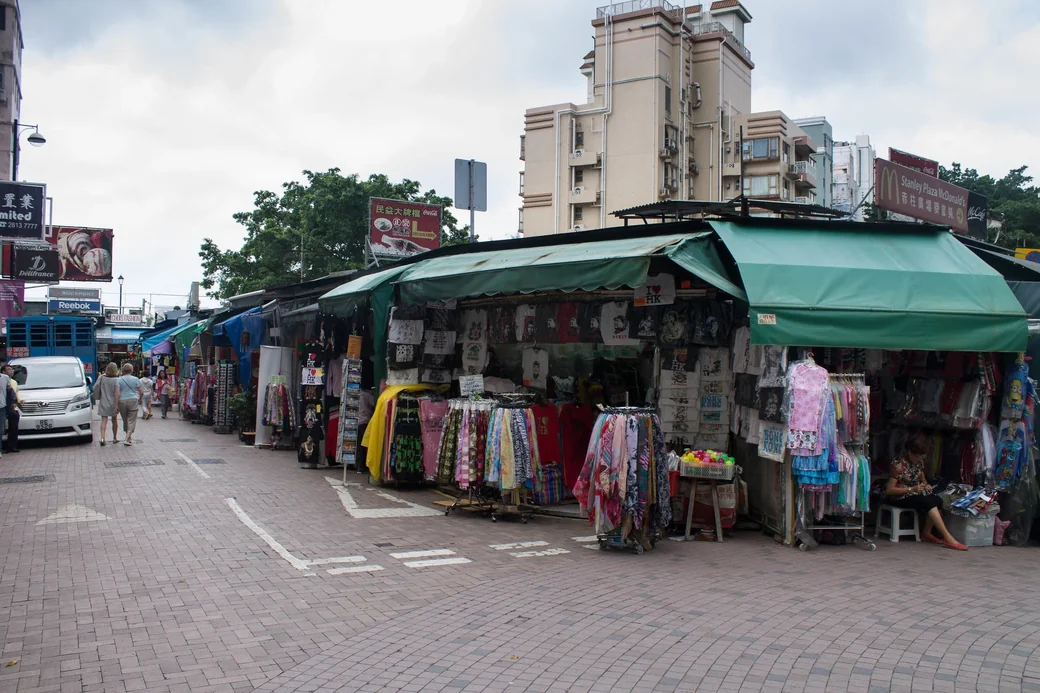
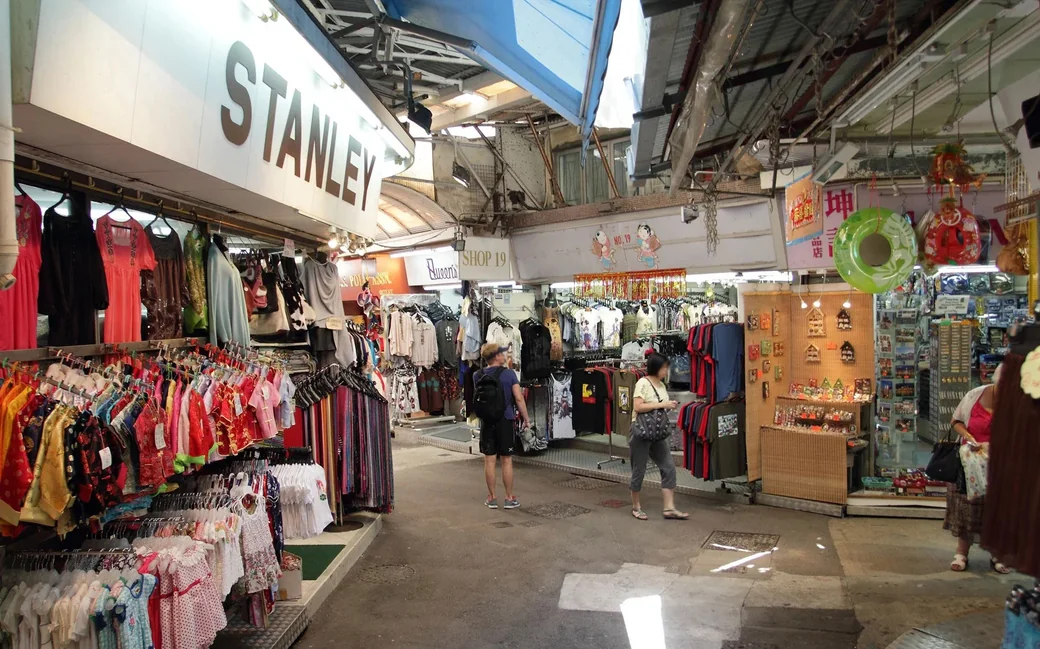
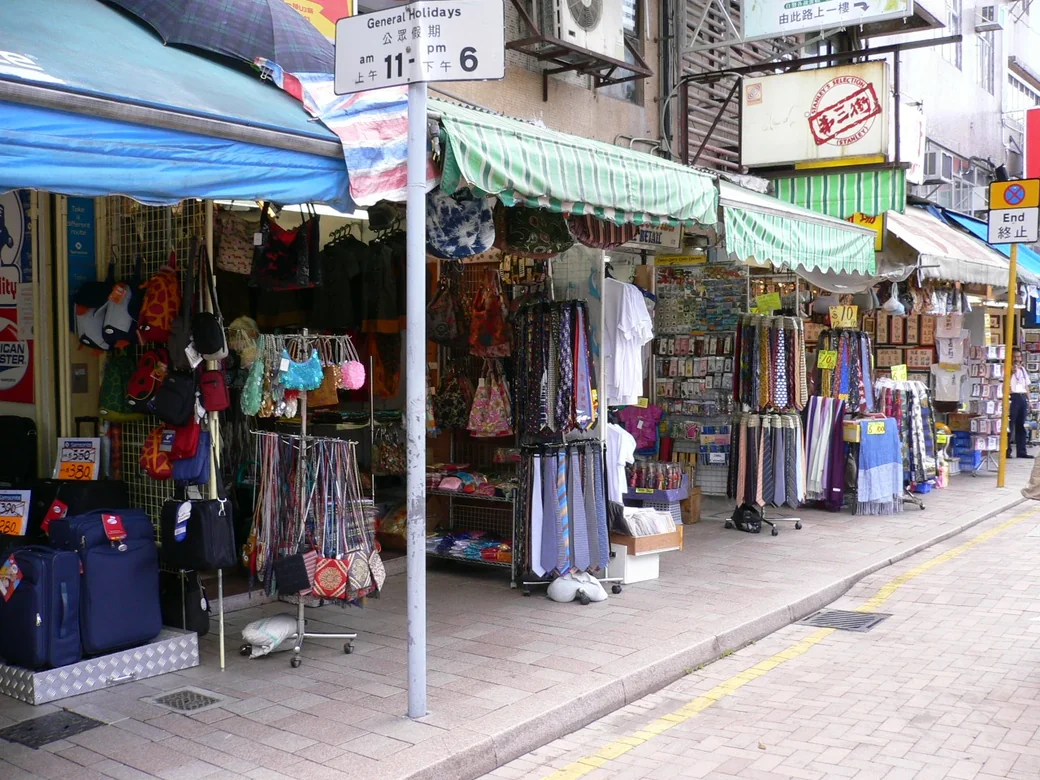
Stanley Market is one of Hong Kong's best-known open-air markets, set in the seaside town of Stanley on the southern coast of Hong Kong Island. Its narrow lanes are packed with shops selling fashion, gifts and souvenirs, and it has long been a favourite place for unhurried browsing and present hunting. What sets it apart is its relaxed setting by the sea: the market sits just behind the bay, so a stroll through the stalls blends naturally into time by the water.
Stanley Market: Location, accommodation options and contact
Stanley New Street and Stanley Market Road, Stanley, Southern District, Hong Kong Island, Hong Kong
The place's location on the map and nearby accommodation and hotel options are shown by Stay22. Cookies are used. Your consent is remembered on every page; you can turn it off at any time in the cookie settings.
Stanley Hong Kong history: from Chek Chue fishing village to market town
Chek Chue (“Red Pillar”) is recorded on a Ming-dynasty map drawn between 1577 and 1595, so the village is far older than its English name. In 1841 it was the largest settlement on Hong Kong Island, with around two thousand residents, and it acted as a temporary administrative centre before Victoria City grew. The name Stanley honours Lord Stanley, the Colonial Secretary of the day. The Tanka (boat-dwelling fishing communities) sheltered in Stanley Bay and nearby Tai Tam Bay, and the official record of Pak Tai Temple notes that Stanley was the island's biggest fishing village, with more than two thousand fishermen. Today the market keeps that harbour-town character.
Why is Stanley called the Red Pillar? Stories behind the name Chek Chue
The Chinese name Chek Chue means “red pillar”, and its original meaning has been lost. According to one rumour, red-flowering cotton trees once stood here and looked like crimson pillars in the morning light. Another account says the reddish rocks, or the glow of sunset on them, resembled red pillars seen from the sea. A Qing-era tale tells of a typhoon that flattened everything except one battered cotton tree, which stood like a red pillar. According to a further rumour, the name echoes a phrase meaning “bandits' dwelling” from the days of pirates, though historians point out that the name is recorded from the Ming dynasty onwards.
Stanley Market shopping guide: lanes, silk, paintings and souvenirs
Rather than a single hall, Stanley Market is a living street of independently run shops. The market occupies the lanes of Stanley New Street and Stanley Market Road, and most of it is covered, so you can browse in any weather. From Stanley Village Bus Terminus, follow the signs down the steps into the village and the lanes appear within a few minutes. Shops sell clothing in Western and Chinese styles, silk garments, accessories, jewellery, leather goods, paintings, handicrafts, chopsticks, greeting cards and carved name seals. Wander slowly, because each lane has its own mix. A personalised name seal or a silk piece makes a lasting reminder of Hong Kong.
How to bargain at Stanley Market: friendly tips for a good deal
Bargaining is expected at Stanley Market and is part of the pleasure. Greet the shopkeeper, look closely at the item, then ask the price and suggest your own with a smile. A calm, cheerful tone usually makes the exchange easy, and thanking the seller warmly if you decide to move on keeps everyone happy. Comparing two or three shops before buying helps you recognise a fair price, and many visitors enjoy choosing several gifts from one friendly shop. Silk, leather and carved seals are worth examining in good light.
Best time to visit Stanley Market and where to take photos
Weekday mornings, before the sun climbs and the crowds arrive, are the calmest time to explore, while weekends are livelier. Individual shops set their own hours, with most of the market open from the morning until early evening. October to December usually brings the clearest and driest weather, and the roofed lanes keep rainy days enjoyable. For photographs, try the colourful lanes around midday, the colonnaded verandas of Murray House in late afternoon, the pavilion roof of Blake Pier, and the view across Stanley Bay from Ma Hang Park. In typhoon season, check the Hong Kong Observatory warnings before you travel.
How to get to Stanley Market by bus from Central
Board a Citybus at the Exchange Square bus terminus beneath the IFC, near Central and Hong Kong MTR stations. Routes 6, 6A, 6X, 66 and 260 serve Stanley, and the ride usually takes less than an hour. Routes 6, 6A and 66 climb through the hills for the best views, while 6X and 260 pass through the Aberdeen Tunnel and travel more directly. Boarding at the terminus gives you the pick of the seats, and the front of the upper deck is the favourite. Routes 6, 6A, 6X and 260 stop at Stanley Village Bus Terminus, and route 66 ends at Stanley Plaza. Tap an Octopus card (Hong Kong's rechargeable contactless travel card) as you board.
Stanley Market by minibus, taxi or car: more ways to arrive
Green minibus 40 runs from Causeway Bay to Stanley Village near Stanley Main Beach and is a quick, popular choice. Bus 973 links Tsim Sha Tsui in Kowloon with Stanley, route 14 comes from Sai Wan Ho, minibus 16M from Chai Wan MTR, route 73 from Cyberport and route 63 from the Causeway Bay side. MTR travellers can change at Central, Causeway Bay or Chai Wan, or ride the South Island Line to Ocean Park for onward buses and minibuses. Red taxis from across Hong Kong Island reach Stanley easily. Drivers can park at the Stanley Plaza car park on Carmel Road, a short walk from the waterfront.
Murray House Stanley: the 1846 colonial building rebuilt stone by stone
Murray House was built in 1846 in Central as officers' quarters for Murray Barracks and named after Sir George Murray, Master-General of the Ordnance. Its neoclassical design has heavy stone arches below and lighter Doric and Ionic columns above, with verandas on every side to suit the subtropical climate. In 1982 it was dismantled to make way for the Bank of China Tower, with more than 3,000 blocks labelled and stored. It was rebuilt in Stanley and reopened in the early 2000s beside Stanley Plaza. Stroll the colonnaded verandas for sea breezes and views over the bay.
Blake Pier Stanley: the relocated pier with a historic roof
Blake Pier is named after Sir Henry Arthur Blake, the twelfth Governor of Hong Kong, and began life as a ferry pier in Central. Its roof structure was first moved to Morse Park in Kowloon, then in 2006 transferred to Stanley beside Murray House, where the pier was recommissioned on 31 July 2007. Surveyors recorded the roof with 3D laser scanning before the move. Today it is a favourite spot to watch boats, enjoy the sea breeze and photograph the pavilion roof against the bay, just a short walk from the lanes along the promenade.
Stanley Tin Hau Temple: 1767 bell, tiger skin and crab-head legend
Tin Hau Temple was built in 1767 by fishermen led by Chan Shun-chak, when Stanley was the island's largest fishing village. Tin Hau (Queen of Heaven, protector of seafarers) is honoured in a two-hall, one-courtyard plan, and the temple keeps a bell cast in 1767 and an iron weight of the same period. A tiger skin from the 1940s hangs inside and is believed to ward off evil. As local lore has it, Stanley's shape resembles a crab and the temple stands on its head, which in feng shui (Chinese geomancy) keeps the crab from wandering. According to another story, a bomb that fell just outside the temple in wartime did not explode. Worshippers celebrate Tin Hau's birthday on the 23rd day of the third lunar month.
Pak Tai Temple and Ma Hang Park: a seaside walk above Stanley Bay
Pak Tai Temple (Pak Tai means Northern Emperor; a Taoist protector of the sea) was built in 1805 by fishermen using rocks from the hillside. Simple white walls and a green-tiled roof sit above the shore, and a cloud-shaped gong dated 1805 is its most treasured relic. As local lore has it, the pirate Cheung Po Tsai built it and dug secret tunnels to a cave at Chung Hom Kok, later filled in. Ma Hang Park, opened on 17 January 2011, covers 50,000 square metres with a Butterfly Garden, a Bird Watching Corner and an Education Trail, plus boards introducing local birds, butterflies and plants.
Pat Kan Uk Stanley: the Eight Houses beside the sea
Pat Kan Uk (“Eight Houses”) is a row of eight small single-storey houses on the seafront at the southern end of Stanley. They were built in the early 1930s as compensation for families whose land at Wong Ma Kok was needed for a military camp. Brick walls, green door and window frames and a traditional tiled roof give the row its charm. It is a Grade III historic building, and people still live here, each house with its own street number from one to eight. Enjoy the view from the path, keep voices low and photograph from a respectful distance.
Stanley Post Office: Hong Kong's oldest post office still in service
Stanley Post Office, at 2 Wong Ma Kok Road, has served since 1937 in its original building, making it the oldest post office in Hong Kong still in service. It began in 1912 as a postal counter inside Stanley Police Station. The single-storey building has a timber roof and window grilles bearing the “GR” (George Rex) cypher of King George VI. A restoration in 2007 re-exposed the terrazzo floor and wooden roof structure, rebuilt the counters in their 1930s style and reinstated a stamp vending machine and a post box bearing the royal cypher. With Grade 2 historic status, it is a charming stop for postcards.
Stanley Main Street waterfront: Yellow House, promenade and sea views
The waterfront along Stanley Main Street is lined with restaurants, cafés and bars facing the bay, and the Stanley Promenade links them to Murray House and Blake Pier. The bright Yellow House at nos. 86 and 88, a Grade III historic building, was painted blue for years and became yellow in 2015; as local lore has it, feng shui (Chinese geomancy) played a part in the change. Beside Murray House, Stanley Plaza (opened in 2001) has an outdoor amphitheatre that hosts concerts and events through the year. The rooftop garden of the Stanley Municipal Services Building, opened in 2006, offers another view over the harbour. Linked together, the market lanes, the waterfront, the temples, Ma Hang Park and the beaches easily turn a shopping stop into a relaxed half-day by the sea.
Stanley beaches and dragon boat races: Main Beach and St Stephen's Beach
Stanley has two sandy beaches. Stanley Main Beach on the eastern side has barbecue areas, shark nets and a water sports centre, and is popular with windsurfers. St Stephen's Beach on the western side is a secluded spot a short stroll away. Each year around the Tuen Ng Festival (Dragon Boat Festival, held on the fifth day of the fifth lunar month), Stanley Main Beach hosts the Stanley Dragon Boat Championships, when teams paddle long decorated boats along the bay. Visiting on race day adds a festive atmosphere to a Stanley outing.
St Stephen's College Heritage Trail and other heritage walks near Stanley
St Stephen's College was founded in 1903 and moved to its Stanley campus in 1930. Its 15-hectare grounds are the largest of any secondary school in Hong Kong, and its School House, completed in 1930, was declared a monument in 2011. It is the first school in Hong Kong with its own Heritage Trail on campus, and visits follow the school's own schedule. Nearby, the Old Stanley Police Station of 1859 is a declared monument, and Section 1 of the Wilson Trail begins in Stanley for hikers heading into the hills.
Visiting Stanley respectfully: temples, homes and local etiquette
Stanley's temples are active places of worship, so modest clothing, a quiet voice and a polite request before photographing worshippers are appreciated. Incense, offerings and festivals such as Tin Hau's birthday are part of daily life. Pat Kan Uk and many waterfront houses are private homes, and enjoying them from the path honours the residents. The post office and the shops are working businesses, so a friendly greeting goes a long way. Signs appear in Chinese and English, and shopkeepers are used to welcoming visitors from around the world. These small courtesies make every encounter warmer.
Stanley Market: Visitor Tips
Weekday mornings are the calmest time to browse, and weekends bring the liveliest crowds. The lanes are largely covered, so a rainy day works well, and October to December usually offers the clearest, driest weather. Each shop sets its own hours, so arriving by early afternoon gives you the full choice. Greet the shopkeeper, ask the price and bargain with a smile; it is part of the fun. Carry an Octopus card (Hong Kong's rechargeable contactless travel card) for the bus home. After the lanes, walk the promenade to Murray House and Blake Pier, then continue to the temples and Ma Hang Park for views over Stanley Bay. In typhoon season it is wise to check the Hong Kong Observatory warnings before travelling to the south coast.
Stanley Market: Best Time to Visit
Weekday mornings from opening until midday are the quietest. October to December brings the clearest, driest air; late afternoon suits the waterfront and Murray House.
Quick Info
1h
Stanley Market: Getting There
From Central, take a Citybus from the Exchange Square bus terminus beneath the International Finance Centre (IFC), a short walk from Central and Hong Kong MTR stations. Routes 6, 6A, 6X, 66 and 260 all run to Stanley, and the journey typically takes under an hour. Routes 6, 6A and 66 wind over the hills with the most scenic views, while 6X and 260 use the Aberdeen Tunnel and suit anyone who prefers a straighter ride. Routes 6, 6A, 6X and 260 stop at Stanley Village Bus Terminus, a couple of minutes' walk from the market; route 66 ends at Stanley Plaza, from where escalators lead down to the waterfront. From Causeway Bay, green minibus 40 is a quick alternative, and bus 973 runs from Tsim Sha Tsui in Kowloon. Other links include route 14 from Sai Wan Ho, minibus 16M from Chai Wan MTR, route 73 from Cyberport and route 63 from the Causeway Bay side. Stanley is served by buses, minibuses and taxis, so MTR passengers change at Central, Causeway Bay, Chai Wan or Ocean Park (South Island Line). Citybus routes 6, 6X and 260 operate wheelchair-accessible buses.
Nearby stops & parking
Stanley Village Bus Terminus is the main stop, about two to three minutes' walk from the market. Green minibus 40 from Causeway Bay arrives at Stanley Village near Stanley Main Beach, a few minutes from the lanes. Bus 66 ends at Stanley Plaza, roughly ten minutes on foot from the market via the plaza escalators. A taxi rank serves the area, and Hong Kong Island taxis are red. Drivers can use the car park at Stanley Plaza on Carmel Road, and Link also runs the Ma Hang car parks nearby. Public transport is the relaxed way to arrive on busy weekends.
Stanley Market: Dress Code & Etiquette
Light, comfortable clothing and walking shoes suit the market and the seafront. In the Tin Hau and Pak Tai temples, modest clothing, a quiet voice and a polite request before photographing worshippers are appreciated. The eight houses of Pat Kan Uk are private homes, so enjoy them from the path and keep voices low.
Stanley Market: Amenities & Facilities
Covered lanes (rain and sun shelter)
Public beach a short walk away
Seafront promenade
Bus terminus within a few minutes' walk
Restaurants, cafés and bars along the waterfront
Historic working post office at the edge of the market
Public library and rooftop garden at the municipal services building