Tate Britain is London's national gallery of British art, with works ranging from 1500 to the present day. It stands on the north bank of the Thames at Millbank, a short walk upriver from the Houses of Parliament, in a stately classical building facing the water. Its rooms bring together paintings, sculpture and works on paper by the artists who shaped art in Britain, and the gallery is best known for Turner, the Pre-Raphaelites and modern names such as Hockney and Bacon.
Tate Britain: Location, accommodation options and contact
Millbank, London SW1P 4RG
The place's location on the map and nearby accommodation and hotel options are shown by Stay22. Cookies are used. Your consent is remembered on every page; you can turn it off at any time in the cookie settings.
Tate Britain History: From Millbank Penitentiary to National Gallery
The ground beneath Tate Britain has a story few galleries can match. In 1799 the philosopher Jeremy Bentham bought this riverside plot on the Crown's behalf, intending to build his famous panopticon prison (a circular design that lets one guard watch every cell). That plan was dropped, and a different design opened in 1816 as Millbank Penitentiary, the first national penitentiary. Its walls enclosed some sixteen acres in an irregular octagon, and people sentenced to transportation were held here before boarding boats bound for overseas penal colonies. The prison closed in 1890 and was cleared, and the gallery rose on part of the site only a few years later. The angled streets around the building still echo the old star-shaped plan, and a stone bollard (mooring post) by the river marks the former landing steps.
Sir Henry Tate: The Sugar Merchant Who Gave London a Gallery
Henry Tate, born in Chorley in 1819, began as a grocer's apprentice and rose to become one of the great sugar refiners of his age. In 1889 he offered his collection of contemporary paintings, sixty-five works in all, to the nation and funded a gallery to house them. His gift, formally presented in 1894, also included Ophelia and The Lady of Shalott, favourites of the Pre-Raphaelites (a mid-nineteenth-century circle of painters devoted to vivid colour and fine detail). The architect Sidney R. J. Smith designed the building, and the heir to the throne opened it on 21 July 1897 as a national gallery for art made in Britain, with the public admitted in mid-August. Visitors simply called it the Tate Gallery, and that became its official name in 1932. Tate reportedly refused the title of baronet (a hereditary honour) more than once before accepting it. The Duveen family later paid for the Turner rooms and the sculpture galleries. When Tate Modern opened in 2000, the Millbank building became Tate Britain.
Tate Britain Architecture: Portico, Duveen Galleries and the Clore Gallery
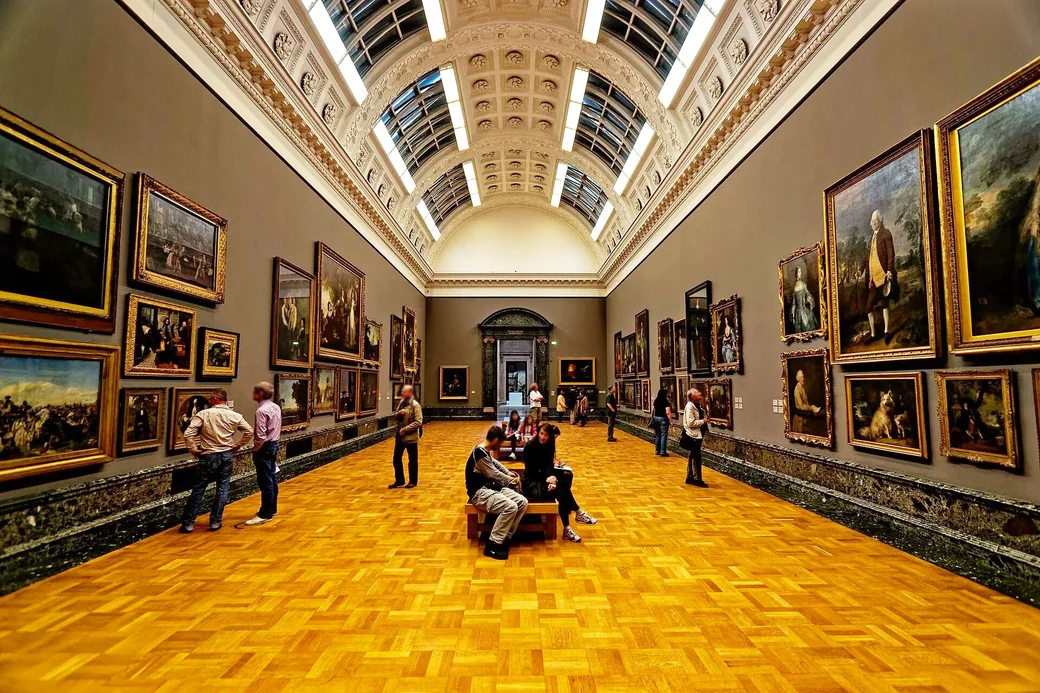
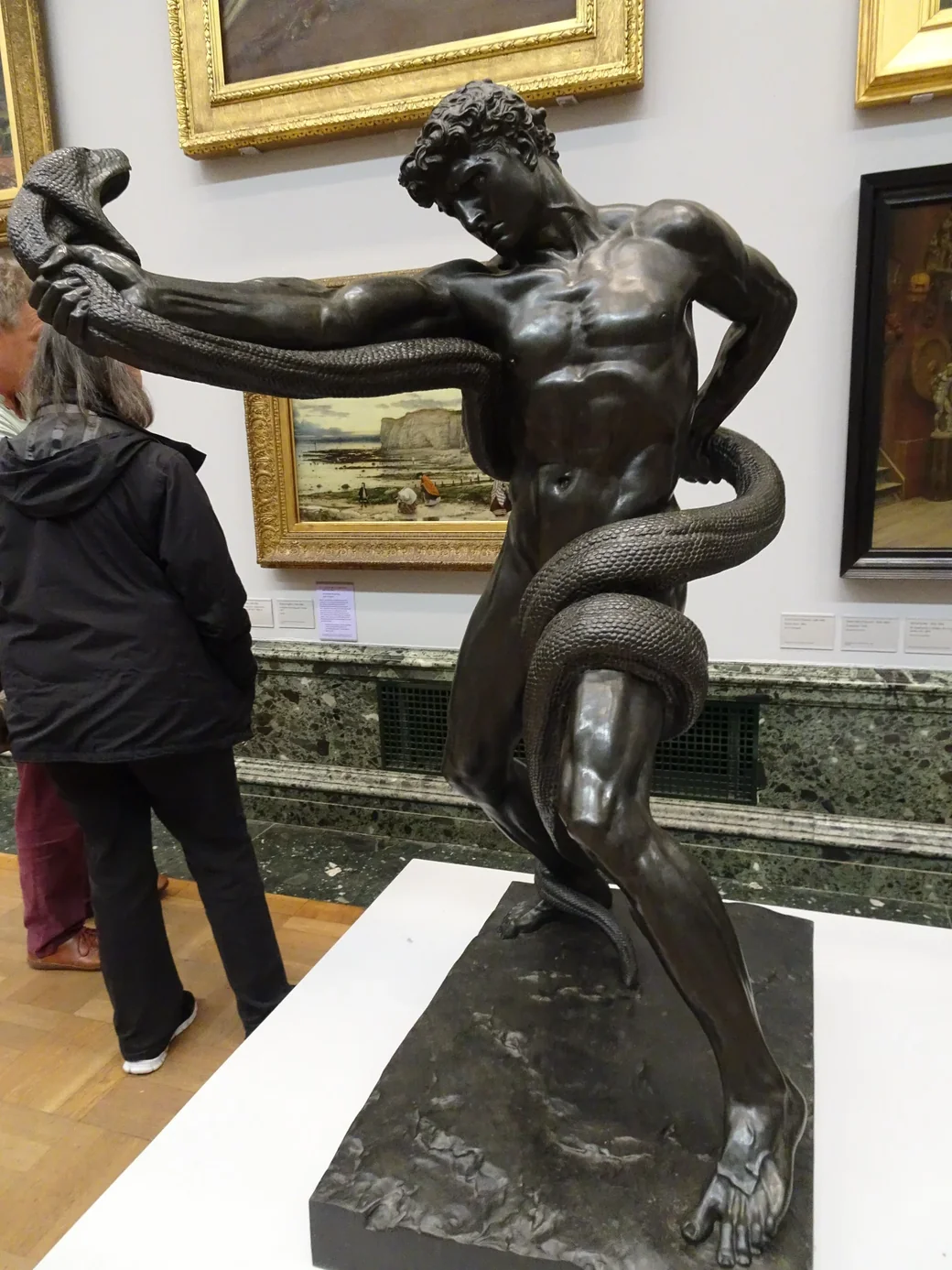
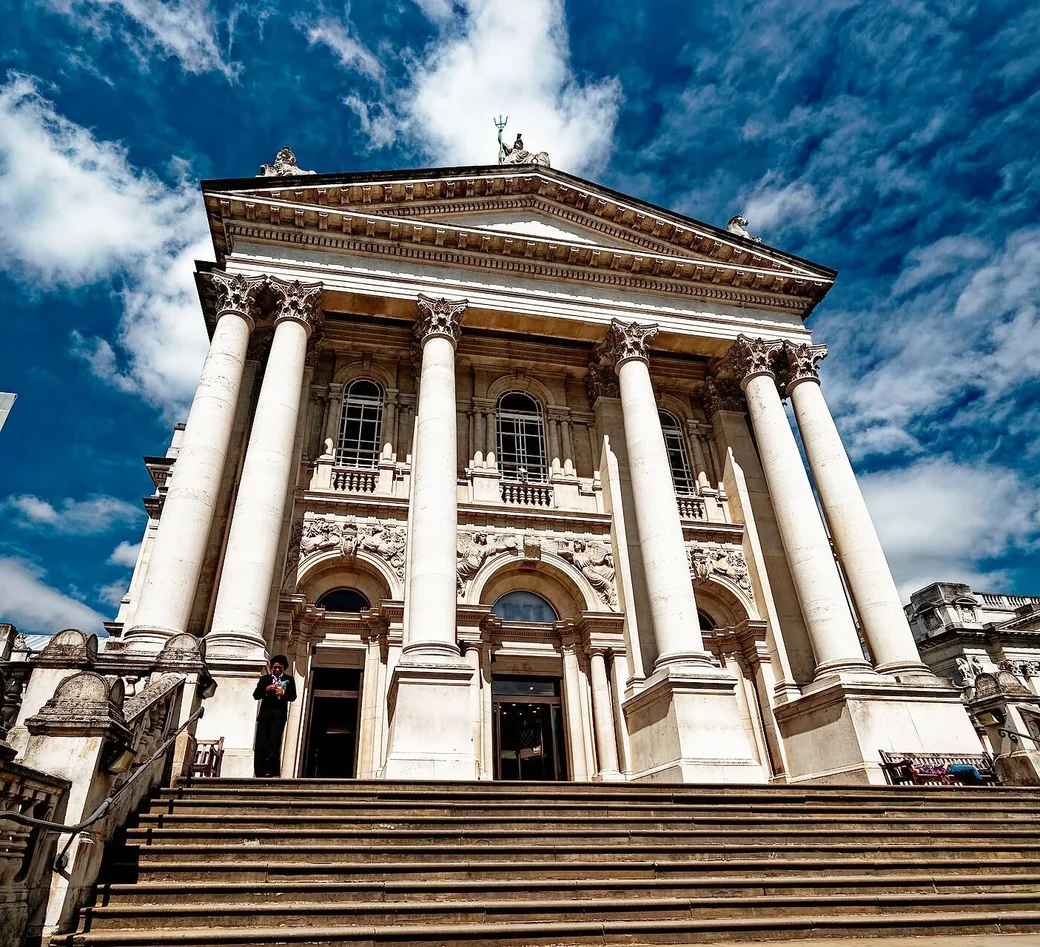
Sidney R. J. Smith's 1897 front is classical in spirit: a Portland-stone portico with a dome rising behind it. Beyond the entrance, the Duveen Galleries, designed by John Russell Pope with Romaine-Walker and Gilbert Jenkins and opened by King George VI in 1937, form a barrel-vaulted sequence about ninety metres long, the first public galleries built expressly for sculpture. In 1987 James Stirling's Clore Gallery added a witty postmodern wing whose façades quote their neighbours. The 2013 refurbishment by Caruso St John dropped a black-and-white terrazzo (polished stone-chip) spiral staircase through the rotunda (the circular, domed entrance hall), echoing the original mosaic floor, and reopened a circular balcony that had been closed since the 1920s. The whole complex has been Grade II* listed (a high national protection grade for historic buildings) since 1970. Together, these layers turn a walk through the rooms into a tour of architecture as much as of painting.
Tate Britain Collection: Five Centuries of Art in Chronological Rooms
The displays follow time, so a visit reads like a story. The 2023 rehang brought together more than 800 works by over 350 artists, starting with Tudor and Jacobean portraits and ending with commissions by living artists. Half of the contemporary artists shown are women, and more than 200 works acquired since 2000 hang beside the old favourites. Rooms are devoted to Blake, Constable, the Pre-Raphaelites and Henry Moore, while changing solo displays shine a light on individual careers. Look out also for the Art Around the Building commissions, and for the Turner galleries, which form a wing of their own. If you like to browse before travelling, the wider Tate collection is searchable online and covers some 70,000 artworks.
Must-See Paintings at Tate Britain: Ophelia, The Lady of Shalott and More
Several paintings draw visitors straight to their walls. Millais's Ophelia (1851–2), showing Shakespeare's heroine floating among riverside flowers, took months to complete, with the landscape painted outdoors in Surrey and Elizabeth Siddal posing for the figure. Waterhouse's The Lady of Shalott (1888) illustrates Tennyson's poem about a woman who defies a curse; low-flying swallows and snuffed candles foretell her fate. Sargent's Carnation, Lily, Lily, Rose (1885–6) was painted in the few minutes of good evening light available each day, while two girls lit paper lanterns. The Cholmondeley Ladies, from around 1600–10, show two women who look identical, born, married and delivered of children on the same day, though their lace, jewels and eye colours differ in careful detail.
Turner at Tate Britain: The Clore Gallery and the Turner Bequest
Tate Britain holds the world's largest collection of Turner's work, thanks to the Turner Bequest. When the painter died in 1851 he left the contents of his studio to the nation: around 300 oil paintings and some 30,000 sketches and watercolours, including hundreds of sketchbooks. Turner had asked for a dedicated gallery, a wish finally met in 1987 when the Clore Gallery opened, 136 years later. Its rooms present exhibited masterpieces such as Snow Storm: Hannibal and His Army Crossing the Alps and Peace – Burial at Sea, alongside luminous unfinished canvases like Norham Castle, Sunrise. A few other Turners, including The Fighting Temeraire, hang at the National Gallery instead. Delicate works on paper rotate through a dedicated room, and more drawings can be studied in the Prints and Drawings Rooms by appointment.
Hockney, Bacon and the Turner Prize: Modern and Contemporary Highlights
Further along, the story turns to the twentieth century and today. Francis Bacon's Three Studies for Figures at the Base of a Crucifixion was first shown in April 1945, near the end of the Second World War. David Hockney's A Bigger Splash (1967), a swimming-pool scene painted slowly to freeze a fleeting instant, is among the most reproduced pictures in the collection. Rooms also feature Bridget Riley, Henry Moore, Victor Pasmore's abstractions and recent acquisitions by artists such as Lubaina Himid and Allison Katz. Tate Britain is also the home of the Turner Prize, founded in 1984 and named after the painter; its exhibition has been staged here in many years and in other cities in others. Each year an artist is invited to answer the Duveen Galleries with a new commission.
Floods, Wartime and Survival: The Resilient History of Tate Britain
Few galleries have weathered as much as this one. In the early hours of 7 January 1928 the Thames overflowed, the river wall opposite collapsed and water poured into the nine lower-ground galleries and the basement. Eighteen works were damaged beyond repair and nearly three hundred paintings suffered to some degree, yet Turner's works on paper, soaked and muddy, kept their colours, and the blotting sheets used to dry them were later preserved as a record of the rescue. Wall paintings finished in the restaurant only two months earlier came through submersion untouched. Waterproofing of the lower floors followed, long before the Thames Barrier came into operation in 1982. In the Second World War most of the collection went to safe storage, and Stanley Spencer's huge The Resurrection, Cookham, too big to move, was shielded behind a brick wall.
Surprising Stories and Legends of Millbank: Runners, Bricks, Tunnels and Ghosts
Tate Britain has a habit of getting people talking. In 1976 a sculpture of 120 firebricks, Carl Andre's Equivalent VIII, became the subject of a nationwide debate about modern art after a newspaper article; cartoons and letters poured in, and curiosity brought extra visitors. In 2008 Martin Creed's Work No. 850 sent a runner sprinting the length of the Duveen Galleries every thirty seconds, with a pause of equal length between runs. For several winters an annual Winter Commission turned the façade into a canvas for new artworks. And at the back of the building stands a bronze statue of the painter John Everett Millais, installed in 1905 and moved there in 2000, after one of the gallery's directors had once tried to have it replaced.
Millbank has gathered its share of folklore. According to local legend, a network of underground passages once led from the penitentiary down to the river steps, and the old vaults beneath the Morpeth Arms, the pub built in 1845 for the prison's warders, are said to be a remnant. Rumour adds that the ghost of a convict lingers in those cellars, and that the pub keeps a camera trained on them so that curious drinkers can watch for the spirit on a screen. Another tale claims the warders themselves lost their way in the maze of corridors. It is also said that the damp ground that had troubled the prison made some people doubt the site for a gallery. And a tale sometimes told on river cruises places Martin Creed's artwork of lights going on and off in an empty room at Tate Modern, although that work was in fact shown at Millbank, in the 2001 Turner Prize exhibition. The tunnels and the ghost remain hearsay rather than documented fact, but they add spice to a riverside stroll.
Planning Your Tate Britain Visit: Opening Days, Best Time, Crowds and Photo Spots
Tate Britain is open every day except 24–26 December, with last entry shortly before closing, so a late arrival risks missing the Turner rooms. Plan about two to three hours for the highlights; art lovers can happily spend half a day, and a boat trip to Tate Modern easily turns the afternoon into a full cultural day. Weekday mornings and the final hour before closing are the quietest; the middle of weekend afternoons is the busiest. Because the visit is indoors, wet and cold days suit it perfectly, while spring and early autumn add pleasant riverside walking. Booking is recommended for temporary exhibitions. Check the official website for the entrance in use on the day, since access points can change for maintenance work or events.
For photographs, three views stand out. The spiral staircase in the rotunda looks best from the circular balcony above it, reopened in 2013. The long, vaulted perspective of the Duveen Galleries rewards a spot at one end and a little patience while the crowds thin. Outside, the Portland-stone façade is best seen from the riverside path across the road, where morning light tends to fall on the river-facing front. Photography is for personal use only and without flash, so keep the camera low-key and ask before photographing other visitors. To avoid crowds, arrive on a weekday morning or in the last hour before closing, start with the Turner rooms and work backwards, and use the foyer of the Clore Gallery as a quiet corner when you need a pause. A riverside café and the gallery shops offer further places to pause, and even a one-hour visit focused on a few rooms is worthwhile.
How to Get to Tate Britain: Tube, Bus, Train and the Tate Boat
The easiest rail link is Pimlico station on the Victoria line, a walk of about ten minutes. Vauxhall (Victoria line and National Rail) and Westminster (Jubilee, District and Circle lines) are both within a pleasant riverside walk of fifteen minutes or so. Buses are even closer: route 87 stops on Millbank by the gallery, routes 88 and C10 on John Islip Street, and routes 2, 36, 185 and 436 on Vauxhall Bridge Road. The Tate boat shuttles between Millbank Pier and Tate Modern's Bankside Pier and offers a fine view of the Thames; its livery has carried spots inspired by Damien Hirst's paintings. By car, parking is limited, so public transport is wiser; taxis can use the drop-off point on Millbank. Millbank Pier was designed by the architects of the London Eye and lies right on the Thames Path. The Tate boat runs on the Uber Boat by Thames Clippers river bus lines: RB1 on weekdays and RB2 at weekends.
Tate Britain Accessibility and Families: Step-Free Access, Quiet Rooms and More
Tate Britain publishes unusually detailed access information. The Manton Entrance on Atterbury Street has a ramp and automatic doors and leads to the lower floor, where the café, toilets, a baby care room and the Linbury Galleries are reached at level; two large lifts, one beside the entrance desk and one near the Lower Rotunda, serve the main floor. Wheelchairs and walkers can be borrowed, mobility scooters reserved a day ahead, and accessible parking spaces booked. Accessible toilets and baby-changing facilities are on the lower floor; because larger adult-changing facilities may not always be available, check the official accessibility page before you travel. Quiet and multi-faith rooms, ear defenders, a visual story for autistic visitors, large-print exhibition guides, hearing loops in the auditorium and Manton Studio, and communication cards complete the offer. Assistance dogs are welcome, and children can try digital drawing screens.
Tate Britain Etiquette and Rules: Photography, Bags and Do's and Don'ts
Photography is welcome in most galleries for personal, non-commercial use, unless a sign says otherwise; flash, camera supports and selfie sticks are not allowed. Please do not touch the works, eat or drink in the galleries, or bring pastels, charcoal, markers or paints; smoking and vaping are not permitted anywhere in the building. Bags are checked on arrival, and anything larger than cabin size (55 × 40 × 20 cm) cannot be brought in. The cloakroom takes coats, umbrellas and non-electric scooters or folding bikes, though space can run out on busy days. There is no formal dress code, but comfortable shoes help. Speak quietly in front of the pictures so that others can enjoy peaceful contemplation, and ask a member of staff whenever you are unsure.
What's Near Tate Britain: Westminster, Millbank Pier and the Riverside Walk
The gallery sits in a rich stretch of riverside London. Walk north along the Thames Path and you reach Westminster, with the Houses of Parliament, Big Ben and Westminster Abbey, in around fifteen minutes. A short stroll the other way brings you to the Morpeth Arms, a pub with a Spying Room that looks across the water to the headquarters of MI6, and to the old stone bollard that recalls the prison landing steps. Chelsea College of Arts stands beside the gallery on another part of the former prison site, and Millbank Pier offers the direct boat to Tate Modern, where Shakespeare's Globe and the Millennium Bridge are close at hand. Combine them all for an easy and rewarding day out.
Tate Britain Languages, Guides and Tours: What to Expect
Tate Britain's guided tours and talks are given in English; if you need another language, check the programme first. Tours run on most days several times around midday and early afternoon, so confirm on the day, and themed tours, such as those for families, are also listed. Before arriving you can download the gallery map and try the self-guided audio highlights on the Tate website, which cover the collection from the sixteenth to the early twentieth century. Independent operators also offer private tours in several languages. The visual story, large-print guides and communication cards help every visitor find their way, and the Prints and Drawings Rooms and the Library and Archive Reading Rooms welcome visitors by arrangement.
Tate Britain: Visitor Tips
Head for the Turner rooms or the Pre-Raphaelites first, before the crowds build, then work your way through the chronological rooms. For photographs, the spiral staircase in the rotunda, the long perspective of the Duveen Galleries and the façade seen from the riverside path across the road are the favourites. Pick up the gallery map on arrival, ask at an information desk about the day's tours, and keep the café for a pause halfway round. If drawings are your passion, arrange a Prints and Drawings Room appointment before your trip, and finish with the Tate boat to Tate Modern for a view of the river.
Tate Britain: Best Time to Visit
Weekday mornings or late afternoons are calmest. The visit is entirely indoors, so rainy days and winter afternoons work especially well.
Tate Britain: Admission Fees
Free admission
Free to enter without booking, the collection traces British art from the sixteenth century onwards; temporary exhibitions are ticketed separately.
Free
Quick Info
2h 30m
easy
Tate Britain: Getting There
The nearest Underground station is Pimlico on the Victoria line, about a ten-minute walk away. Vauxhall, also on the Victoria line and a National Rail stop, is slightly farther, and Westminster (Jubilee, District and Circle lines) is a pleasant riverside walk of roughly fifteen minutes. Buses are closer still: route 87 stops on Millbank by the gallery, routes 88 and C10 serve John Islip Street, and routes 2, 36, 185 and 436 stop on Vauxhall Bridge Road. By river, the Tate boat links Millbank Pier with Tate Modern's Bankside Pier. Driving is not recommended: street parking nearby is limited and operates pay-and-display (pay at a street machine) on weekdays. Taxis and coaches use the drop-off point on Millbank. The Tate boat runs on the Uber Boat by Thames Clippers river bus lines: RB1 on weekdays and RB2 at weekends.
Nearby stops & parking
Closest bus stops: Tate Britain on Millbank (route 87), John Islip Street (routes 88 and C10) and Vauxhall Bridge Road (routes 2, 36, 185 and 436). Underground: Pimlico about 600 m away, Vauxhall about 850 m, Westminster about 1.2 km. Rail: Vauxhall about 850 m, Victoria about 1.6 km. Millbank Pier is a few minutes' walk. Cycle-hire docking stations stand near Millbank Tower, on Rampayne Street and by Vauxhall Bridge, and bicycle parking is available near the Manton entrance on Atterbury Street. Taxis and coaches drop off and pick up on Millbank. Street parking is limited; five accessible parking spaces off John Islip Street can be reserved in advance.
Tate Britain: Dress Code & Etiquette
There is no formal dress code; comfortable shoes are the best choice for a long visit. The galleries are quiet spaces, so speak softly, silence your phone, do not touch the works and keep food and drink for the café. Coats, umbrellas and larger bags can be left in the cloakroom, and bags bigger than cabin size are not accepted into the building. Bags are checked on arrival, so allow a little extra time.