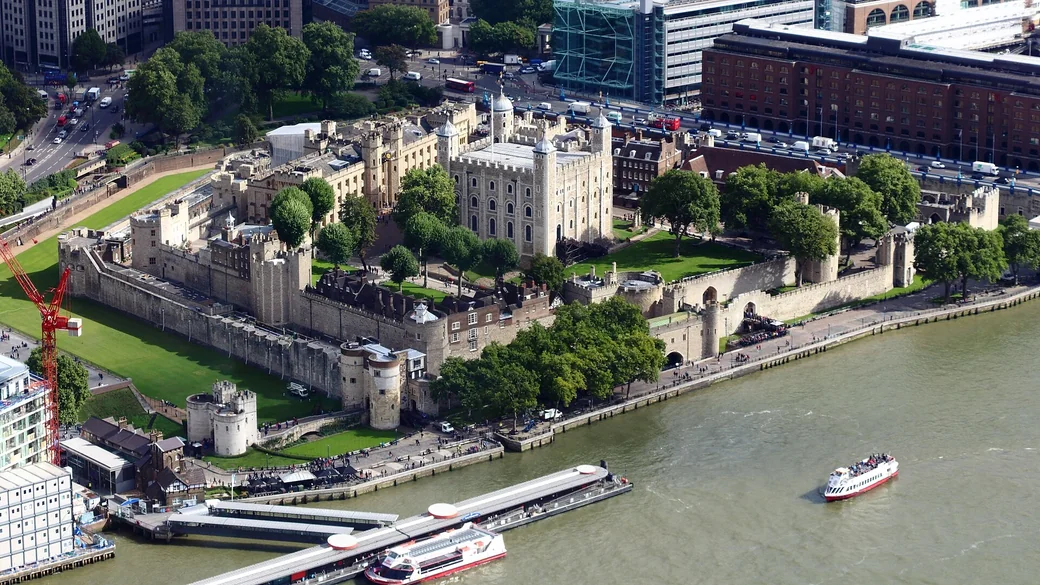
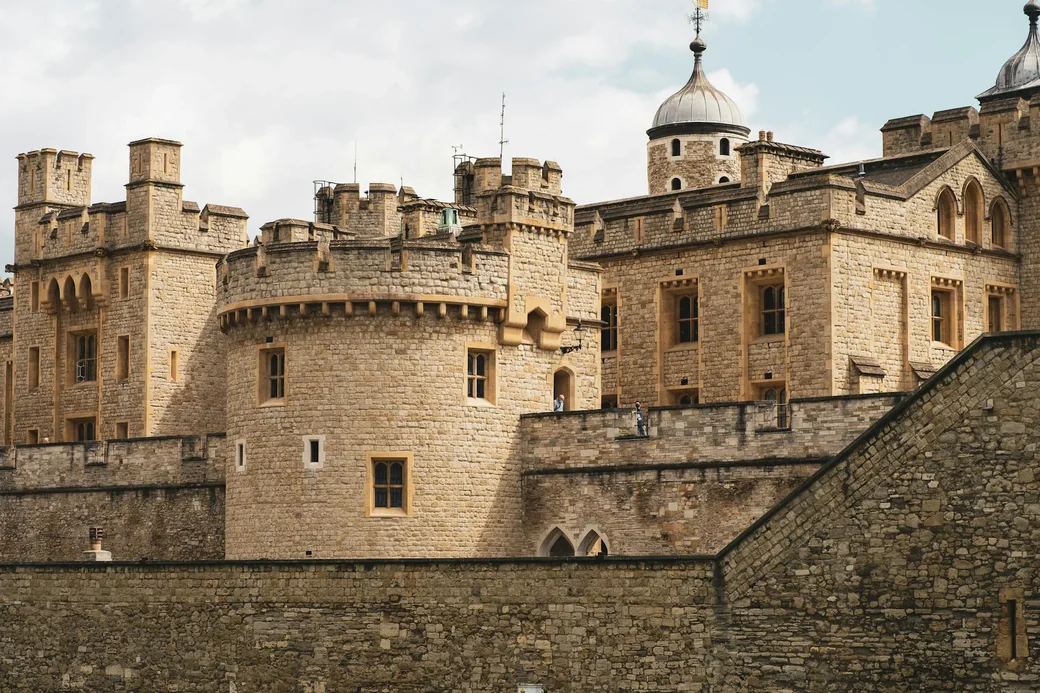
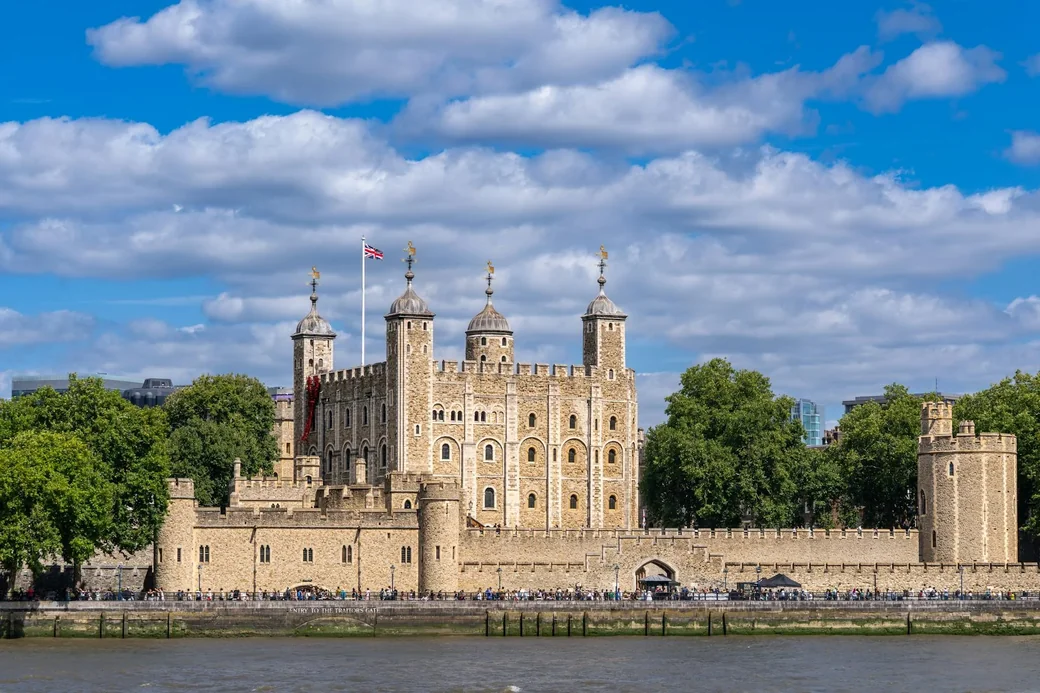
The Tower of London is a historic royal castle on the north bank of the River Thames, at the eastern edge of the old City of London. Ringed by massive stone walls and towers, it is one of the most famous castles in the world and one of England's best-known historic sites. Today it is a living monument where visitors explore medieval towers and battlements, see the royal treasures kept here and meet the guardians who still live within its walls.
Tower of London: Location, accommodation options and contact
Tower of London, London EC3N 4AB
The place's location on the map and nearby accommodation and hotel options are shown by Stay22. Cookies are used. Your consent is remembered on every page; you can turn it off at any time in the cookie settings.
Tower of London: Nearly 1,000 Years as Fortress, Palace and Prison
Founded after the Norman conquest of 1066, the Tower grew from a timber stronghold into a vast fortress. William's great stone keep, the White Tower, was begun around 1078 and later whitewashed under Henry III, which gave the keep its name. Over the centuries the site served as a royal residence, treasury, armoury, mint, record office and menagerie; the prison reputation came later. Its power was practical and symbolic: whoever held the Tower held the city. According to legend, medieval writers even believed Julius Caesar had built it; archaeology shows it is Norman. It has been a World Heritage Site since 1988. It was William the Conqueror who began it in the winter of 1066, as a timber stronghold built into a corner of the Roman city wall; work on his stone keep was supervised by Gundulf, Bishop of Rochester, and the whitewashing that gave the White Tower its name began in 1240. Today the Tower is cared for by an independent charity.
White Tower, Concentric Walls and Medieval Palace: Architecture Guide
The White Tower measures about 36 by 32 metres at its base and rises roughly 27 metres. It is built mainly of Kentish ragstone, with fine details once cut from stone shipped across the Channel from Normandy, much of which was replaced in later centuries. The entrance was deliberately raised above ground, as in other Norman keeps. Around it, two further rings of walls, thirteen towers on the inner circuit and a wide moat complete a layout largely fixed by 1285. Look for the semicircular apse of St John's Chapel, the early use of brick in the Beauchamp Tower and the water gate known as Traitors' Gate. The inner ward was shaped under Richard I and Henry III, while Edward I completed the outer circuit and the moat. Inside, you can walk along the battlements and step into the rooms of the medieval palace.
Crown Jewels at the Jewel House: What to See and How to Beat the Queue
The Jewel House shows around 140 pieces of royal regalia set with more than 23,000 gemstones. Highlights include St Edward's Crown, placed on the monarch's head at the moment of crowning; the Imperial State Crown with its historic sapphires and a large red spinel; and the Sovereign's Sceptre, topped by the largest stone cut from the Cullinan diamond. Most of the medieval regalia was melted down in 1649, so the oldest surviving piece is a twelfth-century coronation spoon. Go early, when queues are shortest. A moving walkway carries you past the cases, and photography is not allowed inside.
Koh-i-Noor, Cullinan and Other Famous Stones: Stories and Legends
Two diamonds draw the most questions. The Cullinan, found in a mine in southern Africa in 1905 and presented to the king two years later, was cut into several stones that now sit in sceptres, crowns and orbs. The Koh-i-Noor, about 105 carats, is set in a queen consort's crown and passed through many hands: emperors, shahs, emirs and maharajas. More than one country today claims it, and the Tower's display presents it as a symbol of conquest, so treat it as a contested story. According to legend, the stone brings misfortune to men who wear it, a tale often given as the reason it has been set in queens' crowns. According to legend, St Edward's Sapphire came from the ring of Edward the Confessor, and a king of Castile gave the Black Prince's Ruby, taken from a ruler of Granada, to Edward the Black Prince in 1367.
White Tower, Line of Kings and Royal Mint: Armour, Coins and a Norman Chapel
Inside the White Tower the Royal Armouries shows arms and armour; it is the oldest museum in the country, with roots in the medieval royal arsenal. The Line of Kings, first assembled in the seventeenth century, presents life-size wooden horses carrying suits of armour beneath carved royal heads. On the upper floor St John's Chapel survives almost unchanged, a plain, round-ended Norman space among the finest of its kind. A separate exhibition tells the story of the Royal Mint, which struck the country's coins inside the Tower for more than five hundred years. According to a folk belief, a famous royal suit of armour here brought luck to those hoping for a child. Please look, but never touch.
Prisoners, Executions and Torture: The True Story Behind the Dark Reputation
The Tower's grim fame is real but exaggerated. Before the twentieth century only seven people were executed inside the walls, on Tower Green, usually because a public scene was thought too risky; many more died on Tower Hill outside. There was never a permanent torture chamber, and about 48 cases of torture are recorded between 1540 and 1640, each needing high-level approval. Prisoners were mostly nobles and political figures who could arrange better food and furnishings, and some lived with family and servants. Look for the carved inscriptions in the Beauchamp Tower, the Bloody Tower and the memorial at the scaffold site. Convicted spies were shot here during the two world wars, the last in 1941.
Yeoman Warder (Beefeater) Tours: Who They Are, When They Run and Languages
The Yeoman Warders, nicknamed Beefeaters, are retired service members who must have served at least twenty-two years and reached warrant-officer rank or above. A few dozen live inside the walls with their families, and they have guarded the Tower since at least the early sixteenth century. Their guided tour needs no separate booking, leaves regularly from near the entrance between mid-morning and mid-afternoon, lasts about an hour and is given in English only, so join early. For other languages, audio guides exist in Dutch, French, German, Italian, Japanese, Korean, Mandarin Chinese, Portuguese, Russian, Spanish and Ukrainian, plus a sign-language digital guide. The origin of the name Beefeater is uncertain: one theory points to generous beef rations, another to an old word for a servant who tended the royal sideboard. Their everyday uniform is dark blue, with red-and-gold state dress kept for ceremonial occasions, and inside the walls they have a private pub of their own, The Keys, open only to the Warders and their guests. In 2007 the first woman joined the corps.
Ravens of the Tower: Legend, Ravenmaster and the Real Story
According to legend, if the ravens ever leave the Tower, the White Tower will crumble and the kingdom will fall. In one version of the story, a seventeenth-century king ordered at least six to be kept after the royal astronomer complained that they disturbed his observations from the White Tower. Historians note that the earliest written record of the legend dates to the Second World War, so the tradition may be much younger than it sounds. According to a wartime tale, only a handful of ravens survived the bombing years, and when the last pair, Grip and Mabel, disappeared, newspapers reported it as an omen. Today a Yeoman Warder known as the Ravenmaster and a small team look after the birds, which eat raw meat and the odd egg. According to the Tower, a raven named Grog flew off in 1981 and was last seen outside an East End pub. Watch them from a respectful distance and never feed or touch them. The earliest known picture of captive ravens at the Tower dates from 1883.
Ghost Stories of the Tower: Anne Boleyn, the Princes, Becket and More
The Tower is often called one of the most haunted places in the capital, though every tale is hearsay. According to legend, Anne Boleyn glides from Tower Green towards the chapel where she is buried, sometimes headless, and once led a procession of knights and ladies. According to legend, two small figures in white, taken to be the Princes in the Tower, walk down a staircase hand in hand; what really happened to them in 1483 remains unsolved. According to legend, Thomas Becket's ghost struck a new gate with his cross until it fell, and tradition links this to the name of St Thomas's Tower; records do show a gatehouse collapsing in 1240. Others named in these stories: Henry VI on the anniversary of his death, Walter Raleigh, Lady Jane Grey, a phantom bear from 1816, a glowing tube in the Jewel House in 1817 and a lace-cuffed hand in a visitor's photograph. After-hours ghost tours run on selected evenings.
Ceremony of the Keys, Opening Ceremony and Gun Salutes: Living Traditions
Every night the Chief Yeoman Warder locks the Tower's outer gates in the Ceremony of the Keys, escorted by guards. A sentry challenges him at the Bloody Tower archway with "Halt, who comes there?" and the ceremony ends on the stroke of ten with the Last Post. The Tower says it has happened for about seven hundred years, though its present form is often traced to the nineteenth century. Places are limited and must be booked in advance. In the morning the gates are unlocked in a short opening ceremony that visitors can watch with a special early ticket. Gun salutes are fired from the Wharf on royal occasions and a few other days; the Wharf then closes early and the Warder tour times shift that day. Navy ships that moor at the Wharf still owe the Constable a barrel of wine, rum or brandy. The salutes usually consist of 62 rounds. The Tower also keeps the custom of Beating the Bounds, a ceremonial walk along the boundary of its old liberties.
Royal Menagerie, Royal Mint and the Moat: The Tower's Other Lives
For some six centuries the Tower kept exotic animals in a royal menagerie, with gifts that included a polar bear in 1252, led on a chain to fish in the Thames, and an elephant in 1255. The skulls of two Barbary lions found in the moat during excavations in 1936–37 date to the Middle Ages, as radiocarbon dating later confirmed. The collection moved to London Zoo in the 1830s. The Tower also housed the Royal Mint from about 1279 to 1812 and the national record office. The moat, drained in the 1840s, was filled with 888,246 ceramic poppies in 2014, each marking a military life lost in the First World War, and in 2022 it bloomed with a meadow of wild flowers.
Tower of London Opening Hours, Tickets and Best Time to Visit
Plan at least three hours, and more if you add the Yeoman Warder tour and the White Tower. The Tower opens in the morning, a little later on Sundays and Mondays, closes earlier in winter than in the warmer months, and stops admitting visitors shortly before closing. It is shut from 24 to 26 December and on 1 January. A ticket is valid for one entry only, so finish everything before you leave. Book ahead, head straight for the Crown Jewels, then take a Yeoman Warder tour. Weekday afternoons outside school holidays are calmest; check the official calendar for exact hours. The riverside Wharf opens earlier and closes later than the fortress, though it closes earlier on some days.
How to Get to the Tower of London by Tube, DLR, Train, Bus and River
Tower Hill station, on the District and Circle lines, is the simplest option: five minutes on foot through the underpass. Tower Gateway on the Docklands Light Railway and Fenchurch Street are about ten minutes away, and London Bridge, Monument, Bank, Aldgate and Aldgate East are within fifteen. Lifts reach street level at Tower Hill, Tower Gateway and London Bridge. Boats call at Tower Pier beside the entrance and give a scenic approach from Westminster or the London Eye. Buses 15, 42, 78, 100 and 343 stop nearby. The Tower has no car park and lies inside the Congestion Charge zone, so avoid driving.
Accessibility, Facilities and House Rules: Cobbles, Stairs, Bags and Photos
Expect uneven cobbles, steep spiral stairs and low doorways. Wheelchair access is limited, but the Jewel House has level entry and a moving walkway, the White Tower has a lift to its basement shop and the chapel has a platform lift operated by a Yeoman Warder. Wheelchairs can be borrowed, accessible and Changing Places toilets are on site, assistance dogs are welcome, and there is a sign-language digital guide and a self-led audio-described tour. Lighting is deliberately low in several buildings. Everyone goes through a security check on entry; suitcases, large bags and rolling luggage are not allowed and there is no left-luggage. Photography without flash is welcome in most areas, but not in the Jewel House or the Martin Tower. Lost children should ask a Yeoman Warder. Wi-Fi is available. Comfortable shoes make the cobbles and stairs much easier.
Near the Tower: Tower Bridge, Tower Wharf, St Katharine Docks and Photo Spots
Step onto Tower Wharf, the riverside walk below the walls, for the classic view of Tower Bridge with the Shard beyond; it opens earlier and closes later than the fortress itself. Walk across Tower Bridge or visit its glass-floored walkways, then wander to St Katharine Docks, a small marina a few minutes east. Near Tower Hill station a stretch of the Roman city wall still stands, and the nearby Tower Hill memorial marks the place where many were executed. HMS Belfast is visible downriver. For photographs, try the Wharf at sunset, the battlements at opening time and the bridge approach for the full silhouette.
Famous Prisoners, Escapes and Close Calls: Flambard, Guy Fawkes, Raleigh and Thomas Blood
The Tower's first recorded prisoner was also an early escapee: a bishop named Ranulf Flambard, held in 1100, is said to have had a rope smuggled in inside a wine cask and to have climbed out of a window in 1101 after giving his guards a feast. Guy Fawkes was brought here in November 1605 after the Gunpowder Plot, and Sir Walter Raleigh spent years in the Bloody Tower, where his family lived with him and a son was born. In 1671 a man named Thomas Blood tried to steal the Crown Jewels and was caught before he could get away. In the Blitz, bombs on 23 September 1940 destroyed several buildings, and on 5 October another bomb blew apart the North Bastion, narrowly missing the White Tower. The fate of the Princes in 1483 is the great unsolved case: bones found beneath a staircase near the White Tower in 1674 were long thought to be theirs, were examined again in 1933 and have never been settled by modern tests.
Hidden Details and Curiosities: the Traitors' Gate Myth, the Chapel Royal, a Private Pub and Film Sets
A few details surprise even repeat visitors. Traitors' Gate already had that name by the 1540s, yet a contemporary chronicle suggests Anne Boleyn entered through a smaller gate near the Byward Tower, so the famous image of her arriving by water is doubtful. The chapel of St Peter ad Vincula is still a working church; it holds the graves of three women executed in the sixteenth century, Anne Boleyn, Catherine Howard and Lady Jane Grey, may close for services and does not allow photography during them. On Legge's Mount the blocked arrow loops are described as the only original medieval ones in the fortress, while many other battlements are Victorian reconstructions. Inside the walls the Yeoman Warders have their own private pub, The Keys, open only to them and their guests. The Tower has also served as a location for films, television dramas and documentary series.
Tower of London: Visitor Tips
Book a timed ticket in advance and arrive early for the Crown Jewels, where queues build quickly. Join a Yeoman Warder tour near the entrance soon after you arrive; it explains the layout and tells the best stories. Photography is welcome in most areas without flash, but not in the Jewel House. Start on the battlements or along Tower Wharf for views, and save the White Tower for a quieter hour. Finish with the riverside walk and the view of Tower Bridge.
Tower of London: Best Time to Visit
Weekday afternoons are calmer; arrive at opening to reach the Crown Jewels before queues build. Winter is quiet, summer days are long.
Tower of London: Admission Fees
Adult (18–64 years)
Admission covers the Crown Jewels, the White Tower and the Yeoman Warder (Beefeater) tours led by the Tower's ceremonial guardians. Standard fare for visitors aged 18 to 64.
£38
Senior (65+)
Admission covers the Crown Jewels, the White Tower and the Yeoman Warder (Beefeater) tours led by the Tower's ceremonial guardians. Reduced fare for seniors aged 65 and over; valid ID may be requested.
£30.30
Student (18+)
Admission covers the Crown Jewels, the White Tower and the Yeoman Warder (Beefeater) tours led by the Tower's ceremonial guardians. Reduced fare for students aged 18 and over who show a valid student card.
£30.30
Disabled concession
Admission covers the Crown Jewels, the White Tower and the Yeoman Warder (Beefeater) tours led by the Tower's ceremonial guardians. Reduced fare for visitors with a disability; a free access companion ticket is available.
£30.30
Child (5–15 years)
Admission covers the Crown Jewels, the White Tower and the Yeoman Warder (Beefeater) tours led by the Tower's ceremonial guardians. Fare for children aged 5 to 15, who must be accompanied by an adult aged 18 or over.
£19
Young person (16–17 years)
Admission covers the Crown Jewels, the White Tower and the Yeoman Warder (Beefeater) tours led by the Tower's ceremonial guardians. Reduced fare for young visitors aged 16 to 17.
£19
Children under 5 (free)
Children under 5 enter free of charge.
Free
Opening Ceremony experience – Adult (18–64 years)
Enter before opening to watch the gates of the Middle Tower being unlocked at the traditional Opening Ceremony, then be first in line for the Crown Jewels; offered on selected dates in the warmer months, with a limited number of places each day. Standard fare for visitors aged 18 to 64.
£62
Opening Ceremony experience – Child / young person (age 5–15 / 16–17)
Enter before opening to watch the gates of the Middle Tower being unlocked at the traditional Opening Ceremony, then be first in line for the Crown Jewels; offered on selected dates in the warmer months, with a limited number of places each day. Fare for children aged 5 and over and young people aged 16 and 17; under-5s do not need a ticket.
£33.50
Opening Ceremony experience – Concession
Enter before opening to watch the gates of the Middle Tower being unlocked at the traditional Opening Ceremony, then be first in line for the Crown Jewels; offered on selected dates in the warmer months, with a limited number of places each day. Reduced fare for seniors aged 65 and over, students and disabled visitors.
£49.50
Ravens experience – Adult (18–64 years)
An early-morning talk about the legendary Tower ravens, offered on selected days, with admission to the Tower and the Crown Jewels included. Standard fare for visitors aged 18 to 64.
£90
Ravens experience – Child / young person (age 5–15 / 16–17)
An early-morning talk about the legendary Tower ravens, offered on selected days, with admission to the Tower and the Crown Jewels included. Fare for children aged 5 and over and young people aged 16 and 17; under-5s do not need a ticket.
£50
Ravens experience – Concession
An early-morning talk about the legendary Tower ravens, offered on selected days, with admission to the Tower and the Crown Jewels included. Reduced fare for seniors aged 65 and over, students and disabled visitors.
£70
Quick Info
3h
moderate
Tower of London: Getting There
The nearest Underground station is Tower Hill, on the District and Circle lines, about five minutes on foot; follow the signs through the underpass to the entrance. Tower Gateway (Docklands Light Railway) and Fenchurch Street (National Rail) are around ten minutes away, while London Bridge, Monument, Bank, Aldgate and Aldgate East stations are ten to fifteen minutes on foot. Lifts connect Tower Hill, Tower Gateway and London Bridge stations to street level. By river, Tower Pier sits beside the entrance and is served by boats from Westminster, the London Eye and other piers along the Thames. Several bus routes, including 15, 42, 78, 100 and 343, stop nearby, as do the open-top sightseeing buses. There is no car park at the Tower and the area lies inside the Congestion Charge zone, so public transport, a taxi or a boat is the sensible choice.
Nearby stops & parking
Tower Hill station is the main arrival point, with the Tower Hill coach and car park beside it for coaches and Blue Badge holders. Tower Gateway station is about a ten-minute walk away. Tower Pier is the riverside stop next to the entrance, while Tower Bridge Quay, on the far side of the bridge, is the departure point of the official river tour. Taxis and ride-hailing cars can set down close to the entrance on Tower Hill. Bus stops cluster along Tower Hill and Great Tower Street.
Tower of London: Dress Code & Etiquette
There is no dress code. Wear sturdy, comfortable shoes for uneven cobbles and steep spiral stairs, and bring a layer, as the stone buildings stay cool. St Peter ad Vincula is a working church: speak quietly, remove your hat if asked and follow the guidance of the staff there. Be respectful at the memorial on Tower Green.