Tsim Sha Tsui Promenade is a paved waterfront walk along the southern tip of the Kowloon peninsula, looking straight across Victoria Harbour at the skyline of Hong Kong Island. It is one of the city's classic strolls, loved by locals and visitors alike for unhurried walks, people-watching and photography. Cultural landmarks, statues and gardens line the way, and the harbour view that unfolds along it is one of the defining images of Hong Kong.
Tsim Sha Tsui Promenade: Location, accommodation options and contact
Salisbury Road, Tsim Sha Tsui, Kowloon, Hong Kong
The place's location on the map and nearby accommodation and hotel options are shown by Stay22. Cookies are used. Your consent is remembered on every page; you can turn it off at any time in the cookie settings.
Walking the Victoria Harbour Waterfront End to End
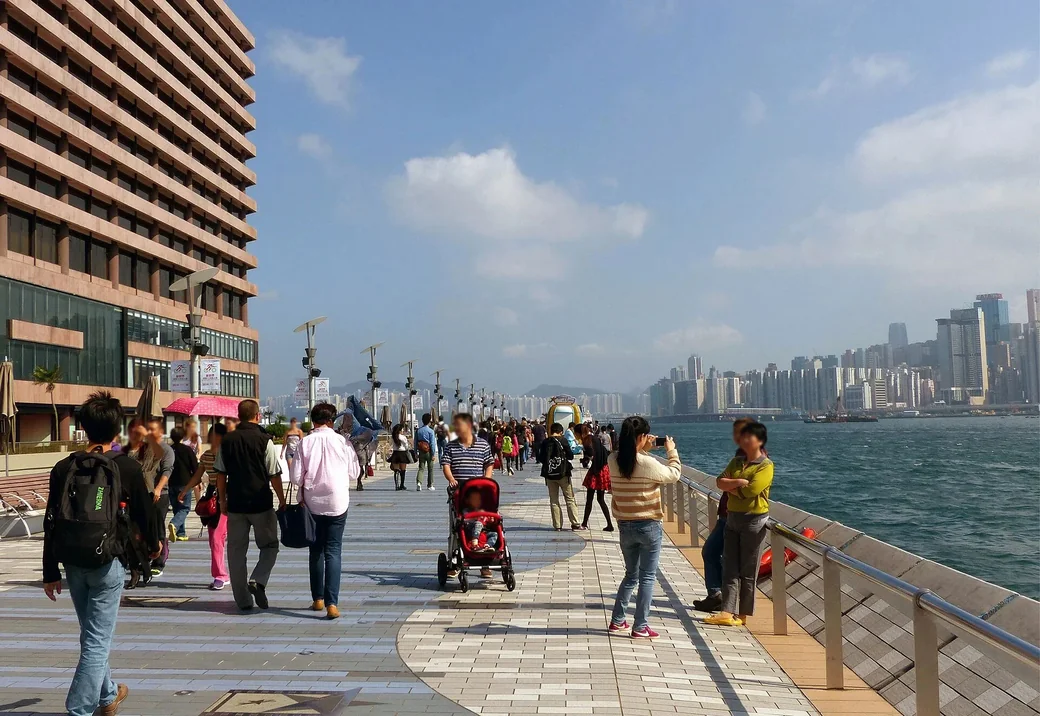
The promenade runs roughly a kilometre and a half along the harbour, from the Star Ferry Pier in the west to the Hung Hom end in the east, and the whole thing is flat and continuous. A steady walk takes about half an hour; most people stretch it to an hour and a half with stops. Going west to east works best, because the skyline widens ahead of you and the Avenue of Stars arrives roughly halfway, where the benches and shade are.
Avenue of Stars: Handprints, QR Codes and Augmented Reality
The central stretch of the promenade is the Avenue of Stars, a tribute to Hong Kong cinema. Its story begins in 1982, when the New World group built a waterfront walk at Tsim Sha Tsui East; the avenue itself opened on 28 April 2004 with seventy-three honourees and was handed over to the government as public property. After a full rebuild led by the landscape architect James Corner, it reopened on 31 January 2019. More than a hundred handprints now sit in the timber handrails at eye level rather than underfoot, and each plaque carries a QR code leading to a short biography and film clips.
The Bruce Lee Statue and the Idea of Being Like Water
The bronze figure of Bruce Lee, two and a half metres tall and sculpted by Cao Chong-en, shows the classic ready-to-strike pose from the 1972 film Fist of Fury. The Hong Kong Bruce Lee Club raised the funds, and his brother Robert Lee unveiled it on 27 November 2005, the day that would have been his sixty-fifth birthday. Since the rebuild, flowing-water features and soft lighting surround the statue, echoing his philosophy of being like water, and an augmented-reality experience lets visitors interact with it through a phone. According to local accounts, admirers began leaving flowers at the base, and the habit has simply stayed.
Anita Mui, the Film Award Statuette and McDull
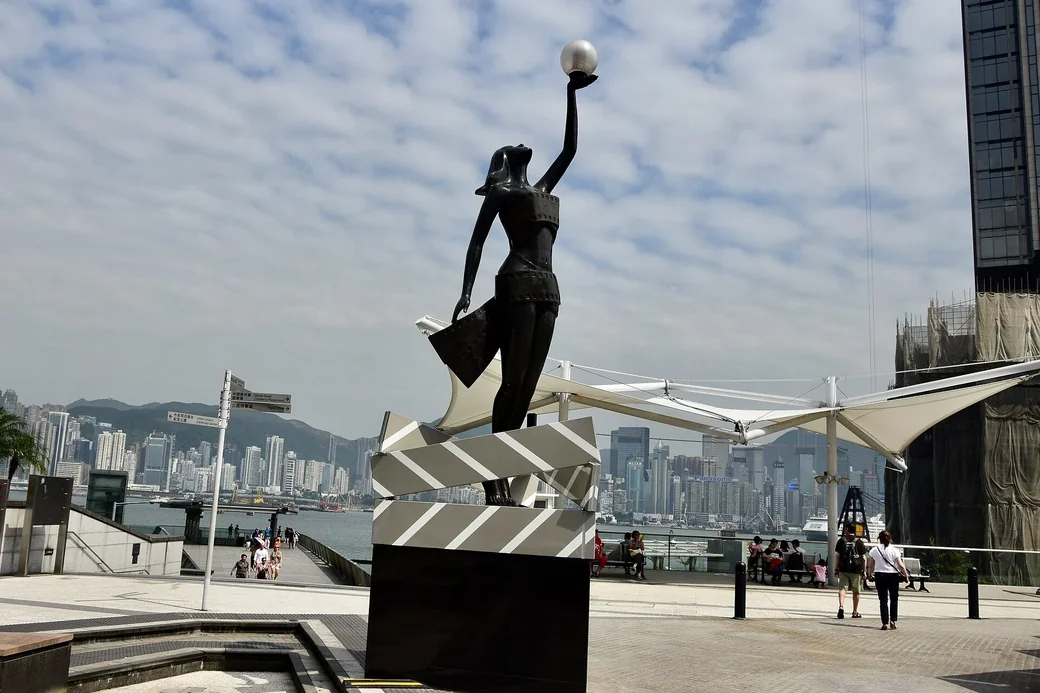
Bruce Lee is joined by a bronze of the singer and actress Anita Mui, added in 2014 and now set among flowing water that echoes the line Life Written in Water, which the avenue associates with her. At the entrance from Salisbury Garden stands a 4.5-metre replica of the Hong Kong Film Awards statuette, and close to the ground sits McDull, the much-loved local cartoon piglet created by Brian Tse and Alice Mak. Rumour has it that he sits low so small children can reach him, and that his raised finger is a wish-making gesture, which is why so many photographs copy the pose.
The Clock Tower, Last Trace of the Kowloon Terminus
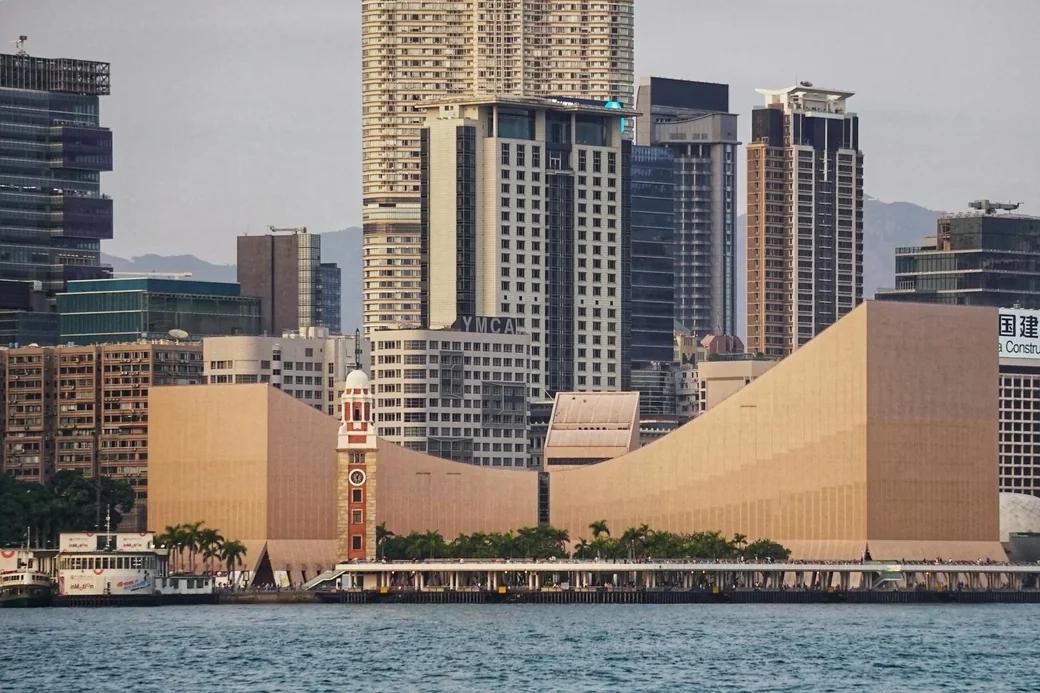
At the western end stands a red brick and granite tower, forty-four metres to its roof with a seven-metre lightning rod above. Completed in 1915, it is the only remnant of the Kowloon terminus of the Kowloon-Canton Railway; the First World War delayed building materials, and the whole station opened in 1916. The clock reused works from the demolished Pedder Street Clock Tower and all four faces were running from 22 March 1921, while the bell was cast in England in 1919. During the Japanese occupation the tower was painted camouflage grey and the bell fell silent; the clock restarted on 2 October 1945. The terminus moved to Hung Hom in 1975, the station building came down, and the tower was kept and declared a monument on 13 July 1990. The bell returned in 2010, and since 9 December 2021 it has chimed hourly, synchronised with the Hong Kong Observatory. According to a popular story, this terminus was once the first step of an overland journey all the way to Europe.
Arriving by Star Ferry Across Victoria Harbour
The green and white ferries have been crossing this stretch of water since the late nineteenth century, and the Central to Tsim Sha Tsui route still runs from early morning into the evening, with sailings every few minutes. The crossing itself takes under ten minutes and lands you at the promenade's western end, a minute from the Clock Tower. The upper deck is open to the breeze and gives the better angle; the lower deck sits closer to the water.
Three Cultural Landmarks Side by Side
Within a few hundred metres sit the Hong Kong Cultural Centre, the Space Museum and the Museum of Art, all built on former station grounds. The Space Museum opened on 8 October 1980 and is crowned by the white egg-shaped dome of Hong Kong's first local planetarium. The Cultural Centre, opened in 1989, is famous for the solid, window-free walls behind its sweeping tiled facade, and rumour has it the design was meant to leave judgement of a performance to the audience rather than the view. The Museum of Art reopened in 2019 after four years of renovation. Together with the shopping malls and ferry crossings on the promenade's doorstep, they make it easy to turn the walk into a full day out.
Salisbury Garden and the Promenade's Quiet Green Engineering
Salisbury Garden gives the walk its central lawn, shade and an event trellis, while the rebuilt promenade beside it was redesigned by James Corner together with international and local designers and earned SITES certification for sustainable open space. Balustrades are made from milled rice husks mixed with salt and a dash of mineral oil, strong enough for salty air, and the bio-wood seating also comes from old rice husks, with more than double the previous number of seats. Paving bricks contain recycled bottle glass and a pattern that softens glare. The Arbour shade structure, four metres high and weighing 25 tonnes, shelters the path, solar panels power the mobile carts, and a wave generator, the first of its kind in Hong Kong and mainland China, can produce up to 600 watts at peak times.
Sunset, Blue Hour and the Lit Skyline
The promenade faces due south across the water, which makes the hour either side of sunset its best stretch of the day. The towers opposite catch warm light first, then fall into the deep blue of dusk, and the office floors and crown lighting come on across the far shore. Arriving about an hour early gives you a railing spot and all three stages in one visit. A tripod is easier to manage in the wide plaza near the Cultural Centre than along the crowded central railing.
Best Photo Spots and the Calmest Hours
The classic frame is from the railing just east of the Cultural Centre, where the full sweep of the far shore fits in one shot. Statues and shade trellises make lively foreground, and the eastern end towards Tsim Sha Tsui East offers a slightly angled view with generous elbow room that many photographers prefer. Weekday mornings are the most peaceful window of the week, and the golden hour before sunset rewards anyone who arrives early. No other spot brings you as close to the skyline: the harbour is narrow enough here for individual towers on the far shore to be picked out one by one, with nothing in the way.
Ocean Terminal and Its Rooftop Deck
A short walk west, Ocean Terminal opened on 22 March 1966 on the site of the old Kowloon Wharf and ferry pier, and it remains the harbour's cruise gateway. Its extension, designed by Foster + Partners and completed in 2017, added a public rooftop deck that juts into the harbour for a 270-degree sweep, with two outdoor event spaces including a lawn. The deck looks back at Kowloon as well as across to the island, which makes it a perfect companion to the promenade, and it is especially lovely at sunset.
The Time Ball Tower and the Ritual of the Falling Ball
Before radio, ships in the harbour set their chronometers by a falling ball. The tower of 1884 stands in the grounds of 1881 Heritage, the restored former Marine Police headquarters just behind the promenade, and it was declared a monument in 1994. Each day the ball was raised shortly before one o'clock and released at exactly one, so captains could correct their chronometers before long voyages. Rumour has it that crews watched the tower through binoculars so as not to miss the drop, since a few seconds of error meant miles at sea. The service later moved uphill to Signal Hill.
Nine Dragons and the Harbour's Feng Shui Stories
Kowloon means nine dragons, and according to a long-told story the name was given in the thirteenth century by a boy emperor who counted eight hills around him and was reminded by an attendant that he himself was the ninth. Rumour has it that a master of feng shui (the Chinese art of arranging buildings in harmony with natural energy) was consulted when a harbourfront hotel opened here in 1980, which is said to explain its three-storey glass wall, its island reception desk where the dragons may leave some wealth, and the fountain at its entrance, said to represent a pearl. A publicist of the time joked that nobody wants nine irritated dragons stranded in the lobby. Across the water, popular talk read the sharp edges of one bank tower as sending harsh energy at its neighbour, whose rooftop cranes were nicknamed cannons; its architect said the form was inspired by growing bamboo.
The Law That Protects the Harbour, and the Races Held on It
Reclamation narrowed Victoria Harbour for more than a century until a 1997 ordinance made it a protected public asset, setting a legal presumption against filling it in. The open water in front of you is the direct result. Once a year the harbour is given over to swimmers in a cross-harbour race first held in 1906 and revived in 2011, finishing at the Avenue of Stars. Dragon boat racing, run off the Tsim Sha Tsui East stretch since 1976, fills the same water in early summer.
Access, Family Facilities and the Easy Rules of the Walk
The promenade is open around the clock and free to enter. The route is step-free from end to end, with accessible toilets near the cafe area and in Salisbury Garden, and baby-care facilities in the mall alongside. Free government Wi-Fi covers the avenue, and a staffed service counter midway handles lost property and first aid. The Avenue of Stars is a smoke-free zone kept clear of bicycles, skateboards, drones and fishing lines so that everyone can stroll in comfort, and pets are welcome. When typhoon or heavy-rain warnings are issued, the seafront closes temporarily for everyone's safety.
The Sharp Sand Spit: How Tsim Sha Tsui Got Its Name and Shoreline
Tsim Sha Tsui means sharp sandspit, a name that dates back some four hundred years to the Ming era and describes the pointed headland at the tip of the Kowloon peninsula. Reclamation has since carried the coastline outwards: Blackhead Point, once a cape, now sits inland among the towers, and the railway terminus and promenade stand on made land. The water in front of you was first called Hong Kong Harbour before being renamed Victoria Harbour in honour of Queen Victoria, and it covers about forty-one square kilometres.
Moving Around the Neighbourhood: Underground Links and Octopus Interchange
Two MTR (Mass Transit Railway, Hong Kong's metro) stations serve the promenade, joined by the Mody Road and Middle Road subways. From Tsim Sha Tsui station, exits F and G lead into those walkways, which reach East Tsim Sha Tsui station without crossing a street. Each station keeps its own fare gates, but holders of the Octopus card (Hong Kong's contactless travel card) who change between the two within the permitted interchange time are treated as making a single journey. The Space Museum sits between them, and the Star Ferry Pier, bus stops, minibus stops and taxi bays gather close by, so the neighbourhood works beautifully as a car-free base.
Signal Hill Garden: The Quiet Hilltop Behind the Waterfront
A few minutes inland, Signal Hill Garden occupies Blackhead Point, a small hill that was once a cape on the shore. It was known locally as Tai Pau Mai (big bag of rice), and the name Blackhead is said to recall a trading company of the same name. The Edwardian-style Signal Tower, built in 1907 by the Hong Kong Observatory, ran its time ball from 8 January 1908 to 30 June 1933; a storey was added in 1927, the tower served as a temporary ammunition store in the Second World War, and it was declared a monument in 2015. Beside the garden, the Middle Road Children's Playground gives families a lively stop a short walk along the street.
Tsim Sha Tsui Promenade: Visitor Tips
Walk the promenade from west to east so the skyline opens up gradually ahead of you. When you stop for photographs, the broad plaza beside the Cultural Centre keeps the central path free for everyone. Clear days after rain give the sharpest view of the far shore, so a glance at the sky helps you plan the evening. Drinking fountains and plenty of shaded benches line the route.
Tsim Sha Tsui Promenade: Best Time to Visit
Autumn and early winter give the clearest air. Arrive an hour before sunset for golden hour, blue hour and the lit skyline in one walk; weekday mornings are quietest.
Quick Info
1h 30m
easy
Tsim Sha Tsui Promenade: Getting There
The simplest approach is by MTR (Mass Transit Railway, Hong Kong's metro): East Tsim Sha Tsui station on the Tuen Ma line sits a few minutes' walk from the Avenue of Stars, and Exit J brings you out closest to the water. Tsim Sha Tsui station on the Tsuen Wan and Kwun Tong lines is linked to it by the Mody Road and Middle Road underground passages, and each station has its own fare gates. The most enjoyable arrival is by Star Ferry from Central or Wan Chai, which lands you at the promenade's western end beside the Clock Tower. Dozens of bus routes stop along Salisbury Road near Salisbury Garden, the Cultural Centre and the ferry terminus.
Nearby stops & parking
Closest rail stops are East Tsim Sha Tsui (Exit J) and Tsim Sha Tsui, linked by underground passages. The Star Ferry Pier at the western end serves Central and Wan Chai. Bus stops line Salisbury Road at the ferry terminus, the Cultural Centre and East Tsim Sha Tsui station, with routes such as 5C, 8, 9, 26, 35A and 81C among many others. The nearest paid parking is at K11 MUSEA, and coaches use designated drop-off bays close by.
Tsim Sha Tsui Promenade: Dress Code & Etiquette
This is a relaxed seaside setting where everyday clothing is perfectly fine. Comfortable walking shoes make the full stretch a pleasure, and a light windbreaker is welcome even in warm months, because the harbour breeze is fresher than in the streets behind. The promenade is a smoke-free area, and pets are welcome to stroll along.