Skip to contentSkip to navigation
Guide&Travel
Favorites (0)
Sign InSign up
Guide&Travel

In-depth city guides — compare destinations, plan your budget, and discover what's nearby. In 12 languages.

support@guideandtravel.com
Bulgaria

Explore

  • Cities
  • Places
  • Events & Key Dates

General Information

  • About Flights
  • About Car Rental
  • About Travel Insurance
  • About SIM Cards
  • About Visas

Tools

  • City Comparison
  • Packing List

Support

  • Help Center
  • Contact Us
  • FAQ

Company

  • About Us
  • Blog
  • Sponsorship

Subscribe to our Newsletter

Get travel tips, exclusive deals, and inspiration delivered to your inbox.

© 2026 GuideAndTravel. All rights reserved.

Privacy PolicyTerms of ServiceCookie PolicyImage Credits
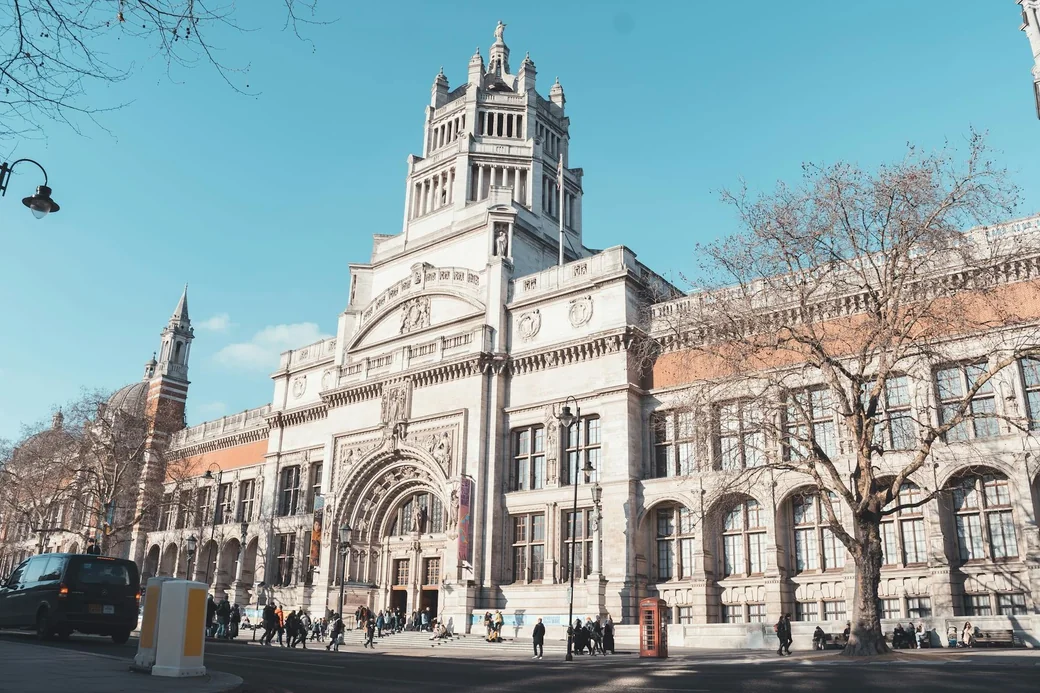
Victoria and Albert Museum (V&A) in London, the grand museum with an ornate Edwardian facade and a crowned central entrance on Cromwell Road in South Kensington
HomeEuropeUnited KingdomLondonVictoria and Albert Museum (V&A)
Museums (History, Science, Art)
Must See
Featured

Victoria and Albert Museum (V&A)

Victoria and Albert Museum

London
4.63

Rating

4.63

Category

Museums (History, Science, Art)

Admission

FreeDetails

Location

London

Accessible

Wheelchair friendly

About Victoria and Albert Museum (V&A)

The Victoria and Albert Museum, known to most people simply as the V&A, is London's great museum of art and design, set in South Kensington in the west of the city. Its galleries bring together objects from many cultures and periods, from fashion and furniture to sculpture and jewellery, showing how people have made and decorated the things around them. The museum occupies a grand Victorian building with striking modern additions, where famous masterpieces sit alongside beautifully crafted everyday objects.

Victoria and Albert Museum (V&A): Location, accommodation options and contact

Cromwell Road, South Kensington, London SW7 2RL, United Kingdom

The place's location on the map and nearby accommodation and hotel options are shown by Stay22. Cookies are used. Your consent is remembered on every page; you can turn it off at any time in the cookie settings.

Visit Website
Get Directions

V&A London: The World's Largest Museum of Art and Design

The V&A in South Kensington looks after about 2.8 million objects that stretch across some 5,000 years, from ancient carvings to contemporary fashion. Around 145 galleries and seven miles of corridors fill a 12-acre site, so nobody sees everything in a single day. The museum holds national collections of photography, ceramics, furniture, glass, jewellery, textiles, sculpture and more. General admission is free and needs no booking, which makes it easy to return, choosing a few galleries each time instead of rushing through all of them. The V&A also houses the National Art Library, and many of its collections have national status: photography, watercolours and drawings, ceramics, fashion, furniture and woodwork, glass, jewellery, metalwork including silver, portrait miniatures, post-classical sculpture and textiles. Theatre and performance forms another major collecting area.

History of the V&A: From the Great Exhibition to South Kensington

The profits of the 1851 Great Exhibition helped found the museum. Henry Cole, its first director, opened the Museum of Manufactures at Marlborough House in 1852 as a school for designers and the public. In 1857 it moved to the district of Brompton, which was renamed South Kensington to sound more fashionable. Queen Victoria laid the foundation stone of the new building in 1899, at what proved to be her last official public appearance, and the name Victoria and Albert Museum was announced that day. The same land also hosts the neighbouring museums, colleges and concert hall nicknamed Albertopolis (the district built around Prince Albert's ideas). The roots reach back to the Government School of Design of 1837, and in 1853 the collection was renamed the Museum of Ornamental Art. Queen Victoria really wanted to call the new museum simply the Albert Museum. King Edward VII and Queen Alexandra opened the buildings in 1909. The first temporary iron buildings were so ugly that a magazine nicknamed them the Brompton Boilers; they were re-erected in 1867 in Bethnal Green, where they now house Young V&A.

Aston Webb Façade, Grand Entrance and the Architecture of the V&A

Aston Webb's long façade on Cromwell Road, built between 1899 and 1909 in red brick and Portland stone, stretches for about 220 metres. A statue of Fame crowns the central tower. Above the entrance, a line from the painter Joshua Reynolds says that every art must fulfil its purpose completely. Under the glass rotunda inside hangs a blown-glass chandelier by Dale Chihuly. On the Exhibition Road side, stonework damaged in the Second World War was left unrepaired on purpose as a memorial. Look up, because the ceilings are as rich as the cases. Also look at the Henry Cole Wing on Exhibition Road, first built as a school of naval architecture and later a school of science, with its sgraffito (scratched-plaster) decoration. A small triangle of land opposite the main entrance was bought in 1863 so that new buildings could never block the view from Thurloe Square.

The Cast Courts: Trajan's Column and Michelangelo's David in Plaster

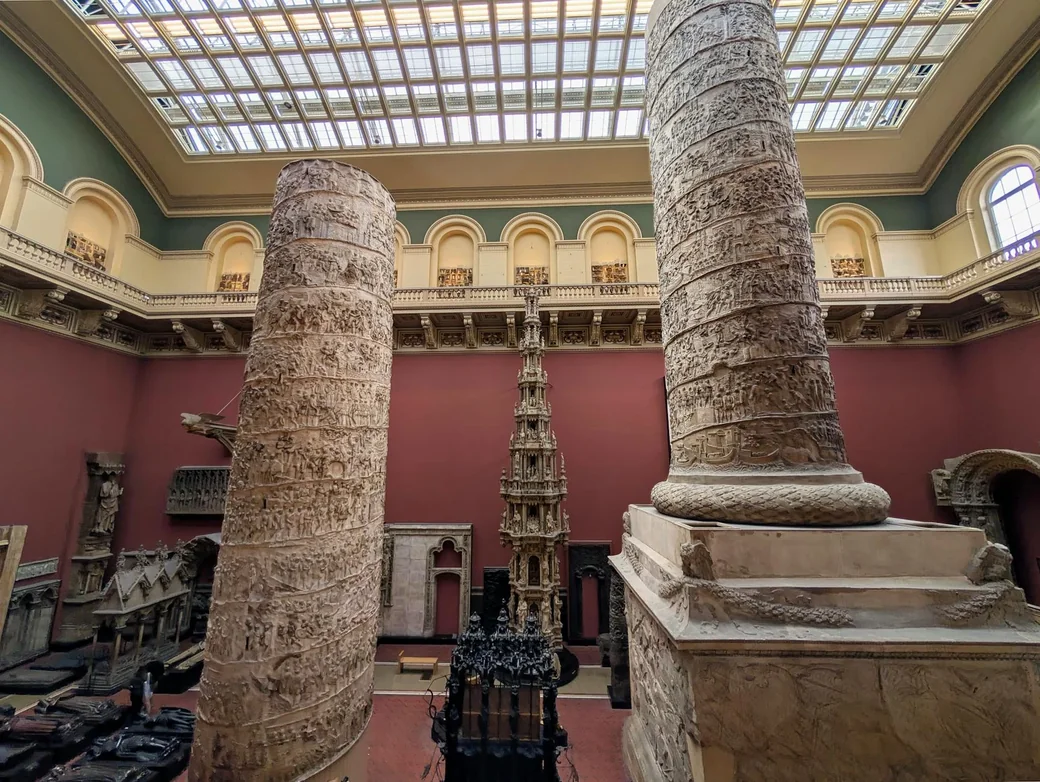
Two vast skylit halls, completed in 1873, hold plaster copies of famous sculptures, tombs and church doorways from across Europe, made so that students and visitors who could not travel could still study them. The cast of Trajan's Column from Rome stands 35.6 metres tall and is shown in two sections, and you can step inside its base. Nearby stands a full-size copy of Michelangelo's David. Casts can also preserve details that have since worn away on the originals, and the Victorian lettering and painted decoration on the walls are part of the show. No other object in the collection stands taller. The room at the base of the column opened to visitors in 2018.

The World's First Museum Restaurant: Victorian Refreshment Rooms

The South Kensington Museum was the first museum in the world to open a public restaurant. Three decorated rooms survive. The Gamble Room glows with ceramic tiles and an enamelled ceiling, the Poynter Room has blue-and-white tiles showing the seasons and months, and the Morris Room, designed by Philip Webb and William Morris, is a softly green dining room. It was also the first museum in the world to light its galleries with gas, allowing evening opening, which Henry Cole hoped would be an antidote to the gin palace. Today you can take coffee or lunch in these rooms, and the nearby Ceramic Staircase is just as lavish. The restaurant offered first- and second-class menus and a third-class service for workers and visitors on lower incomes. The Poynter Room began life as the Grill Room, and the Morris Room as the Green Dining Room. The Ceramic Staircase is covered with lead-glazed earthenware reliefs and hexagonal tiles.

Raphael Cartoons: Designs for the Sistine Chapel Tapestries

Seven huge paintings on paper by Raphael, made as full-size patterns for tapestries intended for the Sistine Chapel, hang in the gallery created for them, Room 48a. Ten tapestries were planned, and they were woven in Brussels from these designs. Queen Victoria lent them to the museum in 1865, at Prince Albert's suggestion, and they are still on loan from the Royal Collection. They were too big to evacuate in the Second World War and were bricked into a protective shelter. Tactile versions with audio description help blind and partially sighted visitors enjoy them.

Ardabil Carpet: A 1539 Masterpiece of Safavid Weaving

Woven under the Safavid dynasty and dated 946 in the Islamic calendar (1539 to 1540), the Ardabil Carpet measures about 10.4 by 5.3 metres. Wool pile on a silk foundation forms a central medallion framed by two hanging lamps. A panel at one end quotes two lines of verse by the poet Hafez, followed by the signature of Maqsud of Kashan, described as a servant of the court. A second carpet of the same design is in Los Angeles, and the London carpet was restored in the nineteenth century using parts of both, a story that adds to its fame.

Tipu's Tiger and the Story of the South Asia Collections

Made around 1793 for Tipu Sultan, ruler of Mysore, this almost life-size wooden tiger overpowers a figure in European dress, while a hidden organ imitates growls and cries when its handle turns. After the siege of Seringapatam in 1799 it was found in the palace music room and sent to London, where the East India Company displayed it in its museum before it reached the V&A. Some see it as a symbol of resistance, others as a spoil of war. Because galleries are refurbished from time to time, check the museum's collection search for where it is shown today. The V&A's South and South-East Asian collections began as the East India Company's India Museum, founded in 1801 and transferred to the South Kensington Museum in 1879.

The Great Bed of Ware: Shakespeare's Famous Bed

Carved around 1590, the Great Bed of Ware measures about 2.7 metres high, 3.3 wide and 3.4 deep, and is reputed to hold at least four couples. It was probably made as an attraction for an inn in Ware, Hertfordshire. Travellers carved their initials into it or pressed red wax seals, still visible today. Shakespeare mentions it in Twelfth Night in 1601, and Ben Jonson named it in 1609. A record from 1689 says it once slept twenty-six butchers and their wives. It stands in Room 57, and in 1931 it was the most expensive piece of furniture the museum had ever bought. The museum suggests the bed may have been a marketing ploy to attract guests to the White Hart Inn in Ware.

Legends of the V&A: Fairy Cup, Ghost Bed and a Plaster Fig Leaf

Old museums collect stories as well as objects, and the tales below are best read as hearsay. According to legend, a carpenter named Jonas Fosbrooke made the Great Bed of Ware for a king, and his ghost is angry because the bed passed from inn to inn and commoners carved their names into it; sleepers are said to wake with mysterious bruises. The museum's own account, by contrast, dates the bed to about 1590 and sees it as an attraction made for an inn. According to legend, a butler surprised dancing fairies beside St Cuthbert's well, and they left behind the Luck of Edenhall, a glass beaker made in the medieval Middle East, crying that the luck of Edenhall would end if the glass should break or fall. It is said that Queen Victoria was shocked by the plaster cast of David, so a made-to-measure fig leaf was hung on it from two hooks whenever dignitaries visited; the museum still keeps the fig leaf but no longer uses it. Finally, a basement room called Clinch's Hole is reputedly haunted, and it is said to take its name from a warder called Clinch.

Exhibition Road Quarter and the Photography Centre

The Exhibition Road Quarter, completed in 2017 to designs by Amanda Levete's studio AL_A, added the Blavatnik Hall entrance, a column-free underground exhibition gallery of 1,100 square metres and the world's first all-porcelain public courtyard, paved with more than 11,000 handmade tiles. The Photography Centre, expanded in 2023 to seven galleries, is the largest permanent space dedicated to photography in the country. The V&A was the first museum anywhere to collect photographs as art, starting in 1856. A walk-in camera obscura is a highlight. The Aston Webb Screen at the courtyard's edge keeps its wartime bomb damage, now framed by eleven new metal gates, and the courtyard also revealed Victorian façade details that the public had never seen before.

Hidden Treasures, Curious Objects and Surprising Stories at the V&A

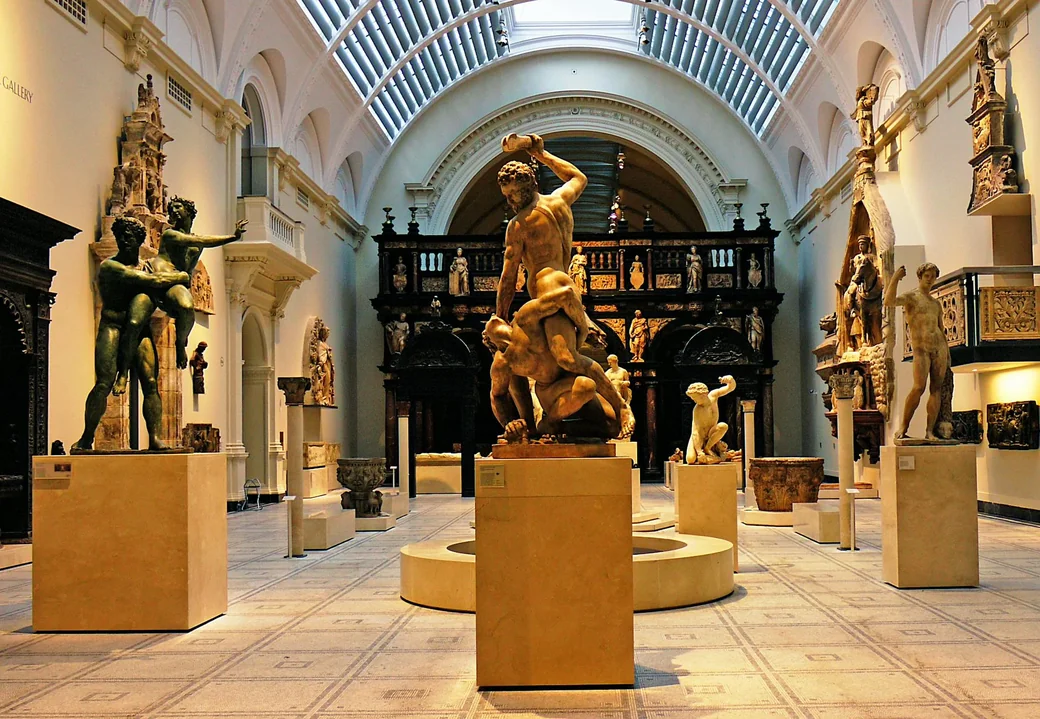
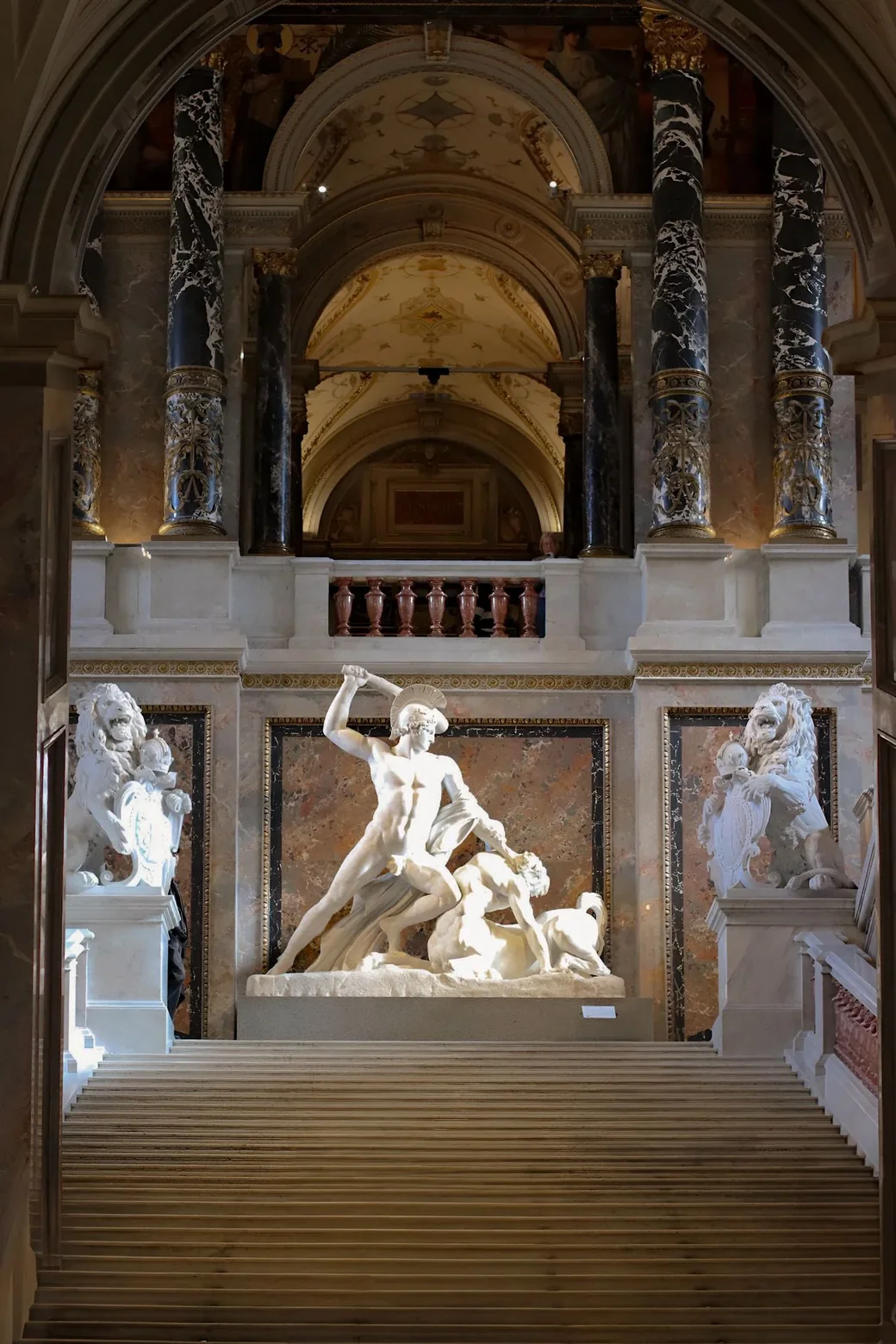
Beyond the stars, look for the Hereford Screen, an iron choir screen of 14,000 pieces whose conservation took 38 people a year, and the Gloucester Candlestick, cast between 1107 and 1113. Canova's Three Graces is a luminous marble group made in the early nineteenth century. Smaller wonders in the collections include Henry VIII's writing box of 1525, a daguerreotype of London from 1839 and a copy of the first commercial Christmas card, which the museum's first director Henry Cole invented in 1843. In the 1860s the South Court was decorated with 35 mosaic portraits of artists, known as the Kensington Valhalla. Other curiosities in the collections include the tallest bed, a state bed 4.62 metres high; the widest garment, a court gown with a skirt almost 2.4 metres wide; the earliest European garment, a shirt dated 1540; and a wedding suit of 1673. A late-17th-century marble and wood ox's head holds a bony growth once wrongly taken for a fossilised brain, and a sculpture of a faithful dog called Bashaw, which had about 50 sittings, was the work John Ruskin disliked most. A cameo portrait of Elizabeth I only 5.5 centimetres high is among the smallest sculptures. A Victorian wardrobe once owned by Mick Jagger, Elton John's spectacles, and a pen case and a manuscript linked to Charles Dickens also belong to the collections. Many items rotate, so check the collection search before you go. Some stories about the museum itself: army engineers served as the first warders and kept a water tank for rowing practice; a pneumatic railway planned in 1872 was never built; a nearby Underground station, Brompton Road, opened in 1906 and closed in 1934; and deliveries once used a turntable to spin horse and cart around. In 1901 Art Nouveau furniture caused such an argument that it was sent to Bethnal Green with a warning notice for design students. The V&A held the first museum rock concert in the country in 1973, and the Design Museum began in 1981 as the Boilerhouse exhibition space here. In 2015 Alexander McQueen: Savage Beauty drew nearly half a million visitors, a museum record until Christian Dior: Designer of Dreams overtook it in 2019, and in 1988 an advertising campaign called the museum an ace café with a rather nice museum attached. In the Second World War parts served as an air-force canteen and a school for children evacuated from Gibraltar, while most collections were stored in the Aldwych Underground tunnel, Montacute House and Westwood Quarry, and spies were equipped in the Royal College of Art building behind. In the 1950s a staff member removed several hundred objects, swords among them. Staff have staged a satirical pantomime every Christmas since 1981, and the museum appears in Dickens's Hard Times (Henry Cole inspired a character), in novels by H. G. Wells and A. S. Byatt, and in films such as The Ipcress File, Hugo and Tinker Tailor Soldier Spy.

John Madejski Garden: Picnics, Paddling and Quiet

The garden at the museum's heart was designed by Kim Wilkie and opened in 2005. A shallow elliptical pool lets visitors paddle on warm days when it is open, always fully clothed and with children supervised, and lawns, lemon trees in glass planters and the surrounding façades make a restful setting. Picnics are welcome here, and a garden café serves light refreshments. Small plaques commemorate Henry Cole's dogs Jim and Tycho, buried in the garden, and parts of the museum's original 1860s entrance now line one side. The garden closes a little before the galleries. The museum has a main café in the historic refreshment rooms, a patisserie and a garden café, and every café offers gluten-free and vegan options. Museum shops sit near both entrances, and you may carry bottled water in the galleries.

Planning Your V&A Visit: Hours, Free Tours, Crowds and Friday Late

The museum is open every day and stays open late on Fridays, when some galleries still close at the usual hour. Galleries begin to empty shortly before closing, and the doors stay shut on 24, 25 and 26 December. Free volunteer-led introductory tours run on many days, so ask at the information desk. Weekday mornings are quietest, and Friday evenings feel relaxed. Use the digital map or a themed trail, check the collection search to see whether an object is on display, and book a free Order an Object appointment (age 16 and over) to see stored pieces. The free volunteer-led tours are given in English, while private licensed guides lead tours in other languages through tour operators. The National Art Library and the Prints and Drawings and Archive study rooms are free to use: only pencils and laptops are allowed, bags stay in the cloakroom, and a USB stick helps because there is no printing. For Order an Object appointments, held in the stores at South Kensington or V&A East Storehouse, you may bring a phone, laptop, headphones, a camera for personal use, pencils and a sketchbook, but no food or drink. A few free lockers fit cabin-size cases, but they are very limited. Allow at least two to three hours, although a full day is easily filled.

Accessibility, Families, Photography and Gallery Rules at the V&A

Both main entrances are step-free and lifts serve all levels. Wheelchairs and walking sticks can be borrowed if requested in advance, trained assistance dogs are welcome, and induction loops, touch objects, a quiet space and a visual story help many visitors. Buggy parks stand near both entrances. Hand-held photography for personal use is welcome, but tripods, monopods, gimbals and lighting are not allowed, and sketching with pencils is encouraged. Do not touch objects, and leave wheeled luggage and large bags in the cloakroom. The nearest Changing Places toilet is at the neighbouring Science Museum, while the V&A itself has several accessible toilets. Neck loops and radio receivers for talks and tours are available from the information desk in the Grand Entrance. Tactile versions of the Raphael Cartoons come with audio descriptions, touch objects stand in the Europe 1600–1815 galleries, and the museum runs touch tours, sign-language events, dementia-friendly tours and relaxed views. The nearest park for assistance dogs to exercise is Hyde Park, about 800 metres away, because the museum has no dedicated area.

V&A Visitor Tips: Photo Spots, Quiet Times and Do's and Don'ts

Good photo spots include the long Cromwell Road façade from across the street, the Chihuly chandelier under the Grand Entrance rotunda, the porcelain Exhibition Road Courtyard, the plaster giants of the Cast Courts, the Ceramic Staircase, the historic refreshment rooms and the garden pool on a clear day. Weekday mornings, Friday evenings and the last two hours before closing are calmest, ideal for popular spaces such as the Cast Courts. Do carry a small bag, wear comfortable shoes, photograph with hand-held cameras and phones, sketch in pencil on a gallery stool and ask staff for help. Don't touch objects, cases or plinths, bring tripods, monopods, gimbals or lighting, carry wheeled luggage or bags above the size limit into the galleries, or try to see everything: choose a few galleries and enjoy them slowly.

Near the V&A: Natural History Museum, Science Museum, Royal Albert Hall and Other V&A Sites

Near the V&A: Natural History Museum, Science Museum, Royal Albert Hall and Other V&A Sites

South Kensington's museum quarter, nicknamed Albertopolis, puts the Natural History Museum and the Science Museum a short walk from the V&A, with the Royal Albert Hall, Kensington Gardens and Hyde Park close by. Harrods in Knightsbridge is roughly a ten-minute walk away, and Imperial College and the Royal College of Music stand in the same district. The V&A family also includes Young V&A in Bethnal Green, the children's museum in the re-erected Brompton Boilers; V&A East Storehouse and V&A East Museum in east London; V&A Dundee; and the V&A Wedgwood Collection in Stoke-on-Trent. All of them are free to enter, and V&A East Storehouse also hosts Order an Object appointments.

Victoria and Albert Museum (V&A): Visitor Tips

Pick up a map at the Grand Entrance or use the digital map and themed trails on the museum's website. If time is short, aim for the Cast Courts, the Raphael Cartoons, the Ardabil Carpet, the Ceramic Staircase and the Great Bed of Ware. Weekday mornings and Friday evenings are the calmest times. Small bags are fine, but wheeled luggage and large bags go to the cloakroom. Photography with hand-held cameras and phones is welcome for personal use. Rest in the John Madejski Garden or the historic cafés, and save the neighbouring Natural History and Science museums for another day to avoid museum fatigue.

Victoria and Albert Museum (V&A): Best Time to Visit

Weekday mornings just after opening and the last two hours before closing are the quietest. Friday evenings bring late opening. Cooler or rainy days suit a long indoor visit.

Victoria and Albert Museum (V&A): Admission Fees

  • Free admission

    The permanent galleries are free to enter without a ticket, including during the late Friday opening; special exhibitions and some events are ticketed separately.

    Free

Quick Info

3h
easy

Victoria and Albert Museum (V&A): Getting There

The easiest route is the Tube (London's Underground) to South Kensington station, served by the Piccadilly, District and Circle lines. From there it is about a five-minute walk, either along Exhibition Road or through the pedestrian subway (the museums tunnel) that leads towards the museum. The subway has steps and no lift, so travellers who need step-free access should choose another route. Gloucester Road station is roughly ten minutes away on foot, and Knightsbridge, about fourteen minutes away, is the nearest station with step-free access. Buses 14, 74, 414 and C1 stop right outside the Cromwell Road entrance, and route 360 serves Exhibition Road. Victoria station is a short Tube ride away. Cromwell Road is a major road into the city from the west, but parking nearby is limited, so public transport is far simpler.

Nearby stops & parking

The bus stop named Victoria and Albert Museum sits outside the Cromwell Road entrance, and the service from this stop runs around the clock. A taxi rank stands beside the museum at Cromwell Gardens, and coaches set down on Exhibition Road. Cycle-hire docking stations are on Exhibition Road and Thurloe Place, with cycle parking close to the Grand Entrance. Street parking in the area is limited and restricted. Several bays on Exhibition Road are reserved for holders of a disabled-parking permit and are available first come, first served. Cloakrooms at both main entrances can store coats and bags during your visit.

Victoria and Albert Museum (V&A): Dress Code & Etiquette

There is no dress code, so wear comfortable shoes for long distances and layers for galleries that vary in temperature. Coats, umbrellas and small bags can be left in the cloakrooms by both entrances, and wheeled luggage and bags above the museum's size limit are not allowed in the galleries. Bottled water is welcome in the galleries, but eat packed lunches in the garden, the Exhibition Road courtyard or the learning-centre lunchrooms. Please speak softly near fragile objects, do not touch cases, plinths or objects, and follow staff guidance in special exhibitions.

Guide / Language

en

Victoria and Albert Museum (V&A): Amenities & Facilities

Free guided tours, digital map and themed trails
John Madejski Garden and picnic areas
Induction loops, touch objects and audio description
Cloakrooms at both main entrances
Museum shops
Step-free entrances, lifts and wheelchair loan
Quiet space and accessible toilets
Cafés and historic Victorian refreshment rooms
Buggy parks near the entrances

Victoria and Albert Museum (V&A): Opening Hours

Monday10:00 - 17:45
Tuesday10:00 - 17:45
Wednesday10:00 - 17:45
Thursday10:00 - 17:45
Friday10:00 - 22:00
Saturday10:00 - 17:45
Sunday10:00 - 17:45