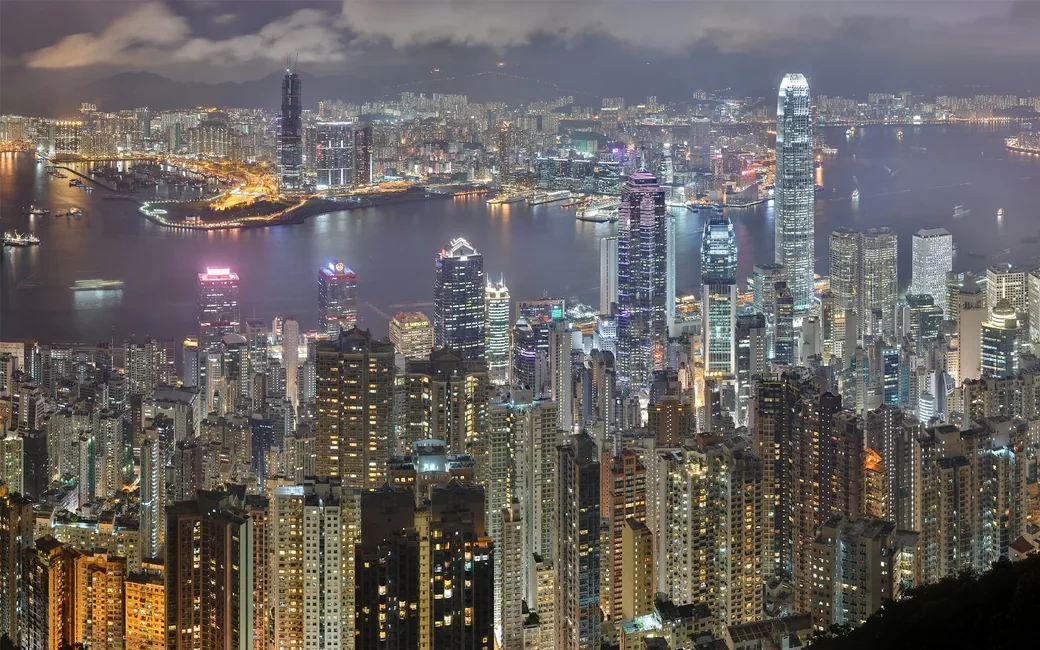
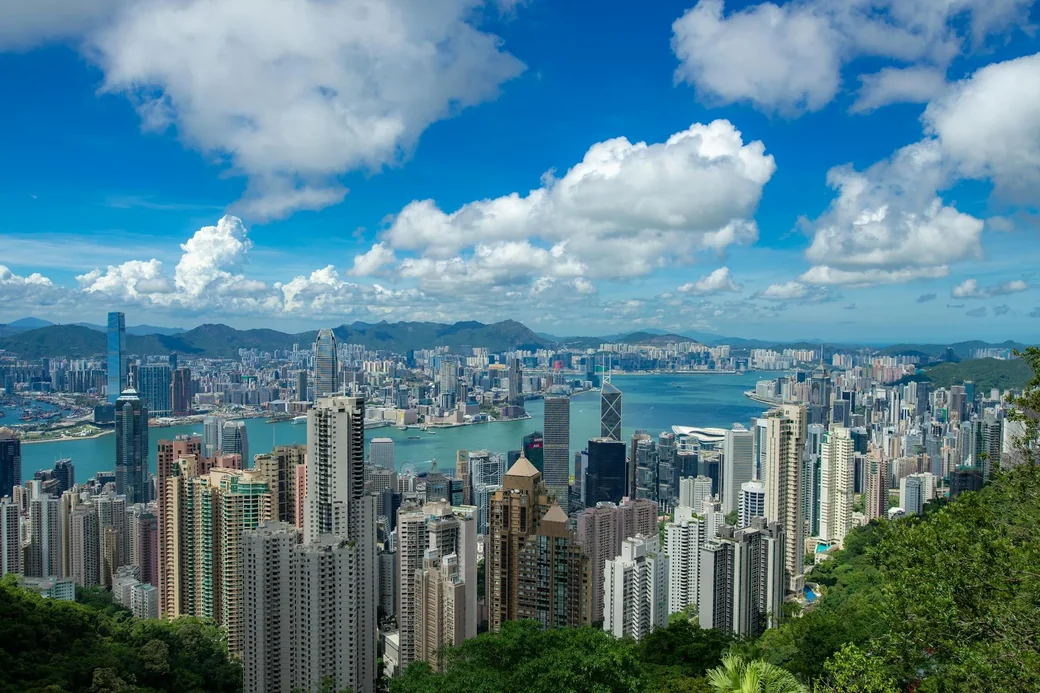
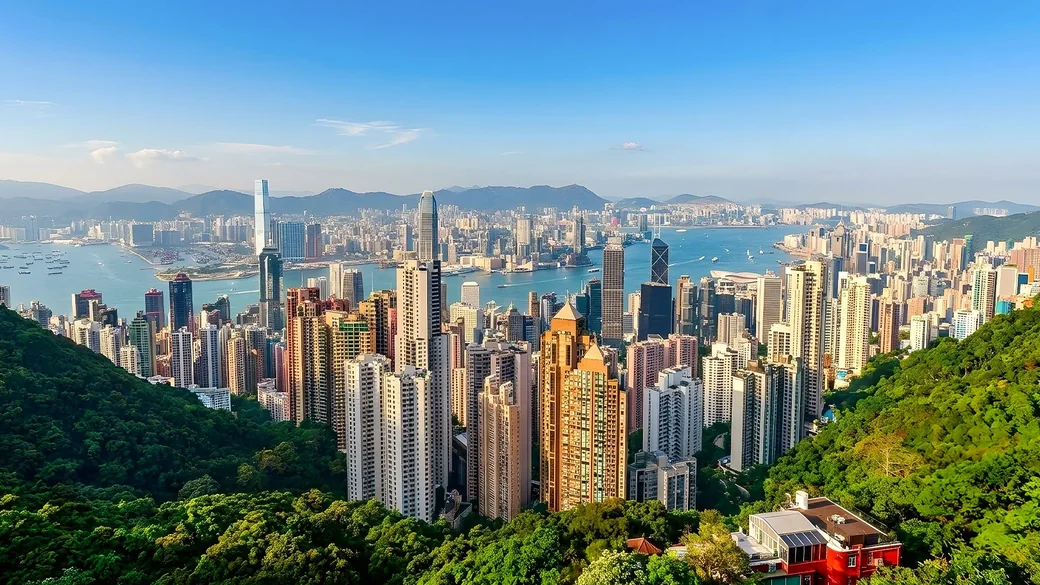
Victoria Peak, usually called simply The Peak, is the green hill that rises behind Central on Hong Kong Island, and it is the city's classic viewpoint. From its upper slopes the skyscrapers of the island fall away towards Victoria Harbour, with Kowloon spread across the far shore. A historic tram climbs to a hilltop cluster of viewing decks, shops and restaurants, and shaded footpaths wind around the summit through woodland. For anyone visiting Hong Kong for the first time, it is the place to take in the whole city at once.
Victoria Peak (The Peak): Location, accommodation options and contact
The Peak Tower, 128 Peak Road, The Peak, Hong Kong Island, Hong Kong (lower tram terminus: 33 Garden Road, Central)
The place's location on the map and nearby accommodation and hotel options are shown by Stay22. Cookies are used. Your consent is remembered on every page; you can turn it off at any time in the cookie settings.
The Highest Point on Hong Kong Island and Its 552-Metre View
At 552 metres, Victoria Peak is the tallest hill on Hong Kong Island, though the true summit carries a telecommunications facility and is closed to visitors. Everything happens at Victoria Gap, the saddle roughly 150 metres lower where the Peak Tower, the Peak Galleria and the tram station cluster together. From the lookouts the harbour, Kowloon, Lamma and the outlying islands line up in layers, and black kites usually circle somewhere below eye level. On clear days you can also follow the ferries crossing far below and see the ridges of the New Territories stacking up beyond Kowloon.
The Peak Tram: Asia's First Cable Funicular, Running Since 1888
Service began on 30 May 1888, making this the first cable funicular in Asia. The Scottish entrepreneur Alexander Findlay Smith had petitioned for the line in 1881, and Governor Sir William Des Voeux opened it. Six generations of tramcar later, the route still follows its original alignment, climbing from 33 to 396 metres over 1,278 metres of track on gradients between four and 25.7 degrees. The present Swiss-built cars carry 210 passengers and take about six minutes.
The Four Request Stops and the Vanished Bowen Road Station
Between the two terminals the tram still serves four small stations — Kennedy Road, MacDonnell Road, May Road and Barker Road — used mainly by Mid-Levels residents. They are request stops: press the button inside the car or on the platform, and note that control can decline the stop when the next tram is full. A fifth station at Bowen Road closed in 1985 and was merged into MacDonnell Road; the old platform and steps are still visible from the track.
Why the Towers Appear to Lean as the Tram Climbs
Passengers often report that the high-rises beside the track tilt towards the hillside as the car climbs. A University of Hong Kong study published in a psychology journal in 2013 attributed the effect to a shift in the perceived vertical, caused by the tilted visual surroundings and the reclined posture of passengers inside the car. The operator now treats the illusion as an attraction in its own right. Sit by a right-hand window going up to see it at its strongest.
Sky Terrace 428, the Highest Viewing Platform in Hong Kong
The open-air deck on the roof of the Peak Tower sits 428 metres above sea level, which is where its name comes from, and it is the highest viewing platform in the territory. It is the only spot on the Peak offering a genuine 360-degree sweep, taking in the harbour to the north and Pok Fu Lam and the South China Sea to the south. Lifts and an accessible restroom serve the deck, and tripods are not permitted.
The Free Rooftop Deck Above the Peak Galleria
Across the plaza from the Peak Tower, the Peak Galleria has an open rooftop deck that costs nothing to use and is larger than the paid platform opposite. It looks both ways: north over the harbour and the skyline, south towards Pok Fu Lam Reservoir and the sea. Telescopes are installed along the rail, the crowds are usually thinner, and the building also houses the bus terminus, a children's playground and the only public car park on the Peak.
Lugard Road Lookout: The Postcard Shot Without a Ticket
Built between 1913 and 1914 and named after Sir Frederick Lugard, this pedestrian road contours the hillside at about 400 metres and forms the opening section of the fifty-kilometre Hong Kong Trail. Twenty minutes from the Peak Tower it reaches the lookout that produces most of the city's postcard images, free of charge. On its northern stretch the path crosses a cantilevered section carried on iron brackets driven into the rock face more than a century ago. The road begins just a couple of minutes' walk from the tram doors. Many visitors stop at the paid viewing deck and the shopping complex beside it, but some of the finest views on the Peak are here, free, along this path.
The Peak Circle Walk: A Level 3.5-Kilometre Loop Around the Summit
Lugard Road and Harlech Road join to form a paved circuit of about 3.5 kilometres that encircles the summit at roughly the height of the Peak Tower. The tourism board grades it easy and reckons on an hour. It is popular with local joggers and dog walkers as well as visitors, and it swaps views as you go: harbour and Kowloon on the Lugard side, then the western district and the open sea as you come round onto Harlech. Walking clockwise saves the skyline for last. Together with the viewing decks, the walks make the Peak worth half a day rather than an hour, ideally a clear one.
Victoria Peak Garden and the Gate Lodge of the Old Mountain Lodge
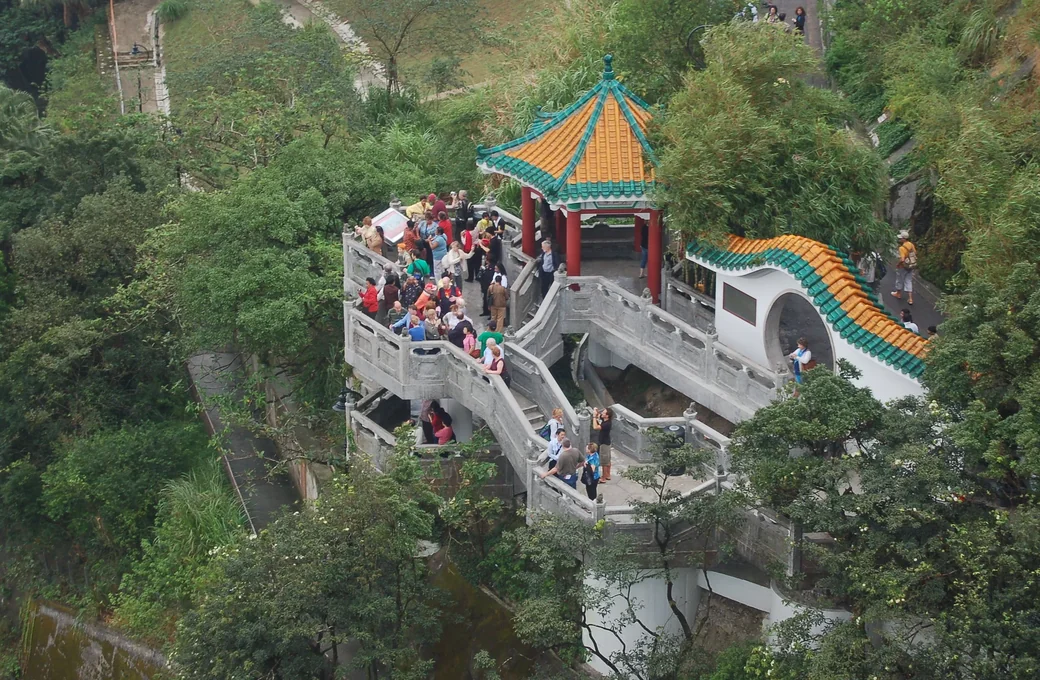
A fifteen to twenty-five minute climb up Mount Austin Road from Victoria Gap reaches the closest publicly accessible point to the summit. The terraced lawns and gazebos occupy the grounds of Mountain Lodge, the governor's summer residence, whose main building was demolished in 1946. One structure survived: the Gate Lodge, built between 1900 and 1902 as quarters for the keeper, declared a monument in 1995 and now used as a site office. The garden faces the open sea rather than the skyline, and it is open around the clock.
Legends of the Peak: The Flag-Raising Hill and an Empty Mansion
According to local lore, the hill was once called the flag-raising mountain because a Qing-era seafarer is said to have used it as a lookout and hoisted a flag to signal his companions at sea; the same stories say that once calm returned to the waters, residents renamed it the mountain of great peace, the name it still carries in Chinese. A second tale attaches to an abandoned pre-war house on Lugard Road, where legend has it that workers heard sounds they could not explain and the building was judged to have unlucky fortune. Both are told as hearsay, not as record.
From Sedan Chairs to a Funicular: How the Peak Was Settled
A summer residence was built here for Governor Sir Richard MacDonnell around 1868, and wealthy households followed, giving their houses names like The Eyrie. Before the tram, everyone travelled by sedan chair carried up the steep paths, which kept the district small. The Peak Hotel opened in 1873 on land owned by the man who later proposed the tramway; it was lost to fire in 1938 and the Peak Galleria now stands on the site. Between 1908 and 1949 the first two seats in the tram carried a brass plaque reserving them for the governor. What drew them was the climate: high above the city, the hill offered relief from the summer heat of the streets below.
The Peak Tower and Its Famous Wok-Shaped Silhouette
The building you see today is the third structure on the site, after a modest lookout in the 1950s and a tower by Chung Wah Nan Architects opened in 1972. British architect Terry Farrell designed the present tower, which opened in 1997 with seven floors and a curved upper deck that the city quickly nicknamed the wok. The design drew lively debate when it was unveiled in 1993; it has since become one of the most recognisable outlines on the ridge.
Hatton Road's Hidden Heritage: A Boundary Stone and a Hilltop Battery
Where Lugard and Harlech roads meet, a path drops onto Hatton Road and into Lung Fu Shan Country Park, designated in 1998 and the smallest country park in Hong Kong at around 47 hectares. About 400 metres along it stands a granite marker inscribed with the words recording the 1903 city boundary, the only one of its group still in its original position. Further on lies Pinewood Battery, completed in 1905 at 307 metres: gun platforms, a command post and shelters survive along a 400-metre heritage trail.
The Peak Has Its Own Weather, Its Own Fog and Its Own Wildlife
The Peak runs noticeably cooler than the waterfront and keeps its own observatory weather station, which has recorded a low of minus one degree. Low cloud is common from February through April and can hide the skyline for days while Central stays clear, so the live webcams are worth a look before you commit. The slopes are also busy with wildlife: black kites are the most visible, alongside many butterflies, and wild boar, porcupines and snakes live in the wooded sections. Do not feed or approach them.
The Sedan Chair Race, a Charity Tradition Born on the Peak
A hospital stands on the Peak's southern side, founded under the will of a banker who asked that it be built in memory of his wife and run for those with least. In 1975 one of its nurses invented a sedan chair race to raise the hospital's profile, choosing sedan chairs because they were how patients first arrived. Teams of eight now carry a seated passenger around a 2.1-kilometre course in costume, and the funds raised go entirely to small local charities rather than to the hospital itself.
Little-Known Details of the Peak Tram: Station Names, Haulage Ropes and the 1919 Station
The names of the intermediate stops are a small lesson in local history. Kennedy Road and MacDonnell Road recall governors of the 1870s and 1860s, May Road honours Governor Francis Henry May, and Barker Road is named for a British garrison commander of the late nineteenth century. The Barker Road station building, completed in 1919, is the oldest surviving station building on the line, and Union Church contributed half the cost of the Kennedy Road stop.
The engineering rewards a closer look too. Two haulage ropes, each 50.5 millimetres thick and designed with a safety factor of eight, pull the car; four separate braking systems stand guard; and the floor is shaped in gentle waves so that standing passengers keep their footing on the slope. The line is largely single track, with a passing section between May Road and Barker Road where the two cars glide past each other.
A few more details for the curious: the first day brought about 600 passengers and the first year around 150,000; the earliest cars offered three classes of seating; coal-fired steam gave way to electric power in 1926; and in the old days a guest who left a Peak party after the last scheduled tram could order a special car at any hour up to three in the morning. In the Peak Tower, a free gallery open to tram ticket holders displays models of the 1888 cars and period objects.
The Peak Lookout, Madame Tussauds, Film Memories and the Famous Night View
Among the heritage buildings near the upper station is The Peak Lookout, a Grade II historic building (a heritage grading for buildings of special merit) that began as a house for tramway engineers, was rebuilt in 1901 as a rest stop for sedan chairs, and has served as a restaurant since 1947; it took its present name in 2001, having long been known as the Peak Cafe.
Inside the Peak Tower, Madame Tussauds Hong Kong opened in 2000 as the first branch of the wax museum in Asia, and the tower also houses the MeiLok Experience Studio. Across the plaza, the Peak Galleria offers Monopoly Dreams, a Monopoly-themed attraction for families.
The names around the hill have their own stories. Mount Kellett Road, which leads to Matilda International Hospital (the hospital behind the sedan chair race), is named for Vice-Admiral Sir Henry Kellett, born in County Tipperary, Ireland, in 1806.
The Peak has also been a screen star. Soldier of Fortune, the 1955 film starring Clark Gable, opens and closes with scenes shot inside a tram car; the line appeared in an episode of the television series The Love Boat; and a commemorative stamp marked the tram's centenary in 1988.
Finally, the night view. In popular travel writing, the Peak's evening panorama is often counted among the world's three great night views, alongside Hakodate in Japan and Naples in Italy. It is an informal popular title rather than an official ranking, but it explains why so many visitors time their visit for dusk.
Opening Hours at a Glance, Weather Arrangements and Practical Details for Families and Pets
Each part of the Peak keeps its own daily hours, so a quick look at each venue's current hours helps you plan the order of your visit. Victoria Peak Garden is open around the clock, and Lugard Road and the Peak Circle Walk have no closing time.
Weather arrangements are clear and simple. Everything stays open under amber and red rainstorm warnings and under typhoon signals 1 and 3. When the black rainstorm warning is in force, the Peak Tower stays open, Sky Terrace 428 closes at once and the tram runs on a restricted basis. At typhoon signal 8 or higher, Sky Terrace 428 closes immediately and the tram stops soon afterwards; service resumes once the signal has been lowered and conditions allow. A few days each year are set aside for planned tram maintenance, when the Peak Tower and Sky Terrace 428 stay open and buses and minibuses carry visitors up.
For families, strollers ride the tram folded to no more than 66 centimetres wide, each car has eight places with seat belts for wheelchairs or strollers, the Peak Tower has a baby care room, and pregnant visitors are advised that if every seat is taken it is most comfortable to wait for the next car. Guide dogs are welcome on the tram, other pets are welcome in the Peak Tower on a lead or in a carrier or stroller, and Victoria Peak Garden has a dog park.
Small conveniences: free Wi-Fi at the tram terminals, in the Peak Tower and on Sky Terrace 428; a 7-Eleven (a convenience store chain) inside the Peak Tower for water and snacks; restrooms next to the bus terminus that are usually quieter than those inside the tower; and, at the lower terminal, a ticket counter that accepts the Octopus card (Hong Kong's rechargeable transit card), which passengers boarding at an intermediate station can also use to pay on board. Holding a phone screen at full brightness two to three centimetres from the reader helps an e-ticket scan quickly.
Victoria Peak (The Peak): Visitor Tips
Check the Hong Kong Observatory's live Victoria Peak webcams before you set off — low cloud can erase the skyline completely while Central below stays dry, and a paid viewing deck is poor value on a grey day. Buy tram tickets online from the official store only; the operator has publicly warned about copycat ticket sites. Note that an online ticket skips the ticket counter but not the boarding queue. Weekday mornings are usually calmer than the early-opening rush. Sit on the right-hand side going up for the best window. Consider riding the tram one way and taking bus 15 or minibus 1 the other way, which avoids the longest queue of the day. Tripods, lighting rigs and drones are not permitted at the tram, the tower or the paid deck. There is no luggage storage anywhere on the Peak.
Victoria Peak (The Peak): Best Time to Visit
October to December for the clearest air; early morning or the hour around sunset. Avoid the March-April fog season.
Quick Info
3h
easy
Victoria Peak (The Peak): Getting There
From MTR (Mass Transit Railway, Hong Kong's metro) Central Station take Exit J2 and walk about ten to fifteen minutes uphill to the Peak Tram lower terminus at 33 Garden Road; the funicular climbs to the upper terminus inside the Peak Tower in roughly six minutes. Citybus route 15 runs from Central Pier and Exchange Square to the Peak Galleria bus terminus at frequent intervals, with route X15 from Central Pier 6 on weekends and public holidays. Green minibus route 1 leaves from Two IFC in Central at frequent intervals and is often the fastest option when the tram queue is long. Taxis are metered and plentiful. On foot, allow one to one and a half hours from Central: the steep Old Peak Road starts near the Zoological and Botanical Gardens, while Hatton Road, known as the Morning Trail, is the gentler climb.
Nearby stops & parking
At the top, the Peak Galleria houses the bus terminus used by route 15, route X15 and green minibus 1, and it is also where the only public car park on the Peak is located, since the Peak Tower itself has none. The upper tram station is inside the Peak Tower, a few steps across the plaza. Taxis drop off and pick up at the forecourt between the two buildings. Down in the city, the lower tram terminus stands at 33 Garden Road, roughly ten to fifteen minutes on foot from MTR Central Station Exit J2, the nearest metro station. Victoria Peak Garden has a small car park of its own at the top of Mount Austin Road. There is no luggage storage at either terminus or inside the tower.
Victoria Peak (The Peak): Dress Code & Etiquette
This is not a religious site and there is no dress code, but the Peak sits several degrees cooler and windier than the harbour front, so bring a light layer for evening visits. Comfortable walking shoes matter if you plan the 3.5 km circuit or the steep climb up Mount Austin Road to the garden. Remember that the Peak is also a residential neighbourhood: keep voices down near houses, stay off private driveways, and give way to joggers on the narrow stretches of Lugard Road. Some upper-floor restaurants in the two complexes expect smarter clothing.