Wat Arun, the Temple of Dawn, is a Buddhist temple and working monastery on the Thonburi bank of the Chao Phraya River in Bangkok, facing Wat Pho and the old royal quarter across the water. Its soaring central prang (a Khmer-style spire), clad in glittering porcelain, gives the city its most recognisable silhouette and is among Thailand's best-known landmarks. Reached by a short ferry ride from the east bank, it is one of the essential stops in Bangkok's historic heart.
Wat Arun (Temple of Dawn): Location, accommodation options and contact
158 Thanon Wang Doem, Khwaeng Wat Arun, Khet Bangkok Yai, Bangkok 10600, Thailand
The place's location on the map and nearby accommodation and hotel options are shown by Stay22. Cookies are used. Your consent is remembered on every page; you can turn it off at any time in the cookie settings.
The temple's full name is Wat Arun Ratchawararam. A temple already stood here in the Ayutthaya period, when the surrounding village was called Bang Makok and the wat took its name from the makok tree (a local hog-plum tree). After Ayutthaya fell in 1767, King Taksin moved his capital across the river to Thonburi and renamed the temple Wat Chaeng, vowing, according to legend, to restore it. The name honours the moment King Taksin reached the temple at first light, not a recommended visiting hour. Plan the grounds for the first hour after opening, when the terraces are empty and the light is soft, and keep the low golden light of late afternoon for photographs from the water. The name Arun comes from Aruna, the Hindu deity of the dawn and charioteer of the sun god Surya. The older Wat Makok was already prominent enough to appear on French maps drawn during the reign of King Narai of Ayutthaya (1656–1688).
Crossing to Wat Arun by Ferry from Tha Tien Pier
The crossing is the easy part of the day. Walk behind Wat Pho to Tha Tien Pier, join the short queue for the cross-river ferry and you are at the temple gate in about three minutes. Boats leave every few minutes through the day, fares are paid in coins at the barrier, and the ride itself gives you the first clear view of the prang from the water. Along the river frontage stand six Chinese-style pavilions of green granite, each with its own landing stage, a reminder that the temple was designed to be approached by water.
The Best Wat Arun Photo Spot Is on the Opposite Bank
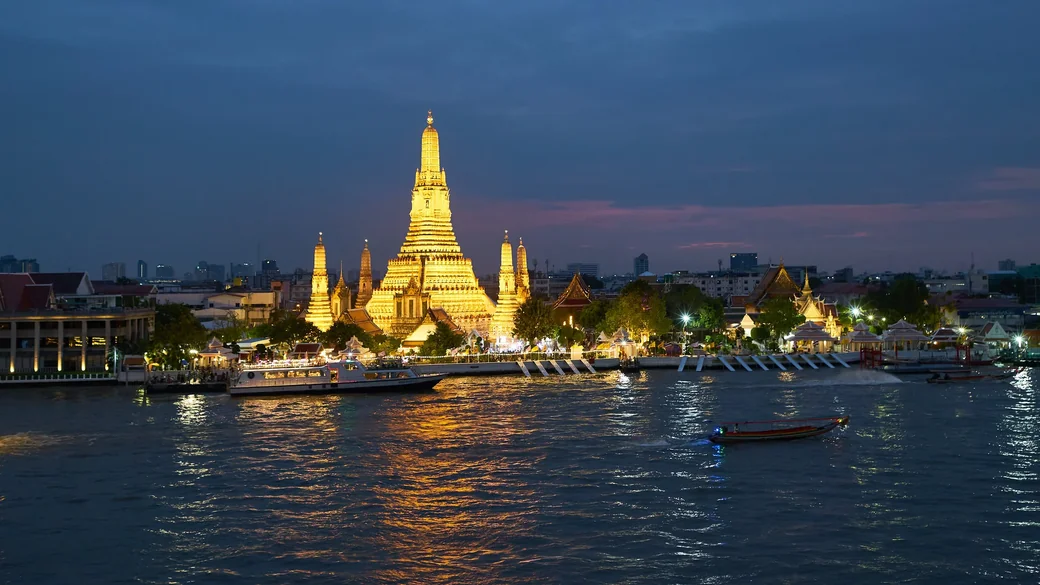
Inside the walls you are too close to fit the spire in a frame. The postcard view belongs to the east bank around Tha Tien, where riverside terraces and rooftop bars line up the prang against the sky. Come back across the water in the last hour of daylight, stay while the floodlights come on, and you get both the golden version and the night one. In that light the porcelain turns rose and gold. Travellers have admired this view for a long time: in 1858 the French explorer Henri Mouhot called the temple the most beautiful in Bangkok and noted that its spire was the first sign of the capital for anyone sailing upriver from the sea. The prang also appears on a Thai coin in everyday circulation.
Dress Code at Wat Arun: Shoulders and Knees Covered
This is a working monastery, and the rule is applied at the gate to everyone. Cover shoulders and knees: no vests, no short shorts, no very short skirts. Light long trousers or a long skirt with a sleeved top survive the heat best. If you arrive unprepared, cover-ups can usually be hired by the entrance, which saves the walk back to the ferry. Wat Arun is a first-class royal temple, so the rule is applied here as consistently as at the Grand Palace across the river.
What the Wat Arun Ticket Actually Covers
The ticket opens the walled inner area: the central prang, the four corner shrines and the ordination hall.
Climbing the Prang: Steep Steps and the Right Shoes
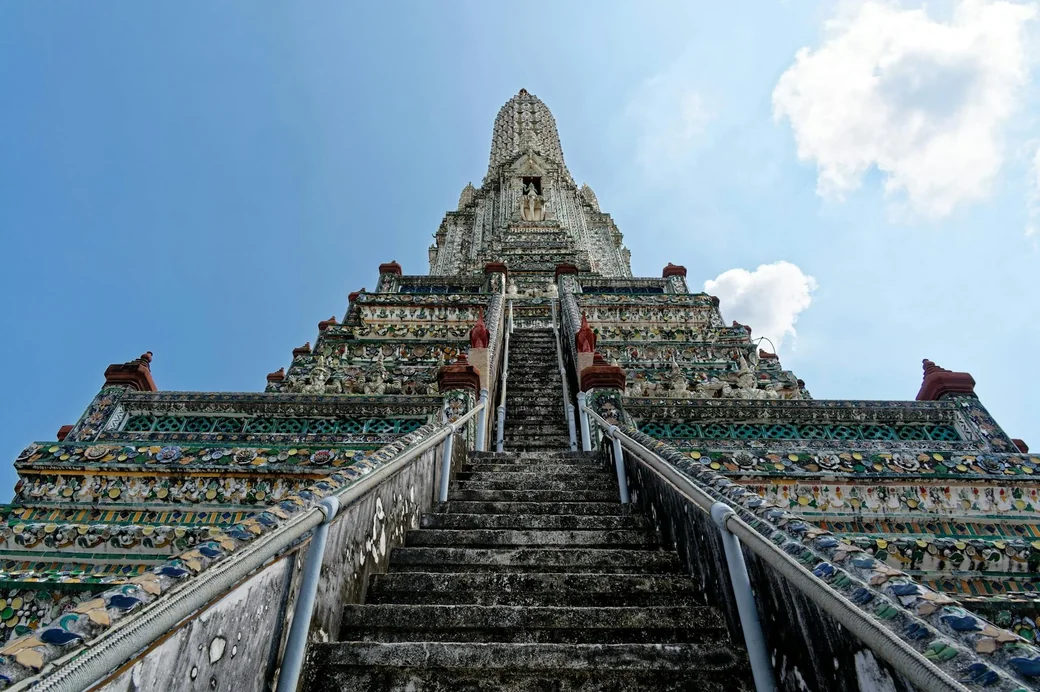
The prang you climb is essentially a nineteenth-century creation: Rama II planned to raise it, and the work was carried out under Rama III, who completed it in 1851. External staircases lead to the lower terraces, and the view over the river and the old city is worth the effort. The steps are narrow, tall and open on one side, so use the handrail, go slowly and come down sideways if that feels safer. Skip the climb in flip-flops, in a long unfitted skirt, or if heights make you uneasy. Published heights for the central prang range from about 67 to 86 metres depending on how it is measured, but every account agrees that it dominates the riverside.
The Porcelain Mosaic: Ship Ballast and Donated China
Stand close to the base and the surface breaks up into cups, plates and bowls. Part of that china arrived as ballast in Chinese trading ships and was reused here; part is benjarong ware that local families gave to the temple to make merit. Seashells fill the gaps. Look for the flowers and rosettes the craftsmen built out of broken rims and handles. Benjarong is a traditional Thai porcelain painted in five colours. The mosaic has been renewed several times: under Rama V, in 1980 ahead of Bangkok's bicentenary, and most extensively between 2013 and 2017, when a great many broken pieces were replaced and lime plaster was used instead of the cement of earlier repairs, giving the surface a lighter, brighter tone.
Reading the Prang as a Model of the Universe
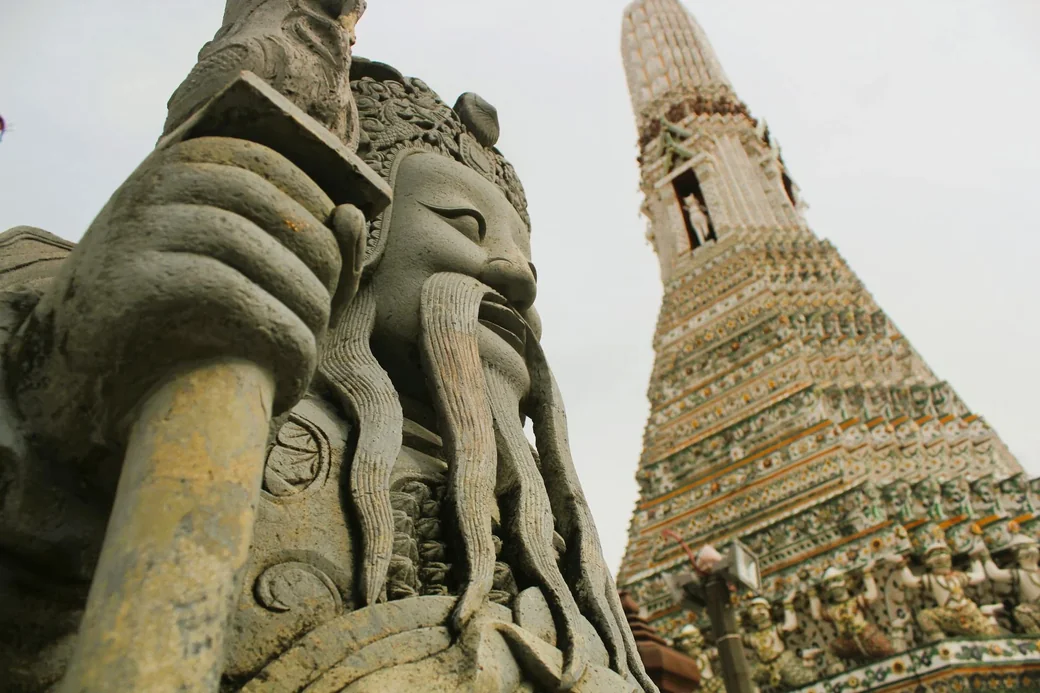
The whole group is a diagram. The tall central spire is Mount Meru at the centre of the world, the four smaller prang at the corners stand for the four continents, and the cloisters mark the edge of the universe. Four small shrines face the cardinal directions with scenes from the life of the Buddha, Indra rides the elephant Erawan on the second terrace, and a seven-pronged trident tops the whole thing. In short, the prang is Khmer in form and Buddhist in meaning. Chinese stone soldiers stand guard around its base, and Erawan, Indra's elephant, is shown with three heads. The four corner prang are dedicated to Phra Phai, the god of the wind, and there are in fact four statues of Indra on Erawan, one facing each direction. Read from bottom to top, the central tower has three symbolic levels: the base stands for Traiphum, the three worlds of existence; the middle for Tavatimsa, the heaven of the thirty-three gods; and the summit for the higher heavens.
The Two Giant Yaksha Guarding the Ordination Hall
At the gate stand two towering demon guardians drawn from the Ramakien, the Thai retelling of the Ramayana. The white one is Sahassa Deja; the green one is Thotsakan, the demon king better known elsewhere as Ravana. They are among the most photographed statues in the complex, and their faces repay a slow look: every tooth, crown tier and mirrored tile is worked separately. Local lore links these guardians to the Tha Tien legend: according to the story, the giant of Wat Chaeng lent money to the giant of Wat Pho across the river, and when the debt went unpaid their fight flattened the opposite bank, which is why that area is still called Tha Tien (the flattened pier).
Inside the Ordination Hall: the Niramitr Buddha and Its Murals
Most visitors photograph the prang and leave without stepping inside. The hall holds the gilded Niramitr Buddha, said to have been designed by Rama II, and some of that king's ashes are interred beneath the image. The murals were painted in the reign of Rama V, and the marble boundary stones set around the building are considered among the finest of their kind in the country. The front of the hall is crowned by a roof with a central spire faced in coloured ceramic, and inside, the high altar is decorated with red, grey and white marble.
The Quiet Corners Most Visitors Walk Past
Follow the cloister that rings the courtyard and you walk between rows of Buddha images, cool and almost empty even at busy hours. Near the river stand the old ordination hall and the smaller vihara that served the temple before the larger buildings were raised; one of them keeps a shrine to King Taksin, together with the bed he is said to have used late in his reign. During Taksin's reign the temple stood within the grounds of his palace; after Rama I moved the court across the river it was left quiet until Rama II restored it. In front of the temple stands a monument to Rama II, erected in 1996 for the golden jubilee of King Bhumibol's reign.
How Thai Worshippers Pay Their Respects at the Prang
Watch for a small ritual repeated all day: three sticks of incense and a pair of candles, then three slow circuits of the prang, always clockwise with the monument on the right. Visitors are welcome to observe from a little distance, and joining in is fine if done quietly. Step aside when someone is kneeling, and never cut across the path of a person mid-circuit. At the end of Buddhist Lent, Wat Arun hosts the royal Kathin, the ceremony in which new robes are presented to the monks; on grand state occasions the king arrives by royal barge procession along the river.
Thai Costume Photo Shoots by the Temple Gate
Small studios along the lanes by the entrance rent traditional Thai outfits by the hour, with hair and make-up if you want them. Booking a day ahead usually gets you a better choice of costume than whatever is left on the rack by midday. Ask for a style with a standing collar if you want full coverage, or a lighter, less layered one on a hot afternoon. The most popular outfits are versions of chut thai (traditional Thai dress), often worn with a sabai, a silk sash draped over one shoulder, and the temple's terraces and gates make the classic backdrop.
Combining Wat Arun With Wat Pho and the Grand Palace
The three sit within a short walk and one ferry ride of each other. A comfortable order is the Grand Palace at opening, Wat Pho next, then the crossing to Wat Arun in the afternoon. The route also retraces the temple's history: for about five years the Emerald Buddha was enshrined at Wat Arun, before it crossed the river to Wat Phra Kaew in the 1780s and the court followed. Seen together, the three tell the story of the capital's move: Wat Arun belonged to Thonburi, the capital of King Taksin, while the Grand Palace and Wat Pho stand in the new city that Rama I founded across the river in 1782.
What Else to See on the Thonburi Side
Most people cross back the moment they leave the gate, which is a pity. Within reach are the Royal Barges National Museum, with the ceremonial boats that once carried the king to this very temple, the riverside hall of Wat Kalayanamit, and the old Portuguese quarter of Kudi Chin around its pink church. Half a day here shows a slower Bangkok that the east bank no longer has. Wat Kalayanamit's great hall shelters one of Bangkok's largest seated Buddha images, deeply revered by the Thai-Chinese community, and Kudi Chin, around Santa Cruz Church, is known for khanom farang kudi chin, small cakes baked to a recipe handed down since the Portuguese settlement.
Wat Arun (Temple of Dawn): Visitor Tips
Come at opening or in the last two hours of the day; midday is the hottest and busiest, and the prang staircase fills with tour groups. Wear shoes with grip rather than flip-flops, because the steps are narrow, steep and open on one side. Bring cash or a QR payment app for the ticket window, and a small coin for the cross-river ferry. Save the famous photograph for the return trip, from the east bank after sunset, when the prang is floodlit.
Wat Arun (Temple of Dawn): Best Time to Visit
Right at opening for cool light and space on the terraces; late afternoon for golden light, then cross to the east bank for the dusk view.
Wat Arun (Temple of Dawn): Admission Fees
Foreign visitors (adult)
Covers the temple grounds and the main prang (the Khmer-style central tower), whose steep steps lead to river views.
THB 200
Thai nationals (with ID card)
Free for Thai citizens on showing a Thai ID card.
Free
Quick Info
1h 30m
moderate
Wat Arun (Temple of Dawn): Getting There
The simplest route is by river. Take the Chao Phraya Express Boat to Tha Tien Pier on the east bank, just behind Wat Pho, then the cross-river ferry that lands at the temple gate in about three minutes. From the Silom Line, change to the boat at Saphan Taksin; from the MRT Blue Line, get off at Sanam Chai and walk a few minutes north to Tha Tien. Itsaraphap station is the closest metro stop on the Thonburi side, roughly ten minutes on foot. Taxis and Grab reach the gate by road through Wang Doem Road, but old-town traffic and the bridges make the crossing slow at rush hour, so the boat almost always wins.
Nearby stops & parking
Tha Tien Pier on the east bank is the main jumping-off point and the one served by the cross-river ferry; Chao Phraya Express boats also call there. MRT Sanam Chai sits about five minutes on foot from that pier, while MRT Itsaraphap is the nearest station on the temple side. Taxis, tuk-tuks and Grab cars drop off on Wang Doem Road by the main gate. Parking around the temple is very limited and the lanes are narrow, so arriving by boat or metro is far less stressful than driving.
Wat Arun (Temple of Dawn): Dress Code & Etiquette
Wat Arun is an active Buddhist temple and the dress code is checked at the gate for everyone. Shoulders and knees must be covered, which rules out vests, short shorts and very short skirts. Light long trousers or a long skirt with a sleeved top are the most comfortable choice in the heat; cover-ups can usually be hired near the entrance if you arrive unprepared. Shoes come off before entering the chapels, hats come off inside, and it is polite to keep your voice down and never point your feet towards a Buddha image.