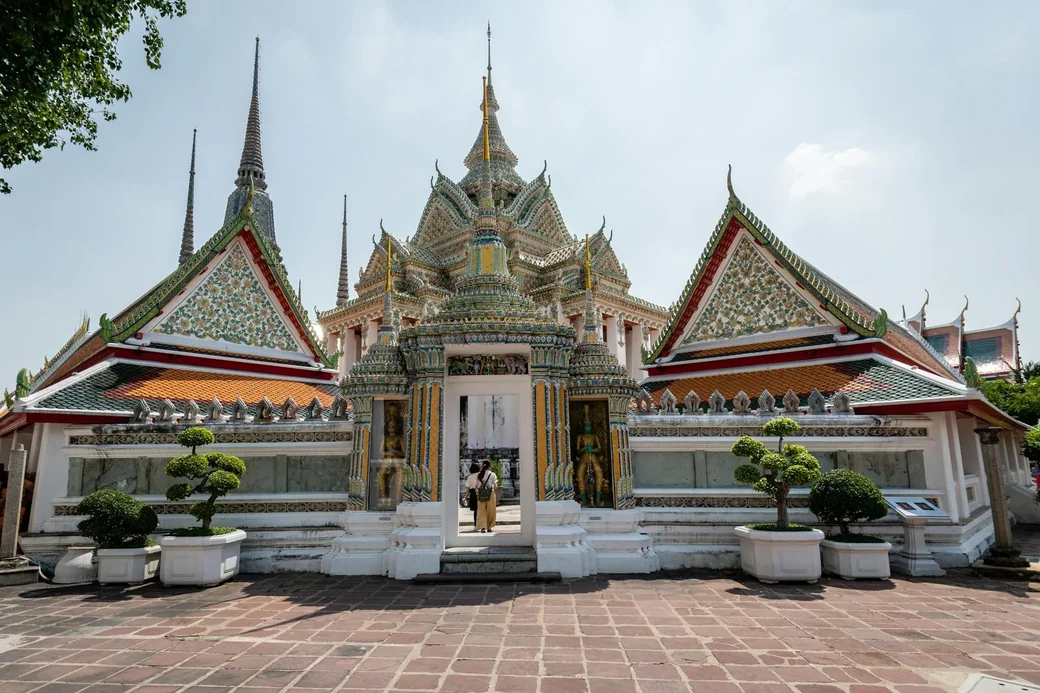
Wat Pho is a royal Buddhist temple and active monastery in Bangkok's historic Rattanakosin quarter, right beside the Grand Palace and a few steps from the Chao Phraya River. It is one of the oldest and largest temples in the city: a walled complex of gilded halls, tiled chedis (bell-shaped stupas) and cloistered courtyards. It is best known for its colossal gilded Reclining Buddha, and also as a historic seat of learning and the home of traditional Thai massage.
Wat Pho (Temple of the Reclining Buddha): Location, accommodation options and contact
The place's location on the map and nearby accommodation and hotel options are shown by Stay22. Cookies are used. Your consent is remembered on every page; you can turn it off at any time in the cookie settings.
The Best Time to Visit Wat Pho and Beat the Crowds
The first ninety minutes after the gates open are the calm ones. From mid-morning the corridor beside the Reclining Buddha fills with tour groups. In the late afternoon the heat eases and the courtyards empty out again.
How to Get to Wat Pho: MRT Sanam Chai, River Boats and Taxis
MRT Sanam Chai on the Blue Line is the easiest arrival: leave by Exit 1 and walk north for about five minutes. From the river, get off at Tha Tien pier, two hundred metres from the gate and also the departure point for the ferry across to Wat Arun. Drivers park by the hour on Chetuphon Road. For a metered taxi, walk out to the main road. Two of the sixteen gates in the outer wall are used by the public: one on Chetuphon Road and one near the north-western corner on Thai Wang Road. Tha Tien pier carries the code N8 on the express-boat network, and the old shophouses around it have been restored as a small riverside quarter of cafés and stalls.
What to Wear at Wat Pho: Dress Code and Shoes-Off Rules
Shoulders and knees must stay covered, and shorts, sleeveless tops and see-through fabric are stopped at the gate. Long trousers are acceptable for everyone, and a wrap can be rented if you arrive unprepared. Shoes come off before the Reclining Buddha hall and the ordination hall; you are handed a bag to carry them. Sit with your feet tucked behind you rather than pointing at any Buddha image.
How Long to Spend at Wat Pho and How to Combine It with the Grand Palace and Wat Arun
Allow ninety minutes to two hours for the complex itself. The classic Rattanakosin day opens at the Grand Palace, walks ten minutes south to Wat Pho, then crosses from Tha Tien pier to Wat Arun in the afternoon, when the light is kindest on the porcelain prang. Three temples back to back is a great deal of gilded detail for one morning, so pace the day and leave room for a long lunch. The pairing has deep roots: after Ayutthaya fell in 1767, King Taksin moved the capital to Thonburi and built his palace directly across the river, and that closeness raised Wat Pho to the rank of royal monastery. Wat Pho heads the list of the six temples in Thailand ranked in the highest grade of first-class royal temples. Its last major restoration was carried out in 1982, in time for Bangkok's bicentennial.
The 46-Metre Reclining Buddha: What to Look For
Gilded from head to foot, the statue is so large that the building was raised around it. Forty-six metres long and fifteen high, the statue fills its hall so completely that you never see it whole; you read it in sections as you walk. Begin at the head, where the pose marks the Buddha passing into final nirvana, and finish at the soles, laid out in mother-of-pearl panels showing the auspicious signs. This is the busiest room in the complex, which is the strongest argument for arriving at opening. The pose is known in Thai as sihasaiyas, the posture of a reclining lion. Under the gold lies a brick core shaped with plaster; the right arm props the head on two box-shaped pillows covered in glass mosaic. Each sole is three metres high and four and a half metres long, divided into 108 panels around a central circle representing a chakra (energy point). The statue and its hall date from 1832, under Rama III.
The 108 Bronze Bowls and the Merit-Making Ritual Locals Follow
Along the back wall of the same hall stands a line of 108 bronze bowls, one for each auspicious characteristic attributed to the Buddha. Thai visitors take a small bag of coins and drop one into every bowl as they walk the corridor, an act of merit that also, they will tell you, settles the mind. The steady metallic rain that results is the sound most people carry away from Wat Pho. The coins also help the monks maintain the temple. Each year, around the Thai New Year festival of Songkran in April, Wat Pho holds a celebration in honour of the Reclining Buddha that supports its upkeep.
The Four Royal Chedis and the 91 Stupas Most Visitors Walk Past
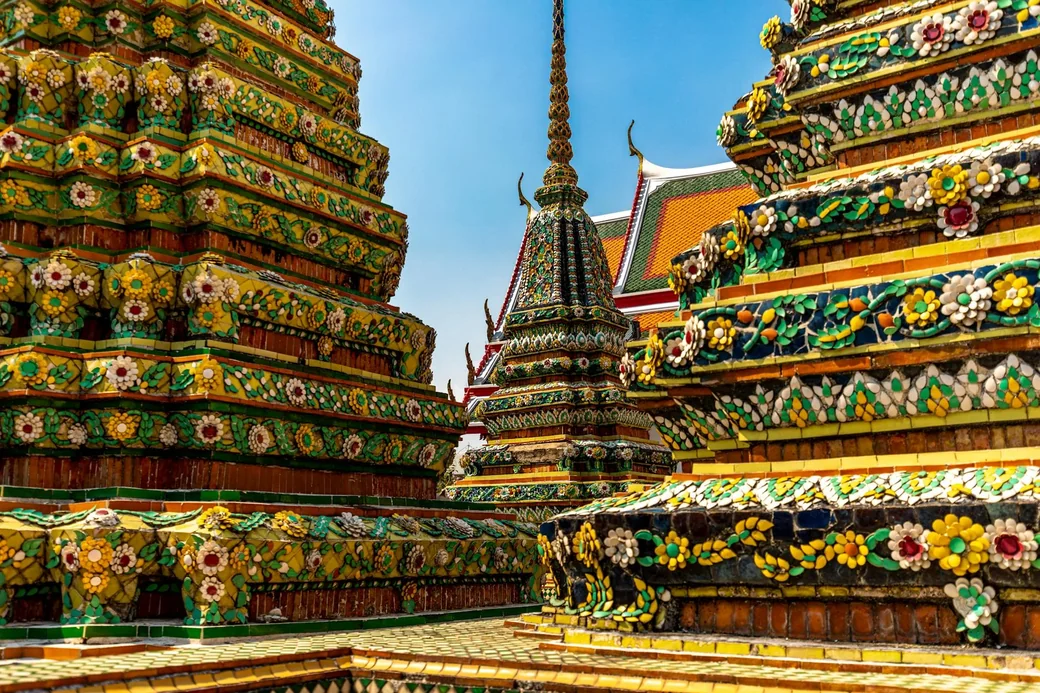
Four tiled chedis rise on the western side of the grounds, one for each of the first four Chakri kings: green for Rama I, white for Rama II, yellow for Rama III and blue for Rama IV. Scattered beyond them stand ninety-one smaller stupas: seventy-one hold ashes of members of the royal family, while twenty, grouped in fives, hold relics of the Buddha. This courtyard is usually the quietest corner of the temple. Each of the four great chedis is 42 metres tall. Rama I built the green one to enshrine the remains of Phra Phuttha Sanphet, a great bronze standing Buddha from Ayutthaya's Wat Phra Si Sanphet that was destroyed when the old capital fell in 1767. Rama III added the white and yellow chedis, and Rama IV built the blue one and enclosed all four so that no more could be added.
Phra Ubosot: Rama I's Ashes and the 394 Gilded Buddhas of the Cloisters
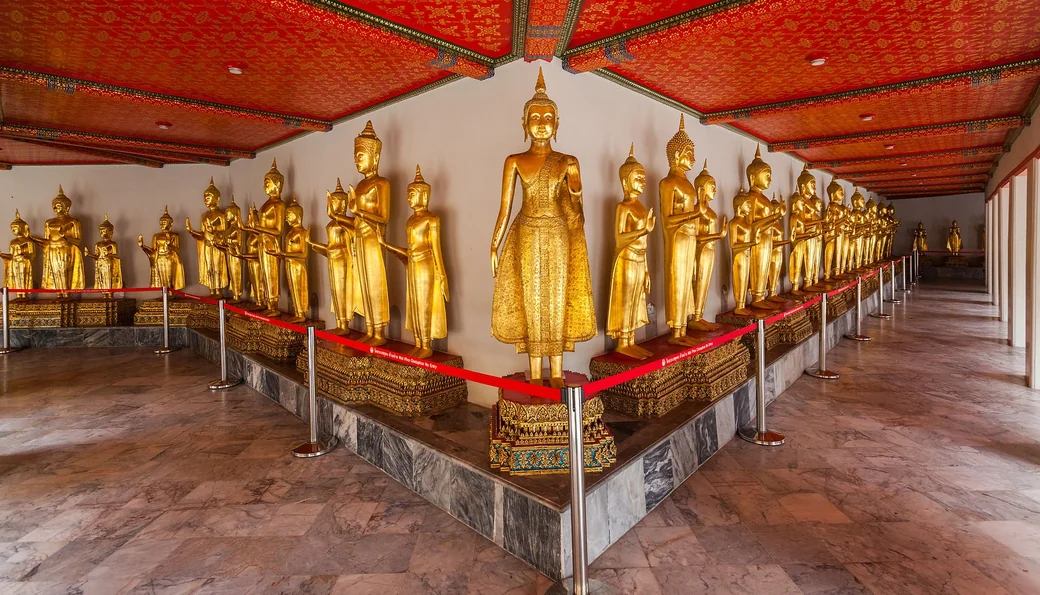
The ordination hall holds Phra Buddha Deva Patimakorn on a three-tiered pedestal, beneath which the ashes of Rama I are interred. Around it, a double cloister lines up 394 gilded Buddha images spanning almost every school of Thai craftsmanship, from Lopburi to Rattanakosin. Two of the finest, Phra Chinnarat and Phra Chinnasri, were brought from Sukhothai under Rama I and sit in the western and southern chapels. Rama I began rebuilding the temple in 1788; in 1801 the new complex received its formal name, Wat Phra Chetuphon Wimonmangkhalaram Ratchaworamahawihan, and became his principal temple, although in everyday speech everyone simply says Wat Pho. The principal image, an Ayutthaya-period Buddha of gilded gold-copper alloy beneath a nine-tiered royal umbrella, was brought by Rama I from Wat Sala Si Na, today's Wat Khuha Sawan in Thonburi, and ten statues of the Buddha's disciples surround it. The hall's teak doors are inlaid with mother-of-pearl scenes from the Ramakien. The cloister is cut by four viharn (image halls): the eastern one holds an eight-metre standing Buddha from Ayutthaya, the northern one the Buddha Palilai cast under Rama I, and the western one a small museum. In all, Wat Pho keeps more than a thousand Buddha images, the largest collection in Thailand.
The 152 Ramakien Marble Reliefs and the Rubbings Sold Outside
A low marble wall around the ordination hall carries 152 bas-reliefs telling episodes from the Ramakien, the Thai version of the Ramayana. They are easy to walk straight past and reward a slow lap. On your way out you will see vendors offering ink rubbings of these scenes; they are taken from cement casts rather than the originals, which is precisely why the temple tolerates the trade. The marble panels were recovered from a temple in Ayutthaya. The low wall around the hall is called kamphaeng kaew (the crystal wall); stone lions guard its gateways, and eight small pavilions shelter the bai sema, boundary stones that mark the sacred ground of the ordination hall.
Thailand's First Public University: the UNESCO-Listed Stone Inscriptions
The Wat Pho you see today is largely the work of Rama III, who launched a vast expansion in 1832 that took sixteen years and seven months and considerably enlarged the grounds. It turned the temple into something unusual: a monastery designed to teach. Between 1831 and 1841 Rama III gathered scholars, royal physicians, poets and monks and had what they knew cut into 1,431 marble tablets set into the walls and cloisters: medicine, massage, astrology, archaeology, literature and religion. UNESCO added the collection to its Memory of the World Register in 2011. Look out too for the sixty diagrams of the body's energy lines and pressure points and the roughly 1,100 herbal formulas. The texts were composed by about fifty people from the court and the monkhood, led by the abbot of Wat Pho, the Supreme Patriarch Prince Paramanuchitchinorot, a celebrated poet and historian. The sixty plaques show thirty views of the front of the body and thirty of the back. In the northern medical pavilion, thirty-two drawings of massage positions line the walls, while the southern pavilion holds verses on the guardian spirits believed to protect newborns; star charts decorate the walls of the library.
The Chinese Stone Giants That Arrived as Ship Ballast
The stone giants scowling beside the gateways arrived almost by accident. Chinese junks that carried Thai rice north returned home light and took on carved stone as ballast, which the temple then put to work as guardians. These Chinese figures, known in Thai as lan than, are often mistaken for the Yak Wat Pho, the temple's true giant guardians, which stand in small niches beside the gates of Phra Mondop; some of the Chinese statues, in tall hats, portray European visitors of the time. According to legend, the giant of Wat Pho once borrowed money from the giant of Wat Chaeng across the river and never repaid it; their fight flattened the riverbank, called Tha Tien (the flattened pier) ever since, until the god Shiva turned both to stone and sent them back to their posts.
Ruesi Dat Ton: the Hermit-Yoga Statues Behind Thai Massage
A set of eighty figures showing hermits in stretching postures was cast for the temple and finished in 1836. Each once had a marble tablet with a poem explaining the ailment it treated, six of them written by Rama III himself. Many were lost over the years. The original figures were cast in an alloy of zinc and tin and set in sixteen pavilions, each with a marble tablet in verse explaining the benefit of the posture; under Rama V they were gathered into one pavilion, and only a fraction of the set survives. Some of the hermits still stretch on the artificial rock hill known as the Contorting Hermit Hill, and a manuscript of the eighty postures commissioned under Rama III records the full series.
Missakawan Park, the Bodhi Tree and Wat Pho's Quietest Corners
Step into Missakawan Park beside the Reclining Buddha hall and the crowds thin out at once. The bodhi tree growing there was raised from a cutting of the sacred tree at Anuradhapura in Sri Lanka. Elsewhere in the grounds stand the Ayutthaya-style Sala Kan Parian, the temple's old assembly hall, the artificial rockeries called Khao Mor, and a walled pond that has been crocodile-free for a very long time. Phra Mondop, the scripture library, stays closed to visitors. The Ayutthaya-style hall is a reminder that a temple stood here long before Bangkok became the capital, probably built or enlarged under King Phetracha, who reigned from 1688 to 1703. The bodhi tree also echoes the temple's very name: Wat Pho is short for the older Wat Photaram, which refers to the monastery of the bodhi tree at Bodh Gaya in India, where the Buddha is believed to have reached enlightenment.
Getting a Massage at Wat Pho's Traditional Medical School
The school inside the grounds opened in 1955 and was the first of its kind approved by Thailand's Ministry of Education. Its style leans on acupressure along the ten sen lines (energy channels) rather than on deep stretching, and sessions are booked on the spot in the pavilion. Massages are still given inside the grounds, which is why the temple smells of herbal balm as often as of incense. The school teaches four disciplines: Thai pharmacy, Thai medicine, Thai midwifery and Thai massage. In 2019 Nuad Thai, the traditional massage taught here, was inscribed on UNESCO's list of the Intangible Cultural Heritage of Humanity, and Wat Pho is still regarded as the national centre of the tradition.
Photographing Wat Pho: Best Light, Wide Lenses and the Quiet South Gate
The light is good twice a day: shortly after opening, when a low sun rakes across the gilded chedis, and in the last hour before closing, when the courtyards empty and the lamps come on. Bring the widest lens you own for the Reclining Buddha hall, where there is simply nowhere to step back to. Leave through the south gate on Chetuphon Road for a calmer exit and a last view back over the stupas. Chetuphon Road splits the walled grounds, roughly 80,000 square metres in all: the northern half holds everything described in these tips, while the southern half houses the monks and the monastic school and is closed to visitors. Part of that southern area once held a section of a French star fort, demolished by King Phetracha after the 1688 siege of Bangkok. In the southern section stands Tamnak Wasukri, the former residence of the poet-abbot Prince Paramanuchitchinorot and a gift from his nephew Rama III; it opens to visitors once a year, on his birthday.
Wat Pho (Temple of the Reclining Buddha): Visitor Tips
Arrive when the gates open and walk straight to the Reclining Buddha hall; by mid-morning the corridor beside the statue moves at a shuffle. Keep the entrance ticket to hand, wear shoes you can slip off quickly, and carry a light long-sleeved layer rather than relying on the wraps lent at the gate. The grounds are largely unshaded, so plan the outdoor courtyards for the first or last hour of the day and save the covered cloisters for the middle. Give yourself at least ninety minutes: most visitors see the big statue in fifteen and miss the inscriptions, the hermit statues and the chedi courtyard entirely. Cash is worth having for the massage pavilion and the small coin sets sold at the hall.
Wat Pho (Temple of the Reclining Buddha): Best Time to Visit
Early morning, before the tour groups; late afternoon is cooler and quieter, with warm light on the chedis.
Wat Pho (Temple of the Reclining Buddha): Admission Fees
Foreign visitors (adult)
Covers the temple complex with the giant Reclining Buddha hall, the courtyards and the rows of decorated stupas.
THB 300
Children under 120 cm (free)
Free for children under 120 cm; height, not age, decides.
Free
Thai nationals (with ID card)
Free for Thai citizens on showing a Thai ID card.
Free
Quick Info
2h
easy
Wat Pho (Temple of the Reclining Buddha): Getting There
The simplest approach is the MRT Blue Line to Sanam Chai station, leaving by Exit 1 and walking about five minutes north along Sanam Chai Road to the ticket gate. From the river, take any Chao Phraya Express Boat to Tha Tien pier and walk under two hundred metres to the entrance; the same pier serves the cross-river ferry to Wat Arun, which makes the two temples an easy pair. On foot, the Grand Palace is roughly ten minutes north along Sanam Chai Road. Taxis and tuk-tuks reach the temple easily; for a metered taxi, walk out to the main road.
Nearby stops & parking
MRT Sanam Chai (Blue Line), Exit 1, is the closest rail station at about five minutes on foot. Tha Tien pier serves the orange-flag Chao Phraya Express Boat and the cross-river ferry to Wat Arun. Several city bus routes run along Sanam Chai and Maha Rat roads. Drivers can use the hourly car park on Chetuphon Road, which splits the temple grounds; taxi drop-off is easiest at the north gate on Thai Wang Road, while the south gate on Chetuphon Road is the quieter option late in the day.
Wat Pho (Temple of the Reclining Buddha): Dress Code & Etiquette
Wat Pho is an active monastery and the dress code is enforced at the gate. Shoulders and knees must be covered: no shorts, no sleeveless tops, no see-through fabric. Long trousers are acceptable for everyone, and a sarong or wrap can be rented at the entrance if needed. Shoes come off before you enter the Reclining Buddha hall and the ordination hall, and a plastic bag is handed out for carrying them. Photography is allowed throughout the grounds, but keep your feet from pointing at Buddha images, do not climb on any structure for a photo, and step aside when monks or worshippers are passing.
Guide / Language
th
en
zh
Wat Pho (Temple of the Reclining Buddha): Amenities & Facilities
Sarong rental
Traditional Thai massage
Guided tours
Restrooms
Souvenir and book shop
Car park
Drinking water
Partial wheelchair access
Wat Pho (Temple of the Reclining Buddha): Opening Hours