Wat Saket is a royal Buddhist temple in Bangkok's old city, crowned by a gilded chedi (stupa) on Phu Khao Thong, the Golden Mount, an artificial hill that rises above the surrounding rooftops. A staircase winds up the hill to a terrace with sweeping views over the historic centre and the modern skyline. Within walking distance of the old royal quarter, it combines a peaceful temple complex at ground level with one of the most rewarding viewpoints in the city.
Wat Saket (The Golden Mount): Location, accommodation options and contact
344 Chakkraphatdi Phong Road, Ban Bat, Pom Prap Sattru Phai, Bangkok 10100, Thailand
The place's location on the map and nearby accommodation and hotel options are shown by Stay22. Cookies are used. Your consent is remembered on every page; you can turn it off at any time in the cookie settings.
Best Time to Visit Wat Saket: Cool Mornings or Golden Hour
The first hours after the gates open are cool, quiet and shaded. The other sweet spot is the late afternoon, so you step onto the terrace as the light turns amber over the old city. Around midday the stairs take the full tropical sun and the tour groups peak. On wan phra, the Buddhist holy days that follow the phases of the moon, local worshippers come in greater numbers and the summit is especially lively with offerings.
What the 344 Steps of the Golden Mount Are Really Like
Wat Saket is the temple everyone in Bangkok sees from afar and surprisingly few visitors climb. The number sounds worse than the climb is. The staircase winds around the hill in a long, gentle spiral rather than going straight up, the steps are shallow, and old trees shade most of the route. Small waterfalls, Buddha images and benches break it into stages. At an unhurried pace it takes about fifteen minutes. Published step counts range from about 320 to 344, depending on where the count starts. The way down follows a separate staircase on the other side of the hill, so the flow of visitors runs in one direction.
Reaching Wat Saket Easily by Metro, Canal Boat or Grab
The nearest station is Sam Yot on the MRT Blue Line, fifteen shaded minutes away past the temple-supply shops. From Pratunam or Siam, the Khlong Saen Saep canal boat to Phan Fa Lilat pier leaves you five minutes from the gate. The temple stands beside Khlong Mahanak canal, and Phan Fa Lilat is the last pier at the western end of the Khlong Saen Saep boat line. The Democracy Monument and Ratchadamnoen Klang Avenue are a short walk west.
Accessibility at Wat Saket: The Terrace Is Reached on Foot
There is no lift or escalator; the spiral staircase is the only route to the chedi. The lower courtyard is a different story: the ordination hall, the gardens and the halls are flat and easy with a wheelchair or a pushchair, and the restrooms, shaded seating and drink stalls are all at ground level. Visitors who prefer not to climb still enjoy a fine view of the mount: the gilded chedi rises straight above the courtyard and is clearly seen from the bank of Khlong Mahanak beside the temple.
Dress Code and Etiquette Inside an Active Monastery
Wat Saket Ratchawora Mahawihan, to give it its full name, belongs to the highest grade of Thailand's royal temples and is a working monastery. Shoulders and knees covered, men and women alike. Light long trousers or a long skirt beat shorts in this heat, and see-through fabrics are refused at the gate. Shoes come off before the halls. Do not point your feet at a Buddha image, keep your voice low near people praying, and ask before photographing monks. Monks live and study in the monastery, and their chanting can often be heard from the halls in the early morning and evening.
Ring the Bells, Strike the Gong, Circle the Chedi Three Times
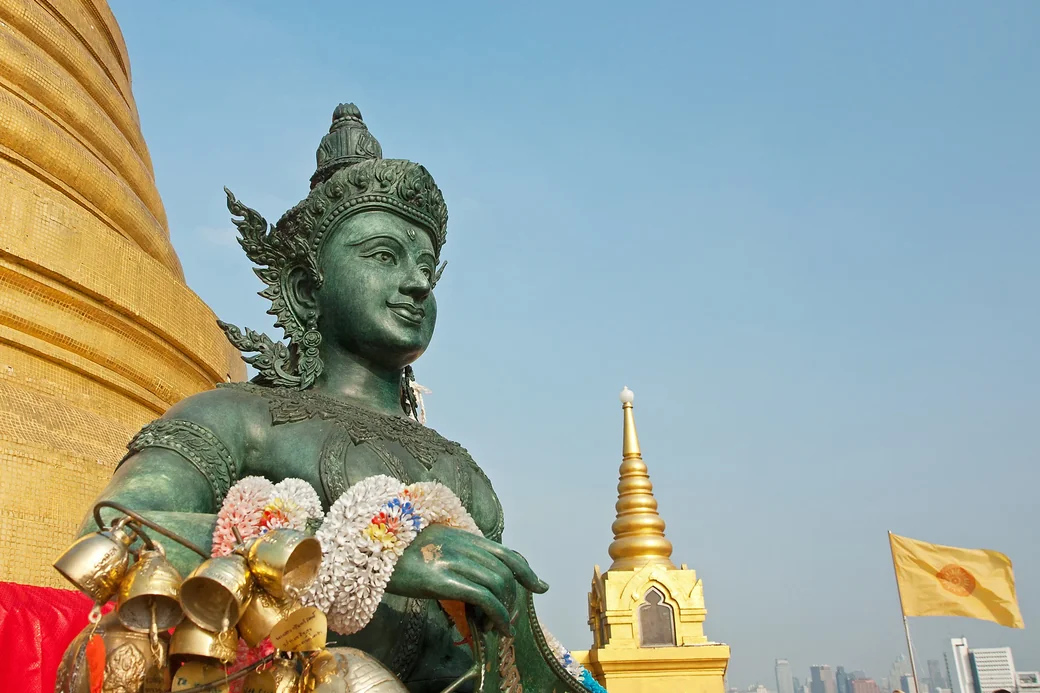
The row of bronze bells on the upper path is not decoration. Thai visitors ring each one for merit, then finish with the big gong, whose sound carries across the whole neighbourhood. On the terrace, join the wian thian: three slow clockwise laps of the golden chedi, a ritual most foreign visitors walk straight past.
The Hidden Air-Conditioned Buddha Hall Almost Everyone Misses
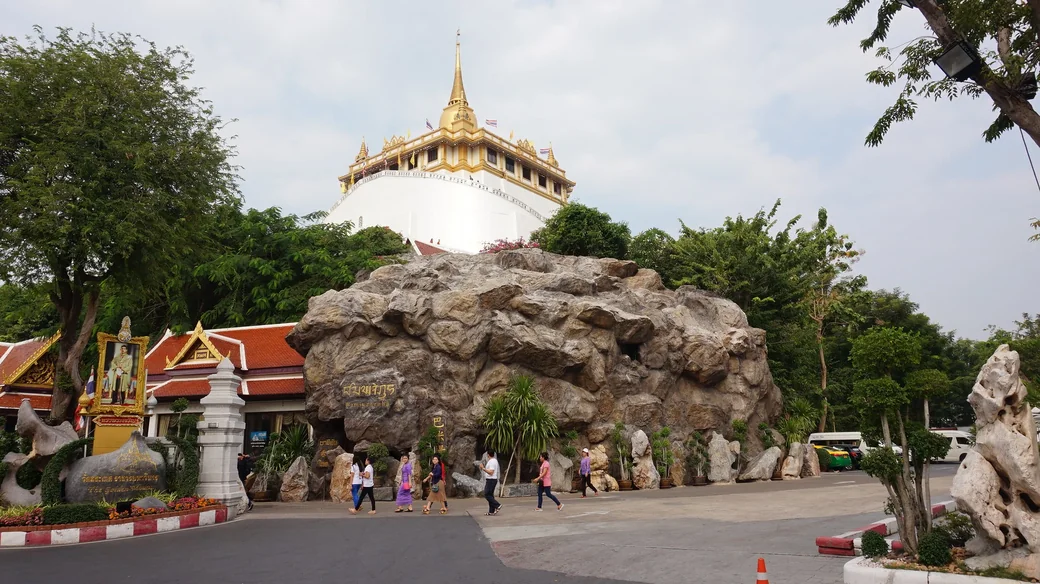
Just before the staircase, an automatic sliding door set into an artificial rock wall opens onto a cool, dim hall with a large standing Buddha. The room is almost always empty, which makes it the best place to rest before or after the climb. The door does not face the main path, so look carefully.
Three Kings and a Chedi That Collapsed Into a Hill
Rama III ordered a giant chedi here, but Bangkok's soft clay could not carry it and the structure collapsed mid-build. The rubble slowly became a weed-covered mound that locals simply called the mountain and soldiers used as a lookout. Rama IV anchored it with teak logs and a smaller chedi; Rama V finished and gilded it. Rama III's model had been the Golden Mount of Ayutthaya, and Rama IV needed thousands of teak logs to anchor the mound. The chedi was completed early in the reign of Rama V, and the thick concrete retaining walls that stop the hill from eroding were added in the 1940s. According to some accounts, Rama III's builders used earth dug out for the city's expanding network of canals to raise the great chedi. The name Borom Banphot means the supreme mountain.
Vultures, Cholera and the Ghost Gate: The Story Brochures Skip
Cremation inside the city walls was considered inauspicious, so the dead left through Pratu Phi, the ghost gate, beside Wat Saket. The 1820 cholera epidemic killed more than thirty thousand people in Bangkok; the temple was overwhelmed and vultures fed on the uncremated dead. The phrase vultures of Wat Saket entered everyday Thai. The disease had reached Bangkok from Penang, and the temple became the city's main receiving ground for bodies. Outbreaks returned every dry season for decades, the worst of them, under Rama III, killing roughly one person in ten. In Thai the phrase is raeng wat saket (the vultures of Wat Saket). Vulture sculptures on the grounds and an overgrown plot of ashes near the foot of the stairs are all that remain of that time. The 1820 epidemic struck during the reign of Rama II. Thai speech often pairs the vultures with pret Wat Suthat (the hungry ghosts of Wat Suthat), a nod to the towering spirits painted in that nearby temple's murals. Open-air cremation at Wat Saket finally ended in 1947, after Bangkok's first public crematorium had opened at Wat Traimit in Chinatown.
The Buddha Relic Sealed Inside the Golden Chedi
In 1898 relics were unearthed at Piprahwa in northern India, a site widely identified with ancient Kapilavastu, and a share was presented to King Chulalongkorn. They were enshrined on the Golden Mount on 23 May 1899, with portions shared with Buddhists in Sri Lanka, Myanmar, Japan and Siberia. The gilded chedi carries the name Borom Banphot. The excavation was carried out by an English engineer, William Claxton Peppé, at a site close to the Nepalese border, and the relics arrived in Bangkok with great ceremony. They are the reason the hill is a pilgrimage site and not merely a viewpoint. The chedi also enshrines a Buddha relic brought from Sri Lanka by Prince Prisdang.
Don't Skip the Courtyard: Marble Ordination Hall and Scripture Library
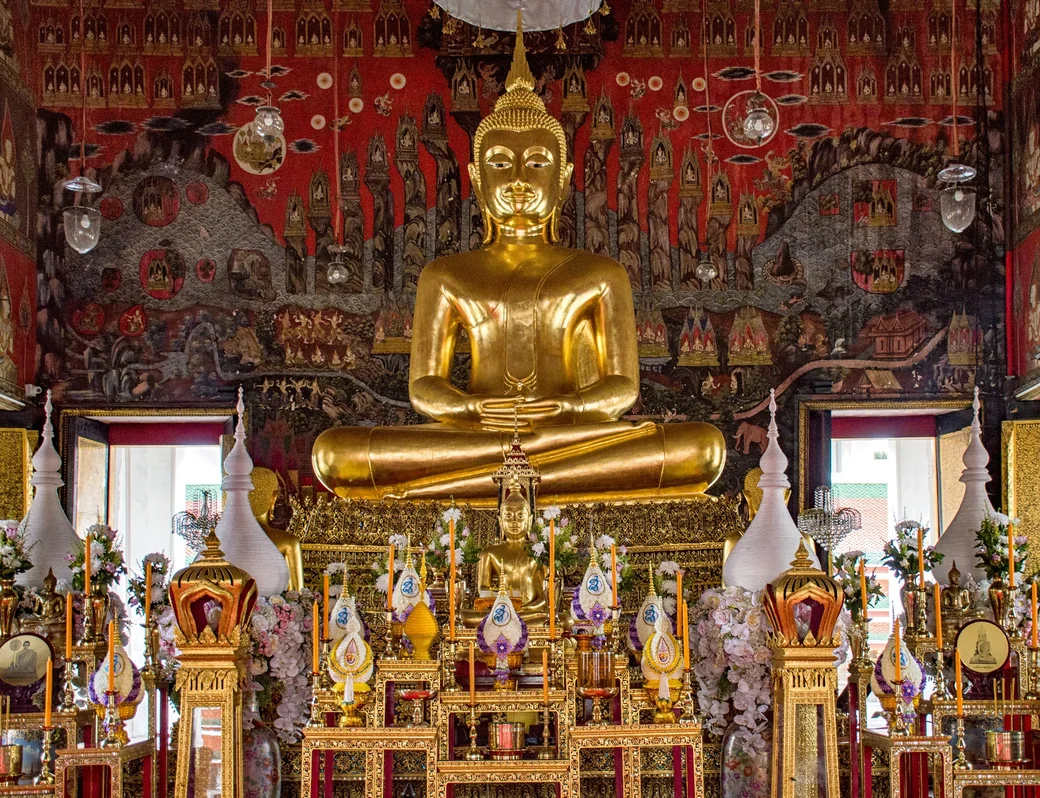
The temple is much older than its hill. It existed in the Ayutthaya period as Wat Sakae; when Rama I founded Bangkok at the end of the 18th century, he had it restored and renamed it Wat Saket, which literally means "to wash the hair". Tradition holds that the king stopped here to bathe and wash his hair on his way back from war, before entering the walled city. Almost everyone heads straight for the stairs and misses the ground-level complex. The ordination hall was refaced with Italian Carrara marble in the early twentieth century, the wihan holds murals including the earth goddess wringing water from her hair, and the ho trai scripture library stands opposite the old cremation ground. The earth goddess in those murals is Phra Mae Thorani. The ordination hall dates from the reign of Rama I; its murals tell the life of the Buddha, and on the wall behind the principal image unfold some of the most vivid scenes of Buddhist hell in the country. The wihan's main image, Phra Attharot, is a standing Buddha more than ten metres tall brought from Phitsanulok, and beside it stands Luang Pho Dusit, which came from a temple that no longer exists. A ho trai traditionally keeps a temple's palm-leaf scriptures safe from damp and insects.
What You Can Actually Pick Out From the Golden Mount Terrace
The terrace gives a full 360-degree view, with the spires of the old royal city on one side, the glass towers of modern Bangkok on the other and the Chao Phraya curling between them. Looking west you pick out the Grand Palace and the Temple of the Emerald Buddha, with Wat Suthat and the Giant Swing much nearer. Turn and the Democracy Monument and the Rama VIII Bridge appear, while the Silom and Siam towers close the eastern skyline. Until the 1960s the Golden Mount was the highest point in Bangkok. Directly below, at the foot of the hill, stand the metal spires of Loha Prasat and the white walls of Mahakan Fort, one of the last two surviving forts of the old city wall.
Photography on a 77-Metre Hill: Light, Lenses and Water
The white terrace wall bounces hard midday light, so late afternoon is far kinder. Shoot the chedi from the lower terrace to catch the prayer flags, then move to the outer walkway for the skyline. A wide lens suits the tight circular terrace better than a zoom, and there are no drink stalls at the top, so carry water.
The November Temple Fair and the Red Cloth Ceremony
Around the Loy Krathong full moon the temple holds a fair lasting several days and nights: food stalls, fairground games, sideshows, a candlelit procession up the hill and the wrapping of the chedi in a long red cloth on which devotees write their names. Crowds fill the grounds from early evening, so come as early as you can. Bangkok residents have been coming to the fair for generations, and devotees write their family's names on the red cloth as well as their own before praying. The fair is said to go back to the reign of Rama V, which makes it one of the oldest temple fairs in the city.
Pair Wat Saket With Loha Prasat and the Alms Bowl Village
Ten minutes on foot is Loha Prasat at Wat Ratchanatdaram, the only iron-spired temple of its kind. South along Bamrung Mueang Road, past shops selling everything a temple needs, lies Ban Bat, where families have hammered monks' alms bowls since the 1700s. Khao San Road is a twenty-minute walk west. Loha Prasat's thirty-seven metal spires stand for the thirty-seven virtues that lead to enlightenment. In Ban Bat, each bowl is traditionally made from eight strips of steel, said to recall the Noble Eightfold Path. Mahakan Fort's only surviving twin is Phra Sumen Fort on the river near Khao San Road, so a walk between the two follows the line of the old city wall.
Wat Saket (The Golden Mount): Visitor Tips
Come at either end of the day — the stairs face open sky and the middle of the day is punishing. There is no lift, so the terrace is reachable only on foot; the courtyard, halls and gardens below are flat and easy. Carry water, because the vendors are all at the bottom. Shoulders and knees must be covered. Give yourself ninety minutes if you want to see the ordination hall and library as well as the view, and pair the visit with Loha Prasat and the alms-bowl workshops of Ban Bat, both within a ten-minute walk.
Wat Saket (The Golden Mount): Best Time to Visit
Just after opening for cool, empty stairs, or in the late afternoon for golden-hour light over the old city
Wat Saket (The Golden Mount): Admission Fees
Foreign visitors (adult)
Covers the climb up the Golden Mount's winding staircase to the hilltop temple and its wide city views.
THB 100
Thai nationals (with ID card)
Free for Thai citizens on showing a Thai ID card.
Free
Quick Info
1h 30m
moderate
Wat Saket (The Golden Mount): Getting There
Wat Saket sits just outside Bangkok's old royal island, in a pocket the rail network never quite reached. The closest station is Sam Yot on the MRT Blue Line, a walk of about fifteen minutes north-east along Bamrung Mueang Road and then onto Chakkraphatdi Phong Road — mostly shaded, and it takes you past the temple-supply shops. From Pratunam or Siam, the Khlong Saen Saep canal boat is a fast and cheap alternative: get off at Phan Fa Lilat pier and the entrance is a five-minute walk over the bridge. Grab or Bolt is the simplest option from Sukhumvit or Silom. From Khao San Road it is a twenty-minute walk east past the Democracy Monument; from the Grand Palace and Wat Pho, about ten minutes by car or half an hour on foot.
Nearby stops & parking
MRT Sam Yot (Blue Line) is the nearest station, roughly 1 km away. Phan Fa Lilat pier on the Khlong Saen Saep canal boat line is the closest water stop, about 500 m north. Taxis, Grab cars and tuk-tuks drop off at the main gate on Chakkraphatdi Phong Road; there is a small parking area but it fills quickly, and street parking in the surrounding lanes is tight.
Wat Saket (The Golden Mount): Dress Code & Etiquette
This is an active monastery, so shoulders and knees must be covered — for men as well as women. Light long trousers or a long skirt work best in the heat; vests, short shorts and see-through fabrics are not accepted. Shoes come off before you enter the ordination hall and the shrine rooms. Keep your voice down near people who are praying, never point the soles of your feet at a Buddha image, and ask before photographing monks.
Guide / Language
en
th
Wat Saket (The Golden Mount): Amenities & Facilities