Wat Traimit is a Buddhist temple at the top of Yaowarat Road, where Bangkok's Chinatown begins, beside its junction with Charoen Krung Road. It is world-famous as the home of the Golden Buddha, a seated Buddha image cast in solid gold and enshrined high up in a gleaming white marble pavilion. Compact, easy to reach and right next to the lanes and food stalls of Chinatown, it is one of the most memorable temple visits in Bangkok.
Wat Traimit (Temple of the Golden Buddha): Location, accommodation options and contact
The place's location on the map and nearby accommodation and hotel options are shown by Stay22. Cookies are used. Your consent is remembered on every page; you can turn it off at any time in the cookie settings.
The statue's formal name is Phra Phuttha Maha Suwanna Patimakon. The image is three metres tall, weighs five and a half tonnes and is cast from gold whose purity varies: about 40 per cent in the body, 80 per cent from chin to forehead and 99 per cent in the hair and topknot. Guinness World Records recognises it as the largest solid gold sculpture in existence and, measured by the value of its metal, the most valuable religious object in the world. Estimates of that value shift constantly with the gold market. In Thai it is affectionately called Luang Pho Thongkham (the Venerable Golden Father) and also Phra Sukhothai Traimit. Measured differently, it stands 3.91 metres from the base to the tip of its flame finial and 3.10 metres across the lap; as early as 1991 the Guinness Book of Records listed it as the sacred object with the highest intrinsic value.
How a plaster Buddha turned out to be solid gold in 1955
On 25 May 1955 the image was being hoisted into a newly built hall when the ropes broke and it fell hard onto the ground. The impact chipped the plaster shell and exposed a glint of gold underneath. Work stopped immediately. The discovery came close to the celebration of 2500 years since the Buddha's passing, and Thai newspapers of the day treated it as something close to a miracle. According to the story told at the temple, a heavy rainstorm broke that night, and the abbot, coming out to check on the fallen image, saw the glint of gold through a crack in the plaster by the light of his lamp.
Nine cast sections and a key hidden in the base
Once the plaster was removed, conservators found that the Buddha had been cast as separate sections that slot together with remarkable precision, and that a key had been sealed into the plaster at the base. The key allows the image to be taken apart for transport. Most sources count nine sections, though a few say ten. The image was made by the lost-wax technique, with gold walls one to one and a half centimetres thick; the sections are the head, the torso, the lap and three pieces for each arm.
Twenty forgotten years under a tin roof
The image came from an abandoned temple, and nobody suspected what lay beneath its dull coating. When the image reached Wat Traimit in 1935 the temple had nowhere suitable to put it, so this five-and-a-half-tonne object stood outdoors under a plain corrugated roof for two decades. Nobody protected it, because nobody believed there was anything to protect. That detail, more than any statistic, is what gives the story its edge when you finally stand in front of the statue. Before Wat Traimit, it was the principal image of Wat Chotanaram, also known as Wat Phraya Krai, founded under Rama III by the court official Phraya Krai Kosa on a riverside site now occupied by Asiatique. It had probably reached Bangkok in the early Rattanakosin period, when thousands of old Buddha images were brought to the new capital from the northern cities.
See the plaster shards and the rope that broke
The exhibition floor keeps physical evidence of the 1955 accident: fragments of the original plaster and lacquer coating, photographs taken step by step as the shell was chipped away, and according to long-standing visitor accounts the old pulley and rope used in the failed lift. Seeing the dull grey plaster next to images of the gold beneath it is the single best reason to buy the museum ticket. A model in the exhibition shows the statue divided down the middle, one half in its old coat of plaster, lacquer and gilding, the other in bare gold, which makes the scale of the disguise easy to grasp.
How to read a Sukhothai Buddha image
The statue sits in the Maravijaya posture, right hand reaching down to touch the earth as witness to the Buddha's awakening. The egg-shaped head, the flame finial above the topknot, the elongated earlobes and the slim waist are all hallmarks of Sukhothai art, which points to the Sukhothai period. According to the story passed down, the shell of black lacquer and plaster was applied to hide the image from plunderers, probably before the fall of Ayutthaya in 1767. Other Sukhothai signatures to look for are the V-shaped hairline, the eyebrows that meet above an aquiline nose, three folds at the neck and broad shoulders. The image was probably moved from Sukhothai to Ayutthaya around 1403, and some scholars identify it with the gold Buddha "in the middle of Sukhothai city" mentioned on the Ram Khamhaeng inscription, although that link is debated.
Phra Maha Mondop: a shrine paid for by Chinatown
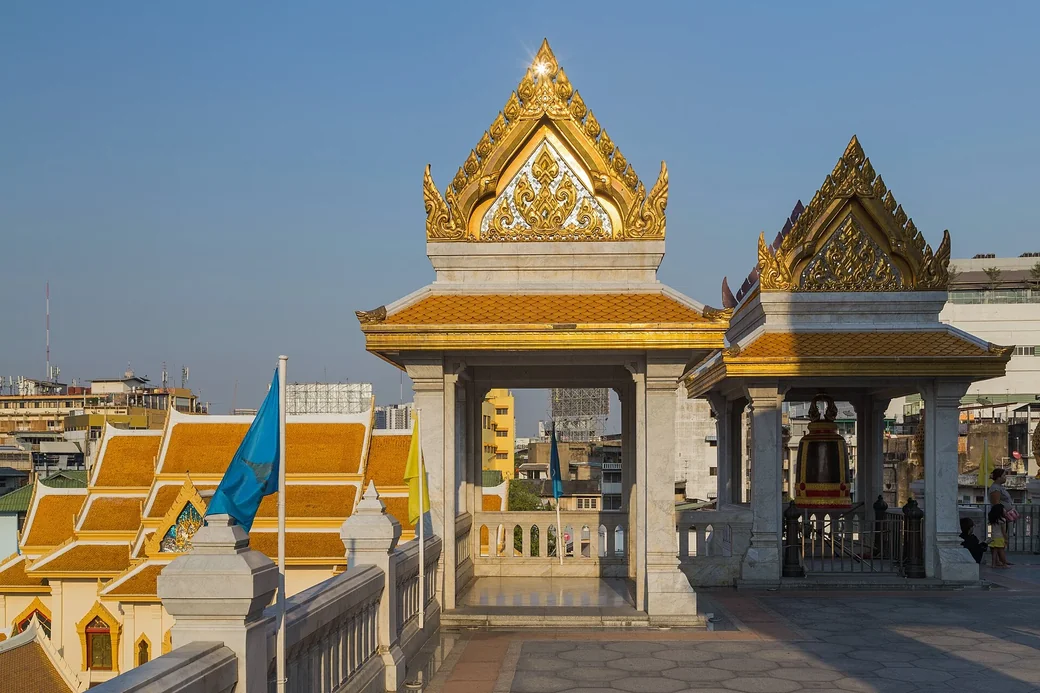
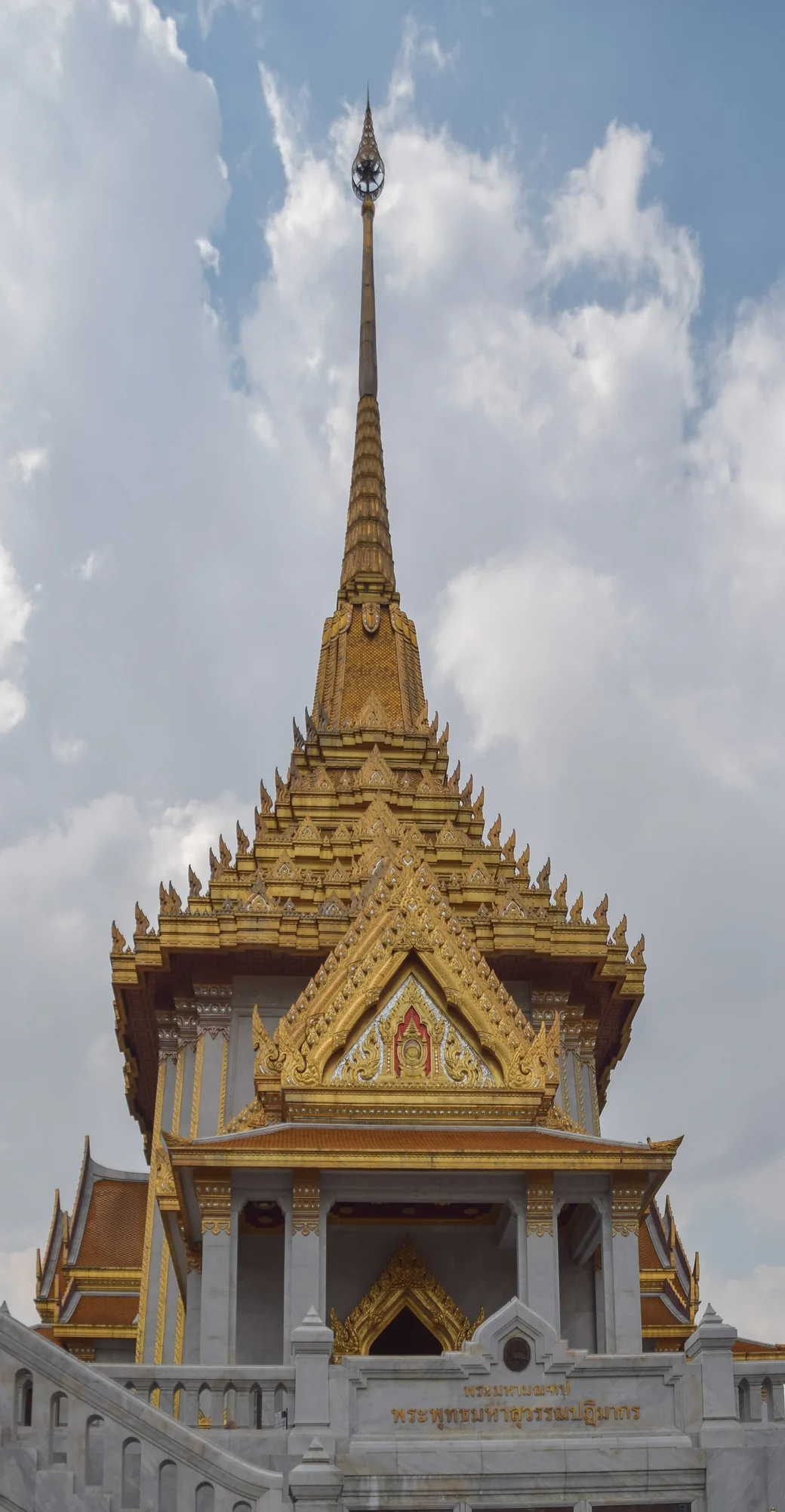
The four-storey marble pavilion was designed by Thai architect Arvuth Ngoenchuklin in an applied Thai style, built in reinforced concrete and clad in stone chosen for durability. The project was launched by the business community of Samphanthawong district together with the temple and local Chinese families, in honour of King Bhumibol's eightieth birthday year. It was completed in 2007 and opened to the public on 14 February 2010. The Golden Buddha sits on its top floor. Two large bells flank the entrance to the shrine floor, and the walkway around it looks out over the rooftops of Yaowarat.
Two museums under one golden roof
Below the shrine floor are two separate exhibitions. One covers the Golden Buddha itself, from Sukhothai casting to the 1955 rediscovery. The other is the Yaowarat Chinatown Heritage Center, which follows Chinese migration into Bangkok from the early Rattanakosin period to the present through models, film and reconstructed street scenes. Together they turn what could be a ten-minute photo stop into a proper introduction to Chinatown, making the temple a natural starting point for a walk through Yaowarat. The Heritage Center on the second floor opened in 2009 with the support of the Crown Property Bureau and the Samphanthawong business community; dioramas, film and multimedia follow the Teochew and other Chinese communities, the making of Yaowarat Road and the rise of its merchant houses. The Golden Buddha exhibition fills the third floor, and the shrine crowns the fourth.
The ordination hall almost every visitor misses
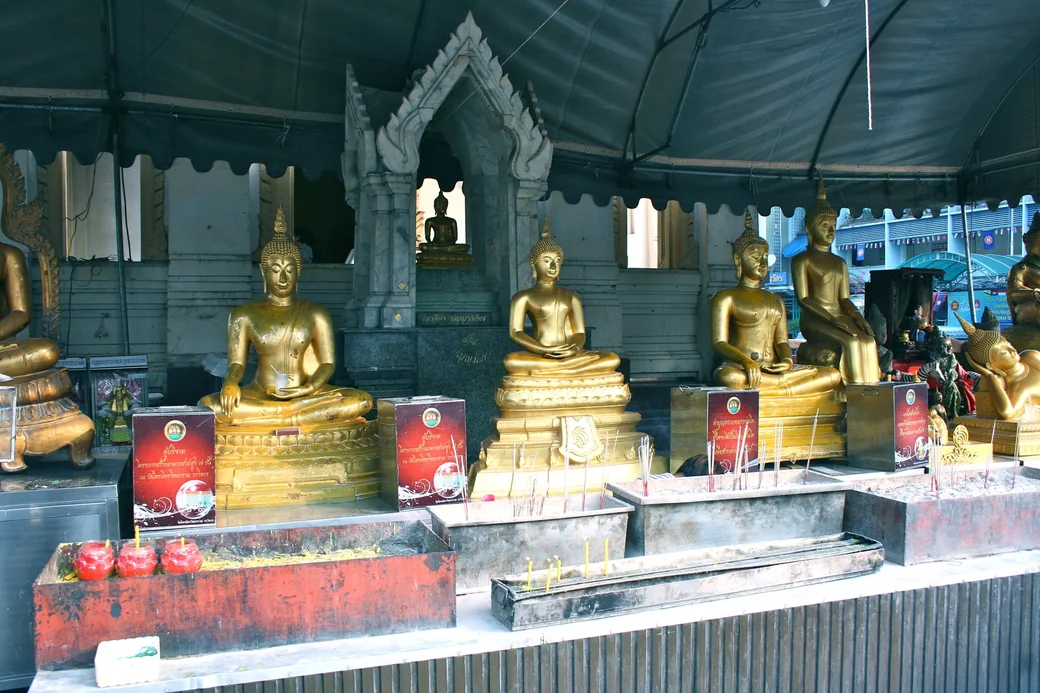
Across the courtyard from the marble pavilion stands the ubosot, home to Phra Puttha Thotsaphonlayan, the temple's principal image in gilded lacquer over stucco. This is where local families come with jasmine garlands to make merit, and it feels entirely different from the shrine upstairs. Look too for the golden naga (serpent guardian) guarding the stairway and the cast metal panels of Ramayana scenes set into the pavilion walls. Its applied Thai design sets a three-tiered roof on a reinforced-concrete frame; a gallery runs around the building with small halls at its four corners, the door and window panels are painted in lai rot nam (gold-leaf patterns on black lacquer), and gilded metal stars stud the ceiling.
Best time of day to visit and beat the crowds
From late morning the coaches arrive and the temple fills with visitors continuing into Yaowarat. If your plan is an evening street-food walk through Chinatown, come in the early afternoon and allow extra time for the exhibitions so the visit does not feel rushed. Coming in from Yaowarat you pass the Chinatown Gate on Odeon Circle, built by the Thai-Chinese community and unveiled on 5 December 1999 for King Bhumibol's 72nd birthday; the Chinese characters meaning "Long live the King" are in the handwriting of Princess Maha Chakri Sirindhorn. Local lore likens Yaowarat Road to a dragon, which makes the circle its "dragon head".
Dress code, shoes and photography rules
Cover shoulders and knees, leave sleeveless tops and short shorts for elsewhere, and be ready to take off your shoes before entering the halls. Cover-ups can be borrowed or bought at the entrance. Still photography is allowed throughout, video recording is not. Keep to the edges of the shrine floor when worshippers are praying and never turn the soles of your feet towards the image.
Getting to Wat Traimit by metro and taxi
Hua Lamphong is the nearest MRT station; leave by Exit 1 and the temple is a walk of two or three hundred metres. Taxis and ride-hailing work well outside peak hours, but Yaowarat traffic is slow in the late afternoon and a short walk often beats a long crawl. MRT Wat Mangkon, also on the Blue Line, sets you down in the heart of Yaowarat for a walk back through Chinatown, and from the river, Ratchawong pier (N5) on the Chao Phraya Express Boat line is a walk away through the market lanes. Bangkok's historic Hua Lamphong railway station, opened in 1916, stands right by the MRT exit.
From Wat Sam Chin to a royal temple: the name explained
The temple began as Wat Sam Chin, the temple of the three Chinese, founded according to oral tradition by three Chinese friends who donated the land, most likely during the reign of King Rama III. It was renamed Wat Traimit Withayaram, meaning three friends, on 3 February 1940, and raised to the rank of second-class royal temple in 1956. The name honours the founders, not the gold. The land lay at the edge of what was then a young Chinese quarter, and the full formal name today is Wat Traimit Withayaram Worawihan. The suffix Worawihan in the full name marks the temple's grade among Thailand's royal temples.
Award-winning architecture beyond the golden hall
The gold is not the only thing worth looking at. The monks' quarters of 1937 and the ordination hall of 1947, designed by Luang Wisansinlapakam in the applied Thai style, are regarded as fine examples of Thai religious architecture built after the end of the absolute monarchy, and they received the ASA Architectural Conservation Award in 2011. Look for the proportions rather than the gilding. The temple itself is modest by Bangkok standards, and that contrast with the gold is exactly the point. The monks' quarters comprise fourteen two-storey buildings. The temple also has a place in Bangkok's social history: in 1940 it opened the city's first permanent crematorium for ordinary people, a public-health milestone.
Merit-making, gold leaf and Chinese New Year
Wat Traimit is a working temple, and watching the rituals is part of the visit: jasmine garlands laid before the images, incense, and gold leaf pressed onto Buddha figures for good fortune. During Chinese New Year the temple becomes one of the focal points of the Yaowarat celebrations and the courtyard fills with offerings. On some days the temple hands out free food and drink to visitors. Princess Maha Chakri Sirindhorn has presided over the Yaowarat Chinese New Year celebrations many times, and the illuminated street just outside the temple becomes the heart of the festivities.
Wat Traimit (Temple of the Golden Buddha): Visitor Tips
Come early on a weekday and you may have the shrine floor almost to yourself, which matters because the Buddha is best appreciated in silence rather than in a queue. Buy the exhibition ticket as well as the shrine ticket if you have an hour to spare, since the two museum floors are where the story actually gets told. Save your camera battery for the ordination hall and the Ramayana reliefs, which most visitors walk straight past. Before you leave, step to the edge of the shrine floor and look out over the rooftops around the temple; it is usually the quietest moment of the whole visit.
Wat Traimit (Temple of the Golden Buddha): Best Time to Visit
Weekday mornings just after opening, when the halls are quiet and the gold catches soft light; late afternoon works too, but avoid midday heat.
Wat Traimit (Temple of the Golden Buddha): Admission Fees
Golden Buddha hall (foreign visitors)
Entry to the shrine hall holding the solid-gold Buddha image, about 3 metres tall and one of the world's largest gold statues.
THB 40
Yaowarat Chinatown Heritage Center and museum floors
Exhibition floors on the history of Bangkok's Chinese community and the story of the Golden Buddha; the exhibition floors are closed on Mondays.
THB 100
Golden Buddha hall (Thai nationals, free)
Free for Thai citizens on showing a Thai ID card.
Free
Quick Info
1h 15m
easy
Wat Traimit (Temple of the Golden Buddha): Getting There
The simplest approach is the MRT Blue Line to Hua Lamphong station. Take Exit 1 and walk roughly 200 to 300 metres along Traimit Road; the white marble pavilion is visible almost immediately and the walk takes under five minutes. Taxis and ride-hailing cars drop off at the temple gate, but Charoen Krung and Yaowarat traffic can crawl in the late afternoon, so the metro is usually faster. On foot, Wat Traimit is about twenty minutes from the Chao Phraya river piers through the back lanes of Talat Noi.
Nearby stops & parking
Hua Lamphong MRT station is the closest rail stop, with Exit 1 pointing straight at the temple. The old Hua Lamphong railway station and its river pier sit on the other side of the same junction. Odeon Circle, where the Chinatown gate stands, is a two-minute walk and serves as the main bus and taxi pick-up point for the whole quarter. There is a car park in front of the Phra Maha Mondop, but it fills quickly and street parking nearby is difficult.
Wat Traimit (Temple of the Golden Buddha): Dress Code & Etiquette
Wat Traimit is an active place of worship, so shoulders and knees should be covered for all visitors; sleeveless tops, short shorts and see-through fabrics are not acceptable on the shrine floor. Shoes come off before you enter the halls, so easy footwear saves time on the stairs. Sarongs and scarves can be borrowed or bought at the entrance if you arrive unprepared. Keep your voice low, never point your feet towards the Buddha image, and step aside for worshippers making offerings. Photography is permitted, video recording is not.
Guide / Language
th
en
Wat Traimit (Temple of the Golden Buddha): Amenities & Facilities
Souvenir stalls
Shaded seating areas
Restrooms
Museum and exhibition floors
Air-conditioned halls
On-site car park
Wat Traimit (Temple of the Golden Buddha): Opening Hours