Westminster Abbey, formally the Collegiate Church of St Peter at Westminster, is one of the great Gothic churches of Europe and the ceremonial heart of the British monarchy. It stands in central London beside Parliament Square, directly across from the Houses of Parliament. Kings and queens are crowned beneath its soaring vaults, and its chapels and cloisters hold the tombs and memorials of monarchs, writers, scientists and statesmen, making a visit a walk through a thousand years of national history.
Westminster Abbey: Location, accommodation options and contact
Westminster Abbey, 20 Dean's Yard, London SW1P 3PA
The place's location on the map and nearby accommodation and hotel options are shown by Stay22. Cookies are used. Your consent is remembered on every page; you can turn it off at any time in the cookie settings.
History of Westminster Abbey: From a Benedictine Monastery to the Royal Church
Westminster Abbey began as a small Benedictine monastery founded around 960 on Thorney Island, a marshy islet beside the Thames. In the 1040s King Edward, later canonised as Edward the Confessor, rebuilt it as a great stone church dedicated to Saint Peter, consecrated in December 1065. Because it stood west of St Paul's, it became known as the "west minster", which gave the district its name. William the Conqueror was crowned here on Christmas Day 1066. Henry III began the Gothic rebuilding in 1245, and in 1560 Elizabeth I refounded the church by royal charter and confirmed its status as a Royal Peculiar, answerable directly to the sovereign rather than to any bishop. This makes the Abbey neither a cathedral nor an ordinary parish church.
Westminster Abbey Architecture: Gothic Vaults, Hawksmoor's Towers and the Cosmati Pavement
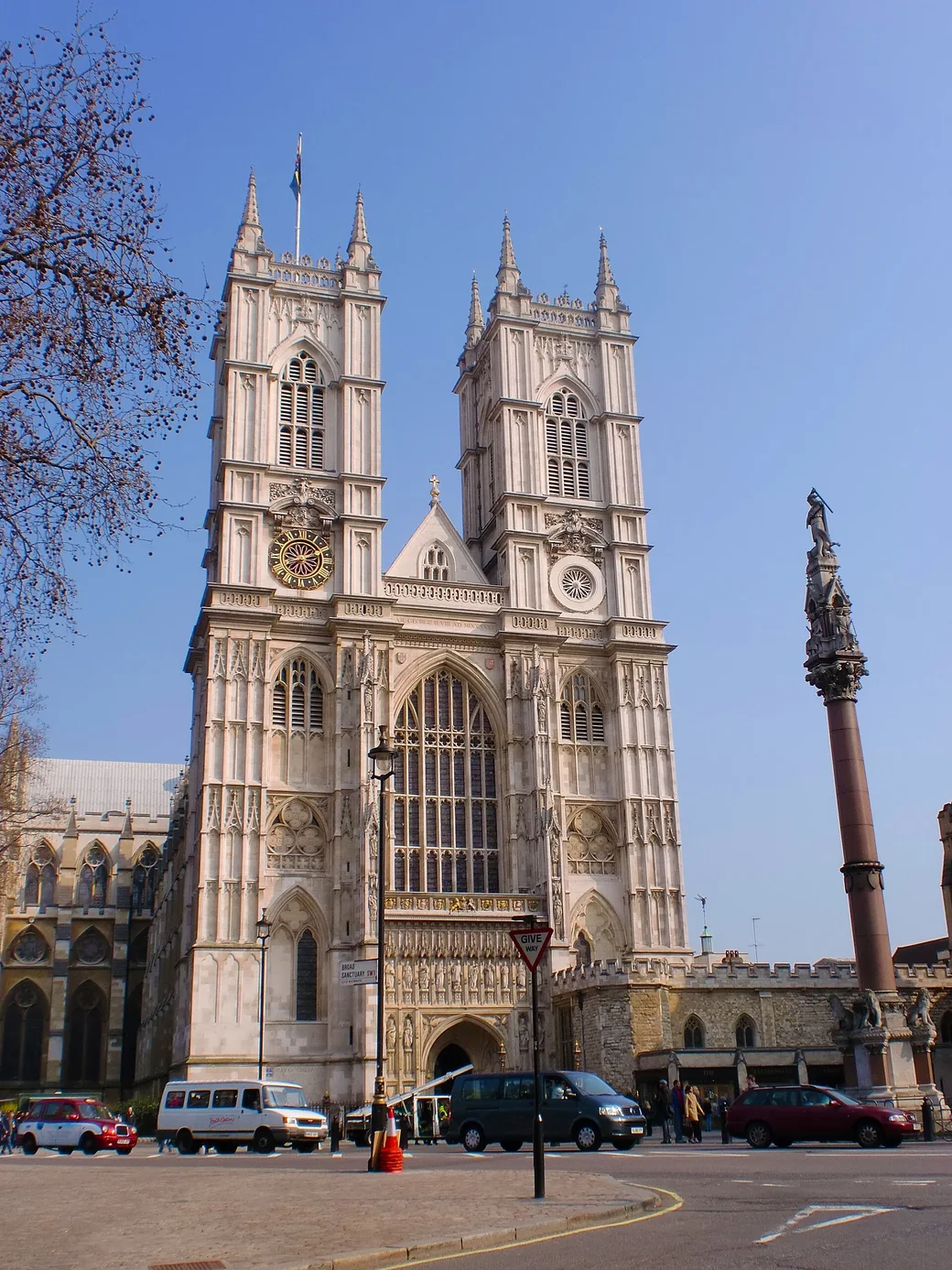
Step into the nave and look up: its vault rises about 31 metres, the highest Gothic vault in the country. Henry III's design, inspired by the great cathedrals of the continent, combines pointed arches, ribbed vaults, flying buttresses and tall windows. Henry VII's Lady Chapel, consecrated in 1516, adds a spectacular fan-vaulted ceiling, while the twin west towers were completed in 1745 to Nicholas Hawksmoor's design. Underfoot, the Cosmati Pavement before the High Altar is a medieval mosaic of coloured stone and glass. Look out for modern stained glass too, including the window designed by David Hockney in honour of Queen Elizabeth II.
Coronations, Royal Weddings and the Coronation Chair at Westminster Abbey
Every monarch since 1066 has been crowned here, apart from two kings who were never crowned. The ritual still centres on the Coronation Chair in St George's Chapel, made on the order of Edward I to hold the Stone of Scone, which he took from Scone, near Perth, in 1296. The Stone, an ancient coronation stone and a cherished symbol of kingship in its homeland, was returned there in 1996 and has been displayed at Perth Museum since 2024; it travels back to the Abbey only for coronations. Visitors can still see centuries of graffiti carved into the Chair. The church has also hosted sixteen royal weddings and many state funerals, so history feels close at every step. Famous weddings here include that of the future Queen Elizabeth II in 1947 and that of Prince William and Catherine Middleton in 2011.
Royal Tombs, the Shrine of Saint Edward and Henry VII's Lady Chapel
Across the church, around 3,300 people are buried and more than 600 monuments stand. Behind the High Altar lies the Shrine of Saint Edward the Confessor, the spiritual heart of the Abbey, ringed by the tombs of medieval kings and queens including Henry III, Edward I and Eleanor of Castile, Edward III, Richard II and Henry V. This raised area is not open to general visitors; the only way in is a verger-guided tour. In Henry VII's Lady Chapel you will find the Tudor king's tomb by the sculptor Pietro Torrigiano, and the tomb shared by Elizabeth I and her half-sister Mary I. Banners of the Knights Grand Cross of the Order of the Bath (a senior British order of chivalry) hang above the carved stalls.
Poets' Corner at Westminster Abbey: Chaucer, Shakespeare, Dickens and Ben Jonson
In the south transept, Poets' Corner commemorates more than a hundred writers. Geoffrey Chaucer was laid to rest here in 1400, though as Clerk of the King's Works rather than as a poet; two centuries later Edmund Spenser asked to lie beside him, and a tradition was born. Charles Dickens, Thomas Hardy (whose heart is buried in Dorset), Rudyard Kipling and Samuel Johnson rest here, while Shakespeare, Jane Austen, the Brontë sisters, C. S. Lewis and Ted Hughes are remembered with memorials. Ben Jonson, uniquely, is buried standing upright in the nave, according to the Abbey's own records.
Scientists' Corner and Famous Graves: Newton, Darwin, Hawking and Handel
Near the choir screen, Scientists' Corner gathers some of history's greatest minds. Isaac Newton was buried in 1727 beneath a monument; his Latin epitaph says that what was mortal of him lies here. Charles Darwin rests in the north aisle of the nave, and the ashes of Stephen Hawking were placed between them in 2018 under a stone that repeats Newton's words in English and carries a black-hole formula. Michael Faraday and James Clerk Maxwell are commemorated nearby. George Frideric Handel lies in Poets' Corner, while the grand monuments of the Statesmen's Aisle fill the north transept.
The Tomb of the Unknown Warrior: Westminster Abbey's Most Moving Grave
Just inside the Great West Door lies the grave of the Unknown Warrior, an unidentified soldier of the First World War brought home and buried on 11 November 1920 in soil from the battlefields, beneath a slab of black marble. The idea came from an army chaplain, David Railton, and the grave became one of the first tombs of its kind in the world. It is the only grave in the Abbey that visitors must never step on. Since 1923, royal brides married at the Abbey have sent their bouquets to rest upon it, and visiting heads of state still lay wreaths here.
Queen's Diamond Jubilee Galleries: The Hidden Triforium Museum above the Nave
High above the nave, in the medieval triforium (the arched gallery above the nave) about 16 metres above the floor, the Queen's Diamond Jubilee Galleries opened in 2018 as a major new addition to the building. Climb the star-shaped Weston Tower by stairs, or take the lift, and you reach more than 300 treasures: wax funeral effigies, medieval stained glass, manuscripts and objects linked to coronations. The windows frame rare views down onto the Lady Chapel and across to the Palace of Westminster. Entry is by timed slot, booked together with your Abbey admission, and photography is not allowed in the Galleries, so simply enjoy the view.
Cloisters, Chapter House, Pyx Chamber and the Oldest Door in the Land
Beyond the church, the Cloisters lead to the octagonal Chapter House, built in the 1250s, where monks gathered each day and where, in the fourteenth century, the medieval parliament sometimes met. Next door, the Pyx Chamber, a stout eleventh-century vault, once guarded the royal treasure. The oak door at its entrance has been dated by tree rings to the 1050s, making it the oldest door in the land and the only one from Anglo-Saxon times. The peaceful College Garden has been cultivated for roughly nine hundred years and is open free of charge on selected weekdays. The other areas are included in general admission and form a quiet contrast to the busy nave.
Little-Known Facts about Westminster Abbey: Wartime Survival, a Famous School and Modern Martyrs
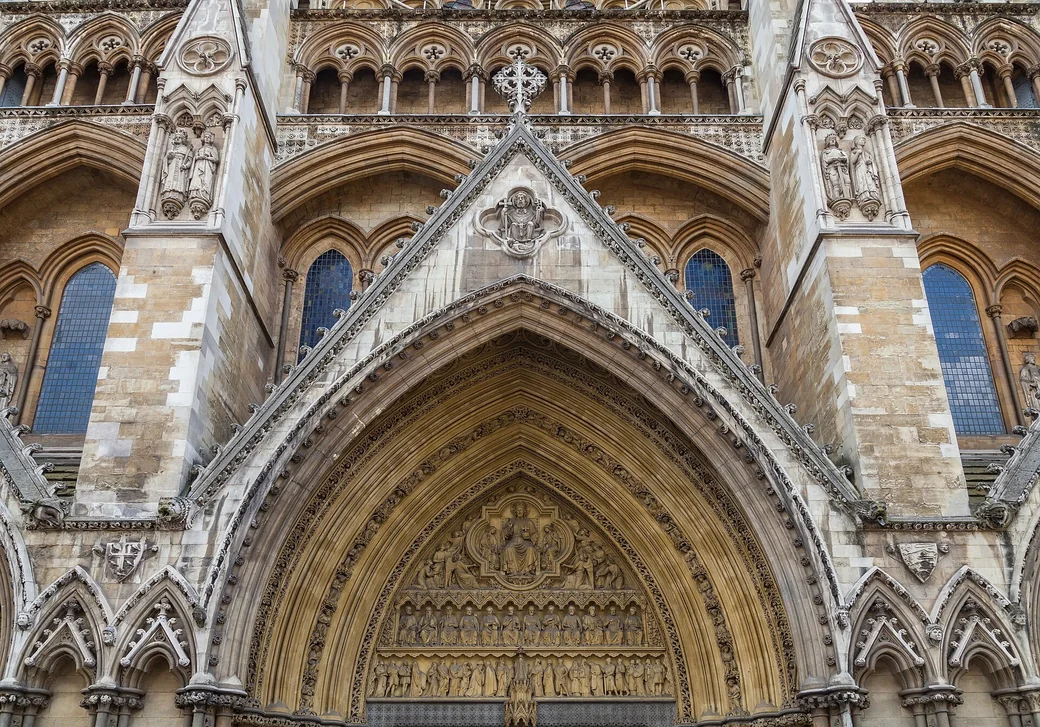
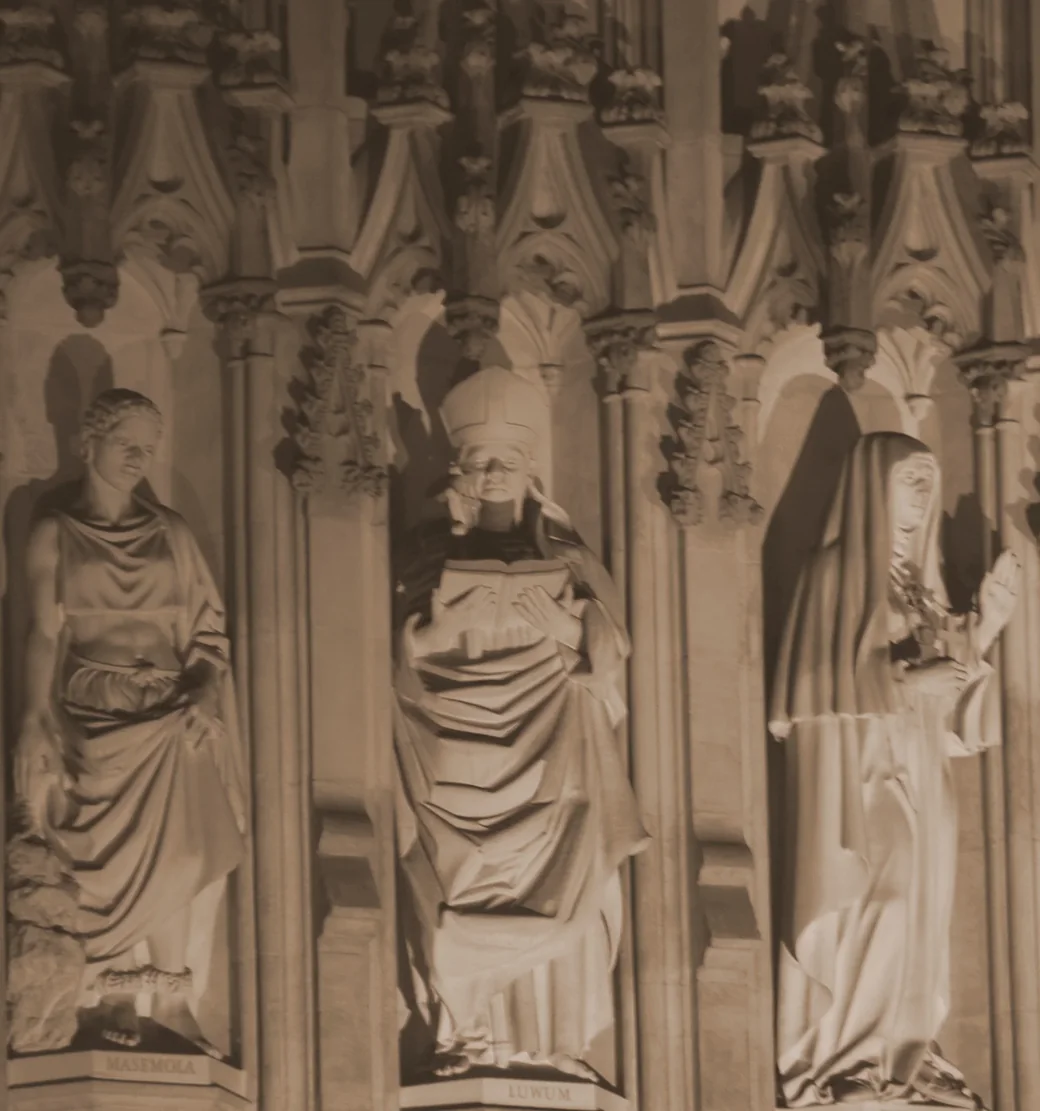
Elizabeth I's charter of 1560 also provided for forty scholars, the seed of Westminster School, which still stands beside the Abbey. During the Second World War, incendiary bombs fell on the Abbey in May 1941 and destroyed the lantern roof above the crossing, rebuilt in 1958; the Coronation Chair was evacuated to Gloucester Cathedral, while the Stone of Scone was secretly buried inside the Abbey. Look up at the west front: since 1998 its ten niches, empty since the Middle Ages, hold statues of twentieth-century martyrs, among them Martin Luther King Jr, Óscar Romero and Dietrich Bonhoeffer. In 2010 Pope Benedict XVI became the first pope to visit the Abbey.
Westminster Abbey Legends: The Door, the Jerusalem Prophecy, Saint Edward's Ring and the Stone of Destiny
According to legend, the weathered hide once found on the oldest door came from a thief whose skin was nailed there as a warning after the great treasury robbery of 1303. The robbery itself is recorded history, but scientific study of the door found no support for the grisly tale. Another story says King Henry IV had been told he would die in Jerusalem; when he collapsed in the Abbey in 1413 and was carried into the Jerusalem Chamber, the legend says he realised the prophecy had come true. Chroniclers also report that at William the Conqueror's coronation, guards outside mistook the cheering for trouble and set nearby houses alight.
A medieval tale says Edward the Confessor once gave his ring to a beggar who, years later, proved to be Saint John the Evangelist in disguise, sending the ring back with a warning that the king's death was near. Another legend holds that the Stone of Destiny was the pillow of the biblical Jacob; the Stone was taken from Westminster by four students in 1950 and found at Arbroath Abbey months later, and a rumour insists that the stone returned was a copy. Visitors also tell of a grey-robed monk in the Cloisters and a soldier beside the Unknown Warrior's grave. And Thomas Parr, buried in the south transept, is said to have lived to the age of 152.
Services, Evensong and Choral Music at Westminster Abbey: How to Attend a Service
Worship has never stopped here, and the weekday pattern includes Morning Prayer, Holy Communion and Evensong (the sung evening service). In term time the Abbey Choir sings the services in the Quire (the choir stalls), while visiting choirs or the Lay Vicars (the Abbey's adult professional singers) take over during recesses. Sung Evensong in the late afternoon is the most atmospheric way to hear the church as it was meant to sound. Services are open to everyone and are not ticketed, but they fill up, so arrive early and enter by the Great West Door. Photography is not allowed during services. Check the published service list, because times change on special occasions.
How to Visit Westminster Abbey: Booking, Passes, Guided Tours and Planning Your Time
Book a timed ticket on the Abbey's official website in advance; a multimedia guide is included in many languages, and a shortened version can be downloaded to your phone. Your online ticket can be upgraded on site to an annual pass valid for three visits. The Queen's Diamond Jubilee Galleries are an add-on bought together with your admission, while the tour led by a verger (a lay officer who looks after the church and guides visitors), the only way to enter the Shrine of Saint Edward, is booked on the day at the information desk. Major London sightseeing passes are accepted. The Abbey closes to sightseers on Sundays and can close at short notice, so check the calendar before you travel. Saturday hours can differ slightly from weekdays, so check the entry times on the official website.
Best Time to Visit Westminster Abbey, Photography, Etiquette and Security Rules
Weekday mornings from Tuesday to Thursday, soon after opening, are the quietest; late mornings, early afternoons, weekends and school holidays are busiest. Plan two to three hours, more if you add the Galleries and the full multimedia guide. Personal photography is permitted in most of the church, but never during services, in the Shrine of Saint Edward, St Faith's Chapel or the Galleries, and flash, video, selfie sticks, tripods and drones are banned. For outdoor shots, the west front with its Hawksmoor towers looks best from Broad Sanctuary in soft late-afternoon light, and the arcades of the Cloisters make a calm backdrop.
Westminster Abbey is a working church, so dress modestly and move quietly. Gentlemen traditionally remove their hats indoors, and comfortable flat shoes are wise because the floors are uneven. Everyone passes through a security check. Small bags up to 40 x 30 x 20 cm are allowed, but there is no cloakroom, and luggage, large backpacks, wheeled bags, scooters, pets (assistance dogs excepted), portable speakers and outside food are not permitted. Entry is single-use, so you cannot re-enter once you leave. Do not step on the Unknown Warrior's grave, and keep voices low in chapels and during services.
Getting to Westminster Abbey, Accessibility and What to See Nearby
Westminster station (Jubilee, District and Circle lines) is about four minutes' walk away and St James's Park station about six. Charing Cross, Waterloo and Victoria are within a 25-minute walk, and buses stop on Victoria Street and Parliament Square. There is no car park at the Abbey, so public transport is the best choice. Wheelchairs can be borrowed, a lift serves the Galleries, there are accessible toilets in the Cloisters and a hearing loop covers the church; guide dogs are welcome. Nearby you can see the Palace of Westminster and Big Ben, St Margaret's Church, the Jewel Tower, the Churchill War Rooms, St James's Park and Buckingham Palace. Pushchairs are welcome, baby changing is available in the Cloisters, and the multimedia guide also comes in sign-language and audio-described versions. Refreshments are served at the Cellarium Café and Terrace, and the Abbey Shop sells guidebooks and gifts. Together with the Palace of Westminster and St Margaret's Church, the Abbey forms a UNESCO World Heritage Site, inscribed in 1987.
Westminster Abbey: Visitor Tips
Book a timed ticket online and arrive a little early, because everyone passes through a security check. Start with the quiet corners, Poets' Corner and the Cloisters, before the nave fills up. Use the multimedia guide, which is included with admission, and download its shortened version to your phone if you prefer. Do not step on the grave of the Unknown Warrior. Photography is allowed in most of the church but never during services, and flash, video, tripods and selfie sticks are not permitted. Plan two to three hours and wear comfortable flat shoes. The Abbey is closed to sightseers on Sundays and can close at short notice, so check the official calendar the day before.
Westminster Abbey: Best Time to Visit
Weekday mornings from Tuesday to Thursday, soon after opening, are the calmest. Late-afternoon light flatters the west front. Spring and early autumn avoid the heaviest crowds.
Westminster Abbey: Admission Fees
Adult (18+)
Visit the coronation church and burial place of monarchs, poets and scientists, with a multimedia guide included; the Abbey is a working church, so some areas may close during services. Full fare for adult visitors aged 18 and over.
£32
Senior (65+)
Visit the coronation church and burial place of monarchs, poets and scientists, with a multimedia guide included; the Abbey is a working church, so some areas may close during services. Reduced fare for seniors aged 65 and over; valid ID may be requested.
£29
Student
Visit the coronation church and burial place of monarchs, poets and scientists, with a multimedia guide included; the Abbey is a working church, so some areas may close during services. Reduced fare for students with a valid student card.
£29
Child (6–17 years)
Visit the coronation church and burial place of monarchs, poets and scientists, with a multimedia guide included; the Abbey is a working church, so some areas may close during services. Fare for children aged 6 to 17.
£14
Family (1 adult + 1 child)
Visit the coronation church and burial place of monarchs, poets and scientists, with a multimedia guide included; the Abbey is a working church, so some areas may close during services. Fare for one adult and one child travelling together.
£32
Children under 6 (free)
Children under 6 enter free of charge.
Free
Queen's Diamond Jubilee Galleries – Adult (18+)
Museum spaces in the medieval triforium high above the Abbey floor, with treasures and views over the Palace of Westminster; entry is by timed ticket together with a general admission ticket, and the galleries are closed on Sundays. Full fare for adult visitors aged 18 and over.
£5
Queen's Diamond Jubilee Galleries – Children 17 and under (free)
Museum spaces in the medieval triforium high above the Abbey floor, with treasures and views over the Palace of Westminster; entry is by timed ticket together with a general admission ticket, and the galleries are closed on Sundays. Children and young people aged 17 and under enter the galleries free of charge with a timed ticket.
Free
Quick Info
2h
easy
Westminster Abbey: Getting There
Westminster Abbey stands beside Parliament Square in the heart of London, a few minutes' walk from the Palace of Westminster and Big Ben.
By Underground, Westminster station (Jubilee, District and Circle lines) is about 300 metres away, a four-minute walk, and St James's Park station (District and Circle lines) is about 500 metres away. By rail, Charing Cross is roughly 16 minutes' walk, Waterloo 19 and Victoria 24. Several bus routes serve the area: routes 11, 24, 148 and 211 run along Victoria Street beside the Abbey, route 88 stops on Great Smith Street, and 3, 12, 87, 159 and 453 call at Parliament Square.
Driving is not sensible, because the Abbey has no car park and the area lies inside London's congestion zone. Cyclists will find bike racks nearby, but folding bikes are not allowed inside. Visitor entry is on the north side, while worshippers use the Great West Door.
Nearby stops & parking
The closest stops are Westminster Underground station, with a step-free route from the Jubilee line, and St James's Park station. Bus stops stand on Victoria Street and around Parliament Square, and river boats call at Westminster Pier, five minutes away on foot. A drop-off space for taxis and private cars is located outside the Abbey's West Doors. There is no parking at the Abbey itself; the nearest public car parks are Q-Park Westminster near Great College Street and the car park on Rochester Row, and Blue Badge holders (the UK disabled parking permit) may use designated bays nearby. There is no left-luggage service at the Abbey, so use the facilities at Charing Cross or Victoria stations if you carry large bags.
Westminster Abbey: Dress Code & Etiquette
Westminster Abbey is an active place of worship, so visitors are asked to dress respectfully. There is no strict dress code for sightseeing, but modest, comfortable clothing is best: cover your shoulders and avoid very short garments. Gentlemen traditionally remove hats indoors. Wear flat, comfortable shoes, because the floors are uneven and you will be on your feet for a long time; the church can also feel cool, so bring a light layer. Keep your voice low, switch your phone to silent, and show quiet respect near tombs, chapels and anyone at prayer. Those attending a service are asked to dress smartly. Stay behind any ropes and follow the instructions of the Abbey Marshals.