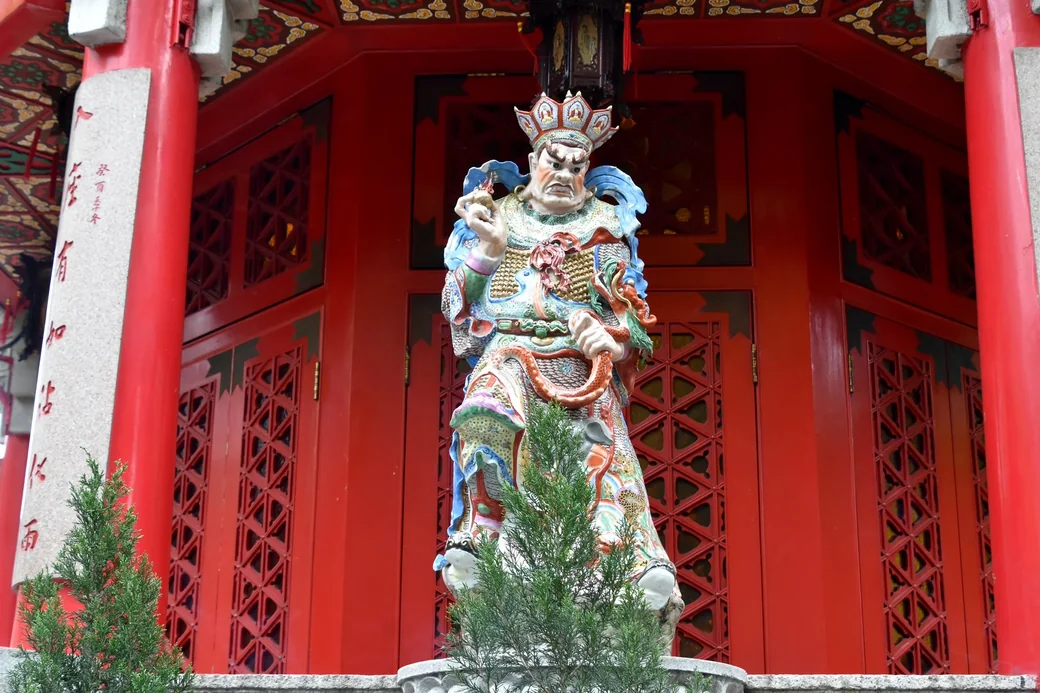
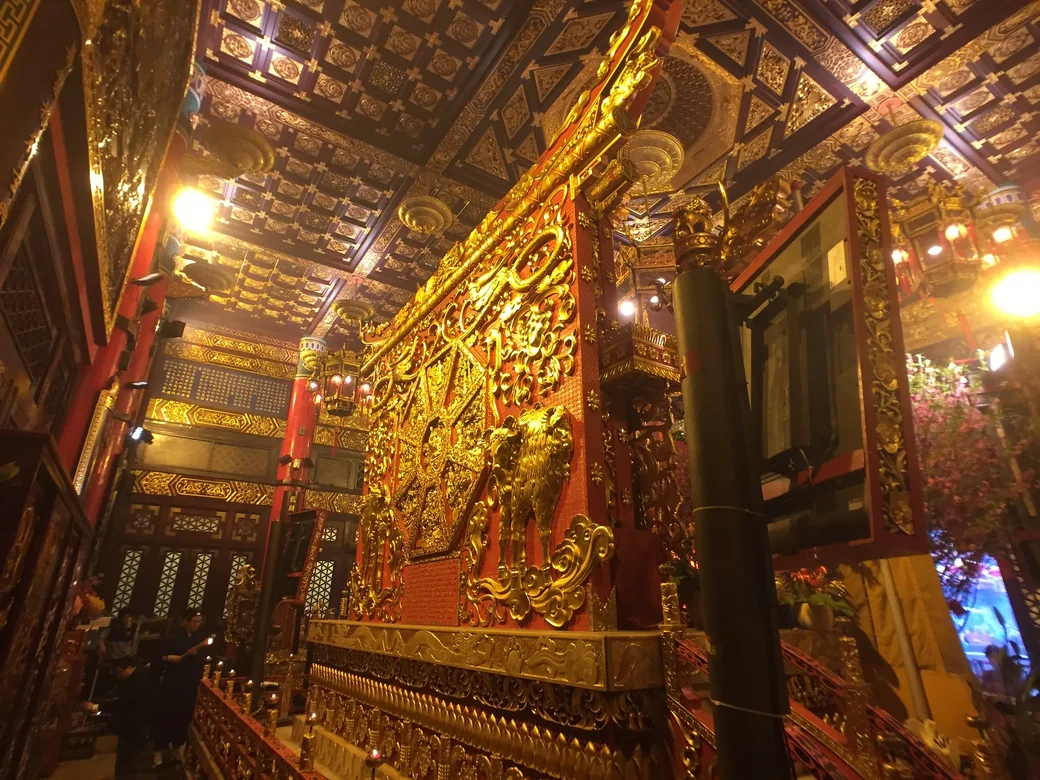
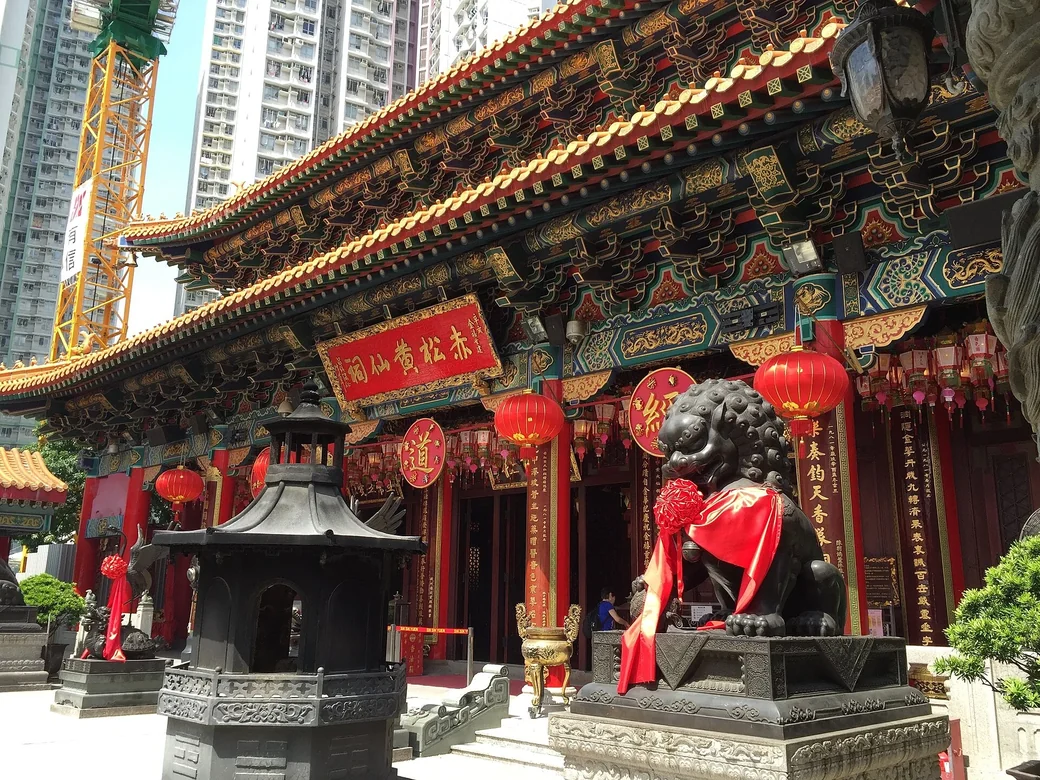
Wong Tai Sin Temple is a large, working Taoist temple in the heart of Kowloon, Hong Kong, dedicated to the immortal Wong Tai Sin. It is one of the busiest places of worship in the city and far from a museum piece: every day local people come here to pray, burn incense and seek guidance for what lies ahead. Ornate traditional halls, open worship platforms and a peaceful classical Chinese garden sit together among the surrounding housing estates, making it one of the best places in Hong Kong to see living faith up close.
Wong Tai Sin Temple: Location, accommodation options and contact
2 Chuk Yuen Village, Wong Tai Sin, Kowloon, Hong Kong
The place's location on the map and nearby accommodation and hotel options are shown by Stay22. Cookies are used. Your consent is remembered on every page; you can turn it off at any time in the cookie settings.
Three Teachings in One Courtyard: Taoism, Buddhism and Confucianism
What makes this temple unusual is not its size but its mixture. The main altar is Taoist, yet the Three Saints Hall honours Lu Dongbin, Guanyin (the Buddhist goddess of mercy) and Lord Guan side by side, Guanyin has her own hall, and Confucius is venerated in the Lin Kok, whose interior carries porcelain panels illustrating the six classical arts of a cultivated person.
Worshippers move between these halls without any sense of switching camps. Sik Sik Yuen, the charitable body that runs the site, describes its outlook as three religions united in veneration — a way of thinking that suits a city built on overlapping traditions.
From Shepherd Boy to Immortal: Who Wong Tai Sin Was
The temple's own account names him Wong Cho-ping, born in 328 during the Eastern Jin dynasty. His family was poor, and at eight he was herding sheep on Jinhua Mountain in Zhejiang; at fifteen, following an immortal's advice, he withdrew to a stone cave to practise the Tao.
According to the legend, when his elder brother finally found him forty years later and asked where the sheep had gone, Wong led him to a heap of white boulders, called out to them, and the rocks rose up as a flock. A white jade sheep in the garden, a gift from Lanxi, recalls the story.
Another account told in Guangdong holds that a man named Tong Kwai-tou, suffering from an eye ailment, was healed beside a boulder by an elderly Taoist who pressed herb juice onto his eye; when he understood who the old man had been, he kept an image of Wong Tai Sin at home and the rock took the immortal's name. In Hong Kong the saying attached to him is yau kau bit ying (whatever is asked for is answered), and people speak of three kinds of blessing: health for the upright, harmony for the married and sufficiency for the poor. Devotion to him has since travelled with Hong Kong families to Southeast Asia, Europe, North America and Australia.
A Layout Built on the Five Elements
Five structures on the site stand for the five elements of Chinese geomancy: the Bronze Pavilion for metal, the Scripture Hall for wood, the Yuk Yik Fountain for water, the Yue Heung Pavilion for fire and the Earth Wall for earth. Later repairs were meant to leave their dimensions and orientation untouched.
According to one popular saying, walking clockwise three times around the fountain will turn your luck. The Bronze Pavilion, first built in 1924 and understood as Wong Tai Sin's meditation room, is closed to those outside the temple community. Of the Yue Heung Pavilion it is said that a red glow once appeared there during the war years.
How the Temple Came to Kowloon, and What Its Name Means
In 1915 a painted image of Wong Tai Sin travelled from Guangdong to Hong Kong, and an altar was set up in Wan Chai. Six years later the shrine moved to Chuk Yuen at the foot of Lion Rock, and the organisation Sik Sik Yuen was founded to look after it.
The first main hall was modest: lease conditions on the land meant it was built of bamboo, timber and zinc sheet, a long way from today's tiled roofs. The name itself is worth knowing — sik sik yuen (the garden of restraint in what one desires).
When the temple finally opened to everyone in 1956, the Tung Wah Group of Hospitals was authorised to help manage it, and those entering were asked for a ten-cent donation towards Tung Wah's free schools — a requirement dropped in later years. Soon afterwards the site appeared on a clearance list for new public housing, and lobbying by Tung Wah is credited with saving it.
A few details complete the story. The image was carried to Hong Kong by the Taoist priest Leung Yan-am and his son; before 1956 the temple spent decades as a private hall, open only to members and their families; and in 1969 the surrounding district itself took the temple's name.
Main Altar, Worship Platforms and the Zodiac Bronzes
Day to day, worship happens on the open platforms in front of the altar hall rather than inside it; the hall itself is opened for the public at certain points in the religious calendar. Behind the seat of Wong Tai Sin is a gilded relief showing his attainment of the Tao.
On the lower platform stand bronze figures of the twelve zodiac animals, designed together with specialists in historic Chinese architecture from Beijing. Find your own sign — it is the one souvenir photograph almost everyone takes here. Around the platforms, the architecture shows the classic temple palette: red pillars, golden roof ridges and blue painted friezes.
The Nine-Dragon Wall Behind the Main Altar
Built for the temple's sixtieth anniversary and modelled on the celebrated wall in Beijing's Beihai Park, this relief carries nine dragons across its length. Nine is the most auspicious number in Chinese tradition and the dragon the oldest symbol of power and good fortune, so the pairing is deliberate.
It is one of the easier things to photograph well here: stand back far enough to get the whole wall, then move in for a single dragon's head. Mid-morning light brings out the modelling without flattening the glazes.
Good Wish Garden: The Quiet Half of the Visit
Opened in 1991 at the rear of the complex, this walled garden covers roughly 5,600 square metres and borrows its vocabulary from the Summer Palace in Beijing: ponds, rockeries, arched bridges, a moon gate and pavilions in circular, square and fan shapes.
Step through the gate and the noise drops away almost immediately. The white jade sheep stands here, and the water and greenery make this the one place on site where the air is clear of incense. Most visitors skip it, which is exactly why it is worth your last half hour.
Why the First-Incense Tradition Exists
For years the temple could not open to the general public, so people set up makeshift altars outside the walls and burned incense facing the main hall from the street. When permission finally came to open the main hall during the first lunar month only, that narrow window turned the opening moment itself into something people competed for.
That is the origin of the first-incense custom still kept today, when worshippers gather before midnight to offer the year's first sticks. Expect long queues and a crowd far larger than usual on those nights: the gates open the evening before. The temple also keeps longer hours on the first and fifteenth days of each lunar month, when regular worshippers come.
The permission to open the main hall during the first lunar month was granted in 1934. The other high points of the temple's year are Wong Tai Sin's birthday, celebrated with large rites on the twenty-third day of the eighth lunar month, and the highest Taoist offering ceremony, which is performed here only once every five years.
Kau Cim: How the Fortune Sticks Actually Work
Light your incense, kneel before the altar, hold your question clearly in mind and shake the bamboo cylinder until a single numbered stick falls out. Exchange that number for the matching verse, then carry it to one of the interpreters in the arcade beside the grounds.
The sticks themselves are provided by the temple. The interpreters are independent licensed practitioners, not temple staff, so agree the scope of a reading before it begins. Some stalls display English signs, and the temple also runs an online interpretation service. Electronic scanning booths were introduced some years ago, but most people still prefer a person across the table. The arcade is recognised as the largest building of soothsayers' stalls in the world.
Medicine Lots and a Century of Charitable Medicine
Long before it was a sightseeing stop, the temple was a place people came to when they were ill. Five hundred medicine lots were brought from Guangzhou and sorted into five specialities of a hundred each; the verse a worshipper drew carried not only a reading of their condition but a prescription to take to the dispensary, and where no medicine was needed it offered advice instead.
Qualified physicians were engaged from 1955 and prescribing by lot ended in 2005. The charitable Chinese medicine clinic itself, running since 1924, still operates inside the grounds with a daily quota of numbered appointments. That charitable spirit runs through the whole organisation: Sik Sik Yuen works under the motto pou chai hyun sin (to aid all and to encourage goodness) and channels donations into medical, educational and elderly services.
The Underground Taisui Yuenchen Hall and Its LED Night Sky
Beneath the first worshipping platform lies a hall that few first-time visitors expect. Begun in 2007 and opened in 2011 for Sik Sik Yuen's ninetieth anniversary, it honours the sixty Taisui, the guardian deities of the sixty-year calendrical cycle, alongside the Goddess of the Great Dipper.
The ceiling is its signature: more than a hundred energy-saving lights recreate the Hong Kong night sky in spring and autumn. The plaque was inscribed by the scholar Jao Tsung-i, and a later restoration added painted murals. It is reached by a separate entrance and keeps its own hours.
Intangible Heritage and the Belief and Customs Culture Centre
What is protected here is not only the architecture but the practice. Wong Tai Sin belief and customs entered Hong Kong's inventory of intangible cultural heritage in 2014, joined China's national representative list the same year, and were added to Hong Kong's own representative list in 2017 — the first time a deity-centred folk belief from the city received that national recognition.
To carry it forward, Sik Sik Yuen opened the Cultural Centre for Wong Tai Sin Belief and Customs, where interactive and projected displays explain divination, ritual and the ethics behind them. The buildings have formal protection too: the complex was listed as a Grade I historic building (the highest heritage grade) in 2010. It was also the first Taoist temple authorised by the Hong Kong government to conduct Taoist wedding ceremonies and issue marriage certificates.
Stories the Temple Keeps: The War Years and a Turning Wind
During the occupation years of the Second World War, people from the surrounding village sheltered within the temple grounds and the resident priests spoke on their behalf; the complex came through the period intact, and it is said that Wong Tai Sin watched over those who had taken refuge there.
The temple's own chronicle records a second episode: a fire in the neighbouring settlement in 1954 reached the main gate and blackened the lettering on the iron railing before the wind suddenly changed direction and the buildings were spared. Both stories are told here as they have been handed down.
Incense Etiquette in Practice: Nine Sticks, Three Points
The temple's guidance is refreshingly specific. Nine thin sticks are enough for a full round: three each at the main altar platform, the Three Saints Hall and the Yue Heung Pavilion. Hold them in both hands, bow, and keep the gesture unhurried — sincerity matters more than quantity.
Paper offerings, candles, raw oil and oversized incense are not permitted, and burning great bundles is discouraged on environmental grounds; sandalwood incense is provided instead. The temple sells no ritual goods itself, and flowers alone are considered a worthy offering. You will see the practice in full from early morning, when the courtyards begin to fill with worshippers carrying thin bundles of incense.
A Route That Works in Ninety Minutes
Come out of the station, pass under the main gate and start at the first worshipping platform while the light is still soft. From there take the Three Saints Hall, the zodiac bronzes on the lower platform, then the Nine-Dragon Wall behind the altar.
Save the Good Wish Garden for last: it is the one place where sitting down for ten minutes genuinely changes the visit. Leave through the arcade if you want a reading, and keep in mind that the main hall and the underground hall follow their own schedules. Ninety minutes is comfortable; two hours if you stop often. Keep the scale in mind when pacing yourself: the grounds cover more than 18,000 square metres.
Wong Tai Sin Temple: Visitor Tips
Come on a weekday morning: tour groups thin out and you can actually hear the fortune sticks. Nine thin incense sticks are enough — three at each of the three offering points. Thick bundles, candles and paper offerings are not allowed inside.
The Good Wish Garden behind the main altar is the calmest spot and gives you clean backgrounds for photos without crowds. For the roof figures, a zoom lens pays off far more than a wide angle.
If you want your fortune stick explained in English, look for booths in the arcade with English signs, or use the temple's own online stick-interpretation service. Agree on the scope of a reading before it starts. Avoid photographing worshippers close-up, and keep your voice low on the platforms.
Wong Tai Sin Temple: Best Time to Visit
Weekday mornings right after opening, or the last hour before closing; October to December for cool, dry weather.
Quick Info
1h 30m
easy
Wong Tai Sin Temple: Getting There
The easiest way is the MTR (Mass Transit Railway, Hong Kong's metro). Take the Kwun Tong Line to Wong Tai Sin station and leave by Exit B2; the temple gate is about a three-minute walk and is signposted from inside the station. Exit B3 brings you out next to Temple Mall North, also within sight of the entrance.
Several bus routes stop right outside the temple, and a further group of routes — including airport and cross-harbour services — stops on Lung Cheung Road beside the station.
If you are already at Diamond Hill, it is a walk of roughly fifteen minutes along Lung Cheung Road, which also lets you combine the visit with Chi Lin Nunnery and Nan Lian Garden.
Driving is possible but rarely worth it: there is no dedicated visitor car park at the temple and the nearby shopping-centre garages fill up quickly. Taxis can drop you at the forecourt on Chuk Yuen Road.
Nearby stops & parking
Wong Tai Sin station (Kwun Tong Line) sits directly beneath the road in front of the temple; Exit B2 is the main one for visitors and Exit B3 comes out beside Temple Mall North. Exit D has lift access and is the route to use with a wheelchair or a pram.
Buses stop at the Wong Tai Sin interchange stops on Lung Cheung Road, in front of Temple Mall, and at the Chuk Yuen bus terminus a short walk north.
There is no visitor car park belonging to the temple. The nearest paid garages are under Temple Mall and Plaza Hollywood at Diamond Hill, plus the public car park on Sheung Fung Street. Designated accessible bays are marked on Shatin Pass Road and Tsui Fung Street, with more inside the Sheung Fung Street car park. Taxis use the forecourt on the Chuk Yuen Road side.
Wong Tai Sin Temple: Dress Code & Etiquette
There is no strict dress code, but this is an active place of worship and the temple asks visitors to come neatly dressed and to worship sincerely, without hurrying. In practice that means covered shoulders and knees; beach wear, very short shorts and strappy tops are out of place.
Shoes stay on — you are not asked to remove them. Keep your voice down on the worshipping platforms, do not step in front of someone mid-prayer, and let people finish before you move through a queue.
Thick incense bundles, candles, paper offerings and raw oil may not be brought in, and burning large quantities of incense is discouraged. A small bunch of flowers is considered a perfectly good offering. Some halls, such as the Bronze Pavilion, are reserved for the temple's own Taoist community.
Guide / Language
zh
en
Wong Tai Sin Temple: Amenities & Facilities
Mobile app and online fortune-stick interpretation